Introduction
Speech-to-text transcription platforms convert spoken audio into written text using AI, machine learning, or a mix of automated and human-supported workflows. These platforms can transcribe meetings, interviews, podcasts, webinars, lectures, videos, phone calls, customer support recordings, legal conversations, medical notes, and business discussions.
For modern teams, transcription is no longer just about turning audio into text. It now supports searchable knowledge, meeting summaries, subtitles, content repurposing, compliance documentation, customer intelligence, accessibility, and workflow automation. A good transcription platform helps teams save time, reduce manual note-taking, improve documentation, and make audio or video content easier to analyze and reuse.
Common use cases include meeting transcription, podcast transcription, video subtitles, sales call analysis, customer support review, market research interviews, education notes, legal documentation, healthcare documentation, and media content production.
Buyers should evaluate transcription platforms based on accuracy, speaker identification, language support, real-time transcription, editing tools, integrations, API access, security, compliance, collaboration features, export options, and pricing.
Best for: Content creators, journalists, researchers, sales teams, customer support teams, educators, legal teams, healthcare teams, podcasters, media teams, developers, and enterprises managing audio or video data at scale.
Not ideal for: Users who only need occasional short notes, teams with highly sensitive recordings that cannot be processed externally, or organizations that require fully human-certified transcription for legal, medical, or regulatory reasons.
Key Trends in Speech-to-Text Transcription Platforms
AI accuracy is improving across different accents, speaking styles, and noisy environments. Buyers now expect better recognition of natural conversations, multi-speaker discussions, and industry-specific terms.
Real-time transcription is becoming a standard need for meetings, webinars, events, customer calls, and live collaboration. Teams want instant captions, notes, and searchable transcripts as conversations happen.
AI summaries are becoming part of transcription workflows. Many platforms now generate meeting summaries, action items, highlights, chapters, and key decisions from transcripts.
Multilingual transcription is becoming more important. Global teams need platforms that support multiple languages, translation, subtitles, and regional speech patterns.
Speaker identification is now a major buying factor. Teams want to know who said what, especially in meetings, interviews, sales calls, legal conversations, and research sessions.
Privacy and compliance expectations are increasing. Buyers want encryption, data retention controls, user permissions, access logs, SSO, and strong vendor transparency.
Developer-friendly APIs are growing in demand. Product teams want to add transcription, captions, voice analytics, and audio intelligence directly into their own apps and workflows.
Transcription is becoming more connected with video workflows. Teams need captions, subtitles, searchable video libraries, timestamps, and editing tools for content production.
Domain-specific transcription is gaining attention. Healthcare, legal, finance, education, and customer support teams often need better vocabulary handling and specialized language models.
Human review still matters for high-stakes content. AI transcription can be fast and affordable, but important transcripts may still need human correction for accuracy, context, names, legal wording, and technical terms.
How We Selected These Tools
The tools in this list were selected based on practical transcription needs, market recognition, feature depth, usability, accuracy expectations, security posture, and fit across different user segments.
The evaluation considered how well each platform supports audio and video transcription, speaker identification, timestamps, editing, export formats, collaboration, summaries, and language coverage.
Ease of use was considered because transcription tools are used by non-technical users such as creators, journalists, educators, managers, researchers, and business teams.
API and developer support were reviewed because many companies want to embed speech-to-text capabilities into applications, call platforms, analytics tools, and customer workflows.
Security posture was considered through access controls, encryption, account security, role-based permissions, SSO options, and compliance-related documentation.
Real-time capabilities were considered because meetings, calls, webinars, and live events increasingly require instant transcription and captions.
Integration strength was reviewed because transcription platforms often connect with meeting tools, video platforms, CRM systems, cloud storage, editing tools, research workflows, and collaboration platforms.
Support and onboarding were considered because transcription adoption depends on user training, workflow setup, accuracy testing, API implementation, and quality control.
The list includes a balanced mix of meeting transcription platforms, creator-friendly tools, media transcription platforms, human-supported transcription services, enterprise APIs, and developer-first speech platforms.
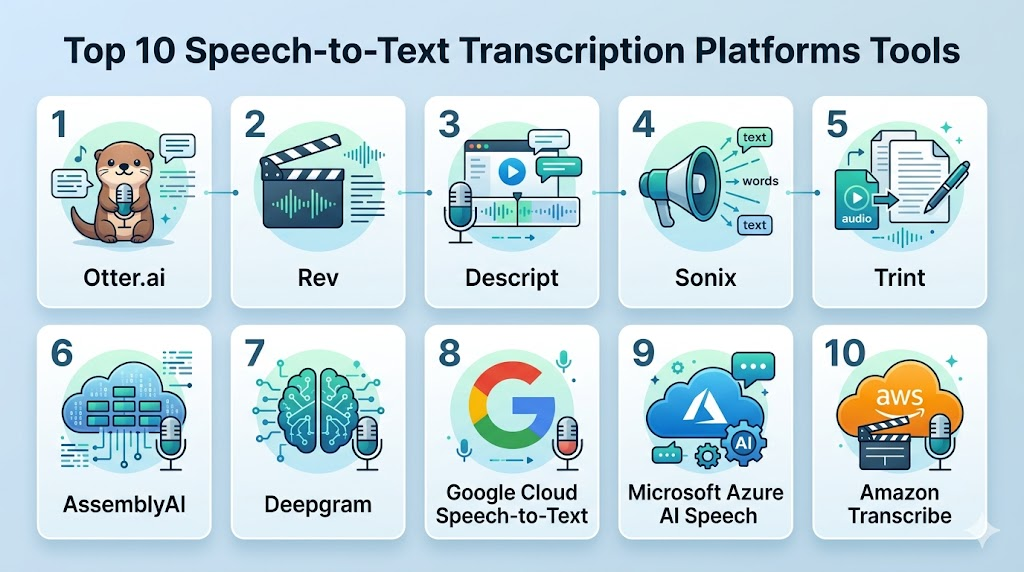
Top 10 Speech-to-Text Transcription Platforms Tools
1. Otter.ai
Short description: Otter.ai is a meeting-focused transcription platform that records, transcribes, summarizes, and organizes conversations. It is best for business users, students, managers, sales teams, and teams that need searchable meeting notes and action items.
Key Features
- Real-time meeting transcription
- Speaker identification for conversations
- AI-generated summaries and action items
- Searchable transcript library
- Collaboration tools for comments and highlights
- Meeting integrations for common video conferencing workflows
- Export options for transcripts and notes
Pros
- Strong for meetings, interviews, and business conversations
- Easy for non-technical users to adopt
- Helpful summaries reduce manual note-taking
Cons
- Accuracy can vary with accents, background noise, and overlapping speakers
- Not ideal for full media production workflows
- Advanced team controls may depend on plan level
Platforms / Deployment
Web / iOS / Android. Cloud deployment.
Security & Compliance
Otter.ai may support account controls, team administration, and security settings depending on plan. Specific compliance certifications should be verified directly during procurement.
Integrations & Ecosystem
Otter.ai works well for teams that want meeting notes and searchable conversation records connected to daily business workflows.
- Video meeting tools
- Calendar workflows
- Team collaboration
- Meeting note sharing
- Audio import workflows
- Business productivity tools
Support & Community
Otter.ai provides help documentation, onboarding resources, customer support options, and user education. It has strong recognition among meeting transcription users.
2. Rev
Short description: Rev is a transcription and captioning platform known for both AI transcription and human transcription services. It is useful for media teams, legal teams, researchers, educators, journalists, and businesses that need flexible accuracy options.
Key Features
- AI transcription for faster turnaround
- Human transcription options for higher accuracy needs
- Captions and subtitles for video content
- Audio and video file upload support
- Timestamped transcripts
- Editing and export options
- Support for business, media, research, and legal workflows
Pros
- Good choice when human review is important
- Useful for captions, subtitles, and professional transcripts
- Flexible for different accuracy and turnaround needs
Cons
- Human transcription may cost more than automated tools
- Real-time meeting workflow may not be the main strength
- Enterprise controls should be reviewed by plan
Platforms / Deployment
Web-based platform. Cloud deployment.
Security & Compliance
Rev may support account security, file handling controls, and business workflows. Specific compliance certifications and data handling requirements should be verified directly.
Integrations & Ecosystem
Rev fits teams that need transcription, captions, and subtitles for media, research, education, and professional documentation.
- Audio and video workflows
- Captioning workflows
- Media production
- Research interviews
- Legal documentation workflows
- Export-based integrations
Support & Community
Rev provides support resources, documentation, customer service, and professional transcription workflow guidance. It is widely recognized in transcription and captioning markets.
3. Descript
Short description: Descript is an audio and video editing platform with strong transcription features. It is best for podcasters, video creators, marketers, course creators, and teams that want to edit media using text-based workflows.
Key Features
- Automatic transcription for audio and video
- Text-based editing for podcasts and videos
- Speaker labels and transcript editing
- Screen recording and video editing tools
- Captions and subtitle workflows
- AI voice and audio cleanup features
- Collaboration and project sharing
Pros
- Excellent for creators editing audio and video from transcripts
- Strong all-in-one workflow for podcasts and video content
- Reduces switching between transcription and editing tools
Cons
- May be more than needed for simple transcription only
- Accuracy may still require manual cleanup
- Advanced collaboration and export features may vary by plan
Platforms / Deployment
Web / Windows / macOS. Cloud-connected workflows.
Security & Compliance
Descript may support account security, team controls, and cloud project management. Specific compliance certifications should be verified directly.
Integrations & Ecosystem
Descript is useful for creators and marketing teams that need transcription connected to editing, captions, and content production.
- Podcast workflows
- Video editing workflows
- Screen recording
- Caption generation
- Collaboration workflows
- Export to media platforms
Support & Community
Descript provides tutorials, support resources, product education, and a strong creator community. It is especially popular among podcast and video production users.
4. Sonix
Short description: Sonix is an automated transcription, translation, and subtitle platform used by creators, researchers, media teams, and businesses. It is useful for teams that need searchable transcripts, multilingual workflows, and simple editing tools.
Key Features
- Automated audio and video transcription
- Subtitle and caption generation
- Translation support for multilingual content
- Browser-based transcript editing
- Speaker labeling and timestamps
- Searchable transcript library
- Export options for transcripts and subtitles
Pros
- Good balance of transcription, subtitles, and translation
- Useful for media, research, and content workflows
- Easy browser-based editing experience
Cons
- Accuracy may vary by audio quality and language
- Human review may be needed for important transcripts
- Enterprise security details should be verified directly
Platforms / Deployment
Web-based platform. Cloud deployment.
Security & Compliance
Sonix may support team administration, account controls, and secure file workflows depending on plan. Specific certifications should be verified during evaluation.
Integrations & Ecosystem
Sonix works well for teams managing video captions, searchable transcripts, and multilingual content workflows.
- Video editing workflows
- Subtitle exports
- Research workflows
- Cloud storage workflows
- Media production
- Content localization
Support & Community
Sonix provides documentation, help resources, support options, and user guides. It is widely used by creators, researchers, and media teams.
5. Trint
Short description: Trint is an AI transcription platform designed for journalists, media teams, content creators, and enterprises that need searchable transcripts, collaboration, and content production workflows.
Key Features
- AI transcription for audio and video
- Collaborative transcript editing
- Searchable media library
- Speaker identification and timestamps
- Translation and subtitle workflows
- Story-building and content production tools
- Team collaboration and review features
Pros
- Strong for journalism and media production teams
- Good collaboration features for transcript editing
- Useful for turning interviews into content
Cons
- May be more content-production focused than developer-focused
- Pricing may not suit very light users
- Accuracy still depends on audio quality and speaker clarity
Platforms / Deployment
Web-based platform. Cloud deployment.
Security & Compliance
Trint may support team controls, account security, and enterprise administration depending on plan. Specific compliance certifications should be verified directly.
Integrations & Ecosystem
Trint fits teams that need transcription connected with editorial, media, and storytelling workflows.
- Media production workflows
- Research interviews
- Journalism workflows
- Subtitle exports
- Collaboration tools
- Content planning workflows
Support & Community
Trint provides documentation, support resources, onboarding guidance, and customer support. It has strong visibility among journalists and media teams.
6. AssemblyAI
Short description: AssemblyAI is a developer-focused speech AI platform that provides transcription, speaker diarization, summarization, sentiment analysis, and audio intelligence through APIs. It is best for product teams, developers, SaaS platforms, and businesses building speech features into applications.
Key Features
- Speech-to-text API for audio and video
- Speaker diarization and timestamps
- Summarization and topic detection
- Sentiment and audio intelligence features
- Real-time and batch transcription options
- Developer-friendly documentation and API workflows
- Scalable speech AI infrastructure
Pros
- Strong choice for developers and product teams
- Useful for building transcription into applications
- Provides more than basic transcription through audio intelligence
Cons
- Less ideal for users wanting a simple manual transcription dashboard only
- Requires technical implementation for best value
- Costs depend on usage and processing volume
Platforms / Deployment
API-driven platform. Cloud deployment.
Security & Compliance
AssemblyAI may support API security, account controls, and enterprise-grade configurations depending on plan. Specific compliance certifications should be verified during procurement.
Integrations & Ecosystem
AssemblyAI is useful for businesses embedding transcription and speech intelligence into products, workflows, and internal systems.
- API integrations
- SaaS applications
- Call analytics workflows
- Media processing pipelines
- Customer intelligence platforms
- Developer automation workflows
Support & Community
AssemblyAI provides developer documentation, API guides, support resources, and technical examples. It is strong among developers and AI product builders.
7. Deepgram
Short description: Deepgram is a speech AI platform focused on fast, scalable, and developer-friendly speech-to-text, audio intelligence, and real-time transcription. It is suitable for developers, contact centers, media platforms, and businesses with large audio processing needs.
Key Features
- Real-time and batch transcription
- Developer-friendly speech-to-text APIs
- Speaker diarization and timestamps
- Custom vocabulary and model options depending on use case
- Audio intelligence capabilities
- Scalable infrastructure for high-volume audio
- Support for voice applications and analytics workflows
Pros
- Strong for real-time and high-volume transcription
- Good fit for developers and contact center workflows
- Flexible API-first architecture
Cons
- More technical than creator-focused transcription tools
- Requires implementation planning for non-developer teams
- Pricing depends on usage and workload scale
Platforms / Deployment
API-driven platform. Cloud deployment. Enterprise deployment options may vary.
Security & Compliance
Deepgram may support enterprise security controls, API security, and deployment options depending on customer requirements. Specific certifications should be verified directly.
Integrations & Ecosystem
Deepgram works well for organizations building transcription into voice products, customer service platforms, analytics tools, and media workflows.
- Contact center platforms
- Voice applications
- API-based workflows
- Real-time captioning
- Media processing
- Analytics systems
Support & Community
Deepgram provides developer documentation, technical support resources, and implementation guidance. It has strong visibility among developers and voice AI teams.
8. Google Cloud Speech-to-Text
Short description: Google Cloud Speech-to-Text is a cloud-based speech recognition service for developers and enterprises that need scalable transcription, real-time recognition, and integration with cloud workflows.
Key Features
- Batch and streaming speech recognition
- Support for multiple languages and audio formats
- Speaker diarization and timestamps depending on configuration
- Custom vocabulary and model adaptation options
- Integration with cloud storage and analytics workflows
- API-based transcription for applications
- Suitable for scalable enterprise workloads
Pros
- Strong cloud infrastructure and developer ecosystem
- Good fit for scalable application-based transcription
- Useful for teams already using Google Cloud services
Cons
- Requires technical implementation
- Not a simple out-of-the-box editor for casual users
- Pricing and configuration need careful planning
Platforms / Deployment
API-driven platform. Cloud deployment.
Security & Compliance
Google Cloud may provide enterprise security controls, identity management, encryption, access controls, and compliance resources depending on service configuration. Specific compliance requirements should be verified during procurement.
Integrations & Ecosystem
Google Cloud Speech-to-Text fits teams building cloud-based transcription workflows and AI-powered applications.
- Google Cloud services
- Cloud storage workflows
- Data analytics systems
- Contact center workflows
- Custom applications
- API-driven automation
Support & Community
Google Cloud provides technical documentation, enterprise support options, developer resources, and a large cloud community. Support depth depends on account and service plan.
9. Microsoft Azure AI Speech
Short description: Microsoft Azure AI Speech is a cloud speech service that supports speech recognition, transcription, translation, and voice workflows. It is suitable for enterprises, developers, contact centers, and businesses using Microsoft cloud and productivity ecosystems.
Key Features
- Speech-to-text and real-time transcription
- Speaker recognition and transcription features depending on configuration
- Custom speech models and vocabulary options
- Translation and speech AI workflows
- Integration with Azure cloud services
- API and SDK support for developers
- Enterprise administration and identity integration options
Pros
- Strong fit for Microsoft-oriented enterprises
- Good developer and cloud integration ecosystem
- Flexible for contact center, app, and enterprise workflows
Cons
- Requires technical setup for application use
- Not built as a simple standalone transcript editor
- Pricing and configuration require careful review
Platforms / Deployment
API and SDK-driven platform. Cloud deployment. Enterprise deployment options may vary.
Security & Compliance
Azure may provide identity management, encryption, access controls, logging, and compliance resources depending on configuration. Specific certifications and service coverage should be verified directly.
Integrations & Ecosystem
Azure AI Speech is useful for organizations that need speech-to-text inside Microsoft-connected applications and enterprise systems.
- Azure cloud services
- Microsoft productivity workflows
- Contact center platforms
- Custom applications
- Developer SDKs
- Enterprise identity systems
Support & Community
Microsoft provides documentation, enterprise support options, technical resources, and developer community support. Support depth depends on account and plan.
10. Amazon Transcribe
Short description: Amazon Transcribe is a cloud-based automatic speech recognition service for developers and enterprises. It is useful for call analytics, media transcription, subtitles, customer conversations, and applications built on AWS.
Key Features
- Batch and streaming transcription
- Speaker identification and timestamps
- Custom vocabulary and custom language model options
- Call analytics features for contact center use cases
- Subtitle generation workflows
- Integration with AWS services
- API-based workflows for scalable transcription
Pros
- Strong fit for AWS-based applications and workflows
- Useful for call analytics and enterprise transcription pipelines
- Scales well for developer-driven workloads
Cons
- Requires technical implementation
- Not designed mainly as a simple editor for creators
- Pricing, storage, and processing costs need planning
Platforms / Deployment
API-driven platform. Cloud deployment.
Security & Compliance
AWS provides cloud security controls, identity access management, encryption options, logging, and compliance resources depending on service configuration. Specific compliance requirements should be verified directly.
Integrations & Ecosystem
Amazon Transcribe works well for teams building transcription workflows within AWS infrastructure.
- AWS storage workflows
- Contact center analytics
- Media processing pipelines
- Subtitle workflows
- Data analytics systems
- Custom applications
Support & Community
AWS provides technical documentation, support options, developer resources, and a large cloud community. Support level depends on account and support plan.
Comparison Table
| Tool Name | Best For | Platform(s) Supported | Deployment | Standout Feature | Public Rating |
|---|---|---|---|---|---|
| Otter.ai | Meeting notes and business conversations | Web / iOS / Android | Cloud | Real-time meeting transcription and summaries | N/A |
| Rev | AI and human-supported transcription | Web | Cloud | Flexible AI plus human transcription options | N/A |
| Descript | Podcast and video editing workflows | Web / Windows / macOS | Cloud-connected | Text-based audio and video editing | N/A |
| Sonix | Subtitles, translation, and searchable transcripts | Web | Cloud | Combined transcription and multilingual workflows | N/A |
| Trint | Journalism and media production | Web | Cloud | Collaborative transcript editing | N/A |
| AssemblyAI | Developer speech AI workflows | API | Cloud | Speech AI API with audio intelligence | N/A |
| Deepgram | Real-time and high-volume speech AI | API | Cloud / Enterprise options may vary | Fast API-first transcription | N/A |
| Google Cloud Speech-to-Text | Cloud-based app transcription | API | Cloud | Scalable speech recognition in cloud workflows | N/A |
| Microsoft Azure AI Speech | Enterprise and Microsoft cloud workflows | API / SDK | Cloud / Enterprise options may vary | Speech services connected to Azure ecosystem | N/A |
| Amazon Transcribe | AWS-based transcription pipelines | API | Cloud | Scalable transcription and call analytics | N/A |
Evaluation & Scoring of Speech-to-Text Transcription Platforms
| Tool Name | Core (25%) | Ease (15%) | Integrations (15%) | Security (10%) | Performance (10%) | Support (10%) | Value (15%) | Weighted Total (0–10) |
|---|---|---|---|---|---|---|---|---|
| Otter.ai | 8 | 9 | 8 | 7 | 8 | 8 | 8 | 8.10 |
| Rev | 9 | 8 | 7 | 7 | 8 | 8 | 8 | 8.00 |
| Descript | 9 | 9 | 8 | 7 | 8 | 8 | 8 | 8.30 |
| Sonix | 8 | 9 | 7 | 7 | 8 | 8 | 8 | 8.00 |
| Trint | 8 | 8 | 7 | 8 | 8 | 8 | 7 | 7.75 |
| AssemblyAI | 9 | 7 | 10 | 8 | 9 | 8 | 8 | 8.50 |
| Deepgram | 9 | 7 | 10 | 8 | 9 | 8 | 8 | 8.50 |
| Google Cloud Speech-to-Text | 9 | 6 | 10 | 9 | 9 | 8 | 8 | 8.45 |
| Microsoft Azure AI Speech | 9 | 6 | 10 | 9 | 9 | 8 | 8 | 8.45 |
| Amazon Transcribe | 9 | 6 | 10 | 9 | 9 | 8 | 8 | 8.45 |
These scores are comparative and should be used as a practical shortlist guide. A higher score usually means stronger scalability, API depth, security posture, or enterprise ecosystem fit. A lower score does not mean the tool is weak; it may simply focus on simpler meeting workflows, creator editing, or human-supported transcription. Buyers should validate these scores through real audio testing, privacy review, workflow pilots, and integration checks.
Which Speech-to-Text Transcription Platforms Tool Is Right for You?
Solo / Freelancer
Solo users and freelancers usually need a transcription platform that is simple, affordable, and fast. They may need transcripts for podcasts, interviews, YouTube videos, client meetings, research calls, or content repurposing.
Otter.ai, Rev, Descript, Sonix, and Trint are practical options for individual users. Otter.ai works well for meetings and interviews. Descript is better for creators who edit audio and video. Rev is useful when human-supported accuracy is needed. Sonix is helpful for subtitles and multilingual workflows.
SMB
Small and medium-sized businesses often use transcription for meetings, sales calls, webinars, customer interviews, training content, podcasts, and internal documentation.
Otter.ai, Descript, Rev, Sonix, and Trint are strong SMB-friendly choices. Sales and customer teams may prefer tools with summaries and collaboration. Marketing teams may prefer tools that support captions and content repurposing. Teams with technical products may consider AssemblyAI or Deepgram if transcription needs to be embedded into applications.
Mid-Market
Mid-market organizations usually need more structure, stronger collaboration, better permissions, workflow integration, and higher-volume transcription processing. They may manage customer calls, training libraries, research interviews, media assets, and internal meetings at scale.
AssemblyAI, Deepgram, Otter.ai, Trint, Rev, and Sonix can be good options depending on the use case. Developer-led teams should prioritize APIs. Media teams should prioritize editing and subtitle workflows. Business teams should prioritize collaboration, summaries, and searchable knowledge.
Enterprise
Enterprises need transcription platforms that support scale, security, access controls, compliance review, integration with existing systems, and predictable workflows. They may need transcription for contact centers, meetings, legal review, training, research, internal knowledge, or AI-powered analytics.
Google Cloud Speech-to-Text, Microsoft Azure AI Speech, Amazon Transcribe, Deepgram, and AssemblyAI are strong enterprise and developer-focused options. Otter.ai, Rev, and Trint may also fit enterprise teams depending on workflow needs. Enterprises should carefully review data handling, retention controls, encryption, access permissions, and procurement requirements.
Budget vs Premium
Budget-focused users should start by identifying how much transcription they need each month and whether automated accuracy is enough. If content is low-risk, an AI-only platform may provide strong value.
Premium tools make sense when teams need human-reviewed transcripts, high-volume APIs, real-time transcription, advanced summaries, team collaboration, SSO, compliance controls, or domain-specific accuracy. Buyers should compare pricing based on transcription hours, users, storage, exports, API calls, and support level.
Feature Depth vs Ease of Use
Feature-rich tools may include real-time transcription, speaker diarization, summaries, sentiment analysis, APIs, call analytics, custom vocabulary, translation, and enterprise administration. These are valuable for teams with complex workflows.
Ease-of-use-focused tools are better for meetings, interviews, podcasts, and everyday documentation. If users are not technical, a clean transcript editor and simple upload process may matter more than advanced API features.
Integrations & Scalability
Transcription platforms are most useful when they connect with the tools teams already use. Otherwise, transcripts may become isolated files that are hard to search, share, or analyze.
Meeting-focused teams should check calendar and video conferencing integrations. Media teams should check editing and subtitle exports. Developers should check APIs, SDKs, webhooks, and processing limits. Enterprises should check cloud ecosystem fit, authentication, data pipelines, and monitoring.
Security & Compliance Needs
Security is important when recordings include customer conversations, legal discussions, healthcare notes, financial information, internal meetings, or confidential business strategy.
Buyers should evaluate encryption, access controls, retention settings, user permissions, SSO, audit logs, data processing policies, private storage, and compliance documentation. Do not assume certifications or regulatory fit. Always verify security and compliance requirements directly before purchase.
Frequently Asked Questions (FAQs)
1. What is a speech-to-text transcription platform?
A speech-to-text transcription platform converts spoken audio into written text. It can process meetings, interviews, podcasts, videos, calls, lectures, and other audio or video recordings.
2. How accurate are AI transcription platforms?
Accuracy depends on audio quality, background noise, speaker clarity, accents, language, microphone quality, and technical vocabulary. Important transcripts should still be reviewed manually before final use.
3. What is speaker diarization?
Speaker diarization identifies different speakers in a recording and helps show who said what. It is useful for meetings, interviews, sales calls, legal discussions, and research conversations.
4. What pricing models do transcription platforms use?
Pricing may be based on transcription minutes, users, storage, features, API usage, exports, human review, or enterprise requirements. Buyers should compare both monthly usage and long-term scale.
5. Which transcription tool is best for meetings?
Otter.ai is strong for meeting transcription and summaries. Other platforms may also work depending on integrations, language needs, team size, and privacy requirements.
6. Which transcription tool is best for developers?
AssemblyAI, Deepgram, Google Cloud Speech-to-Text, Microsoft Azure AI Speech, and Amazon Transcribe are strong developer-focused options because they provide APIs for scalable speech workflows.
7. Are transcription platforms secure?
Many platforms provide security controls such as encryption, account permissions, access controls, and enterprise settings. Security varies by vendor and plan, so teams should verify details before uploading sensitive recordings.
8. Can transcription platforms generate subtitles?
Yes, many transcription tools can generate captions or subtitles for videos. Sonix, Rev, Descript, Trint, and several cloud APIs can support subtitle workflows depending on format and requirements.
9. What are common mistakes when choosing transcription software?
Common mistakes include ignoring audio quality, not testing accents, skipping security review, choosing a tool without export options, and assuming AI transcripts do not need human review.
10. How hard is it to switch transcription platforms?
Switching can be simple for light users but harder for teams with transcript libraries, integrations, workflows, custom vocabulary, API usage, or compliance policies. Testing before migration is important.
Conclusion
Speech-to-text transcription platforms help teams turn conversations, recordings, calls, videos, and events into searchable, reusable, and actionable text. The best platform depends on the type of audio, required accuracy, security needs, workflow complexity, and whether users need a simple editor or a developer-grade API. Otter.ai is strong for meetings, Rev is useful when human-supported transcription matters, and Descript is excellent for creator editing workflows. Sonix and Trint are practical for media, research, and subtitle workflows. AssemblyAI, Deepgram, Google Cloud Speech-to-Text, Microsoft Azure AI Speech, and Amazon Transcribe are stronger for developers, enterprises, and high-volume transcription pipelines. The best next step is to shortlist two or three platforms, test them with real audio samples, check accuracy and speaker labels, review security controls, validate integrations, and run a small pilot before scaling.
