Introduction
Language learning apps help people learn new languages through mobile lessons, speaking practice, vocabulary drills, grammar exercises, listening activities, writing tasks, flashcards, games, tutor sessions, and AI-based practice. These apps make language learning more flexible because users can study on a phone, tablet, or computer without depending only on classroom schedules.
Language learning apps matter because global work, online education, migration, travel, remote jobs, customer support, international business, and cross-border collaboration are increasing the need for practical language skills. A good app can help learners build vocabulary, improve pronunciation, practice conversations, and stay consistent through daily learning habits.
Common use cases include travel preparation, career improvement, exam support, workplace communication, school learning, relocation, cultural learning, and business language training.
Buyers should evaluate language coverage, lesson quality, speaking practice, grammar support, AI features, offline learning, pricing, progress tracking, tutor access, community feedback, and data privacy.
Best for: students, professionals, travelers, immigrants, remote workers, language hobbyists, educators, HR teams, global companies, and anyone who wants flexible language learning.
Not ideal for: learners who need advanced academic fluency, certified exam preparation only, deep grammar study, or full human tutoring without app-based practice.
Key Trends in Language Learning Apps
- AI conversation practice is becoming more common, helping learners practice realistic speaking scenarios without waiting for a human partner.
- Personalized learning paths are improving, with apps adapting lessons based on mistakes, goals, level, and daily learning behavior.
- Speech recognition and pronunciation feedback are becoming more important, especially for learners who want confidence in real conversations.
- Short daily lessons remain popular, because busy learners prefer bite-sized practice instead of long study sessions.
- Gamification continues to drive engagement, using streaks, levels, rewards, challenges, and reminders to build daily learning habits.
- Human tutor and community feedback models are growing, especially for learners who want correction from native speakers or professional teachers.
- Business language training is expanding, with companies using language apps for employee development, customer support readiness, and global team communication.
- Multimodal learning is becoming standard, combining reading, listening, speaking, writing, visuals, stories, videos, and interactive exercises.
- Offline learning and mobile-first access remain important, especially for travelers and learners with limited internet access.
- Privacy and learner data protection are becoming key buying factors, especially for schools, companies, and younger learners.
How We Selected These Tools
The tools in this list were selected based on their practical value for learners, educators, businesses, and self-study users.
Selection criteria included:
- Market recognition and adoption among language learners worldwide
- Breadth of language coverage and course availability
- Quality of lesson structure, exercises, and learning flow
- Speaking, listening, reading, and writing practice support
- Pronunciation feedback, AI practice, or conversation support where available
- Ease of use across mobile and web platforms
- Suitability for beginners, intermediate learners, and business users
- Pricing flexibility, including free plans, subscriptions, and premium options
- Progress tracking, reminders, review systems, and retention features
- Support resources, community strength, and learner guidance
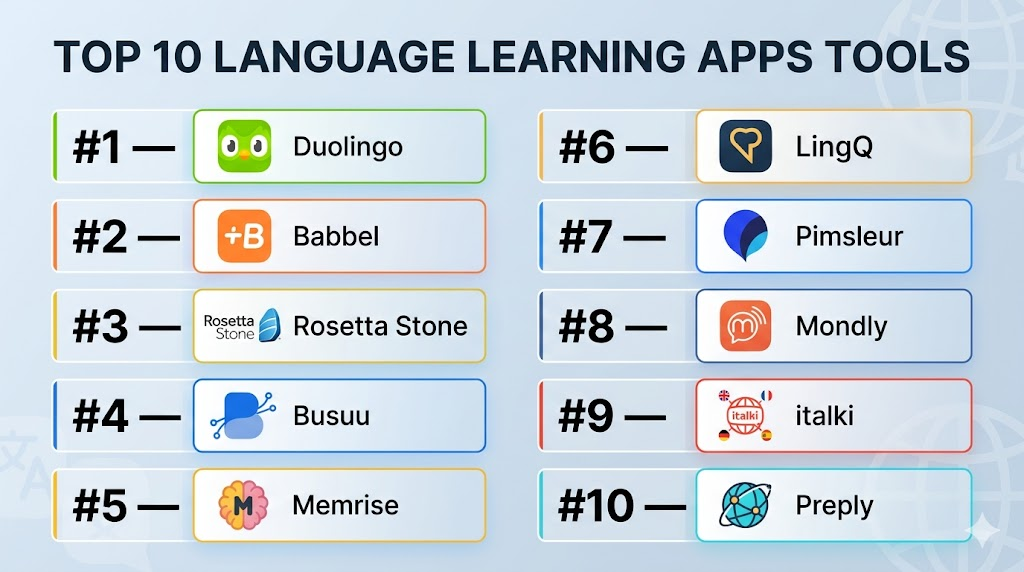
Top 10 Language Learning Apps Tools
#1 — Duolingo
Short description: Duolingo is a popular language learning app built around short, game-like lessons. It is useful for beginners, casual learners, students, travelers, and anyone who wants a fun way to build daily language practice.
Key Features
- Bite-sized lessons for vocabulary, grammar, reading, listening, and speaking
- Gamified learning with streaks, points, levels, and challenges
- Wide language coverage across many popular and regional languages
- Speaking and listening exercises depending on language course
- Progress tracking and daily reminders
- Free access with optional paid upgrades
- Mobile-first learning experience
Pros
- Very easy to start for beginners
- Strong habit-building through gamification
- Useful for casual daily practice and vocabulary growth
Cons
- May not be enough for advanced fluency by itself
- Grammar depth varies by language course
- Learners may need additional speaking practice outside the app
Platforms / Deployment
Web / iOS / Android
Cloud
Security & Compliance
Duolingo provides account-based access and user privacy controls. Specific enterprise security details, SSO, audit logs, RBAC, SOC 2, ISO 27001, GDPR, and HIPAA details should be verified directly. Unknown details should be treated as Not publicly stated.
Integrations & Ecosystem
Duolingo is primarily a consumer-focused learning app, but it also fits classroom-style and self-study workflows where learners need structured daily practice.
Common ecosystem areas include:
- Mobile learning
- School language practice
- Self-study routines
- Travel preparation
- Beginner vocabulary building
- Habit-based learning
Support & Community
Duolingo has help resources, learner forums, product guidance, and a large user community. It is easy for new learners to find tips, discussions, and learning motivation.
#2 — Babbel
Short description: Babbel is a language learning app focused on structured lessons, practical conversation skills, grammar explanations, and real-life usage. It is useful for adults, professionals, travelers, and learners who prefer guided course-style learning.
Key Features
- Structured lessons built around practical language use
- Conversation-focused exercises
- Grammar explanations in context
- Review system for vocabulary retention
- Pronunciation practice depending on language
- Offline lesson access depending on platform and plan
- Courses designed for travel, work, and daily communication
Pros
- Stronger structure than many casual learning apps
- Good balance of grammar, vocabulary, and conversation practice
- Useful for adult learners who want practical communication skills
Cons
- Language selection may be more limited than some broader apps
- Most serious usage requires a paid subscription
- Learners seeking live tutoring may need an additional platform
Platforms / Deployment
Web / iOS / Android
Cloud
Security & Compliance
Babbel provides account access and subscription management. Specific security certifications, enterprise controls, SSO, audit logs, RBAC, SOC 2, ISO 27001, GDPR, and HIPAA details should be verified directly. Unknown details should be listed as Not publicly stated.
Integrations & Ecosystem
Babbel fits self-paced learning, travel preparation, business communication practice, and adult education workflows.
Common ecosystem areas include:
- Mobile language learning
- Business language basics
- Travel-focused learning
- Grammar and vocabulary review
- Conversation preparation
- Self-paced study plans
Support & Community
Babbel provides help documentation, learner support, and structured course guidance. It is especially useful for learners who prefer a more traditional learning path inside an app.
#3 — Rosetta Stone
Short description: Rosetta Stone is a long-standing language learning platform known for immersive learning and pronunciation practice. It is suitable for learners who prefer visual, audio-based, and context-driven lessons rather than heavy translation.
Key Features
- Immersive learning approach using images, audio, and context
- Pronunciation feedback technology
- Structured lessons for multiple languages
- Listening, speaking, reading, and matching exercises
- Mobile and web access
- Offline learning options depending on platform and plan
- Suitable for self-paced learners and organizations
Pros
- Strong immersive learning style
- Helpful pronunciation practice for speaking confidence
- Good for learners who prefer less translation-heavy learning
Cons
- Learning style may feel slow for users who want direct grammar explanations
- Paid plans may not suit casual learners
- Some learners may need additional conversation practice
Platforms / Deployment
Web / iOS / Android
Cloud
Security & Compliance
Rosetta Stone provides account-based learning access and organization-focused options depending on offering. Specific enterprise security details, SSO, audit logs, RBAC, SOC 2, ISO 27001, GDPR, and HIPAA should be verified directly. Unknown items should be written as Not publicly stated.
Integrations & Ecosystem
Rosetta Stone fits education, self-study, enterprise training, and immersive language learning workflows.
Common ecosystem areas include:
- Education language programs
- Corporate learning
- Mobile self-study
- Pronunciation practice
- Immersive vocabulary learning
- Structured course delivery
Support & Community
Rosetta Stone provides support resources, learning guidance, and business or education support options depending on plan. It is a mature option for learners who want a structured, established platform.
#4 — Busuu
Short description: Busuu is a language learning app that combines structured lessons, vocabulary practice, grammar, study plans, and community feedback. It is useful for learners who want guided learning plus correction from other users or native speakers.
Key Features
- Structured language courses
- Vocabulary, grammar, reading, listening, and speaking practice
- Personalized study plans depending on goals
- Community feedback on written and spoken exercises
- Progress tracking and review features
- Offline mode depending on plan
- Certificates or progress milestones may vary by offering
Pros
- Good mix of structured lessons and community feedback
- Useful for learners who want correction from real people
- Strong fit for goal-based self-study
Cons
- Community feedback quality can vary
- Some useful features may require a paid plan
- Advanced fluency may still require live speaking practice
Platforms / Deployment
Web / iOS / Android
Cloud
Security & Compliance
Busuu provides account-based access and learning profile management. Specific security certifications, enterprise controls, SSO, audit logs, RBAC, GDPR, SOC 2, ISO 27001, and HIPAA details should be verified directly. Unknown details should be treated as Not publicly stated.
Integrations & Ecosystem
Busuu is useful for learners who want a blend of app-based lessons and social learning.
Common ecosystem areas include:
- Self-paced language learning
- Community correction workflows
- Mobile learning
- Grammar and vocabulary practice
- Travel and work language preparation
- Progress-based study plans
Support & Community
Busuu has help resources, learner support, and a community-based learning model. Its community feedback feature can be valuable for learners who want more interaction than solo drills.
#5 — Memrise
Short description: Memrise is a language learning app focused on vocabulary, listening, memory techniques, and exposure to real-world language. It is useful for learners who want practical phrases, native speaker examples, and repetition-based learning.
Key Features
- Vocabulary and phrase learning
- Memory-based review system
- Native speaker video examples depending on course
- Listening and pronunciation practice
- Short daily lessons
- Mobile-first learning experience
- Useful for travel, casual learning, and vocabulary building
Pros
- Good for vocabulary retention and phrase practice
- Native speaker examples help learners hear real usage
- Easy to use for casual and intermediate learners
Cons
- May not provide deep grammar instruction
- Course depth can vary by language
- Learners may need other tools for structured speaking practice
Platforms / Deployment
Web / iOS / Android
Cloud
Security & Compliance
Memrise provides user accounts and subscription management. Specific security certifications, SSO, audit logs, RBAC, SOC 2, ISO 27001, GDPR, and HIPAA details should be verified directly. Unknown details should be listed as Not publicly stated.
Integrations & Ecosystem
Memrise works well as a vocabulary and listening companion for self-study learners.
Common ecosystem areas include:
- Vocabulary practice
- Travel phrase learning
- Listening improvement
- Mobile learning routines
- Memory-based review
- Casual language learning
Support & Community
Memrise provides help resources and user support. It also has a learner community around practical vocabulary and language habit building.
#6 — LingQ
Short description: LingQ is a language learning platform focused on reading, listening, vocabulary building, and learning from real content. It is useful for learners who prefer immersion through stories, articles, podcasts, transcripts, and imported content.
Key Features
- Reading and listening-based language learning
- Vocabulary tracking through saved words and phrases
- Import content from different sources depending on platform support
- Audio and transcript-based learning workflows
- Progress tracking for known and new words
- Large content library depending on language
- Suitable for intermediate and self-directed learners
Pros
- Strong for immersion-based learners
- Useful for building vocabulary through real content
- Good for learners who enjoy reading and listening practice
Cons
- May feel less guided for complete beginners
- Interface and workflow may require some adjustment
- Speaking practice is not the main focus
Platforms / Deployment
Web / iOS / Android
Cloud
Security & Compliance
LingQ provides account-based access and learner progress tracking. Specific security certifications, enterprise controls, SSO, audit logs, RBAC, GDPR, SOC 2, ISO 27001, and HIPAA details should be verified directly. Unknown details should be written as Not publicly stated.
Integrations & Ecosystem
LingQ fits immersion-based learning workflows and works well for learners who want to study with authentic content.
Common ecosystem areas include:
- Reading practice
- Listening practice
- Vocabulary tracking
- Imported learning content
- Self-directed study
- Intermediate language development
Support & Community
LingQ provides learning resources, help documentation, and community-driven learning discussions. It is most useful for learners who enjoy independent study and content-based learning.
#7 — Pimsleur
Short description: Pimsleur is an audio-first language learning platform focused on speaking, listening, pronunciation, and conversation recall. It is useful for commuters, travelers, busy professionals, and learners who prefer learning by listening and repeating.
Key Features
- Audio-based language lessons
- Speaking and listening practice
- Conversation-focused repetition method
- Downloadable lessons depending on platform and plan
- Hands-free learning experience
- Useful for travel and daily communication
- Structured lesson progression
Pros
- Strong for listening and speaking confidence
- Good for learners who prefer audio learning
- Useful during commutes, walks, or hands-free study sessions
Cons
- Less visual and writing-focused than other apps
- May not suit learners who prefer interactive exercises
- Paid access is usually needed for serious use
Platforms / Deployment
Web / iOS / Android
Cloud
Security & Compliance
Pimsleur provides account-based access and subscription management. Specific security certifications, SSO, audit logs, RBAC, SOC 2, ISO 27001, GDPR, and HIPAA details should be verified directly. Unknown items should be treated as Not publicly stated.
Integrations & Ecosystem
Pimsleur fits audio-first learning routines and is useful for learners who want speaking practice without needing screen-heavy lessons.
Common ecosystem areas include:
- Audio learning
- Travel preparation
- Conversation practice
- Mobile learning
- Commute-based study
- Pronunciation development
Support & Community
Pimsleur provides help documentation, account support, and learning guidance. It is especially useful for learners who value a structured audio method.
#8 — Mondly
Short description: Mondly is a language learning app that offers vocabulary, phrases, grammar practice, chatbot-style conversations, speech recognition, and interactive lessons. It is useful for beginners and casual learners who want visual and conversation-oriented learning.
Key Features
- Interactive lessons for vocabulary, grammar, and phrases
- Speech recognition practice
- Chatbot-style conversation exercises
- Daily lessons and progress tracking
- Multiple language options
- Visual and audio learning activities
- Family or business-related options may vary by offering
Pros
- Friendly for beginners and casual learners
- Good visual and interactive lesson experience
- Useful for basic speaking and conversation practice
Cons
- Advanced learners may need deeper resources
- Grammar depth may vary by language
- Some features may depend on subscription level
Platforms / Deployment
Web / iOS / Android
Cloud
Security & Compliance
Mondly provides account-based access and subscription management. Specific enterprise security details, SSO, audit logs, RBAC, SOC 2, ISO 27001, GDPR, and HIPAA should be verified directly. Unknown details should be written as Not publicly stated.
Integrations & Ecosystem
Mondly supports mobile-first language learning with interactive exercises and conversation-style practice.
Common ecosystem areas include:
- Beginner language learning
- Mobile learning
- Speech practice
- Daily lesson routines
- Travel language preparation
- Basic conversation development
Support & Community
Mondly provides help resources and user support. It is approachable for learners who want a simple, visual, and interactive way to start learning.
#9 — italki
Short description: italki is a language learning marketplace that connects learners with tutors and conversation partners. It is useful for learners who want live speaking practice, personalized lessons, pronunciation feedback, and human correction.
Key Features
- One-on-one language lessons with tutors
- Conversation practice with native or fluent speakers
- Flexible scheduling depending on tutor availability
- Tutor profiles, lesson types, and learner reviews
- Support for many languages
- Personalized learning based on goals
- Useful for speaking confidence and real interaction
Pros
- Strong for real speaking practice
- Learners can choose tutors based on budget, goals, and style
- Good supplement to self-paced language apps
Cons
- Quality depends on tutor selection
- Costs vary by tutor and lesson frequency
- Not a traditional app-only course structure
Platforms / Deployment
Web / iOS / Android
Cloud
Security & Compliance
italki provides account-based access, payment workflows, and user profiles. Specific security certifications, SSO, audit logs, RBAC, SOC 2, ISO 27001, GDPR, and HIPAA details should be verified directly. Unknown details should be treated as Not publicly stated.
Integrations & Ecosystem
italki fits human-led learning workflows where learners want practice, correction, and personalized guidance.
Common ecosystem areas include:
- Online tutoring
- Conversation practice
- Exam speaking preparation
- Pronunciation coaching
- Personalized language goals
- Global tutor marketplace
Support & Community
italki provides platform support, tutor profiles, learner resources, and community-style interaction. Learners should review tutor experience, lesson format, and cancellation rules before booking.
#10 — Preply
Short description: Preply is an online tutoring platform where learners can book language lessons with tutors. It is useful for students, professionals, business learners, exam candidates, and anyone who wants personalized human teaching.
Key Features
- One-on-one tutor-led language lessons
- Flexible scheduling and tutor selection
- Support for many languages and learner goals
- Business language and exam preparation options depending on tutor
- Personalized lesson plans
- Video-based online learning
- Useful for speaking, grammar, writing, and confidence building
Pros
- Strong for personalized learning and speaking practice
- Good option for learners with specific goals
- Flexible tutor choice across skill levels and budgets
Cons
- Learning quality depends on tutor fit
- More expensive than many self-study apps if used regularly
- Requires commitment to scheduled sessions
Platforms / Deployment
Web / iOS / Android
Cloud
Security & Compliance
Preply provides account-based access, payment systems, and online lesson workflows. Specific security certifications, SSO, audit logs, RBAC, SOC 2, ISO 27001, GDPR, and HIPAA should be verified directly. Unknown details should be listed as Not publicly stated.
Integrations & Ecosystem
Preply is useful for learners who want structured human feedback instead of only app-based exercises.
Common ecosystem areas include:
- Online language tutoring
- Business language learning
- Exam preparation
- Speaking practice
- Personalized lesson planning
- Professional communication coaching
Support & Community
Preply provides support resources, tutor profiles, booking workflows, and learner assistance. Users should compare tutors carefully and choose based on goals, teaching style, and availability.
Comparison Table
| Tool Name | Best For | Platform(s) Supported | Deployment | Standout Feature | Public Rating |
|---|---|---|---|---|---|
| Duolingo | Beginners and daily habit-based learning | Web / iOS / Android | Cloud | Gamified bite-sized language lessons | N/A |
| Babbel | Adults and practical conversation learning | Web / iOS / Android | Cloud | Structured real-life language courses | N/A |
| Rosetta Stone | Immersive learning and pronunciation practice | Web / iOS / Android | Cloud | Context-based immersive method | N/A |
| Busuu | Goal-based learning with community feedback | Web / iOS / Android | Cloud | Community correction and structured lessons | N/A |
| Memrise | Vocabulary, phrases, and listening practice | Web / iOS / Android | Cloud | Memory-based learning with native speaker examples | N/A |
| LingQ | Reading, listening, and immersion learning | Web / iOS / Android | Cloud | Learning from real content and vocabulary tracking | N/A |
| Pimsleur | Audio learners and speaking confidence | Web / iOS / Android | Cloud | Structured audio-first conversation practice | N/A |
| Mondly | Beginners and interactive visual learning | Web / iOS / Android | Cloud | Chatbot-style and speech recognition practice | N/A |
| italki | Live tutoring and conversation practice | Web / iOS / Android | Cloud | Tutor marketplace for personalized lessons | N/A |
| Preply | Personalized tutor-led language learning | Web / iOS / Android | Cloud | One-on-one online language lessons | N/A |
Evaluation & Scoring of Language Learning Apps
The scoring below is comparative and practical. It is based on common learning needs such as lesson quality, ease of use, speaking practice, progress tracking, platform access, support, and value. A higher score does not mean the app is best for every learner. A traveler, student, business professional, beginner, and advanced learner may need very different tools.
| Tool Name | Core (25%) | Ease (15%) | Integrations (15%) | Security (10%) | Performance (10%) | Support (10%) | Value (15%) | Weighted Total (0–10) |
|---|---|---|---|---|---|---|---|---|
| Duolingo | 8 | 10 | 6 | 7 | 8 | 8 | 9 | 8.05 |
| Babbel | 8 | 9 | 6 | 7 | 8 | 8 | 8 | 7.75 |
| Rosetta Stone | 8 | 8 | 6 | 7 | 8 | 8 | 7 | 7.45 |
| Busuu | 8 | 8 | 6 | 7 | 8 | 8 | 8 | 7.60 |
| Memrise | 7 | 9 | 6 | 6 | 8 | 7 | 8 | 7.25 |
| LingQ | 8 | 7 | 6 | 6 | 8 | 7 | 8 | 7.25 |
| Pimsleur | 8 | 8 | 5 | 6 | 8 | 8 | 7 | 7.15 |
| Mondly | 7 | 9 | 6 | 6 | 8 | 7 | 8 | 7.25 |
| italki | 9 | 8 | 6 | 7 | 8 | 8 | 7 | 7.80 |
| Preply | 9 | 8 | 6 | 7 | 8 | 8 | 7 | 7.80 |
How to interpret these scores:
- The scoring is comparative and should be used as a shortlist guide, not a final decision.
- Self-study learners may care more about ease, price, and daily habit-building.
- Business learners may value speaking practice, tutor quality, and structured communication goals.
- Advanced learners should prioritize live practice, immersion, feedback, and real-world content.
- Always test an app with your target language before committing to a long subscription.
Which Language Learning Apps Tool Is Right for You?
Solo / Freelancer
Solo learners and freelancers usually need flexible learning that fits around work, travel, and client schedules. They may want to improve English, Spanish, French, German, Japanese, or another language for career growth, international clients, travel, or personal development.
Good options include:
- Duolingo for daily practice and beginner-friendly learning
- Babbel for structured lessons and practical conversation
- Memrise for vocabulary and listening practice
- LingQ for reading and listening immersion
- italki or Preply for speaking practice with tutors
For solo users, the best app is usually the one they can use consistently. A mix of one self-study app and one speaking platform often works better than relying on one app only.
SMB
Small and mid-sized businesses may use language learning apps for customer support teams, sales teams, hospitality staff, international teams, relocation support, or employee development. They need simple access, progress visibility, practical lessons, and reasonable pricing.
Good options include:
- Babbel for structured business-friendly learning
- Busuu for guided study and community feedback
- Duolingo for accessible daily practice
- Preply for personalized tutor-led business language learning
- italki for conversation and pronunciation practice
SMBs should consider employee motivation, learning goals, time commitment, and whether the language skill is needed for real customer or business communication.
Mid-Market
Mid-market companies may need language learning for international collaboration, regional expansion, global customer success, employee mobility, and multilingual communication. They may need more structure than casual learners.
Good options include:
- Babbel for structured self-paced learning
- Rosetta Stone for immersive learning programs
- Busuu for guided learning and feedback
- Preply for role-specific tutor-led lessons
- italki for speaking practice and conversation coaching
Mid-market teams should evaluate reporting options, learner engagement, business language support, tutor availability, and whether the tool can support multiple departments or regions.
Enterprise
Enterprise teams often need language learning for global workforce development, customer-facing teams, international mobility, compliance communication, and multilingual collaboration. They need stronger governance, procurement support, learner management, and privacy review.
Good options include:
- Rosetta Stone for structured organization-level language learning
- Babbel for practical language training
- Busuu for scalable self-paced learning with feedback
- Preply for personalized business tutoring
- italki for flexible tutor-led speaking practice
Enterprise buyers should involve HR, learning and development, procurement, security, legal, and regional team leaders before selecting a platform.
Budget vs Premium
Budget-conscious learners should start with apps that offer free or low-cost learning before committing to paid tutoring. Free or freemium tools are useful for building consistency, vocabulary, and basic understanding.
Budget-friendly options may include:
- Duolingo
- Memrise
- Busuu, depending on plan
- Mondly, depending on plan
- LingQ, depending on usage
Premium or more structured options may include:
- Babbel
- Rosetta Stone
- Pimsleur
- italki
- Preply
The best value depends on learning goals. If the goal is casual travel vocabulary, a freemium app may be enough. If the goal is speaking fluently for work, tutor-led practice may provide better value.
Feature Depth vs Ease of Use
Some apps are simple and habit-focused, while others are deeper and better for structured learning or real conversation.
For ease of use:
- Duolingo
- Mondly
- Memrise
- Pimsleur
- Babbel
For deeper learning:
- Rosetta Stone
- Busuu
- LingQ
- italki
- Preply
Beginners may want a simple app first. Intermediate learners should add real content, speaking practice, and feedback to avoid getting stuck at passive understanding.
Integrations & Scalability
Language learning apps are not always integration-heavy like enterprise SaaS tools, but organizations should still evaluate scalability. For companies, the main questions are learner management, reporting, access control, onboarding, and support.
Scalable choices may include:
- Rosetta Stone for structured organization-level learning
- Babbel for practical employee language learning
- Busuu for goal-based learning workflows
- Preply for personalized business tutoring
- italki for flexible tutor-led practice
Scalability should include user management, learner progress visibility, support availability, payment management, privacy review, and fit across different language goals.
Security & Compliance Needs
Security matters when schools, companies, and institutions use language learning apps for students or employees. Even consumer-focused apps may collect learner progress, account data, payment data, and usage behavior.
Teams should evaluate:
- Account security options
- SSO availability for business plans
- User role management
- Learner progress data controls
- Payment and billing controls
- Privacy documentation
- Data retention policies
- Regional data handling rules
- Child or student privacy considerations
- Admin reporting permissions
- Vendor security documentation
- Contract-level data protection terms
For business or education use, buyers should verify security directly with the vendor instead of assuming consumer app controls are enough.
Frequently Asked Questions
1. What are language learning apps?
Language learning apps are digital tools that help users learn vocabulary, grammar, pronunciation, listening, speaking, reading, and writing. They are usually available on mobile devices and web platforms.
2. Can language learning apps make you fluent?
Apps can help build vocabulary, grammar, listening, and practice habits, but fluency usually requires real conversation, feedback, immersion, and consistent practice. Tutor platforms can help fill that speaking gap.
3. Which app is best for beginners?
Duolingo, Babbel, Mondly, Memrise, and Rosetta Stone are beginner-friendly options. The best choice depends on whether the learner prefers games, structure, immersion, visuals, or conversation practice.
4. Which app is best for speaking practice?
italki and Preply are strong for live speaking practice with tutors. Pimsleur, Babbel, Busuu, and Mondly can also help with speaking exercises, but human conversation is often more effective for confidence.
5. What pricing models do language learning apps use?
Most apps use freemium plans, monthly subscriptions, annual subscriptions, lifetime plans, tutor lesson pricing, or organization-level pricing. Tutor platforms usually charge based on tutor rates and lesson frequency.
6. Are free language learning apps enough?
Free apps can be enough for casual learning, vocabulary building, and daily practice. For stronger speaking ability, business communication, or serious progress, paid courses or tutor support may be useful.
7. What common mistakes should learners avoid?
Common mistakes include using only one app, avoiding speaking practice, focusing only on streaks, skipping review, ignoring pronunciation, and expecting fluency without real-world practice.
8. Which app is best for business language learning?
Babbel, Rosetta Stone, Busuu, Preply, and italki can be useful for business language learning. Companies should evaluate learner goals, reporting needs, tutor quality, security, and program structure.
9. Are language learning apps secure?
Most apps provide account security and privacy controls, but business and education buyers should verify security documentation, data handling, user management, and compliance requirements directly.
10. Can companies use language learning apps for employees?
Yes, companies can use language learning apps for employee development, customer support, relocation, global collaboration, and business communication. The right platform depends on team size and reporting needs.
Conclusion
Language learning apps make it easier for learners, professionals, travelers, students, and organizations to build language skills with flexible digital tools. The best app depends on the learner’s goal. Duolingo is strong for daily habit-building, Babbel is useful for structured practical learning, Rosetta Stone supports immersive study, Busuu adds community feedback, Memrise helps vocabulary, LingQ supports immersion, Pimsleur is strong for audio learning, Mondly is beginner-friendly, and italki or Preply are better for live speaking practice. No single app is perfect for every learner. The best next step is to shortlist two or three apps, test them with your target language, compare lesson style, check speaking practice options, review pricing and privacy needs, and choose the tool that you can use consistently.
