Introduction
AI dubbing tools help creators, businesses, educators, marketers, media companies, and production teams automatically translate and recreate spoken audio in multiple languages using artificial intelligence. Instead of hiring traditional voice actors and manually recording every language version, AI dubbing software can generate translated voiceovers with synthetic voices, cloned voices, lip-sync adjustments, subtitles, timing alignment, and multilingual audio workflows.
AI dubbing is becoming important because businesses increasingly publish global video content across YouTube, social media, streaming platforms, online courses, training portals, podcasts, product demos, webinars, and entertainment channels. Traditional dubbing can be expensive, slow, and difficult to scale, while AI dubbing allows teams to localize content faster and reach international audiences more efficiently.
Common use cases include multilingual YouTube videos, training content localization, e-learning translation, international marketing campaigns, streaming media localization, podcast translation, customer onboarding videos, and multilingual product demonstrations.
Buyers should evaluate AI dubbing tools based on translation quality, voice realism, lip-sync capability, editing controls, supported languages, API access, subtitle workflows, security, collaboration features, scalability, pricing, and integration flexibility.
Best for: Video creators, media companies, educators, marketing teams, global SaaS companies, localization teams, course creators, agencies, and enterprises managing multilingual content delivery.
Not ideal for: Teams needing highly emotional cinematic voice acting, projects requiring extensive human-directed performance nuance, or organizations with strict regulatory localization requirements that still require full human linguistic review.
Key Trends in AI Dubbing Tools
Voice cloning quality is improving rapidly. AI voices are becoming more natural, expressive, and emotionally realistic, reducing the robotic tone common in earlier generations.
Lip-sync AI is becoming a major differentiator. Modern dubbing tools increasingly synchronize translated speech with mouth movement to improve realism in multilingual videos.
Multilingual content scaling is now a business priority. Brands and creators want to publish one video globally in many languages without building large localization teams.
AI subtitle and dubbing workflows are merging. Many platforms now combine transcription, translation, subtitle generation, voice synthesis, and video export in one workflow.
Voice rights and ethical AI policies are becoming more important. Businesses increasingly need permission management, consent workflows, and protection against unauthorized voice cloning.
Enterprise security expectations are rising. Buyers want private uploads, secure cloud processing, role-based access, watermarking, audit visibility, and data handling transparency.
Real-time AI translation and dubbing are gaining attention. Some platforms are exploring live multilingual events, webinars, meetings, and streaming translation.
Localization customization is improving. Teams now expect pronunciation control, regional accents, tone editing, and script refinement workflows.
API-driven AI dubbing is becoming more common. Developers and SaaS platforms increasingly want automated dubbing workflows embedded into products and media pipelines.
Human review remains important. Even advanced AI dubbing often requires manual checks for pronunciation, cultural nuance, humor, technical terminology, and legal compliance.
How We Selected These Tools
The tools in this list were selected based on practical AI dubbing needs, market visibility, feature completeness, translation quality, usability, scalability, and suitability across different customer segments.
The evaluation considered how well each tool supports transcription, translation, AI voice generation, lip-sync workflows, subtitle management, multilingual export, and editing flexibility.
Ease of use was reviewed because AI dubbing tools are used by creators, marketers, educators, agencies, localization teams, and enterprise media teams with different technical backgrounds.
Voice quality and realism were considered because natural-sounding speech strongly affects audience trust, engagement, and viewing experience.
Language coverage was evaluated because global businesses often need support for many regional markets and multilingual workflows.
Integration strength was reviewed because AI dubbing tools increasingly connect with video editing workflows, CMS systems, content management pipelines, APIs, and publishing platforms.
Security posture was considered through private uploads, enterprise controls, user permissions, API security, and workflow governance.
Support and onboarding were considered because localization workflows often involve training, review processes, quality control, and large-scale content management.
The list includes a balanced mix of creator-focused AI dubbing platforms, enterprise localization tools, developer-friendly APIs, AI voice platforms, and multilingual video localization systems.
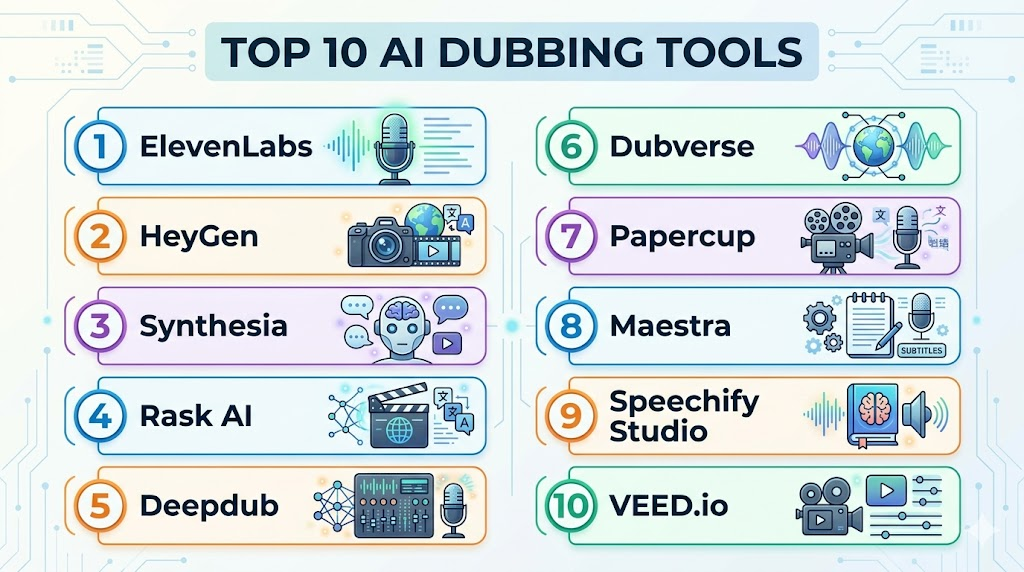
Top 10 AI Dubbing Tools
1. ElevenLabs
Short description: ElevenLabs is a leading AI voice and dubbing platform known for highly realistic synthetic voices, multilingual speech generation, and voice cloning capabilities. It is best for creators, media teams, developers, and businesses needing natural-sounding multilingual audio.
Key Features
- AI voice synthesis with realistic speech generation
- Multilingual AI dubbing workflows
- Voice cloning and custom voice creation
- Text-to-speech and audio generation APIs
- Language translation and voice adaptation
- Editing controls for pacing and pronunciation
- Developer-friendly integration options
Pros
- Strong voice realism compared with many competitors
- Good multilingual support for creators and businesses
- Useful API ecosystem for automation and applications
Cons
- Advanced usage may require careful workflow review
- Ethical and consent considerations are important for voice cloning
- Enterprise governance requirements should be validated directly
Platforms / Deployment
Web-based platform. Cloud deployment. API access available.
Security & Compliance
ElevenLabs may support account security, API controls, and enterprise-level workflows depending on plan selection. Specific compliance certifications should be verified directly.
Integrations & Ecosystem
ElevenLabs is useful for creators, developers, and businesses embedding AI voices into media workflows and applications.
- API integrations
- Video production workflows
- Content localization
- Voice generation pipelines
- SaaS integrations
- Creative automation workflows
Support & Community
ElevenLabs has strong market visibility, documentation, API resources, and an active creator and developer community. Support depth may vary by plan.
2. HeyGen
Short description: HeyGen is an AI video generation and dubbing platform focused on multilingual video localization, avatar-based content, and AI voice workflows. It is useful for marketing teams, educators, creators, and global businesses.
Key Features
- AI dubbing with multilingual translation support
- Lip-sync synchronization for translated videos
- AI avatars and video presenters
- Subtitle and voiceover workflows
- Voice cloning and synthetic voice options
- Video editing and localization workflows
- Browser-based content creation
Pros
- Strong visual localization workflows
- Useful for multilingual business video production
- Lip-sync features improve translated video realism
Cons
- May not replace high-end cinematic dubbing production
- AI avatars may not fit all brand styles
- Enterprise workflow controls should be reviewed carefully
Platforms / Deployment
Web-based platform. Cloud deployment.
Security & Compliance
HeyGen may support access controls and account security options. Specific compliance certifications and enterprise governance capabilities should be verified directly.
Integrations & Ecosystem
HeyGen works well for marketing, training, and multilingual business communication workflows.
- Video marketing workflows
- Subtitle generation
- Localization pipelines
- Social media content creation
- API-based automation
- Presentation workflows
Support & Community
HeyGen provides onboarding resources, support documentation, tutorials, and creator-focused education. Its community is growing rapidly among marketing and content teams.
3. Synthesia
Short description: Synthesia is an AI video generation and localization platform used for training, onboarding, internal communication, and multilingual business videos. It is best for enterprises, HR teams, training teams, and business communication workflows.
Key Features
- AI-generated multilingual video creation
- AI avatars and synthetic presenters
- Voiceover generation and translation workflows
- Enterprise training and onboarding video support
- Subtitle and localization workflows
- Team collaboration and template management
- Video export and sharing features
Pros
- Strong for business communication and training
- Useful multilingual scaling for enterprises
- Template-driven workflows simplify content creation
Cons
- Less focused on entertainment-style dubbing
- Creative flexibility may differ from traditional editing suites
- Voice realism varies depending on language and workflow
Platforms / Deployment
Web-based platform. Cloud deployment.
Security & Compliance
Synthesia may support enterprise administration and business-focused security workflows depending on plan type. Specific certifications should be verified during procurement.
Integrations & Ecosystem
Synthesia works well in enterprise communication, onboarding, and training ecosystems.
- Learning management systems
- HR workflows
- Internal training systems
- Presentation and onboarding workflows
- Team collaboration
- Enterprise video localization
Support & Community
Synthesia provides onboarding, enterprise support, educational resources, and business-focused customer guidance. It is widely recognized in AI training video workflows.
4. Rask AI
Short description: Rask AI is an AI localization platform focused on video translation, dubbing, subtitle generation, and multilingual content adaptation. It is useful for creators, educators, agencies, and media localization workflows.
Key Features
- AI dubbing and translation workflows
- Subtitle generation and multilingual captions
- Voice cloning and speaker preservation
- Lip-sync support for translated video
- Multi-language export options
- Localization workflow management
- Creator-focused video translation workflows
Pros
- Strong multilingual localization focus
- Useful for YouTube and educational creators
- Supports subtitle and dubbing workflows together
Cons
- Enterprise governance features should be validated carefully
- Some editing workflows may require manual review
- Translation nuance may still need human verification
Platforms / Deployment
Web-based platform. Cloud deployment.
Security & Compliance
Rask AI may support account-level security and private uploads. Specific compliance certifications should be verified directly with the vendor.
Integrations & Ecosystem
Rask AI is useful for multilingual video publishing and localization pipelines.
- Creator workflows
- Subtitle systems
- Social media publishing
- Localization pipelines
- Video translation workflows
- Content adaptation workflows
Support & Community
Rask AI provides tutorials, documentation, onboarding guidance, and creator-focused support resources.
5. Deepdub
Short description: Deepdub is an AI dubbing platform designed for media localization, entertainment dubbing, and multilingual content adaptation. It is suitable for production teams, streaming platforms, and professional media localization workflows.
Key Features
- AI dubbing for entertainment and media content
- Voice preservation and localization workflows
- Multi-language adaptation support
- Synthetic voice and dubbing workflows
- Content review and localization management
- Media-oriented production pipelines
- Enterprise localization workflows
Pros
- Focused on professional media localization
- Useful for entertainment and streaming workflows
- Supports scalable multilingual content adaptation
Cons
- Enterprise-oriented workflows may be complex for smaller creators
- Pricing and onboarding may vary significantly
- Human review may still be necessary for nuanced localization
Platforms / Deployment
Cloud deployment. Enterprise workflow configuration may vary.
Security & Compliance
Deepdub may support enterprise security workflows and controlled media processing. Specific compliance certifications should be verified directly.
Integrations & Ecosystem
Deepdub works well in entertainment, streaming, and professional localization environments.
- Streaming workflows
- Media production pipelines
- Localization management
- Enterprise media systems
- Subtitle workflows
- Voice adaptation workflows
Support & Community
Deepdub provides enterprise-oriented support, onboarding, and localization workflow guidance. It is most relevant for professional media environments.
6. Dubverse
Short description: Dubverse is an AI dubbing and localization platform designed for multilingual content adaptation, voice generation, subtitles, and creator workflows. It is useful for marketing teams, educators, media creators, and regional language publishing.
Key Features
- AI voice dubbing and localization
- Subtitle generation and translation
- Multi-language support
- Voice customization workflows
- Video export and sharing tools
- Fast multilingual adaptation workflows
- Creator-friendly interface
Pros
- Useful for regional and multilingual content
- Good balance between usability and localization features
- Practical for educational and creator workflows
Cons
- Advanced enterprise governance should be reviewed carefully
- Human review may still be required for translation accuracy
- Complex cinematic workflows may require additional editing tools
Platforms / Deployment
Web-based platform. Cloud deployment.
Security & Compliance
Dubverse may support account controls and private project management. Specific compliance certifications should be verified directly.
Integrations & Ecosystem
Dubverse supports content teams that need multilingual publishing across digital channels.
- Subtitle workflows
- Social media content
- Educational video localization
- Marketing content adaptation
- Video translation pipelines
- Regional language workflows
Support & Community
Dubverse provides tutorials, onboarding support, and creator education resources. It is increasingly popular among multilingual digital content teams.
7. Papercup
Short description: Papercup is an AI dubbing platform focused on enterprise and media localization. It is designed for broadcasters, publishers, and businesses that need scalable multilingual video translation workflows.
Key Features
- AI-powered multilingual dubbing
- Voice generation and localization workflows
- Human review support options
- Broadcast and publishing workflows
- Subtitle and translation management
- Enterprise localization support
- Scalable multilingual media delivery
Pros
- Strong enterprise localization orientation
- Useful for publishers and broadcasters
- Combines AI workflows with quality review processes
Cons
- May be more enterprise-focused than creator-focused
- Smaller users may find workflows more complex
- Pricing structure may vary by project scale
Platforms / Deployment
Cloud deployment. Enterprise configuration may vary.
Security & Compliance
Papercup may support enterprise-grade workflows and controlled media handling. Specific certifications and compliance details should be verified during procurement.
Integrations & Ecosystem
Papercup fits organizations managing multilingual publishing and large-scale media localization.
- Publishing workflows
- Media localization pipelines
- Broadcast systems
- Subtitle management
- Translation workflows
- Enterprise media operations
Support & Community
Papercup provides enterprise onboarding, support, and localization workflow guidance. It is most relevant for professional media and publishing teams.
8. Maestra
Short description: Maestra is an AI transcription, subtitle, voiceover, and dubbing platform designed for creators, educators, and businesses needing multilingual media workflows.
Key Features
- AI dubbing and voiceover generation
- Subtitle and transcription workflows
- Multi-language translation support
- Voice customization options
- Browser-based editing workflows
- Video localization support
- Collaboration and export workflows
Pros
- Combines transcription, subtitles, and dubbing in one workflow
- Useful for creators and educational teams
- Easy browser-based workflow for non-technical users
Cons
- Enterprise-scale governance should be evaluated carefully
- AI-generated speech may require manual refinement
- Some advanced media workflows may need additional tools
Platforms / Deployment
Web-based platform. Cloud deployment.
Security & Compliance
Maestra may support account security and project-level controls. Specific compliance certifications should be verified directly.
Integrations & Ecosystem
Maestra is useful for content teams managing multilingual subtitles and dubbing together.
- Subtitle workflows
- Educational content
- Creator localization workflows
- Marketing videos
- Translation pipelines
- Browser-based editing workflows
Support & Community
Maestra provides onboarding resources, tutorials, and customer support for multilingual content production.
9. Speechify Studio
Short description: Speechify Studio is an AI voice generation and media creation platform that supports dubbing, narration, synthetic voice workflows, and multilingual content production. It is useful for creators, marketers, educators, and podcast teams.
Key Features
- AI voice generation and narration
- Multilingual voice workflows
- Audio and video dubbing support
- Synthetic voice customization
- Content narration workflows
- Subtitle and media adaptation support
- Browser-based editing workflows
Pros
- Useful for fast narration and multilingual audio workflows
- Practical for educational and marketing content
- Simple interface for content creators
Cons
- Not designed primarily for large enterprise localization workflows
- Advanced cinematic dubbing may require manual editing
- Some voice customization workflows may be limited
Platforms / Deployment
Web-based platform. Cloud deployment.
Security & Compliance
Speechify Studio may support account-level security and controlled project access. Specific compliance certifications should be verified directly.
Integrations & Ecosystem
Speechify Studio works well for creators and educational media teams needing fast AI narration and dubbing.
- Podcast workflows
- Educational content
- Marketing videos
- Voice generation workflows
- Subtitle pipelines
- Browser-based content creation
Support & Community
Speechify Studio provides tutorials, support resources, and onboarding materials for creators and digital media users.
10. VEED.io
Short description: VEED.io is an online video editing platform with AI dubbing, subtitles, voice generation, and localization features. It is best for creators, social media teams, and businesses wanting lightweight browser-based localization workflows.
Key Features
- AI dubbing and translation workflows
- Automatic subtitle generation
- Browser-based video editing
- Voiceover and narration tools
- Social media export support
- Collaboration workflows
- Lightweight multilingual content adaptation
Pros
- Simple browser-based editing and dubbing workflows
- Useful for creators and marketing teams
- Good all-in-one content editing experience
Cons
- Advanced localization workflows may require external review
- Enterprise governance capabilities should be evaluated carefully
- Large-scale media pipelines may require more specialized platforms
Platforms / Deployment
Web-based platform. Cloud deployment.
Security & Compliance
VEED.io may support project access controls and account security features. Specific compliance certifications should be verified directly.
Integrations & Ecosystem
VEED.io works well for lightweight content editing and multilingual publishing workflows.
- Social media publishing
- Subtitle workflows
- Marketing content creation
- Browser-based editing
- Creator workflows
- Video export pipelines
Support & Community
VEED.io provides tutorials, onboarding content, support documentation, and creator-focused educational materials.
Comparison Table
| Tool Name | Best For | Platform(s) Supported | Deployment | Standout Feature | Public Rating |
|---|---|---|---|---|---|
| ElevenLabs | Realistic AI voice generation and dubbing | Web / API | Cloud | High-quality AI voice realism | N/A |
| HeyGen | Multilingual AI avatar videos | Web | Cloud | Lip-sync localization workflows | N/A |
| Synthesia | Enterprise training and onboarding videos | Web | Cloud | AI business video localization | N/A |
| Rask AI | Creator-focused multilingual dubbing | Web | Cloud | Combined subtitle and dubbing workflows | N/A |
| Deepdub | Professional entertainment localization | Enterprise workflows | Cloud | Media-focused AI dubbing pipelines | N/A |
| Dubverse | Regional and multilingual creator localization | Web | Cloud | Fast multilingual adaptation | N/A |
| Papercup | Enterprise media localization | Enterprise workflows | Cloud | AI-assisted publishing localization | N/A |
| Maestra | Combined transcription and dubbing workflows | Web | Cloud | All-in-one subtitle and dubbing workflows | N/A |
| Speechify Studio | AI narration and multilingual voice generation | Web | Cloud | Fast synthetic narration workflows | N/A |
| VEED.io | Browser-based video localization | Web | Cloud | Lightweight editing and dubbing | N/A |
Evaluation & Scoring of AI Dubbing Tools
| Tool Name | Core (25%) | Ease (15%) | Integrations (15%) | Security (10%) | Performance (10%) | Support (10%) | Value (15%) | Weighted Total (0–10) |
|---|---|---|---|---|---|---|---|---|
| ElevenLabs | 10 | 8 | 9 | 7 | 9 | 8 | 8 | 8.60 |
| HeyGen | 9 | 9 | 8 | 7 | 8 | 8 | 8 | 8.30 |
| Synthesia | 9 | 9 | 8 | 8 | 8 | 8 | 7 | 8.20 |
| Rask AI | 8 | 8 | 7 | 7 | 8 | 7 | 8 | 7.75 |
| Deepdub | 9 | 7 | 8 | 8 | 8 | 8 | 7 | 8.00 |
| Dubverse | 8 | 8 | 7 | 7 | 7 | 7 | 8 | 7.55 |
| Papercup | 9 | 7 | 8 | 8 | 8 | 8 | 7 | 8.00 |
| Maestra | 8 | 9 | 7 | 7 | 7 | 7 | 8 | 7.65 |
| Speechify Studio | 7 | 9 | 6 | 6 | 7 | 7 | 8 | 7.15 |
| VEED.io | 7 | 9 | 7 | 6 | 7 | 7 | 8 | 7.35 |
These scores are comparative and should be used as a practical shortlist guide. A higher score usually means stronger voice realism, localization workflows, scalability, or ecosystem support. A lower score does not mean the tool is weak; it may simply focus on lightweight creator workflows, browser-based simplicity, or specific localization use cases. Buyers should validate these scores through real multilingual testing, translation review, voice quality evaluation, and workflow pilots.
Which AI Dubbing Tools Tool Is Right for You?
Solo / Freelancer
Solo creators and freelancers usually need simple AI dubbing workflows that support YouTube videos, online courses, podcasts, social media clips, and multilingual audience growth.
VEED.io, Dubverse, Maestra, Speechify Studio, and Rask AI are practical choices for creators wanting browser-based simplicity and fast localization. ElevenLabs is useful when voice realism matters strongly. Buyers should focus on pricing, editing simplicity, subtitle workflows, and export quality.
SMB
Small and medium-sized businesses often use AI dubbing for marketing, onboarding, product demos, training videos, webinars, and multilingual customer communication.
HeyGen, Synthesia, ElevenLabs, Dubverse, and VEED.io are strong SMB choices depending on the workflow. Marketing teams may prefer HeyGen for lip-sync localization and AI avatars. Training teams may prefer Synthesia. Content teams may prefer ElevenLabs for voice quality and APIs.
Mid-Market
Mid-market organizations usually need scalable multilingual publishing, collaboration, workflow management, subtitle synchronization, review processes, and integration flexibility.
Synthesia, ElevenLabs, Papercup, Deepdub, and HeyGen can support larger localization needs depending on content type. Media-heavy businesses should prioritize voice consistency, localization quality, approval workflows, and content governance.
Enterprise
Enterprises need scalable localization workflows, security, collaboration, multilingual management, APIs, and governance. They may also require legal review, regional customization, and structured approval workflows.
Deepdub, Papercup, Synthesia, ElevenLabs, and enterprise-configured localization pipelines are stronger options for large organizations. Enterprises should validate security, API support, workflow governance, and multilingual review quality before deployment.
Budget vs Premium
Budget-focused users should prioritize tools that combine subtitles, translation, and dubbing in one workflow to avoid paying for multiple services separately.
Premium tools make sense when businesses need realistic voices, scalable localization, API automation, enterprise collaboration, or high-quality multilingual publishing. Teams should compare pricing based on minutes, languages, exports, collaboration features, and voice customization.
Feature Depth vs Ease of Use
Feature-rich platforms support voice cloning, lip-sync correction, subtitle editing, APIs, multilingual scaling, and enterprise workflows. These are useful for large localization operations and media businesses.
Ease-of-use-focused tools help creators localize content quickly without learning complicated editing systems. If the main need is lightweight multilingual publishing, a simpler workflow may provide better value.
Integrations & Scalability
AI dubbing workflows increasingly connect with editing software, CMS platforms, subtitle systems, localization pipelines, APIs, publishing systems, and media management workflows.
Marketing teams should evaluate subtitle exports, video editing compatibility, social publishing support, and collaboration features. Developers should evaluate APIs, automation support, and scalable media processing.
Security & Compliance Needs
Security matters when organizations localize confidential training videos, enterprise media, unreleased marketing campaigns, customer communication, or regulated content.
Buyers should evaluate account security, upload privacy, project permissions, API controls, encryption, audit visibility, SSO options, voice rights management, and data handling practices. Organizations using voice cloning should carefully review ethical usage policies and consent management workflows.
Frequently Asked Questions (FAQs)
1. What are AI dubbing tools?
AI dubbing tools automatically translate and recreate spoken audio in different languages using synthetic voices, voice cloning, subtitles, and localization workflows. They help scale multilingual content production faster than traditional manual dubbing.
2. How are AI dubbing tools different from subtitles?
Subtitles only display translated text on screen, while AI dubbing generates spoken translated audio. Some platforms combine subtitles, transcription, translation, and dubbing in one workflow.
3. Are AI-generated voices realistic?
Modern AI voices can sound surprisingly realistic, especially for business content, educational videos, and creator workflows. However, emotional acting and cinematic performance may still require human voice actors in some projects.
4. What pricing models do AI dubbing platforms use?
Pricing often depends on video minutes, language count, export limits, voice customization, collaboration features, API usage, or enterprise workflow requirements.
5. Can AI dubbing tools support lip-sync?
Some platforms support AI lip-sync workflows that align translated speech with mouth movement. Quality varies depending on language, video style, and platform capabilities.
6. Are AI dubbing tools secure?
Security varies by vendor. Buyers should review upload privacy, user permissions, data handling, encryption, API controls, and enterprise governance before using AI dubbing for sensitive content.
7. What are common mistakes when using AI dubbing tools?
Common mistakes include skipping human review, ignoring pronunciation problems, relying completely on automated translation, failing to check cultural nuance, and not validating subtitle timing or lip-sync quality.
8. Can AI dubbing tools replace human localization teams?
AI dubbing can significantly speed up localization workflows, but many businesses still use human review for quality assurance, technical terminology, legal content, cultural nuance, and final approval.
9. What integrations are useful for AI dubbing workflows?
Useful integrations include video editing tools, subtitle systems, CMS platforms, media asset management tools, APIs, publishing systems, and localization management workflows.
10. How difficult is it to switch AI dubbing platforms?
Switching platforms can require rebuilding voice settings, subtitle workflows, localization templates, and export pipelines. Teams should test voice quality, translation accuracy, and workflow compatibility before migrating fully.
Conclusion
AI dubbing tools are changing how businesses, creators, educators, and media companies localize content for global audiences. The best platform depends on the type of content being localized, the required voice quality, the importance of lip-sync accuracy, the need for APIs or automation, and the level of human review required. ElevenLabs stands out for voice realism and APIs, while HeyGen and Synthesia are strong for business-focused multilingual video workflows. Deepdub and Papercup are more enterprise and media-oriented, while Dubverse, Maestra, VEED.io, and Rask AI are practical for creators and fast multilingual publishing. AI dubbing is improving rapidly, but quality control and human review still matter for important projects. The best next step is to shortlist two or three tools, test real multilingual content, review voice and translation quality carefully, validate security requirements, and run a small localization pilot before scaling globally.
