Introduction
Credit Scoring Platforms are advanced systems used by banks, lenders, fintech companies, and financial institutions to assess borrower creditworthiness and predict risk levels. These platforms analyze financial data, credit history, behavioral patterns, and alternative data sources to generate accurate credit scores and lending decisions.
In today’s digital lending ecosystem, credit scoring is tightly connected with CyberSecurity, Identity Management, Zero Trust, and Access Control frameworks. Since these platforms process highly sensitive personal and financial data, they require strong identity verification, secure data access, and compliance with financial regulations.
Credit Scoring Platforms are used for:
- Risk assessment and borrower scoring
- Loan approval decision-making
- Fraud detection and identity validation
- Alternative credit scoring using AI and data analytics
- Regulatory compliance and reporting
- Integration with loan origination and servicing systems
Key evaluation criteria:
- Accuracy of credit scoring models
- Use of AI and alternative data
- Integration with financial systems
- Fraud detection capabilities
- Security and compliance controls
- Scalability for large datasets
- Real-time decision-making capabilities
- Customization of scoring models
- Reporting and analytics features
- Ease of use and deployment
Best for:
Banks, NBFCs, fintech lenders, and financial institutions that require accurate, scalable, and secure credit risk assessment systems.
Not ideal for:
Organizations with very low lending volumes or those relying on manual underwriting without digital scoring systems.
Key Trends in Credit Scoring Platforms
- AI-driven predictive credit scoring models
- Use of alternative data for thin-file borrowers
- Real-time credit decisioning systems
- Integration with Identity Management for KYC verification
- Zero Trust security for financial data protection
- Cloud-based credit scoring platforms
- API-first architecture for fintech integration
- Automated fraud detection and risk analysis
- Regulatory compliance automation
- Increased use of machine learning models
How These Tools Were Selected
- Market adoption across banks and fintech companies
- Accuracy and reliability of scoring models
- Integration with credit bureaus and financial systems
- Fraud detection and risk analytics capabilities
- Security and compliance features
- Scalability across large lending operations
- Workflow automation and decisioning capabilities
- Reporting and analytics tools
- Ease of deployment and usability
- Balance between enterprise and fintech solutions
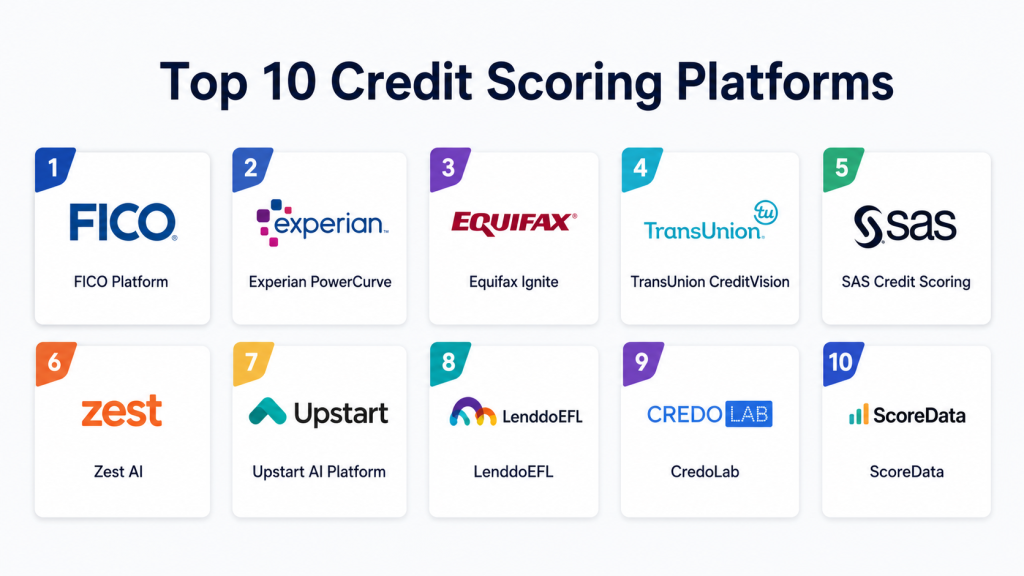
Top 10 Credit Scoring Platforms
1 — FICO Platform
FICO Platform is one of the most widely recognized credit scoring systems globally, known for its industry-standard credit scoring models and analytics capabilities. It enables lenders to assess borrower risk with high accuracy and consistency. The platform is used by banks and financial institutions worldwide. It supports decision automation and real-time credit scoring. FICO is considered a benchmark in credit risk assessment.
Key Features
- Advanced credit scoring models
- Real-time decisioning
- Risk analytics tools
- Fraud detection capabilities
- Workflow automation
- Integration with financial systems
- Reporting dashboards
Pros
- Industry-leading accuracy
- Strong global adoption
- Reliable analytics
Cons
- High cost
- Limited flexibility for customization
Platforms / Deployment
- Web
- Cloud / Hybrid
Security & Compliance
- Enterprise-grade controls
- Not publicly stated certifications
Integrations & Ecosystem
Integrates with banking systems, credit bureaus, and financial platforms.
Support & Community
Global enterprise support.
2 — Experian PowerCurve
Experian PowerCurve is a decisioning and credit scoring platform that helps lenders automate credit risk assessment. It combines analytics, decisioning, and workflow management. The platform is widely used for consumer and commercial lending. It enables real-time credit decisions. Experian PowerCurve is known for its flexibility and strong analytics capabilities.
Key Features
- Decisioning engine
- Credit risk analytics
- Workflow automation
- Fraud detection tools
- Reporting dashboards
- Integration with credit data
- Real-time scoring
Pros
- Strong analytics capabilities
- Flexible configuration
- Good enterprise scalability
Cons
- Complex setup
- Requires expertise
Platforms / Deployment
- Web
- Cloud
Security & Compliance
- RBAC support
- Not publicly stated certifications
Integrations & Ecosystem
Integrates with Experian data and financial systems.
Support & Community
Enterprise-level support.
3 — Equifax Ignite
Equifax Ignite is a cloud-based credit scoring and decisioning platform designed for real-time credit risk assessment and data analytics. It allows lenders to leverage multiple data sources for better decision-making. The platform supports automation and analytics-driven workflows. It is widely used in consumer lending.
Key Features
- Real-time credit scoring
- Data analytics tools
- Decisioning engine
- Fraud detection
- Workflow automation
- Reporting dashboards
- Integration capabilities
Pros
- Real-time data processing
- Strong analytics tools
- Scalable platform
Cons
- Limited customization
- Requires integration effort
Platforms / Deployment
- Web
- Cloud
Security & Compliance
- Standard enterprise controls
- Not publicly stated certifications
Integrations & Ecosystem
Integrates with Equifax data and financial systems.
Support & Community
Enterprise support.
4 — TransUnion CreditVision
TransUnion CreditVision provides advanced credit scoring using alternative data and predictive analytics. It helps lenders assess borrowers with limited credit history. The platform supports risk modeling and decision-making. It is widely used by financial institutions. CreditVision enhances scoring accuracy.
Key Features
- Alternative data scoring
- Predictive analytics
- Risk modeling
- Fraud detection
- Reporting tools
- Workflow automation
- Integration capabilities
Pros
- Strong alternative data usage
- Improved scoring accuracy
- Good analytics
Cons
- Limited customization
- Dependent on data sources
Platforms / Deployment
- Web
- Cloud
Security & Compliance
- Standard controls
- Not publicly stated certifications
Integrations & Ecosystem
Integrates with TransUnion data and systems.
Support & Community
Enterprise support.
5 — SAS Credit Scoring
SAS Credit Scoring is an analytics-driven platform that helps lenders build custom credit scoring models. It provides strong statistical and predictive capabilities. The platform is widely used in enterprise risk management. It supports regulatory compliance and reporting. SAS is known for its advanced analytics.
Key Features
- Custom scoring model development
- Advanced analytics tools
- Risk modeling
- Workflow automation
- Reporting dashboards
- Integration capabilities
- Compliance tracking
Pros
- Highly customizable
- Strong analytics capabilities
- Enterprise-grade solution
Cons
- Requires expertise
- High cost
Platforms / Deployment
- Web
- Cloud / Hybrid
Security & Compliance
- Enterprise controls
- Not publicly stated certifications
Integrations & Ecosystem
Integrates with financial systems and analytics tools.
Support & Community
Strong enterprise support.
6 — Zest AI
Zest AI is an AI-powered credit scoring platform designed to improve lending decisions using machine learning. It helps lenders analyze alternative data and improve approval rates. The platform focuses on fairness and transparency. It is widely used by fintech companies.
Key Features
- AI-based credit scoring
- Alternative data analysis
- Risk prediction models
- Decision automation
- Reporting dashboards
- Integration capabilities
- Compliance tools
Pros
- Strong AI capabilities
- Improves approval rates
- Modern platform
Cons
- Requires data expertise
- Limited enterprise adoption
Platforms / Deployment
- Web
- Cloud
Security & Compliance
- Standard controls
- Not publicly stated certifications
Integrations & Ecosystem
Integrates with fintech and lending systems.
Support & Community
Growing support ecosystem.
7 — Upstart AI Platform
Upstart AI Platform uses machine learning to assess borrower creditworthiness beyond traditional scoring methods. It analyzes education, employment, and behavioral data. The platform is widely used in digital lending. It improves approval rates and reduces risk.
Key Features
- AI-based credit scoring
- Alternative data analysis
- Risk modeling
- Decision automation
- Reporting dashboards
- Integration tools
- Compliance features
Pros
- Innovative scoring models
- High approval accuracy
- Strong fintech adoption
Cons
- Limited customization
- Dependent on AI models
Platforms / Deployment
- Web
- Cloud
Security & Compliance
- Standard controls
- Not publicly stated certifications
Integrations & Ecosystem
Integrates with lending platforms and fintech systems.
Support & Community
Strong fintech support.
8 — LenddoEFL
LenddoEFL is an alternative credit scoring platform focused on emerging markets. It uses non-traditional data sources to assess borrower risk. The platform is widely used by microfinance institutions and fintech companies. It helps lenders reach underserved populations.
Key Features
- Alternative data scoring
- AI-based risk analysis
- Fraud detection tools
- Decision automation
- Reporting dashboards
- Integration capabilities
- Customer insights
Pros
- Strong emerging market focus
- Expands financial inclusion
- Good AI capabilities
Cons
- Limited enterprise adoption
- Niche use case
Platforms / Deployment
- Web
- Cloud
Security & Compliance
- Standard controls
- Not publicly stated certifications
Integrations & Ecosystem
Integrates with fintech and microfinance systems.
Support & Community
Growing support network.
9 — CredoLab
CredoLab is a mobile-based credit scoring platform that uses smartphone metadata to assess credit risk. It is designed for fintech lenders and emerging markets. The platform provides fast and accurate scoring using alternative data.
Key Features
- Mobile-based scoring
- Alternative data analysis
- Risk prediction
- Fraud detection
- Reporting tools
- API integration
- Decision automation
Pros
- Innovative approach
- Fast scoring
- Good fintech fit
Cons
- Limited enterprise use
- Data dependency
Platforms / Deployment
- Web
- Cloud
Security & Compliance
- Standard controls
- Not publicly stated certifications
Integrations & Ecosystem
API-based integration ecosystem.
Support & Community
Fintech-focused support.
10 — ScoreData
ScoreData is an AI-driven credit scoring platform that helps lenders build custom scoring models and automate decisions. It focuses on predictive analytics and risk modeling. The platform is used by financial institutions and fintech companies.
Key Features
- AI-based scoring models
- Risk analytics tools
- Decision automation
- Reporting dashboards
- Integration capabilities
- Workflow automation
- Compliance tools
Pros
- Flexible and customizable
- Strong analytics
- Scalable platform
Cons
- Requires expertise
- Smaller ecosystem
Platforms / Deployment
- Web
- Cloud
Security & Compliance
- Standard controls
- Not publicly stated certifications
Integrations & Ecosystem
Integrates with financial and lending systems.
Support & Community
Growing enterprise support.
Comparison Table
| Tool | Best For | Platforms | Deployment | Standout Feature | Rating |
|---|---|---|---|---|---|
| FICO | Enterprise banks | Web | Hybrid | Industry standard | N/A |
| Experian | Decisioning | Web | Cloud | Analytics | N/A |
| Equifax | Data-driven | Web | Cloud | Real-time scoring | N/A |
| TransUnion | Alternative data | Web | Cloud | Predictive models | N/A |
| SAS | Analytics | Web | Hybrid | Custom models | N/A |
| Zest AI | AI scoring | Web | Cloud | Machine learning | N/A |
| Upstart | Fintech | Web | Cloud | AI decisions | N/A |
| LenddoEFL | Emerging markets | Web | Cloud | Alternative data | N/A |
| CredoLab | Mobile scoring | Web | Cloud | Smartphone data | N/A |
| ScoreData | Custom scoring | Web | Cloud | Predictive analytics | N/A |
Evaluation & Scoring
| Tool | Core | Ease | Integrations | Security | Performance | Support | Value | Total |
|---|---|---|---|---|---|---|---|---|
| FICO | 9 | 7 | 9 | 9 | 9 | 9 | 7 | 8.6 |
| Experian | 8 | 7 | 9 | 9 | 8 | 8 | 7 | 8.1 |
| Equifax | 8 | 8 | 8 | 8 | 8 | 8 | 8 | 8.0 |
| TransUnion | 8 | 8 | 8 | 8 | 8 | 8 | 8 | 8.0 |
| SAS | 9 | 6 | 9 | 9 | 9 | 9 | 7 | 8.3 |
| Zest AI | 8 | 8 | 8 | 8 | 8 | 8 | 8 | 8.0 |
| Upstart | 8 | 8 | 8 | 8 | 8 | 8 | 8 | 8.0 |
| Lenddo | 7 | 8 | 7 | 7 | 8 | 7 | 9 | 7.7 |
| CredoLab | 7 | 9 | 7 | 7 | 8 | 7 | 9 | 7.8 |
| ScoreData | 8 | 8 | 8 | 8 | 8 | 8 | 8 | 8.0 |
Which Credit Scoring Platform Is Right for You?
SMB / Fintech
Zest AI, CredoLab, LenddoEFL
Mid-Market
Experian, Equifax, TransUnion
Enterprise
FICO, SAS
Alternative Data Focus
LenddoEFL, CredoLab
AI Focus
Zest AI, Upstart
FAQs
What is a Credit Scoring Platform?
A Credit Scoring Platform is software used to evaluate a borrower’s creditworthiness. It analyzes financial and behavioral data to generate risk scores. These scores help lenders make lending decisions. It improves accuracy and reduces risk. It is essential in modern lending systems.
Why are credit scoring platforms important?
They help lenders assess risk and avoid bad loans. They improve decision-making and approval speed. They also enhance customer experience. These platforms reduce manual errors. They are critical for financial stability.
Do these platforms use AI?
Yes, many modern platforms use AI and machine learning. They analyze large datasets and alternative data. This improves scoring accuracy. AI also enables faster decision-making. It enhances predictive capabilities.
Are these platforms cloud-based?
Most platforms are cloud-based for scalability and flexibility. Some also support hybrid deployment. Cloud systems enable real-time processing. They reduce infrastructure costs. They also improve accessibility.
Do they integrate with financial systems?
Yes, they integrate with credit bureaus and lending platforms. This ensures seamless data flow. Integration improves accuracy and efficiency. It also supports automation. This is essential for modern lending.
Are credit scoring platforms expensive?
Enterprise platforms are usually expensive. Fintech solutions are more affordable. Pricing depends on features and scale. Customization can increase costs. However, they provide strong ROI.
Which industries use them?
Banks, fintech companies, NBFCs, and financial institutions use them. They are essential in lending. They help manage risk. They are widely adopted globally.
What is the biggest challenge?
Implementation and data integration can be complex. Models require tuning and validation. Data quality is critical. Training may be required. But benefits are significant.
Can small lenders use them?
Yes, fintech solutions are available for small lenders. They are easier to use. They require less setup. They provide essential scoring features. They are cost-effective.
Do they support fraud detection?
Yes, many platforms include fraud detection tools. They analyze patterns and anomalies. This reduces risk. It improves security. It protects lenders from losses.
Conclusion
Credit Scoring Platforms are essential tools that enable lenders to assess risk accurately and make informed decisions. They combine analytics, automation, and AI to improve lending efficiency and reduce financial risk.
These platforms are increasingly integrated with CyberSecurity, Identity Management, and Access Control systems to ensure secure handling of sensitive data. As lending evolves, credit scoring systems play a critical role in digital transformation.
The best platform depends on organizational needs. FICO and SAS lead enterprise deployments, while Zest AI and Upstart support fintech innovation. Experian, Equifax, and TransUnion provide strong mid-market solutions.
Ultimately, modern credit systems require secure, intelligent, and scalable platforms that enhance decision-making while reducing risk and improving customer experience.
