Introduction
Debt Collection Software helps organizations track, manage, and recover outstanding payments efficiently. In simple terms, it automates the process of contacting debtors, managing accounts, and ensuring compliance with regulations, replacing manual collection workflows.
In today’s financial ecosystem, lenders and businesses face rising delinquency rates, strict regulatory oversight, and the need for customer-friendly collection approaches. Modern debt collection platforms now include automation, AI-driven communication, and analytics to improve recovery rates while maintaining compliance.
Real-world use cases include:
- Managing overdue accounts and collections
- Automating communication with debtors
- Tracking repayment schedules
- Compliance and audit reporting
- Integration with billing and CRM systems
What buyers should evaluate:
- Automation and workflow capabilities
- Communication tools (email, SMS, call)
- Compliance and regulatory support
- Reporting and analytics
- Integration with CRM and accounting systems
- Scalability
- Ease of use
- Security features
- Customization
- Cost vs value
Best for: Banks, NBFCs, fintech lenders, collection agencies, and enterprises managing receivables.
Not ideal for: Small businesses with minimal outstanding payments or simple manual processes.
Key Trends in Debt Collection Software
- AI-driven collection strategies and prioritization
- Omnichannel communication with debtors
- Cloud-based collection platforms
- Automation of workflows and reminders
- Integration with CRM and accounting systems
- Real-time analytics and dashboards
- Compliance-focused design for regulations
- Customer-centric collection approaches
- API-first integration ecosystems
- Enhanced data security and audit capabilities
How We Evaluate Debt Collection Software (Methodology)
- Market adoption and vendor credibility
- Depth of collection management features
- Ease of use and user experience
- Integration with financial and CRM systems
- Security and compliance capabilities
- Reporting and analytics features
- Scalability across organizations
- Vendor support and onboarding
- Flexibility and customization
- Value for cost
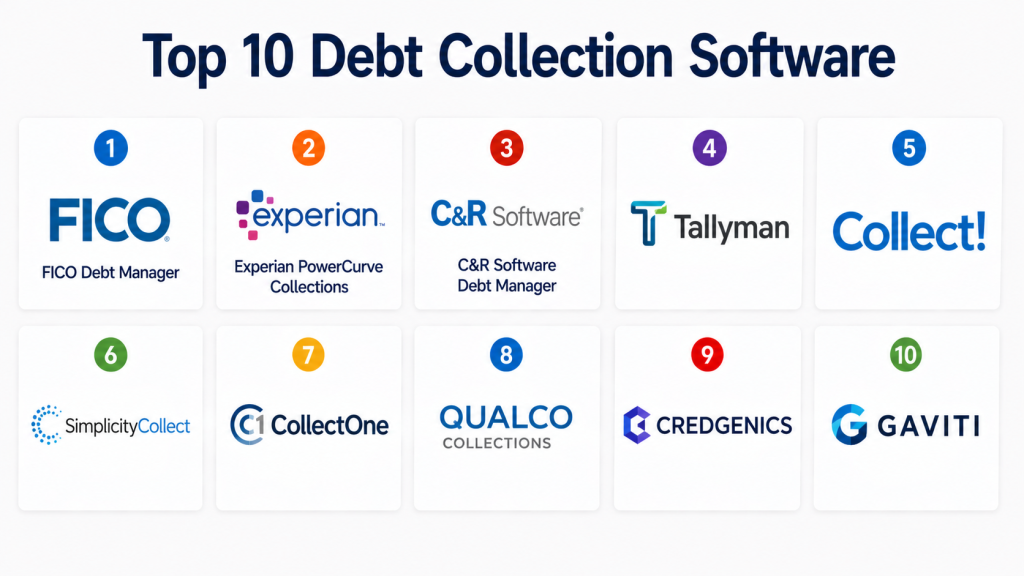
Top 10 Debt Collection Software
#1 — FICO Debt Manager
Short description :
FICO Debt Manager is an enterprise-grade debt collection platform designed for financial institutions. It offers advanced analytics and automation tools. Known for strong risk management and compliance features. Suitable for large organizations. Provides reporting dashboards and workflow automation. Helps improve recovery rates.
Key Features
- Collection management
- Workflow automation
- Risk analytics
- Reporting dashboards
- Compliance tools
- Integration capabilities
Pros
- Strong analytics
- Enterprise scalability
Cons
- Complex implementation
- High cost
Platforms / Deployment
Cloud / On-premise
Security & Compliance
SSO, MFA, encryption, RBAC
Integrations & Ecosystem
Integrates with financial systems.
- CRM platforms
- Banking systems
- APIs
Support & Community
Enterprise-level support.
#2 — Experian PowerCurve Collections
Short description :
Experian PowerCurve Collections is a data-driven platform for managing debt recovery. It offers analytics, automation, and decisioning tools. Known for strong data integration. Suitable for banks and lenders. Provides reporting and dashboards. Helps optimize collection strategies.
Key Features
- Data-driven decisioning
- Workflow automation
- Analytics
- Reporting
- Integration tools
Pros
- Strong analytics
- Data integration
Cons
- Pricing
- Complexity
Platforms / Deployment
Cloud
Security & Compliance
Encryption, access controls
Integrations & Ecosystem
- Data platforms
- APIs
Support & Community
Enterprise support available.
#3 — Tallyman
Short description :
Tallyman is a debt collection and recovery platform used by financial institutions. It supports workflow automation and analytics. Known for flexibility and scalability. Suitable for mid-market and enterprise organizations. Provides reporting tools. Helps streamline collection processes.
Key Features
- Collection workflows
- Analytics
- Reporting
- Automation
- Integration tools
Pros
- Flexible platform
- Scalable
Cons
- Learning curve
- Pricing
Platforms / Deployment
Cloud
Security & Compliance
Encryption, access controls
Integrations & Ecosystem
- APIs
- Financial systems
Support & Community
Moderate support.
#4 — CollectOne
Short description :
CollectOne is a cloud-based debt collection platform designed for agencies and lenders. It offers automation and communication tools. Known for ease of use and quick deployment. Suitable for SMB and mid-market organizations. Provides reporting and analytics. Helps improve recovery efficiency.
Key Features
- Collection management
- Communication tools
- Workflow automation
- Reporting
- Analytics
Pros
- Easy to use
- Quick deployment
Cons
- Limited enterprise features
- Pricing varies
Platforms / Deployment
Cloud
Security & Compliance
Encryption, access controls
Integrations & Ecosystem
- APIs
- CRM tools
Support & Community
Good SMB support.
#5 — SimplicityCollect
Short description :
SimplicityCollect is a debt collection platform focused on automation and compliance. It offers tools for managing accounts and communication. Known for flexibility and usability. Suitable for collection agencies. Provides reporting tools. Helps streamline collection workflows.
Key Features
- Account management
- Workflow automation
- Reporting
- Analytics
- Communication tools
Pros
- Flexible platform
- Easy to use
Cons
- Limited advanced features
- Smaller ecosystem
Platforms / Deployment
Cloud
Security & Compliance
Encryption, access controls
Integrations & Ecosystem
- APIs
- Financial tools
Support & Community
Moderate support.
#6 — Collect!
Short description :
Collect! is a debt collection software designed for agencies and businesses. It offers tools for managing accounts and communication. Known for customization and flexibility. Suitable for SMB organizations. Provides reporting tools. Helps improve collection efficiency.
Key Features
- Account management
- Communication tools
- Reporting
- Analytics
- Customization
Pros
- Customizable
- Flexible
Cons
- Outdated interface
- Limited scalability
Platforms / Deployment
Windows / Cloud
Security & Compliance
Encryption, access controls
Integrations & Ecosystem
- APIs
- Financial tools
Support & Community
Good SMB support.
#7 — DebtPayPro
Short description :
DebtPayPro is a collection management platform designed for agencies. It offers automation and reporting tools. Known for ease of use and affordability. Suitable for SMB organizations. Provides analytics and reporting. Helps streamline collection processes.
Key Features
- Account management
- Workflow automation
- Reporting
- Analytics
- Communication tools
Pros
- Affordable
- Easy to use
Cons
- Limited advanced features
- Smaller ecosystem
Platforms / Deployment
Cloud
Security & Compliance
Encryption, access controls
Integrations & Ecosystem
- APIs
- Financial systems
Support & Community
Moderate support.
#8 — Qualco Collections
Short description :
Qualco Collections is a platform designed for debt recovery and risk management. It offers analytics and automation tools. Known for scalability and flexibility. Suitable for mid-market and enterprise organizations. Provides reporting tools. Helps improve recovery rates.
Key Features
- Risk management
- Collection workflows
- Analytics
- Reporting
- Integration tools
Pros
- Scalable platform
- Strong analytics
Cons
- Complex setup
- Pricing
Platforms / Deployment
Cloud
Security & Compliance
SSO, encryption
Integrations & Ecosystem
- APIs
- Financial systems
Support & Community
Enterprise support available.
#9 — TrioSoft Quantum
Short description :
TrioSoft Quantum is a debt collection software offering account management and reporting tools. Known for customization and flexibility. Suitable for agencies and lenders. Provides analytics and reporting. Helps manage collection workflows efficiently.
Key Features
- Account management
- Reporting
- Analytics
- Workflow tools
- Customization
Pros
- Flexible platform
- Customizable
Cons
- Smaller ecosystem
- Learning curve
Platforms / Deployment
Cloud
Security & Compliance
Encryption, access controls
Integrations & Ecosystem
- APIs
- Financial tools
Support & Community
Moderate support.
#10 — Katabat
Short description :
Katabat is a customer engagement and debt collection platform offering analytics and automation. It supports communication and workflow management. Known for enterprise capabilities. Suitable for large organizations. Provides reporting tools. Helps improve collection outcomes.
Key Features
- Customer engagement
- Workflow automation
- Analytics
- Reporting
- Communication tools
Pros
- Strong enterprise features
- Advanced analytics
Cons
- Pricing
- Complex setup
Platforms / Deployment
Cloud
Security & Compliance
SSO, MFA, encryption
Integrations & Ecosystem
- APIs
- CRM systems
Support & Community
Enterprise-level support.
Comparison Table (Top 10)
| Tool Name | Best For | Platform(s) Supported | Deployment | Standout Feature | Public Rating |
|---|---|---|---|---|---|
| FICO | Enterprise | Web | Hybrid | Analytics | N/A |
| Experian | Enterprise | Web | Cloud | Data-driven | N/A |
| Tallyman | Mid-market | Web | Cloud | Flexibility | N/A |
| CollectOne | SMB | Web | Cloud | Ease of use | N/A |
| SimplicityCollect | SMB | Web | Cloud | Automation | N/A |
| Collect! | SMB | Windows | Hybrid | Customization | N/A |
| DebtPayPro | SMB | Web | Cloud | Affordability | N/A |
| Qualco | Enterprise | Web | Cloud | Risk management | N/A |
| TrioSoft | SMB | Web | Cloud | Flexibility | N/A |
| Katabat | Enterprise | Web | Cloud | Engagement | N/A |
Evaluation & Scoring of Debt Collection Software
| Tool Name | Core | Ease | Integrations | Security | Performance | Support | Value | Weighted Total |
|---|---|---|---|---|---|---|---|---|
| FICO | 9 | 6 | 9 | 9 | 9 | 9 | 7 | 8.4 |
| Experian | 9 | 7 | 9 | 8 | 8 | 8 | 7 | 8.2 |
| Tallyman | 8 | 7 | 8 | 8 | 8 | 8 | 7 | 7.9 |
| CollectOne | 7 | 9 | 7 | 7 | 7 | 8 | 9 | 7.9 |
| SimplicityCollect | 7 | 8 | 7 | 7 | 7 | 7 | 8 | 7.6 |
| Collect! | 7 | 7 | 6 | 7 | 7 | 7 | 8 | 7.2 |
| DebtPayPro | 7 | 9 | 6 | 7 | 7 | 7 | 9 | 7.6 |
| Qualco | 8 | 7 | 8 | 8 | 8 | 8 | 7 | 7.9 |
| TrioSoft | 7 | 7 | 6 | 7 | 7 | 7 | 7 | 7.1 |
| Katabat | 9 | 6 | 8 | 9 | 9 | 9 | 7 | 8.3 |
Interpretation:
These scores provide a comparative view of platform strengths. Enterprise tools excel in analytics and scalability, while SMB tools perform well in usability and affordability. Choose based on collection complexity and organizational needs.
Which Debt Collection Software Is Right for You?
Solo / Freelancer
- Not typically required
SMB
- CollectOne, DebtPayPro
- Focus on simplicity and affordability
Mid-Market
- Tallyman, SimplicityCollect
- Balanced features and scalability
Enterprise
- FICO, Experian, Katabat
- Advanced analytics and integration
Budget vs Premium
- Budget: DebtPayPro
- Premium: FICO
Feature Depth vs Ease of Use
- Deep features: FICO
- Easy to use: CollectOne
Integrations & Scalability
- Strong: Enterprise tools
- Moderate: SMB tools
Security & Compliance Needs
- High: Enterprise platforms
- Moderate: SMB tools
Frequently Asked Questions (FAQs)
1. What is debt collection software?
Debt collection software helps manage and recover outstanding payments. It automates workflows and communication. It improves efficiency and compliance. It provides reporting tools. It is essential for collection processes.
2. How much does it cost?
Pricing varies based on features and scale. SMB tools offer subscription pricing. Enterprise systems use custom pricing. Implementation costs may apply. Evaluate total cost.
3. How long does implementation take?
Implementation can take days to weeks. SMB tools deploy faster. Enterprise systems require more setup. Integration adds complexity. Plan carefully.
4. Is it secure?
Most platforms include encryption and access controls. Enterprise tools offer advanced security. Always review vendor policies. Ensure compliance. Security is critical.
5. Can it integrate with other systems?
Yes, most tools integrate with CRM and financial systems. APIs enable customization. Integration improves workflows. Verify compatibility before choosing.
6. What industries use this software?
Banks, lenders, and collection agencies use it. It helps manage receivables. It improves recovery rates. It supports compliance. Many organizations rely on it.
7. What are common mistakes when choosing?
Choosing based only on price is a mistake. Ignoring scalability limits growth. Not considering integrations causes issues. Overlooking usability affects adoption. Evaluate carefully.
8. Can small businesses use it?
Yes, SMB-focused tools are available. They offer simple features and lower costs. These tools are easy to use. They help improve collections. SMBs benefit.
9. How effective is it?
It improves recovery rates and efficiency. Automation reduces manual work. Analytics provide insights. It enhances communication. It supports better outcomes.
10. Is it easy to switch tools?
Switching tools can be complex. Data migration is challenging. Training is required. Vendor lock-in may occur. Plan carefully.
Conclusion
Debt Collection Software has become essential for organizations looking to improve recovery rates, streamline operations, and maintain compliance in a highly regulated financial environment. By automating workflows, enabling data-driven decision-making, and improving communication with customers, these platforms help organizations recover debts more efficiently while maintaining positive relationships.
However, the best solution depends on your organization’s size, collection complexity, and operational needs. Large enterprises may benefit from advanced platforms like FICO or Experian, while smaller organizations may prefer simpler, cost-effective solutions like CollectOne or DebtPayPro. Choosing the right software requires balancing functionality, usability, and cost.
As a next step, shortlist a few platforms that align with your requirements, run pilot implementations, and evaluate their performance in real-world scenarios. Focus on integration, scalability, and compliance to ensure long-term success.
