Introduction
Fraud Case Management Tools help organizations investigate, manage, document, and resolve fraud alerts in a structured way. These tools are used after suspicious activity is detected by fraud monitoring systems, transaction monitoring systems, identity verification tools, chargeback systems, or internal risk controls. Instead of managing investigations through spreadsheets, emails, or scattered notes, fraud case management platforms centralize alerts, evidence, decisions, workflows, escalations, and audit trails.
Fraud case management matters because fraud is becoming faster, more digital, and more complex. Banks, fintechs, insurers, marketplaces, ecommerce companies, telecom firms, crypto platforms, and payment businesses need faster investigations, better analyst productivity, clear evidence handling, and consistent decision-making.
Real-world use cases include:
- Investigating suspicious transactions and account activity
- Managing fraud alerts from multiple detection systems
- Handling chargebacks, disputes, and account takeover cases
- Documenting investigation decisions for audit and compliance
- Coordinating fraud, AML, risk, support, and operations teams
Buyers should evaluate:
- Case workflow flexibility
- Alert intake and triage capability
- Investigation notes and evidence handling
- Role-based access and audit trails
- Fraud scoring and prioritization
- Integration with fraud detection systems
- SLA and escalation management
- Reporting and dashboard quality
- Collaboration and analyst productivity
- Scalability across teams and regions
Best for: Banks, fintech companies, payment providers, ecommerce businesses, marketplaces, insurers, crypto platforms, fraud operations teams, risk teams, compliance teams, customer support teams, and financial crime investigators that need structured fraud investigation workflows.
Not ideal for: Very small businesses with low fraud volume, teams that only need basic customer support ticketing, or organizations that do not have dedicated staff to review alerts, document findings, and manage fraud investigations consistently.
Key Trends in Fraud Case Management Tools
- Unified fraud and financial crime operations are becoming more common as fraud, scams, mule activity, AML alerts, and identity risk often overlap.
- AI-assisted case prioritization is helping teams focus on the highest-risk cases instead of reviewing alerts only by arrival time.
- Real-time alert intake is becoming more important because fraud teams need to act quickly before losses increase.
- Case automation is improving analyst productivity through automatic assignment, escalation rules, duplicate detection, and workflow routing.
- Evidence centralization is now critical because investigators need transaction history, device data, identity signals, customer communication, and account activity in one place.
- Graph and network analytics are increasingly useful for identifying connected accounts, mule networks, synthetic identities, and organized fraud rings.
- Customer experience awareness is growing because fraud teams must reduce friction for legitimate users while stopping bad actors.
- Low-code workflow configuration is becoming more popular because fraud patterns change quickly and teams need to adjust workflows without long engineering cycles.
- Audit-ready investigation records are now essential for regulated firms that must show how alerts were reviewed, escalated, and resolved.
- Integration with identity, payment, chargeback, and AML systems is becoming a core requirement for modern fraud case operations.
How We Evaluated Fraud Case Management Tools
The following Top 10 tools were selected using practical buyer-focused criteria:
- Market adoption and recognition among fraud teams, banks, fintechs, ecommerce firms, payment providers, and digital businesses.
- Case management depth, including case creation, triage, assignment, escalation, evidence handling, and resolution workflows.
- Fraud operations fit, including support for account takeover, payment fraud, chargebacks, identity fraud, scams, and suspicious behavior reviews.
- Integration flexibility, including APIs, webhooks, data ingestion, fraud detection systems, payment platforms, CRM tools, and customer support systems.
- Automation capability, including rules, routing, prioritization, queue management, and repetitive task reduction.
- Investigation productivity, including analyst dashboards, timeline views, notes, labels, search, collaboration, and reporting.
- Security posture signals, including role-based access, audit logs, permissions, encryption, and administrative controls.
- Scalability, especially for high-volume alert environments, multi-team workflows, and global operations.
- Reporting and governance, including dashboards, case metrics, SLA tracking, quality review, and audit support.
- Customer fit across segments, including SMBs, fintechs, banks, ecommerce companies, marketplaces, and enterprise risk teams.
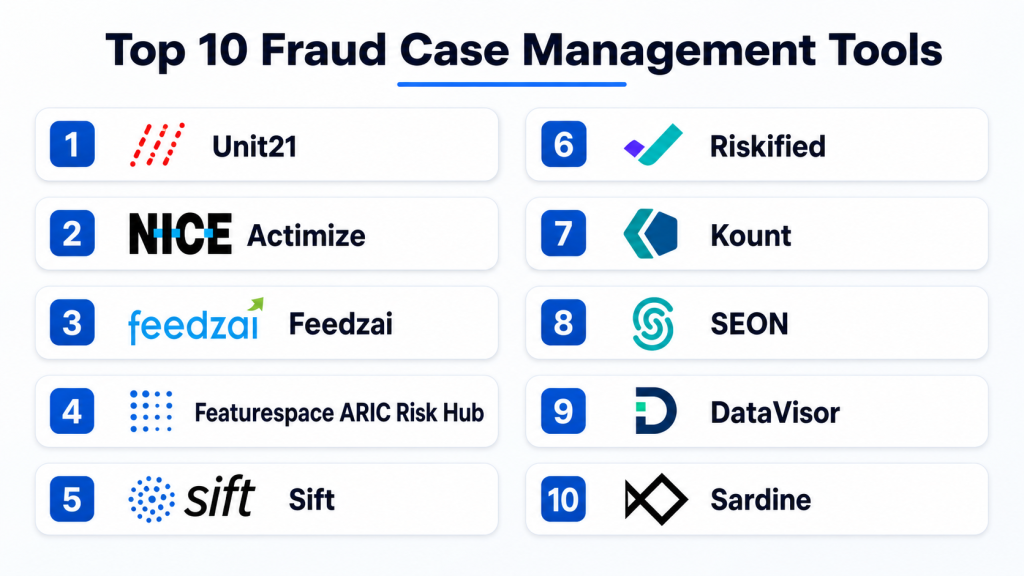
Top 10 Fraud Case Management Tools
#1 — Unit21
Short description: Unit21 is a risk and compliance operations platform used by fintechs, marketplaces, crypto firms, banks, and digital businesses for fraud detection, transaction monitoring, investigations, and case management. It is designed for teams that need flexible workflows, no-code or low-code rule configuration, and strong operational control over risk cases. Fraud teams can use Unit21 to manage alerts, review suspicious activity, assign cases, investigate evidence, and document decisions.
Key Features
- Fraud and AML case management
- Alert intake and investigation workflows
- No-code or low-code rule configuration
- Risk operations dashboards
- Evidence tracking and audit trails
- Workflow routing and team collaboration
- API and data integration support
Pros
- Strong fit for fintechs, crypto firms, marketplaces, and digital platforms.
- Flexible workflows help teams adapt to changing fraud patterns.
- Combines fraud, AML, and risk operations in one platform.
Cons
- Enterprise banks may need deeper validation for complex legacy workflows.
- Case quality depends on clean input data and well-designed rules.
- Advanced configuration still requires strong fraud operations ownership.
Platforms / Deployment
Cloud / Web / API-based deployment
Security & Compliance
Role-based access, audit logs, and platform controls are expected.
Specific certifications: Not publicly stated.
Integrations & Ecosystem
Unit21 is designed to connect risk signals, transaction data, customer profiles, and investigation workflows. It works well for teams that want a centralized risk operations layer across fraud and compliance.
- Payment platforms
- Customer onboarding systems
- Fraud detection tools
- AML monitoring workflows
- APIs and webhooks
- Risk operations dashboards
Support & Community
Support is vendor-led and may include onboarding, documentation, implementation assistance, customer success, and technical guidance depending on the customer plan and deployment scope.
#2 — NICE Actimize
Short description: NICE Actimize is a financial crime and compliance platform used by banks, financial institutions, payment firms, and regulated businesses. Its fraud case management capabilities are often part of broader fraud prevention, AML, sanctions, and financial crime workflows. The platform is best suited for larger organizations that need enterprise-level alert handling, investigation workflows, and case documentation. Fraud teams can use it to investigate suspicious activity, manage escalations, review evidence, and maintain audit-ready records.
Key Features
- Enterprise fraud case management
- Alert triage and investigation workflows
- Financial crime case documentation
- Fraud detection ecosystem alignment
- Risk scoring and prioritization support
- Audit trails and reporting workflows
- Integration with broader compliance systems
Pros
- Strong fit for large banks and regulated financial institutions.
- Broad fraud and financial crime coverage.
- Scalable for complex investigation and governance needs.
Cons
- May be too complex for smaller businesses.
- Implementation can be resource-intensive.
- Best value usually comes when used across a broader financial crime program.
Platforms / Deployment
Cloud / Hosted / Enterprise deployment options vary
Security & Compliance
Enterprise access controls, permissions, audit workflows, and administrative controls are expected.
Specific certifications: Not publicly stated.
Integrations & Ecosystem
NICE Actimize fits into enterprise risk and financial crime environments where fraud case management connects with detection, AML, sanctions, payments, and customer risk workflows.
- Core banking systems
- Payment processing platforms
- Fraud detection systems
- AML and sanctions tools
- Case and investigation workflows
- Enterprise reporting systems
Support & Community
Support is enterprise-focused and typically includes implementation, training, technical support, account management, and configuration assistance depending on contract scope.
#3 — Feedzai
Short description: Feedzai is a financial crime and risk operations platform known for fraud detection, payment risk, real-time decisioning, and investigation workflows. It is used by banks, payment providers, fintechs, and financial institutions that need to detect and manage fraud across digital transactions. Feedzai’s case management capabilities help teams investigate alerts, review customer behavior, and manage suspicious activity decisions.
Key Features
- Fraud case management workflows
- Real-time risk decisioning
- Machine learning-based detection support
- Alert prioritization and investigation tools
- Payment and digital banking fraud monitoring
- Customer behavior analytics
- Reporting and operational dashboards
Pros
- Strong fit for real-time fraud and payment risk environments.
- Useful for connecting fraud detection with investigation workflows.
- Good option for banks and fintechs handling high-volume transactions.
Cons
- Implementation requires good transaction and customer data.
- Advanced model and workflow governance may require skilled teams.
- AML-specific workflows may need validation if used beyond fraud.
Platforms / Deployment
Cloud / Hosted / Enterprise deployment options vary
Security & Compliance
Enterprise access controls, audit workflows, and risk governance controls are expected.
Specific certifications: Not publicly stated.
Integrations & Ecosystem
Feedzai is designed to integrate with payment systems, banking platforms, fraud tools, customer data sources, and risk operations workflows.
- Payment processing systems
- Digital banking platforms
- Customer behavior data
- Fraud monitoring systems
- Risk decisioning workflows
- Case investigation tools
Support & Community
Support is vendor-led and enterprise-oriented, typically including implementation help, customer success, technical guidance, and risk operations assistance.
#4 — Featurespace ARIC Risk Hub
Short description: Featurespace ARIC Risk Hub is a fraud and financial crime platform known for adaptive behavioral analytics and real-time risk monitoring. It helps organizations detect unusual customer behavior, payment fraud, scams, and suspicious transaction activity. Fraud case management workflows can support alert review, investigation, prioritization, and operational decision-making. The platform is especially valuable where customer behavior changes over time and static rules are not enough.
Key Features
- Fraud investigation workflows
- Adaptive behavioral analytics
- Real-time risk scoring
- Alert prioritization
- Payment fraud and scam detection support
- Customer behavior modeling
- Operational dashboards and reporting
Pros
- Strong behavioral analytics capability.
- Useful for high-volume payment and banking environments.
- Helps identify changing fraud patterns more effectively than static rules alone.
Cons
- Advanced analytics require strong data quality.
- Case management depth should be validated for each use case.
- Explainability and governance must be managed carefully.
Platforms / Deployment
Cloud / Hosted / Enterprise options vary
Security & Compliance
Enterprise security controls and audit workflows are expected.
Specific certifications: Not publicly stated.
Integrations & Ecosystem
Featurespace fits into fraud operations environments where customer activity, transaction data, and behavioral risk signals must be analyzed together.
- Payment systems
- Digital banking systems
- Fraud monitoring tools
- Customer behavior data
- Risk dashboards
- Investigation workflows
Support & Community
Support is vendor-led and enterprise-focused, typically including onboarding, implementation support, analytics guidance, and technical assistance depending on customer scope.
#5 — Sift
Short description: Sift is a digital trust and safety platform used by ecommerce companies, fintechs, marketplaces, and online businesses to detect fraud and manage risk decisions. It helps teams investigate fraud signals related to account takeover, payment fraud, fake accounts, chargebacks, and abuse patterns. Sift includes case review and decisioning workflows that support fraud analysts in reviewing suspicious users and transactions.
Key Features
- Fraud case review workflows
- Risk scoring and decisioning
- Account takeover detection support
- Payment fraud investigation
- Chargeback and abuse review support
- Analyst dashboards
- API and event data integrations
Pros
- Strong fit for ecommerce, marketplaces, and digital businesses.
- Good balance of fraud detection and analyst workflow.
- Helps protect customer experience while reducing fraud losses.
Cons
- May not fit enterprise banking case workflows as deeply as financial crime suites.
- Effectiveness depends on event data quality and integration coverage.
- Pricing and workflow needs should be validated carefully.
Platforms / Deployment
Cloud / Web / API-based deployment
Security & Compliance
Platform security controls, user permissions, and audit-style activity records are expected.
Specific certifications: Not publicly stated.
Integrations & Ecosystem
Sift is designed to connect with digital product, payment, user account, checkout, and fraud decisioning workflows. It works best when fed with rich customer behavior data.
- Ecommerce platforms
- Payment systems
- User account systems
- Chargeback workflows
- APIs and event streams
- Trust and safety tools
Support & Community
Support is vendor-led and may include onboarding, documentation, customer success, implementation help, and fraud strategy guidance depending on customer size.
#6 — Riskified
Short description: Riskified is a fraud and risk intelligence platform focused heavily on ecommerce fraud prevention, chargeback protection, policy abuse, and transaction decisioning. It helps merchants review risky orders, reduce chargebacks, and manage fraud-related decisions. While Riskified is known for decisioning and chargeback protection, it also supports operational workflows around fraud review and case outcomes. It is especially useful for ecommerce businesses that want fraud decisions connected to revenue protection and customer approval rates.
Key Features
- Ecommerce fraud review workflows
- Chargeback protection support
- Transaction risk decisioning
- Policy abuse detection support
- Order approval optimization
- Fraud analytics and reporting
- Integration with commerce and payment systems
Pros
- Strong fit for ecommerce and online merchants.
- Helps balance fraud prevention with revenue approval.
- Useful for reducing manual review and chargeback exposure.
Cons
- Not designed as a broad enterprise financial crime case system.
- Best fit is ecommerce and merchant fraud, not every industry.
- Case management depth should be validated for complex investigations.
Platforms / Deployment
Cloud / Web / API-based deployment
Security & Compliance
Security controls are expected, but specific certifications should be confirmed directly.
Specific certifications: Not publicly stated.
Integrations & Ecosystem
Riskified fits into ecommerce, checkout, payment, and order management workflows where fraud decisions affect revenue and customer experience.
- Ecommerce platforms
- Payment gateways
- Order management systems
- Chargeback workflows
- APIs
- Fraud analytics dashboards
Support & Community
Support is vendor-led and may include onboarding, account support, fraud strategy assistance, and performance review depending on customer agreement.
#7 — Kount
Short description: Kount is a fraud prevention and identity trust platform used by ecommerce businesses, financial services firms, payment providers, and digital companies. It helps organizations detect fraud, assess digital identity trust, manage alerts, and support review workflows. Fraud case management capabilities can help analysts review risky transactions, users, devices, and behavioral signals. The platform is especially relevant for card-not-present fraud, account takeover risk, and ecommerce transaction review. Its strength is combining identity signals, device intelligence, risk scoring, and fraud decisioning.
Key Features
- Fraud review workflows
- Digital identity trust signals
- Device and behavior intelligence
- Transaction risk scoring
- Account takeover detection support
- Chargeback reduction tools
- Reporting and fraud analytics
Pros
- Strong fit for ecommerce and digital transaction fraud.
- Useful identity and device intelligence capabilities.
- Helps teams balance risk detection and customer approval.
Cons
- May not replace full financial crime investigation systems for banks.
- Advanced configuration may require fraud operations expertise.
- Case workflows should be tested for team-specific needs.
Platforms / Deployment
Cloud / Web / API-based deployment
Security & Compliance
Platform security controls and administrative permissions are expected.
Specific certifications: Not publicly stated.
Integrations & Ecosystem
Kount is designed to connect fraud signals with ecommerce, payment, identity, and customer account workflows. It is most valuable when integrated early in the transaction decision process.
- Ecommerce systems
- Payment gateways
- Digital account platforms
- Device intelligence workflows
- Chargeback tools
- APIs and reporting dashboards
Support & Community
Support is vendor-led and may include onboarding, technical support, fraud strategy guidance, and customer success resources depending on plan and customer size.
#8 — SEON
Short description: SEON is a fraud prevention and risk management platform used by fintechs, ecommerce companies, online marketplaces, gaming platforms, and digital businesses. It helps teams detect risky users, suspicious transactions, fake accounts, bonus abuse, account takeover, and payment fraud. SEON supports investigation workflows by providing risk signals, user intelligence, device data, email and phone insights, and fraud scores. It is especially attractive for businesses that need quick setup, flexible rules, and digital identity enrichment.
Key Features
- Fraud investigation workflows
- Digital footprint and identity enrichment
- Device fingerprinting support
- Email and phone intelligence
- Rule-based risk scoring
- Account takeover and fake account detection support
- API and dashboard workflows
Pros
- Fast and practical for digital fraud teams.
- Useful enrichment signals for analyst investigations.
- Good fit for fintechs, ecommerce, marketplaces, and gaming platforms.
Cons
- May not fit highly complex enterprise financial crime workflows.
- Case management depth may be lighter than dedicated investigation suites.
- Data signal usefulness varies by region and user profile.
Platforms / Deployment
Cloud / Web / API-based deployment
Security & Compliance
Role-based access and platform controls are expected.
Specific certifications: Not publicly stated.
Integrations & Ecosystem
SEON integrates with digital products, payment systems, onboarding flows, and fraud review processes. It works well when teams need enrichment signals during investigation and decisioning.
- Payment platforms
- Customer onboarding tools
- Ecommerce systems
- APIs
- Fraud rules engine
- Risk dashboards
Support & Community
Support is vendor-led and may include onboarding, documentation, customer support, technical help, and fraud operations guidance depending on plan.
#9 — DataVisor
Short description: DataVisor is a fraud and risk platform focused on AI-driven detection, investigation, and protection against sophisticated fraud patterns. It is used by financial services firms, ecommerce businesses, digital platforms, and organizations that need to detect coordinated attacks and risky behavior . The platform can help teams investigate suspicious accounts, transactions, devices, and networks. DataVisor is especially relevant for detecting organized fraud rings, fake accounts, account takeover, and abuse patterns.
Key Features
- Fraud case investigation workflows
- AI-driven fraud detection support
- Network and pattern analytics
- Account takeover and fake account detection
- Device and behavioral signal analysis
- Alert review and prioritization
- Reporting and risk dashboards
Pros
- Strong fit for detecting complex and organized fraud.
- Useful analytics for unknown or emerging fraud patterns.
- Good option for large digital platforms and financial institutions.
Cons
- Requires strong data integration and data quality.
- Advanced analytics may need skilled teams to operationalize.
- Case workflow fit should be tested during evaluation.
Platforms / Deployment
Cloud / Hosted / Enterprise options vary
Security & Compliance
Enterprise security controls and access management are expected.
Specific certifications: Not publicly stated.
Integrations & Ecosystem
DataVisor fits into fraud detection and investigation environments where large-scale behavioral, identity, device, and transaction data must be analyzed together.
- Transaction systems
- User account platforms
- Device data workflows
- Payment systems
- Risk dashboards
- Investigation tools
Support & Community
Support is vendor-led and may include implementation assistance, technical guidance, customer success, and fraud analytics support depending on customer scope.
#10 — Sardine
Short description: Sardine is a fraud prevention, compliance, and risk platform used by fintechs, crypto companies, banks, marketplaces, and digital businesses. It helps teams detect payment fraud, account fraud, scams, device risk, identity risk, and suspicious user behavior. Sardine can support fraud operations through risk scoring, investigation signals, alert workflows, and fraud decisioning. It is especially relevant for fintech and crypto environments where fraud, payments, identity, and compliance risks overlap.
Key Features
- Fraud investigation and alert workflows
- Payment fraud detection support
- Device and behavioral intelligence
- Scam and account risk signals
- Real-time risk scoring
- Crypto and fintech risk support
- API-based integration options
Pros
- Strong fit for fintech, crypto, and digital financial platforms.
- Useful combination of fraud, payment, identity, and risk signals.
- Supports real-time decisioning and investigation workflows.
Cons
- Case management depth should be validated for large investigation teams.
- Best fit is digital finance and risk-heavy platforms.
- Requires strong integration planning for full value.
Platforms / Deployment
Cloud / Web / API-based deployment
Security & Compliance
Security controls, user permissions, and audit workflows are expected.
Specific certifications: Not publicly stated.
Integrations & Ecosystem
Sardine is designed for modern financial and digital platforms where fraud signals need to connect with payments, identity, onboarding, crypto workflows, and risk operations.
- Payment systems
- Crypto platforms
- Customer onboarding tools
- Device intelligence workflows
- APIs
- Risk dashboards
Support & Community
Support is vendor-led and may include onboarding, technical guidance, implementation help, customer success, and risk operations support depending on customer agreement.
Comparison Table
| Tool Name | Best For | Platform Supported | Deployment | Standout Feature | Public Rating |
|---|---|---|---|---|---|
| Unit21 | Fintechs, crypto firms, and risk operations teams | Web / API | Cloud | Flexible fraud and AML case workflows | N/A |
| NICE Actimize | Banks and large regulated institutions | Enterprise platform | Cloud / Hosted / Enterprise | Enterprise financial crime case management | N/A |
| Feedzai | Payment fraud and real-time risk teams | Enterprise platform | Cloud / Hosted / Enterprise | Real-time fraud decisioning | N/A |
| Featurespace ARIC Risk Hub | Behavioral fraud analytics teams | Enterprise platform | Cloud / Hosted / Enterprise | Adaptive behavioral risk analytics | N/A |
| Sift | Ecommerce, marketplaces, and digital trust teams | Web / API | Cloud | Digital trust and fraud case review | N/A |
| Riskified | Ecommerce merchants and chargeback teams | Web / API | Cloud | Fraud decisioning and chargeback protection | N/A |
| Kount | Ecommerce and digital transaction risk teams | Web / API | Cloud | Identity trust and device intelligence | N/A |
| SEON | Fintechs, marketplaces, gaming, and ecommerce | Web / API | Cloud | Digital footprint and risk enrichment | N/A |
| DataVisor | Large platforms and organized fraud detection teams | Cloud / Enterprise platform | Cloud / Hosted / Enterprise | AI-driven fraud ring detection | N/A |
| Sardine | Fintech, crypto, and payment risk teams | Web / API | Cloud | Device, payment, and identity risk intelligence | N/A |
Evaluation & Scoring of Fraud Case Management Tools
| Tool Name | Core 25% | Ease 15% | Integrations 15% | Security 10% | Performance 10% | Support 10% | Value 15% | Weighted Total 0–10 |
|---|---|---|---|---|---|---|---|---|
| Unit21 | 9 | 9 | 9 | 8 | 8 | 8 | 9 | 8.65 |
| NICE Actimize | 10 | 7 | 9 | 9 | 9 | 9 | 7 | 8.55 |
| Feedzai | 9 | 8 | 9 | 8 | 9 | 8 | 8 | 8.50 |
| Featurespace ARIC Risk Hub | 8 | 7 | 8 | 8 | 9 | 8 | 7 | 7.85 |
| Sift | 8 | 9 | 8 | 8 | 8 | 8 | 8 | 8.15 |
| Riskified | 8 | 8 | 8 | 8 | 8 | 8 | 8 | 8.00 |
| Kount | 8 | 8 | 8 | 8 | 8 | 8 | 8 | 8.00 |
| SEON | 8 | 9 | 8 | 7 | 8 | 8 | 9 | 8.20 |
| DataVisor | 8 | 7 | 8 | 8 | 9 | 8 | 7 | 7.85 |
| Sardine | 8 | 8 | 8 | 8 | 8 | 8 | 8 | 8.00 |
The scoring is comparative and should be used to build a shortlist, not to select one universal winner. Enterprise financial crime platforms may score higher for governance and depth, while digital-first tools may score higher for ease of use and speed of deployment. Ecommerce-focused tools may be excellent for chargebacks and order fraud but may not replace bank-grade investigation systems. Buyers should test real alerts, analyst workflows, integrations, and reporting needs before making a final decision.
Which Fraud Case Management Tool Is Right for You?
Solo / Freelancer
Solo operators and very small businesses usually do not need a dedicated fraud case management platform. If fraud volume is low, basic payment processor tools, ecommerce platform reports, or customer support ticketing may be enough.
However, freelancers or consultants supporting regulated clients may still need structured documentation. In that case, a lightweight risk review process with clear notes, evidence storage, and decision records is more important than buying a large enterprise system.
SMB
Small and medium-sized businesses should prioritize ease of use, quick setup, affordable pricing, and practical fraud review workflows. SEON, Sift, Kount, Riskified, Sardine, and Unit21 may fit depending on the business model.
SMBs should avoid tools that are too complex for their team to operate. The best option is usually one that centralizes evidence, reduces manual review time, and helps analysts make faster decisions.
Mid-Market
Mid-market companies need stronger integrations, queue management, SLA tracking, reporting, and collaboration across fraud, risk, support, and payments teams. Unit21, Sift, Feedzai, Kount, Sardine, and DataVisor may be useful depending on risk profile.
At this stage, fraud case management should connect directly with transaction systems, customer profiles, device data, payment history, identity verification, and customer support records.
Enterprise
Large banks, insurers, payment networks, marketplaces, and financial institutions should prioritize governance, scale, security, case documentation, audit trails, and enterprise reporting. NICE Actimize, Feedzai, Featurespace, DataVisor, and Unit21 are strong candidates depending on the operating model.
Enterprise buyers should run proof-of-concept testing with real alert types, analyst roles, escalation paths, and fraud typologies. The system must support team workflows, security requirements, and audit expectations.
Budget vs Premium
Budget-friendly tools are useful when teams need quick fraud review, basic workflows, and practical investigation support. SEON, Sift, Kount, and some API-first tools can be attractive for digital businesses that need fast deployment.
Premium systems are more suitable for high-volume fraud operations, regulated institutions, and companies that need advanced analytics, multi-team governance, and deeper integrations. Premium value usually comes from scalability, automation, reporting, and support.
Feature Depth vs Ease of Use
Enterprise platforms such as NICE Actimize and Feedzai provide deeper financial crime capabilities but may require more implementation work. Tools like SEON, Sift, Kount, and Riskified can be easier for ecommerce and digital teams to adopt.
Buyers should match complexity to team maturity. A simpler system that analysts use correctly is often better than a powerful system that is poorly configured or ignored.
Integrations & Scalability
Fraud case management tools should integrate with payment systems, identity verification tools, device intelligence, transaction monitoring, customer support software, CRM platforms, chargeback systems, and data warehouses.
Scalability matters because fraud volume can grow quickly. Buyers should evaluate API reliability, data ingestion, queue handling, case search, bulk operations, and reporting performance before choosing a tool.
Security & Compliance Needs
Fraud case management tools handle sensitive customer, transaction, identity, and investigation data. Buyers should evaluate role-based access, MFA, encryption, audit logs, permission controls, data retention, and activity tracking.
Regulated firms should request vendor security documentation directly when certifications are not publicly stated. Fraud investigations should be audit-ready, especially when decisions affect customers, funds, accounts, or regulatory reporting.
Frequently Asked Questions FAQs
1. What is a Fraud Case Management Tool?
A Fraud Case Management Tool helps teams investigate and resolve fraud alerts in a structured system.
It centralizes alerts, notes, evidence, user data, transaction history, decisions, and escalation workflows.
Fraud analysts use it to review suspicious activity and document outcomes.
It replaces scattered spreadsheets, emails, and manual tracking methods.
A good tool improves speed, consistency, visibility, and audit readiness.
2. Who needs fraud case management software?
Banks, fintechs, ecommerce companies, marketplaces, insurers, payment providers, crypto platforms, and digital businesses often need fraud case management software.
Any organization handling online transactions, customer accounts, payments, or identity risk may benefit.
The need increases when alert volume, fraud losses, chargebacks, or compliance pressure grows.
Small businesses may start with simpler tools before adopting dedicated platforms.
Larger teams usually need structured workflows and reporting.
3. How is fraud case management different from fraud detection?
Fraud detection identifies suspicious activity using rules, models, risk scores, or monitoring systems.
Fraud case management helps teams investigate, document, assign, escalate, and resolve those alerts.
Detection answers the question of what looks risky.
Case management answers what happened next and how the team handled it.
Most mature fraud programs need both detection and case management.
4. What features should a fraud case management tool include?
Important features include alert intake, queue management, case assignment, investigation notes, evidence storage, audit trails, dashboards, and reporting.
Role-based access and permission controls are also important for security.
Automation features such as routing, prioritization, and SLA tracking can improve analyst productivity.
Integrations with payment, identity, CRM, and customer support systems are very useful.
The best tool should fit daily fraud team workflows.
5. How much do fraud case management tools cost?
Pricing varies by vendor, number of users, case volume, transaction volume, modules, integrations, and support needs.
Some tools are priced for digital businesses, while enterprise platforms often use custom pricing.
Costs may include implementation, data integration, training, support, and ongoing configuration.
Buyers should calculate total cost of ownership instead of only license fees.
If pricing is not public, it should be treated as Varies / N/A.
6. How long does implementation take?
Implementation time depends on data sources, workflow complexity, integration scope, team size, and reporting needs.
A cloud tool with simple integrations may be deployed faster than an enterprise financial crime platform.
Larger implementations may require data mapping, workflow design, user permissions, testing, and training.
Teams should pilot with real fraud cases before full rollout.
A phased implementation helps reduce operational disruption.
7. Can fraud case management tools reduce false positives?
They can help manage false positives more efficiently, but they do not automatically eliminate them.
False-positive reduction usually depends on better detection rules, risk scoring, data quality, and feedback loops.
A good case management tool helps analysts classify outcomes and feed those results back into detection systems.
This improves future alert quality over time.
The best results come when detection and investigation workflows are connected.
8. What integrations are important?
Important integrations include payment processors, transaction systems, identity verification tools, device intelligence, customer databases, CRM systems, support tools, chargeback platforms, and data warehouses.
For financial institutions, AML and sanctions systems may also be important.
Integrations reduce manual copying and give analysts better context.
API quality and data freshness should be tested before purchase.
A case tool is much more useful when it connects to real operational data.
9. What are common mistakes when choosing a fraud case management tool?
Common mistakes include choosing only by price, ignoring analyst workflow, and failing to test real case scenarios.
Some teams also underestimate integration complexity or overbuy an enterprise system they cannot fully use.
Another mistake is not defining case statuses, escalation rules, and ownership before rollout.
Buyers should involve fraud analysts early in evaluation.
The best tool should improve daily investigations, not just look good in demos.
10. Can ecommerce companies use fraud case management tools?
Yes, ecommerce companies can use fraud case management tools to review suspicious orders, chargebacks, account abuse, refund abuse, and payment fraud.
Tools like Sift, Riskified, Kount, SEON, and DataVisor can support ecommerce risk workflows.
The right choice depends on order volume, chargeback exposure, product type, and payment methods.
Ecommerce teams should balance fraud prevention with customer approval rates.
Too much friction can hurt legitimate customers.
Conclusion
Fraud Case Management Tools are essential for organizations that need to investigate suspicious activity, manage alerts, document decisions, and coordinate fraud operations across teams. Unit21, NICE Actimize, Feedzai, Featurespace ARIC Risk Hub, Sift, Riskified, Kount, SEON, DataVisor, and Sardine each serve different buyer needs. Some are best for banks and regulated financial institutions, while others are better for ecommerce, marketplaces, fintechs, crypto firms, and fast-growing digital businesses.
The best fraud case management tool depends on fraud volume, industry, team size, integration needs, security expectations, and workflow maturity. Buyers should shortlist two or three platforms, test them with real fraud cases, validate integrations, review analyst usability, compare reporting quality, and confirm that case records are audit-ready. A strong fraud case management platform should not only store investigations; it should help teams act faster, reduce losses, protect legitimate customers, and build a more disciplined fraud operations program.
