Introduction
Sanctions Screening Tools help organizations check customers, vendors, transactions, payments, employees, counterparties, and beneficial owners against sanctions lists, watchlists, politically exposed person data, adverse media, and other financial crime risk sources. In simple terms, these tools help businesses avoid dealing with restricted individuals, entities, vessels, countries, or organizations that may create legal, regulatory, reputational, or operational risk.
Sanctions screening matters because financial crime compliance is now more complex, real-time, and global. Banks, fintechs, insurers, crypto firms, marketplaces, payment companies, exporters, logistics firms, and regulated businesses need faster screening, better match accuracy, fewer false positives, and strong audit trails.
Real-world use cases include:
- Screening new customers during onboarding
- Monitoring payments and transactions in real time
- Checking vendors, suppliers, and third parties
- Reviewing beneficial owners and corporate entities
- Supporting AML, KYC, KYB, and regulatory compliance workflows
Buyers should evaluate:
- Sanctions list coverage
- PEP and adverse media support
- Name-matching accuracy
- False-positive reduction
- Real-time transaction screening
- Batch screening capability
- API and workflow integrations
- Case management and audit trails
- Role-based access and user controls
- Scalability across regions and business lines
Best for: Banks, fintech companies, payment providers, crypto platforms, insurance firms, marketplaces, logistics companies, exporters, compliance teams, AML teams, risk teams, and enterprises that need automated sanctions and watchlist screening.
Not ideal for: Very small businesses with no regulated exposure, teams that only need occasional manual checks, or organizations that do not have enough compliance resources to review alerts, manage cases, and document decisions properly.
Key Trends in Sanctions Screening Tools
- Real-time payment screening is becoming essential as financial institutions and payment companies need to detect restricted parties before transactions are completed.
- AI-assisted false-positive reduction is gaining attention because compliance teams often struggle with high alert volumes and repetitive manual reviews.
- Entity resolution and fuzzy matching are improving to handle spelling variations, transliteration issues, aliases, date-of-birth mismatches, and incomplete records.
- Continuous monitoring is replacing one-time onboarding checks because customer, vendor, and sanctions risk can change after the first screening.
- KYB and beneficial ownership screening are becoming more important as regulators and enterprises focus on hidden ownership structures.
- Adverse media integration is growing because sanctions risk often overlaps with fraud, corruption, money laundering, terrorism financing, and reputational risk.
- Cloud-based compliance platforms are becoming more popular due to faster deployment, easier updates, and API-first screening workflows.
- Configurable risk scoring is now a key buying factor because every business has different risk appetite, customer types, regions, and escalation rules.
- Audit-ready case management is critical because compliance teams must prove how alerts were reviewed, escalated, resolved, or dismissed.
- Cross-border compliance coverage is expanding as businesses operate globally and must screen against multiple sanctions regimes and watchlists.
How We Evaluated Sanctions Screening Tools
The following Top 10 tools were selected using practical compliance and buyer-focused criteria:
- Market adoption and recognition among financial institutions, fintech firms, AML teams, regulated enterprises, and compliance professionals.
- Core sanctions screening capability, including individual, entity, vessel, transaction, and counterparty screening.
- Watchlist and risk data coverage, including sanctions, PEPs, adverse media, enforcement data, and other high-risk categories.
- Matching quality, including fuzzy logic, transliteration support, alias handling, entity matching, and false-positive reduction.
- Workflow depth, including alert review, case management, escalation, audit trails, and regulatory documentation.
- API and integration flexibility, including onboarding systems, payment systems, CRM tools, core banking systems, and AML platforms.
- Scalability and performance, especially for real-time screening, batch screening, and high-volume transaction environments.
- Security posture signals, including role-based access, encryption, user permissions, audit logs, and enterprise administration.
- Compliance fit across segments, including banks, fintechs, crypto firms, insurers, marketplaces, and global enterprises.
- Operational usability, including analyst productivity, rule configuration, reporting, and implementation effort.
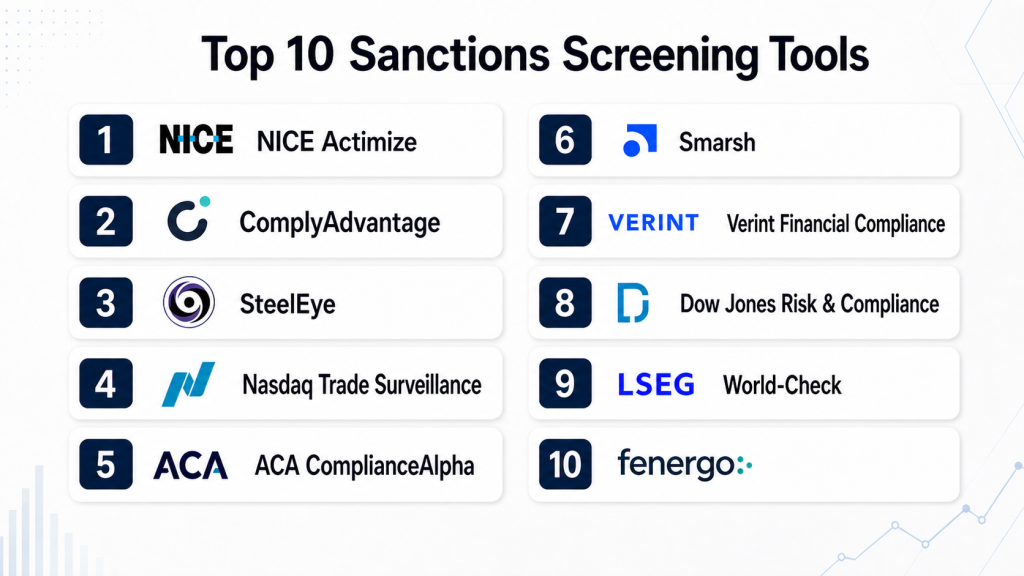
Top 10 Sanctions Screening Tools
#1 — LexisNexis Firco
Short description: LexisNexis Firco is a widely recognized sanctions and watchlist screening solution used by banks, financial institutions, payment companies, and regulated enterprises.
It is designed to screen names, payments, transactions, customers, and counterparties against sanctions, PEP, and risk data sources.
The platform is especially relevant for organizations that need strong financial crime compliance workflows at scale.
Firco is commonly associated with high-volume payment filtering, customer screening, and global compliance operations.
Key Features
- Sanctions and watchlist screening
- Payment and transaction filtering
- Customer and counterparty screening
- Fuzzy name matching and alert generation
- High-volume screening support
- Case review and compliance workflows
- Enterprise integration capabilities
Pros
- Strong recognition in financial crime compliance.
- Suitable for high-volume and enterprise-grade screening.
- Good fit for banks, payment firms, and regulated institutions.
Cons
- May be too complex for small businesses.
- Implementation can require significant planning and configuration.
- Pricing and deployment details are usually enterprise-specific.
Platforms / Deployment
Cloud / Hosted / Enterprise deployment options vary
Security & Compliance
Enterprise access controls, permissions, and audit workflows are expected.
Specific certifications: Not publicly stated.
Integrations & Ecosystem
LexisNexis Firco is designed for enterprise compliance environments where screening must connect with payments, onboarding, customer databases, and AML workflows. It is most valuable when embedded into broader financial crime operations.
- Core banking systems
- Payment processing workflows
- Customer onboarding platforms
- AML and case management systems
- Watchlist data sources
- Enterprise reporting tools
Support & Community
Support is vendor-led and generally enterprise-focused. Implementation, configuration, training, and ongoing support depend on contract scope and deployment model.
#2 — LSEG World-Check
Short description: LSEG World-Check is a well-known risk intelligence and screening data solution used by financial institutions, fintechs, corporates, law firms, and compliance teams.
It helps organizations screen individuals and entities against sanctions, PEPs, adverse media, enforcement records, and other risk categories.
The platform is especially strong as a risk data source for AML, KYC, KYB, and enhanced due diligence workflows.
Organizations often use World-Check data inside onboarding, compliance review, and ongoing monitoring processes.
Key Features
- Sanctions screening data
- PEP and watchlist coverage
- Adverse media and risk intelligence
- Individual and entity screening
- Enhanced due diligence support
- Ongoing monitoring workflows
- API and platform integration options
Pros
- Strong global risk intelligence coverage.
- Widely recognized in compliance and due diligence workflows.
- Useful for AML, KYC, KYB, and third-party risk programs.
Cons
- May require additional workflow tooling for complete case management.
- Data licensing and integration complexity can vary.
- Smaller firms may find it more than they need.
Platforms / Deployment
Web / API / Enterprise integration options vary
Security & Compliance
Enterprise security controls are expected, but specific certifications should be confirmed directly.
Specific certifications: Not publicly stated.
Integrations & Ecosystem
LSEG World-Check is often integrated into compliance platforms, onboarding tools, and risk workflows. Its ecosystem is strongest where organizations need data-driven screening and due diligence.
- KYC platforms
- KYB workflows
- AML systems
- Case management tools
- API integrations
- Due diligence workflows
Support & Community
Support is vendor-led and typically includes product support, onboarding assistance, data guidance, and enterprise account management depending on the customer agreement.
#3 — Dow Jones Risk & Compliance
Short description: Dow Jones Risk & Compliance provides risk data, sanctions screening support, PEP intelligence, adverse media, and due diligence resources for compliance teams.
It is used by financial institutions, fintechs, corporates, legal teams, and regulated businesses that need trusted risk intelligence.
The platform is especially useful for screening customers, entities, third parties, and beneficial owners.
Its strength is high-quality risk data, global coverage, and support for enhanced due diligence workflows.
Organizations can use Dow Jones data and tools to support AML, KYC, KYB, sanctions, and anti-bribery compliance processes.
Key Features
- Sanctions and watchlist screening support
- PEP data and risk intelligence
- Adverse media monitoring
- Entity and beneficial ownership data support
- Due diligence workflows
- Ongoing monitoring support
- API and data integration options
Pros
- Strong risk intelligence and data reputation.
- Useful for sanctions, PEP, adverse media, and due diligence workflows.
- Good fit for financial institutions and global enterprises.
Cons
- May need integration with separate workflow or case management tools.
- Pricing and data packages can vary significantly.
- Smaller teams may need simpler screening solutions.
Platforms / Deployment
Web / API / Data feed / Enterprise deployment options vary
Security & Compliance
Enterprise security controls are expected, but specific certifications should be verified directly.
Specific certifications: Not publicly stated.
Integrations & Ecosystem
Dow Jones Risk & Compliance is designed to support compliance teams with structured risk intelligence. It can be connected into onboarding systems, AML tools, third-party risk platforms, and case review workflows.
- KYC and onboarding tools
- AML platforms
- Third-party risk systems
- Data feeds and APIs
- Case management workflows
- Due diligence systems
Support & Community
Support is vendor-led and typically includes onboarding, customer assistance, data support, and enterprise relationship management depending on selected products.
#4 — ComplyAdvantage
Short description: ComplyAdvantage is a financial crime compliance platform that supports sanctions screening, AML monitoring, PEP screening, adverse media monitoring, and transaction risk workflows.
It is popular among fintechs, banks, payment companies, crypto firms, and growing regulated businesses that need API-first compliance tools.
The platform is especially useful for organizations that want modern screening workflows with automation and configurable risk controls.
ComplyAdvantage can support customer onboarding, continuous monitoring, transaction screening, and alert review.
Its strength is combining data, screening, automation, and workflow tools in a more modern compliance platform.
Key Features
- Sanctions and watchlist screening
- PEP and adverse media monitoring
- Transaction monitoring support
- API-first screening workflows
- Ongoing customer monitoring
- Risk scoring and alerting
- Case management and review tools
Pros
- Strong fit for fintechs, payments, and digital-first businesses.
- API-friendly approach supports modern onboarding and transaction workflows.
- Combines screening with broader financial crime compliance tools.
Cons
- Enterprise requirements may still require careful configuration.
- Alert tuning is important to reduce false positives.
- Coverage and workflow fit should be validated by region and industry.
Platforms / Deployment
Cloud / Web / API-based deployment
Security & Compliance
Role-based access, platform security controls, and audit workflows are expected.
Specific certifications: Not publicly stated.
Integrations & Ecosystem
ComplyAdvantage is designed to integrate with digital onboarding, transaction processing, customer databases, and compliance operations. It is practical for firms that want screening embedded into live workflows.
- Onboarding platforms
- Payment systems
- Transaction monitoring workflows
- AML platforms
- APIs and webhooks
- Case management tools
Support & Community
Support is vendor-led and may include onboarding, technical documentation, API support, customer success, and compliance workflow guidance depending on plan and customer size.
#5 — Oracle Financial Crime and Compliance Management
Short description: Oracle Financial Crime and Compliance Management provides enterprise-grade tools for AML, sanctions screening, fraud monitoring, case management, and compliance operations.
It is best suited for banks, insurers, financial institutions, and large regulated enterprises that already use enterprise data and compliance systems.
The platform can support customer screening, transaction screening, suspicious activity detection, and financial crime investigations.
Oracle’s strength is enterprise scalability, data architecture, and broad financial crime compliance coverage.
- Sanctions screening support
- AML and transaction monitoring
- Enterprise case management
- Customer risk scoring
- Financial crime analytics
- Data integration capabilities
- Large-scale compliance workflow support
Pros
- Strong fit for enterprise financial institutions.
- Broad financial crime compliance coverage beyond sanctions.
- Scalable for complex environments and high data volumes.
Cons
- Implementation can be resource-intensive.
- May be too heavy for smaller firms.
- Configuration requires strong compliance and technical planning.
Platforms / Deployment
Cloud / Enterprise deployment options vary
Security & Compliance
Enterprise security, user permissions, and audit controls are expected.
Specific certifications: Not publicly stated.
Integrations & Ecosystem
Oracle Financial Crime and Compliance Management fits into enterprise banking, insurance, risk, and compliance environments. It is best when connected with core systems, data platforms, and internal compliance workflows.
- Core banking systems
- Customer databases
- Payment systems
- Enterprise data warehouses
- AML workflows
- Case management processes
Support & Community
Support is enterprise-oriented and typically includes implementation partners, technical support, documentation, training, and account management depending on contract structure.
#6 — NICE Actimize Watch List Filtering
Short description: NICE Actimize Watch List Filtering supports sanctions, PEP, and watchlist screening for financial institutions and regulated businesses.
It is part of NICE Actimize’s broader financial crime and compliance technology ecosystem.
The tool is designed to help organizations screen customers, transactions, and entities against relevant watchlists and risk data.
It is especially useful for institutions that want screening connected to AML, fraud, case management, and investigation workflows.
Key Features
- Watchlist and sanctions filtering
- PEP and high-risk entity screening
- Customer and transaction screening
- Alert generation and review workflows
- Case management ecosystem alignment
- Risk-based filtering support
- Enterprise compliance integration
Pros
- Strong fit for banks and large regulated financial institutions.
- Connects screening with broader financial crime workflows.
- Suitable for mature compliance operations.
Cons
- May be complex for smaller firms.
- Implementation and tuning can require significant effort.
- Best value comes when used with broader NICE Actimize ecosystem.
Platforms / Deployment
Cloud / Hosted / Enterprise deployment options vary
Security & Compliance
Enterprise-grade access controls and audit capabilities are expected.
Specific certifications: Not publicly stated.
Integrations & Ecosystem
NICE Actimize Watch List Filtering is designed for enterprise financial crime environments. It works best when integrated with AML, transaction monitoring, fraud, and case management systems.
- AML platforms
- Transaction monitoring systems
- Case management workflows
- Core banking systems
- Payment screening workflows
- Customer onboarding tools
Support & Community
Support is vendor-led and enterprise-focused, often including implementation, training, configuration assistance, and ongoing account support.
#7 — FICO Siron
Short description: FICO Siron is a financial crime compliance solution used for AML, KYC, sanctions screening, risk scoring, and compliance investigations.
It is relevant for banks, financial institutions, fintechs, insurers, and regulated businesses that need structured compliance workflows.
The platform supports customer due diligence, transaction monitoring, watchlist screening, and case management use cases.
Key Features
- Sanctions and watchlist screening
- AML transaction monitoring
- Customer due diligence support
- Risk scoring and alerting
- Case management workflows
- Investigation and review tools
- Compliance reporting support
Pros
- Combines sanctions screening with broader AML workflows.
- Good fit for financial institutions and regulated businesses.
- Supports structured case management and risk review.
Cons
- May require configuration and tuning for best results.
- Smaller firms may find the broader platform too extensive.
- Deployment and pricing details vary by customer requirements.
Platforms / Deployment
Cloud / Hosted / Enterprise deployment options vary
Security & Compliance
Enterprise access controls, audit logs, and compliance workflows are expected.
Specific certifications: Not publicly stated.
Integrations & Ecosystem
FICO Siron fits into financial crime compliance ecosystems where customer data, transaction data, risk signals, and investigations need to work together.
- Core banking platforms
- AML systems
- Customer onboarding workflows
- Payment systems
- Case management tools
- Compliance reporting workflows
Support & Community
Support is vendor-led and generally enterprise-focused. Implementation, product support, training, and configuration assistance may vary based on contract and deployment model.
#8 — Napier AI
Short description: Napier AI provides financial crime compliance tools for screening, transaction monitoring, client activity review, and regulatory workflows.
It is designed for banks, payment companies, fintechs, asset managers, and regulated businesses that need modern AML and sanctions controls.
The platform can support sanctions screening, PEP screening, adverse media monitoring, and ongoing risk monitoring.
Key Features
- Sanctions and watchlist screening
- PEP and adverse media monitoring
- Transaction monitoring support
- Client activity review
- Alert and case workflows
- Risk scoring tools
- Compliance analytics
Pros
- Modern platform approach for financial crime compliance.
- Useful for firms wanting screening plus transaction monitoring.
- Supports automation and analyst productivity.
Cons
- Buyers should validate coverage by region and industry.
- AI-supported workflows still require human compliance review.
- Implementation depends on data quality and integration readiness.
Platforms / Deployment
Cloud / Web / Enterprise options vary
Security & Compliance
Enterprise security and audit workflows are expected.
Specific certifications: Not publicly stated.
Integrations & Ecosystem
Napier AI is designed to connect with customer onboarding, transaction data, case management, and compliance operations. It works well when organizations want financial crime tools in a connected workflow.
- Customer onboarding systems
- Transaction monitoring workflows
- Payment systems
- AML platforms
- Case management tools
- Data integrations
Support & Community
Support is vendor-led and may include onboarding, implementation guidance, technical assistance, and compliance workflow support depending on customer agreement.
#9 — Sanction Scanner
Short description: Sanction Scanner is a sanctions, AML, PEP, and adverse media screening platform used by fintechs, financial institutions, crypto companies, payment firms, and other regulated businesses.
It is designed to help teams screen customers, businesses, transactions, and counterparties against relevant risk data.
The platform is especially useful for organizations that need a focused screening tool with API and workflow capabilities.
Key Features
- Sanctions screening
- PEP screening
- Adverse media monitoring
- Customer and business screening
- API integration support
- Ongoing monitoring
- Alert and case workflows
Pros
- Practical fit for fintechs and growing regulated businesses.
- Focused screening capabilities without excessive complexity.
- API support helps embed screening into onboarding workflows.
Cons
- May not provide the same enterprise depth as larger financial crime suites.
- Buyers should validate data coverage for their region.
- Advanced compliance workflows may require additional tools.
Platforms / Deployment
Cloud / Web / API-based deployment
Security & Compliance
User permissions and workflow controls are expected.
Specific certifications: Not publicly stated.
Integrations & Ecosystem
Sanction Scanner is designed for screening workflows that connect with onboarding, transaction checks, compliance review, and customer monitoring.
- APIs
- KYC systems
- KYB workflows
- Payment platforms
- Customer onboarding tools
- Compliance dashboards
Support & Community
Support is vendor-led and typically includes onboarding assistance, product guidance, technical support, and customer service depending on plan.
#10 — NameScan
Short description: NameScan is a screening solution used for sanctions, PEP, adverse media, and watchlist checks across individuals and entities.
It is relevant for businesses that need practical AML and KYC screening workflows without adopting a large enterprise compliance suite.
The platform can support customer screening, business screening, ongoing monitoring, and API-driven checks.
Key Features
- Sanctions list screening
- PEP screening
- Adverse media checks
- Individual and entity screening
- API access options
- Ongoing monitoring support
- Simple compliance workflows
Pros
- Useful for businesses needing focused screening.
- More accessible than heavy enterprise platforms.
- Can support onboarding and due diligence workflows.
Cons
- May not fit large banks with complex transaction screening needs.
- Advanced workflow and case management depth may vary.
- Buyers should confirm data coverage and regional fit.
Platforms / Deployment
Cloud / Web / API options vary
Security & Compliance
Basic platform security controls are expected.
Specific certifications: Not publicly stated.
Integrations & Ecosystem
NameScan can fit into onboarding, due diligence, and compliance workflows where organizations need quick screening against sanctions, PEP, and risk data sources.
- API workflows
- KYC checks
- Customer onboarding
- Due diligence processes
- Compliance review workflows
- Business verification processes
Support & Community
Support is vendor-led and typically includes product assistance, documentation, and customer support. Public community depth is limited compared with developer-first platforms.
Comparison Table
| Tool Name | Best For | Platform Supported | Deployment | Standout Feature | Public Rating |
|---|---|---|---|---|---|
| LexisNexis Firco | Banks and high-volume financial institutions | Enterprise platform | Cloud / Hosted / Enterprise | Mature payment and sanctions filtering | N/A |
| LSEG World-Check | Global risk intelligence and due diligence | Web / API / Data feed | Cloud / API / Enterprise | Broad sanctions, PEP, and risk data | N/A |
| Dow Jones Risk & Compliance | Risk intelligence and compliance data workflows | Web / API / Data feed | Cloud / API / Enterprise | Strong due diligence and adverse media data | N/A |
| ComplyAdvantage | Fintechs, payments, and digital-first firms | Web / API | Cloud | API-first sanctions and AML screening | N/A |
| Oracle Financial Crime and Compliance Management | Large banks and enterprise compliance teams | Enterprise platform | Cloud / Enterprise | Broad financial crime compliance suite | N/A |
| NICE Actimize Watch List Filtering | Enterprise financial institutions | Enterprise platform | Cloud / Hosted / Enterprise | Watchlist filtering inside a financial crime ecosystem | N/A |
| FICO Siron | Banks and regulated financial businesses | Enterprise platform | Cloud / Hosted / Enterprise | AML, KYC, screening, and case workflows | N/A |
| Napier AI | Modern AML and compliance operations | Web / Enterprise platform | Cloud | AI-supported screening and monitoring | N/A |
| Sanction Scanner | Fintechs and growing compliance teams | Web / API | Cloud | Focused sanctions, PEP, and adverse media screening | N/A |
| NameScan | SMBs and practical due diligence teams | Web / API | Cloud | Accessible sanctions and watchlist checks | N/A |
Evaluation & Scoring of Sanctions Screening Tools
| Tool Name | Core 25% | Ease 15% | Integrations 15% | Security 10% | Performance 10% | Support 10% | Value 15% | Weighted Total 0–10 |
|---|---|---|---|---|---|---|---|---|
| LexisNexis Firco | 10 | 7 | 9 | 9 | 10 | 9 | 7 | 8.80 |
| LSEG World-Check | 9 | 8 | 9 | 9 | 9 | 9 | 7 | 8.55 |
| Dow Jones Risk & Compliance | 9 | 8 | 9 | 9 | 9 | 9 | 7 | 8.55 |
| ComplyAdvantage | 9 | 9 | 9 | 8 | 8 | 8 | 8 | 8.55 |
| Oracle Financial Crime and Compliance Management | 9 | 6 | 9 | 9 | 9 | 9 | 6 | 8.00 |
| NICE Actimize Watch List Filtering | 9 | 7 | 9 | 9 | 9 | 9 | 7 | 8.35 |
| FICO Siron | 8 | 7 | 8 | 8 | 8 | 8 | 7 | 7.75 |
| Napier AI | 8 | 8 | 8 | 8 | 8 | 8 | 8 | 8.00 |
| Sanction Scanner | 8 | 9 | 8 | 7 | 8 | 8 | 9 | 8.10 |
| NameScan | 7 | 9 | 7 | 7 | 7 | 7 | 9 | 7.65 |
The scores are comparative and should be used to build a shortlist, not to declare one universal winner. Enterprise platforms may score higher for scalability and deep financial crime coverage but lower on ease of use or value for smaller teams. API-first tools may be easier for fintechs to integrate quickly but may require careful validation for enterprise-grade requirements. Buyers should test match quality, false-positive rates, list coverage, reporting, and case workflows before making a final choice.
Which Sanctions Screening Tool Is Right for You?
Solo / Freelancer
Solo consultants, small advisory teams, and independent professionals usually do not need a heavy enterprise sanctions screening system. A focused screening tool such as NameScan or Sanction Scanner may be enough for occasional due diligence, basic client checks, or vendor screening.
The main priority should be simplicity, accuracy, and documentation. Even small teams should keep records of searches, decisions, and follow-up actions when dealing with regulated or high-risk clients.
SMB
Small and medium-sized businesses should prioritize ease of use, API access, reasonable cost, and practical alert workflows. Sanction Scanner, NameScan, ComplyAdvantage, and Napier AI may fit this segment depending on industry and screening volume.
SMBs should avoid systems that are too complex for their compliance team to operate. A tool that generates too many false positives without strong review workflows can create more workload than value.
Mid-Market
Mid-market firms need stronger integration, ongoing monitoring, batch screening, case management, and better risk scoring. ComplyAdvantage, Napier AI, FICO Siron, Dow Jones Risk & Compliance, and LSEG World-Check may fit depending on business model.
At this stage, buyers should focus on scaling compliance operations. Screening should connect with onboarding, payments, customer databases, vendor systems, and reporting workflows.
Enterprise
Large banks, insurers, payment networks, global enterprises, and financial institutions should prioritize enterprise scalability, data quality, governance, and auditability. LexisNexis Firco, LSEG World-Check, Dow Jones Risk & Compliance, Oracle, NICE Actimize, and FICO Siron are strong candidates for enterprise evaluation.
Enterprise buyers should run proof-of-concept testing with real customer, payment, vendor, and transaction data. They should validate performance, match accuracy, false-positive rates, escalation workflows, and system resilience.
Budget vs Premium
Budget-friendly tools can work well for businesses with basic screening needs, lower volumes, or simpler compliance workflows. NameScan and Sanction Scanner may be practical for teams that need accessible screening without enterprise complexity.
Premium platforms are better suited for high-volume, multi-region, regulated, or complex environments. The value usually comes from better data coverage, integration depth, scalability, support, and audit-ready workflows.
Feature Depth vs Ease of Use
Enterprise platforms like LexisNexis Firco, Oracle, NICE Actimize, and FICO Siron offer deeper capabilities but may require more implementation effort. Tools like Sanction Scanner and NameScan may be easier to adopt but may not provide the same enterprise depth.
Buyers should match platform depth to team maturity. A powerful platform is not useful if analysts cannot tune alerts, manage cases, and document decisions effectively.
Integrations & Scalability
Sanctions screening should integrate with customer onboarding, vendor management, payment systems, transaction monitoring, AML tools, CRM platforms, and case management workflows. API quality is especially important for fintechs and digital platforms.
Scalability matters when screening volume increases or the business expands into new regions. Buyers should evaluate batch screening, real-time screening, monitoring frequency, and performance under peak load.
Security & Compliance Needs
Security is critical because sanctions screening tools handle sensitive customer, transaction, and investigation data. Buyers should evaluate role-based access, MFA, encryption, audit logs, permission controls, data retention, and user activity tracking.
If certifications are not publicly stated, buyers should request vendor documentation directly. Compliance teams should also confirm whether the platform supports internal policies, regulatory audits, and evidence retention.
Frequently Asked Questions FAQs
1. What is a Sanctions Screening Tool?
A Sanctions Screening Tool checks people, companies, transactions, payments, and counterparties against sanctions and watchlist data.
It helps organizations identify restricted or high-risk parties before doing business with them.
Many tools also include PEP screening, adverse media checks, and ongoing monitoring.
The goal is to reduce legal, financial, and reputational risk.
It is commonly used in AML, KYC, KYB, and compliance workflows.
2. Who needs sanctions screening software?
Banks, fintechs, payment firms, crypto platforms, insurers, exporters, logistics companies, marketplaces, and regulated businesses often need sanctions screening software.
Any organization with cross-border customers, payments, vendors, or counterparties may benefit from screening.
The need is stronger when the business operates in regulated industries or high-risk regions.
Even non-financial companies may need screening for suppliers and third parties.
The right tool depends on risk level, transaction volume, and compliance obligations.
3. How does sanctions screening work?
Sanctions screening compares names, entities, payments, or transaction details against sanctions lists and other risk data sources.
The tool uses matching logic to identify exact or possible matches.
Compliance analysts then review alerts to decide whether the match is true, false, or needs escalation.
Advanced tools use fuzzy matching, aliases, transliteration, and risk scoring.
Screening works best when data is complete, accurate, and regularly updated.
4. What is a false positive in sanctions screening?
A false positive happens when a screening system flags a person or entity that is not actually the restricted party.
This often occurs when names are common, incomplete, misspelled, or similar to watchlist records.
Too many false positives can overwhelm compliance teams and delay onboarding or transactions.
Good tools help reduce false positives with better matching, scoring, and analyst workflows.
However, human review is still important for final decisions.
5. What data should be screened?
Organizations commonly screen customer names, company names, beneficial owners, directors, vendors, suppliers, payments, counterparties, and transaction details.
Financial institutions may also screen account holders, remitters, beneficiaries, and intermediaries.
Businesses with global supply chains may screen vessels, ports, countries, and trade partners.
The right data depends on business model and regulatory exposure.
Incomplete data can reduce screening accuracy.
6. How often should screening be performed?
Screening should happen during onboarding and continue throughout the customer or vendor relationship.
Ongoing monitoring is important because sanctions lists and risk profiles can change.
High-risk customers or transactions may require more frequent screening.
Payment and transaction screening may need to happen in real time.
The frequency should match the organization’s risk-based compliance policy.
7. What is the difference between sanctions screening and PEP screening?
Sanctions screening checks whether a person, entity, or transaction involves a restricted or prohibited party.
PEP screening identifies politically exposed persons who may present higher corruption or bribery risk.
A PEP match does not automatically mean the person is prohibited.
It usually requires enhanced due diligence and risk review.
Many compliance tools include both sanctions and PEP screening together.
8. What is adverse media screening?
Adverse media screening checks news and public risk information for negative mentions related to crime, corruption, fraud, sanctions, terrorism, money laundering, or misconduct.
It helps compliance teams understand broader reputational and financial crime risk.
Adverse media is often used during enhanced due diligence.
It can also support ongoing monitoring of customers, vendors, and counterparties.
The quality of adverse media screening depends on data sources and filtering accuracy.
9. How much do sanctions screening tools cost?
Pricing varies by vendor, number of users, screening volume, data coverage, modules, API usage, and support level.
Some tools are priced for SMBs, while enterprise platforms often use custom pricing.
Costs may include setup, integration, data licensing, monitoring, and support.
Buyers should calculate total cost of ownership, not only subscription fees.
If pricing is not public, it should be treated as Varies / N/A.
10. How long does implementation take?
Implementation depends on system complexity, integration scope, data quality, screening volume, and workflow requirements.
A simple cloud screening tool may be implemented faster than an enterprise financial crime platform.
Larger firms may need data mapping, rule tuning, user training, testing, and approval workflows.
Real-time payment screening usually requires more technical planning.
A phased rollout can reduce operational and compliance risk.
Conclusion
Sanctions Screening Tools are essential for organizations that need to identify restricted parties, manage AML and KYC risk, monitor transactions, and maintain audit-ready compliance workflows. LexisNexis Firco, LSEG World-Check, Dow Jones Risk & Compliance, ComplyAdvantage, Oracle Financial Crime and Compliance Management, NICE Actimize Watch List Filtering, FICO Siron, Napier AI, Sanction Scanner, and NameScan each serve different buyer needs. Some are best for global banks and high-volume payments, while others are better for fintechs, SMBs, due diligence teams, and API-first compliance workflows.
The best sanctions screening tool depends on your industry, transaction volume, regions, customer types, integration needs, and compliance maturity. Buyers should shortlist two or three platforms, test them with real customer and transaction data, compare false-positive rates, validate list coverage, review security controls, and confirm that analysts can manage alerts efficiently. A strong screening platform should not only generate matches; it should help compliance teams make faster, better-documented, and risk-based decisions.
