Introduction
Restaurant Menu Engineering Tools are specialized software solutions that help restaurants design, analyze, and optimize their menus to maximize profitability and enhance customer satisfaction. These platforms provide insights into item performance, contribution margins, and sales trends, enabling operators to make data-driven decisions about pricing, placement, and promotions.
In 2026, restaurants face increased competition, rising food costs, and customer expectations for menu personalization. Menu engineering tools allow operators to identify high-margin items, optimize menu layouts, and adjust pricing dynamically, improving both revenue and customer experience.
Use cases include:
- Identifying top-performing and low-performing menu items
- Optimizing pricing strategies for profitability
- Designing menus to influence customer choices
- Tracking seasonal or regional sales performance
- Integrating menu performance with POS and analytics systems
Key evaluation criteria:
- Item-level sales and margin analysis
- Menu layout and visual design recommendations
- Integration with POS and inventory systems
- Reporting and analytics dashboards
- Dynamic pricing and suggestion capabilities
- Multi-location and menu version management
- Customer behavior and preference insights
- Usability and staff training requirements
- Cost tracking and waste analysis
- Cloud-based scalability and deployment
Best for: Restaurant managers, executive chefs, operations teams, and franchise operators seeking to improve menu profitability and efficiency.
Not ideal for: Small restaurants with limited menu items or establishments that do not track item-level performance data.
Key Trends in Restaurant Menu Engineering Tools
- AI-driven menu optimization using sales and margin data
- Integration with POS and inventory management for real-time insights
- Dynamic pricing adjustments based on cost, seasonality, and demand
- Customer behavior analysis to tailor menus and promotions
- Cloud-based platforms for multi-location operations
- Visual menu design and digital menu boards
- Menu version control and A/B testing
- Reporting on profitability by menu section or item
- Integration with loyalty programs to influence menu choices
- Cost tracking and waste management analytics
How We Selected These Tools (Methodology)
- Evaluated market adoption among small, mid-market, and enterprise restaurants
- Assessed feature completeness: analytics, visual design, pricing, and menu optimization
- Reviewed reliability and performance metrics
- Verified security features, encryption, and access control
- Analyzed integration capabilities with POS, RMS, and inventory systems
- Considered usability and staff training requirements
- Evaluated scalability for multi-location operations
- Reviewed pricing and value relative to features
- Considered innovation: AI-driven recommendations, dynamic pricing, and A/B testing
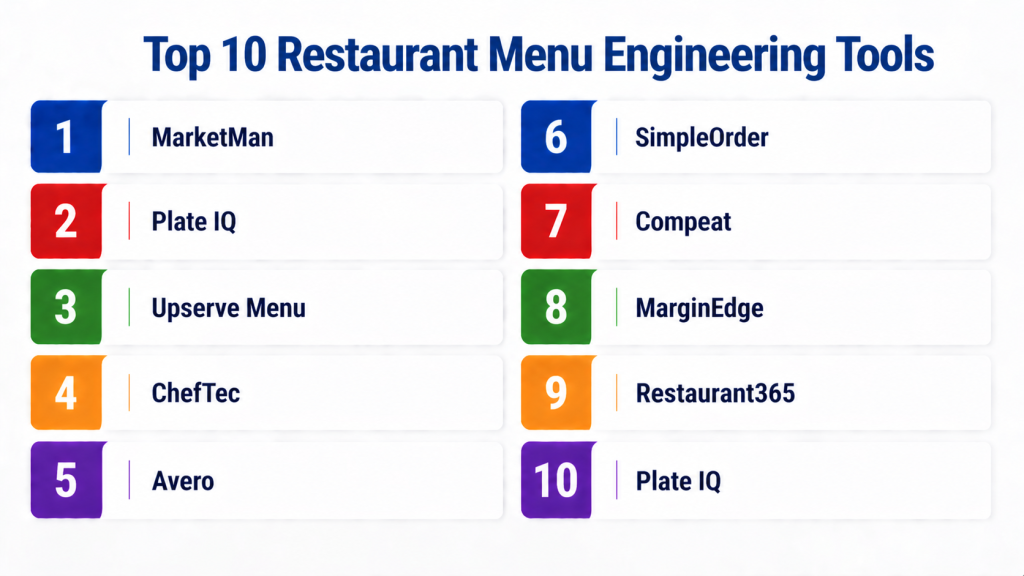
Top 10 Restaurant Menu Engineering Tools
#1 — MarketMan
Short description: MarketMan is a cloud-based menu engineering and inventory management tool that helps restaurants optimize profitability. It provides detailed cost tracking, menu item sales analysis, and insights into food waste. Operators can forecast demand, manage suppliers, and adjust recipes based on cost and margin data. MarketMan is suitable for single-location restaurants and multi-location chains. It integrates with POS systems for accurate, real-time data.
Key Features
- Menu item sales and margin analysis
- Recipe costing and inventory integration
- Forecasting and ordering recommendations
- Supplier management
- Analytics dashboards
- Multi-location support
Pros
- Comprehensive cost and margin insights
- Helps reduce food waste
Cons
- Learning curve for smaller operators
- Advanced features require training
Platforms / Deployment
- Web, iOS / Cloud
Security & Compliance
- SSL encryption
- Data privacy compliant
Integrations & Ecosystem
- POS systems
- Inventory and accounting platforms
- API for custom integrations
Support & Community
Email and chat support; documentation and training resources.
#2 — Plate IQ
Short description: Plate IQ specializes in menu cost analysis and invoice automation. Restaurants can track ingredient costs, monitor menu profitability, and reduce manual data entry. It provides analytics dashboards to highlight high-margin items and monitor vendor performance. The platform is suitable for mid-market restaurants and multi-location operations. Integration with POS and accounting software ensures accurate financial reporting. Plate IQ helps streamline menu management and cost control.
Key Features
- Menu item cost tracking
- Profitability analysis
- Invoice processing automation
- Inventory integration
- Reporting dashboards
Pros
- Reduces manual data entry
- Provides actionable cost insights
Cons
- Limited visual menu design tools
- Best suited for mid to large restaurants
Platforms / Deployment
- Web / Cloud
Security & Compliance
- SSL encryption
- Data privacy controls
Integrations & Ecosystem
- POS systems
- Accounting software
- Inventory management platforms
Support & Community
Email support and documentation; dedicated account managers for enterprise users.
#3 — Upserve Menu
Short description: Upserve Menu is a comprehensive menu analytics tool that tracks item performance, costs, and sales trends. Restaurants gain insights into popular and underperforming dishes to optimize pricing and placement. The platform integrates with POS systems and inventory tools. It supports data-driven menu adjustments for single or multi-location operations. Upserve Menu is suitable for full-service restaurants and chains. Its dashboards provide actionable intelligence for profitability and customer satisfaction.
Key Features
- Menu item profitability analysis
- Menu optimization recommendations
- Cost tracking and reporting
- POS integration
- Sales trend analysis
Pros
- Real-time insights into menu performance
- Easy-to-use interface for staff
Cons
- Premium features may be costly
- Requires POS integration for full functionality
Platforms / Deployment
- Web, iOS / Cloud
Security & Compliance
- SSL encryption
- PCI DSS compliant
Integrations & Ecosystem
- POS platforms
- Inventory and accounting software
- API for custom workflows
Support & Community
24/7 support, knowledge base, and user community forums.
#4 — ChefTec
Short description: ChefTec provides recipe costing, menu analysis, and inventory management for restaurants seeking cost control. It tracks ingredient costs, calculates menu item profitability, and helps manage vendor purchases. The platform supports multi-location operations and generates detailed reporting. ChefTec is suitable for small to mid-sized restaurants. It also assists with waste reduction and operational efficiency. The software integrates with POS systems for accurate sales and cost tracking..
Key Features
- Recipe and menu costing
- Menu profitability analytics
- Inventory tracking
- Vendor and supplier management
- Reporting dashboards
Pros
- Detailed recipe and ingredient cost analysis
- Supports multi-location operations
Cons
- Interface may be less modern than competitors
- Setup requires training
Platforms / Deployment
- Windows, Web / Cloud
Security & Compliance
- SSL encryption
- Data privacy compliant
Integrations & Ecosystem
- POS and RMS systems
- Accounting platforms
- Supplier and inventory management tools
Support & Community
Email and phone support; training resources.
#5 — Avero
Short description:Avero offers menu performance analytics and profitability insights for restaurants. It tracks item-level sales, margins, and labor data to optimize menus and operations. Multi-location reporting helps managers oversee performance across branches. Avero is suitable for mid-market to enterprise restaurants. Integration with POS and accounting systems enables accurate financial tracking. Its dashboards provide actionable insights to improve profitability and customer experience.
Key Features
- Menu item analysis and ranking
- Profitability dashboards
- Cost tracking and reporting
- Sales and labor analytics
- Customer insights
Pros
- Strong analytics for decision-making
- Multi-location reporting
Cons
- Enterprise pricing
- Limited POS integration for smaller restaurants
Platforms / Deployment
- Web / Cloud
Security & Compliance
- SSL encryption
- Data privacy compliant
Integrations & Ecosystem
- POS systems
- Accounting software
- API integration for custom reporting
Support & Community
Email support and knowledge base; enterprise onboarding support.
#6 — SimpleOrder
Short description:SimpleOrder is a cloud-based inventory and menu management platform for restaurants. It tracks menu item costs, monitors inventory, and recommends optimal ordering. The platform simplifies recipe costing and reduces food waste. SimpleOrder is suitable for small to mid-sized restaurants seeking basic menu analytics. Integration with POS systems ensures accurate tracking. Dashboards provide insights for profitability and operational efficiency.
Key Features
- Menu item cost and profitability tracking
- Inventory integration
- Supplier management
- Reporting and analytics dashboards
- Automated ordering recommendations
Pros
- Helps control food costs
- Integrates inventory with menu analysis
Cons
- Limited advanced analytics
- Best suited for small to mid-sized restaurants
Platforms / Deployment
- Web, iOS / Cloud
Security & Compliance
- SSL encryption
- Data privacy compliant
Integrations & Ecosystem
- POS systems
- Inventory and accounting platforms
Support & Community
Email and chat support; online documentation.
#7 — Compeat
Short description: Compeat is an enterprise-focused RMS offering menu engineering, accounting, and analytics. It tracks menu item profitability, labor costs, and inventory for multi-location operations. Restaurants can adjust pricing and menu items based on real-time data. Compeat is suitable for large restaurant chains and multi-location operations. Integration with POS and accounting systems ensures accurate financial and operational insights. Dashboards help optimize overall restaurant performance.
Key Features
- Menu item profitability analysis
- Recipe costing
- Inventory and labor management
- Reporting dashboards
- Multi-location support
Pros
- Comprehensive RMS features including menu analysis
- Scalable for multiple locations
Cons
- Learning curve for new users
- Enterprise pricing
Platforms / Deployment
- Web / Cloud
Security & Compliance
- SSL encryption
- PCI DSS compliant
Integrations & Ecosystem
- POS systems
- Accounting and RMS platforms
- API for custom workflows
Support & Community
Dedicated account support, online documentation, and training.
#8 — MarginEdge
Short description: MarginEdge provides automated cost tracking and menu analytics for restaurants. It integrates invoices, inventory, and menu data to monitor profitability. The platform offers insights into high-margin items and reduces manual accounting tasks. MarginEdge is ideal for mid-market and growing restaurants. POS integration ensures accurate sales and inventory alignment. Dashboards provide actionable insights for cost control and menu optimization..
Key Features
- Menu item profitability tracking
- Recipe and portion costing
- Inventory management
- Invoice automation
- Reporting dashboards
Pros
- Automates data collection and costing
- Provides actionable insights
Cons
- Limited visual menu design features
- More suitable for mid-market and enterprise
Platforms / Deployment
- Web / Cloud
Security & Compliance
- SSL encryption
- Data privacy compliant
Integrations & Ecosystem
- POS platforms
- Accounting software
- Inventory management systems
Support & Community
Email support, training guides, and knowledge base.
#9 — Restaurant365
Short description: Restaurant365 combines menu engineering, accounting, and inventory management into a single platform. It provides detailed insights into menu item performance and profitability across multiple locations. The platform supports recipe costing, vendor tracking, and financial reporting. Restaurant365 is suitable for enterprise and multi-location restaurants. Integration with POS and inventory systems ensures accurate data flow. Its dashboards allow managers to make informed menu and operational decisions.
Key Features
- Menu item profitability analysis
- Inventory and recipe costing
- Accounting and financial reporting
- Multi-location management
- Analytics dashboards
Pros
- Unified platform for finance and menu engineering
- Strong reporting capabilities
Cons
- More complex setup
- Enterprise pricing
Platforms / Deployment
- Web / Cloud
Security & Compliance
- SSL encryption
- PCI DSS compliant
Integrations & Ecosystem
- POS systems
- Accounting software
- Inventory platforms
Support & Community
Dedicated enterprise support, online documentation, and training.
#10 — Plate IQ
Short description: Plate IQ streamlines menu analytics and invoice management for restaurants. It tracks ingredient costs, monitors item profitability, and provides automated reporting. Restaurants can analyze vendor performance and adjust menu pricing for profitability. The platform is suitable for mid-market and enterprise restaurants. Integration with POS and accounting systems ensures accurate financial tracking. Dashboards provide actionable insights to optimize menus and reduce costs..
Key Features
- Menu item cost and profitability analysis
- Invoice and vendor management
- Inventory integration
- Reporting dashboards
- Real-time analytics
Pros
- Streamlines menu cost tracking
- Reduces manual data entry
Cons
- Limited POS integration
- Best suited for mid-market restaurants
Platforms / Deployment
- Web / Cloud
Security & Compliance
- SSL encryption
- Data privacy compliant
Integrations & Ecosystem
- POS systems
- Inventory and accounting software
- API for custom reporting
Support & Community
Email and chat support; knowledge base.
Comparison Table (Top 10)
| Tool Name | Best For | Platform(s) Supported | Deployment | Standout Feature | Public Rating |
|---|---|---|---|---|---|
| MarketMan | Inventory + menu | Web, iOS | Cloud | Menu & cost analysis | N/A |
| Plate IQ | Invoice + menu | Web | Cloud | Invoice automation | N/A |
| Upserve Menu | Analytics + POS | Web, iOS | Cloud | Menu performance dashboards | N/A |
| ChefTec | Recipe + menu | Windows, Web | Cloud | Recipe costing & inventory | N/A |
| Avero | Analytics | Web | Cloud | Multi-location analytics | N/A |
| SimpleOrder | SMB restaurants | Web, iOS | Cloud | Inventory & menu integration | N/A |
| Compeat | Enterprise RMS | Web | Cloud | Multi-location menu & operations | N/A |
| MarginEdge | Cost tracking | Web | Cloud | Automated costing & reporting | N/A |
| Restaurant365 | Multi-location | Web | Cloud | Accounting + menu analysis | N/A |
| Plate IQ | Mid-market | Web | Cloud | Invoice and menu analytics | N/A |
Evaluation & Scoring of Tools
| Tool Name | Core (25%) | Ease (15%) | Integrations (15%) | Security (10%) | Performance (10%) | Support (10%) | Value (15%) | Weighted Total (0–10) |
|---|---|---|---|---|---|---|---|---|
| MarketMan | 9 | 8 | 8 | 8 | 8 | 8 | 7 | 8.0 |
| Plate IQ | 8 | 8 | 7 | 8 | 8 | 7 | 7 | 7.6 |
| Upserve Menu | 9 | 8 | 8 | 8 | 8 | 8 | 7 | 8.0 |
| ChefTec | 8 | 7 | 8 | 8 | 8 | 7 | 7 | 7.7 |
| Avero | 8 | 7 | 8 | 8 | 8 | 7 | 7 | 7.7 |
| SimpleOrder | 7 | 9 | 7 | 7 | 7 | 7 | 7 | 7.3 |
| Compeat | 9 | 7 | 8 | 8 | 8 | 8 | 7 | 7.9 |
| MarginEdge | 8 | 8 | 7 | 8 | 8 | 7 | 7 | 7.7 |
| Restaurant365 | 9 | 7 | 8 | 8 | 8 | 8 | 7 | 7.9 |
| Plate IQ | 8 | 8 | 7 | 8 | 8 | 7 | 7 | 7.6 |
Which Menu Engineering Tool Is Right for You?
Solo / Freelancer
SimpleOrder or ChefTec provides essential menu analytics and costing for small restaurants and cafes.
SMB
MarketMan, Upserve Menu, or MarginEdge helps mid-sized restaurants analyze profitability, track inventory, and optimize pricing.
Mid-Market
Avero, Plate IQ, and Compeat are suitable for multi-location or franchise restaurants needing comprehensive analytics and reporting.
Enterprise
Restaurant365 and Compeat provide enterprise-grade menu engineering, accounting integration, and multi-location management.
Budget vs Premium
SimpleOrder and ChefTec are budget-friendly; MarketMan, Compeat, and Restaurant365 offer advanced analytics and scalability at higher pricing.
Feature Depth vs Ease of Use
MarketMan and Upserve provide advanced analytics and integration; SimpleOrder and ChefTec focus on ease of use.
Integrations & Scalability
Compeat, Restaurant365, and Avero excel in multi-location and POS integrations for scalable operations.
Security & Compliance Needs
All platforms use SSL encryption and comply with data privacy standards. Enterprises should verify access control, audit logs, and regulatory compliance.
Frequently Asked Questions (FAQs)
1. Can these tools track menu item profitability?
Yes. Most menu engineering tools track item-level sales, costs, and margins, providing insights into which dishes are most profitable and which need optimization.
2. Do these systems integrate with POS platforms?
Yes. Integration with POS ensures accurate sales data, inventory tracking, and real-time analytics for menu optimization decisions.
3. Can I use these tools for multi-location restaurants?
Yes. Tools like Compeat, Restaurant365, and Avero allow centralized management and reporting across multiple locations.
4. How do these tools help with menu pricing?
They analyze cost, sales volume, and margins to recommend optimal pricing for profitability and competitive positioning.
5. Are these platforms suitable for small restaurants?
Yes. SimpleOrder and ChefTec are affordable and easy to use, providing essential menu insights without complex enterprise features.
6. Do they provide inventory tracking?
Yes. Most menu engineering tools integrate with inventory systems to track ingredient usage, costs, and reduce waste.
7. Can I customize menu analysis reports?
Yes. Reporting dashboards allow customization by location, menu category, item, and time period.
8. Are these tools cloud-based?
Most platforms are cloud-based, enabling access from multiple devices and locations, with data securely stored and backed up.
9. How long does implementation take?
Small restaurant tools can be set up in days; enterprise platforms may require weeks for full integration and staff training.
10. Do they support predictive analytics?
Some tools, like MarketMan and Upserve, use AI and predictive analytics to forecast demand, optimize pricing, and reduce waste.
Conclusion
Restaurant Menu Engineering Tools are vital for analyzing menu performance, optimizing profitability, and improving operational efficiency. They integrate sales data, inventory, and analytics to provide actionable insights.
Small restaurants benefit from SimpleOrder and ChefTec for basic menu analytics, while mid-market restaurants gain value from MarketMan, Upserve Menu, and MarginEdge for more comprehensive analysis and cost management. Enterprise operations with multiple locations should consider Compeat and Restaurant365 for centralized management, advanced reporting, and multi-location scalability.
To select the right tool, shortlist 2–3 platforms based on restaurant size, menu complexity, and integration requirements. Conduct a pilot program, validate analytics and reporting capabilities, and ensure POS/inventory integration. This approach ensures data-driven menu optimization and maximized profitability.
