Introduction
E-commerce platforms enable businesses to sell products and services online efficiently, managing product catalogs, payments, inventory, and customer interactions in a single system. In modern e-commerce solutions emphasize scalability, omnichannel selling, AI-powered personalization, and seamless integrations with logistics and marketing tools. These platforms are essential for businesses aiming to reach global audiences, optimize operations, and improve customer experience.
Real-world use cases include:
- Retail brands selling through web stores, marketplaces, and social channels.
- SMBs launching online storefronts with minimal technical expertise.
- Enterprises managing complex catalogs and multi-region sales.
- Subscription services offering recurring billing for products.
- Omnichannel operations integrating in-store inventory with online sales.
When evaluating e-commerce platforms, buyers should consider:
- Ease of use and interface design
- Catalog and inventory management
- Payment processing and multi-currency support
- Integration with marketing, CRM, and logistics systems
- Mobile responsiveness and app ecosystem
- SEO and analytics capabilities
- Security, compliance, and data protection
- Scalability and performance
- Customer support and onboarding resources
- Pricing model and total cost of ownership
Best for: Retailers, SMBs, and enterprises seeking online sales channels, omnichannel selling, and customer engagement tools.
Not ideal for: Businesses with minimal online presence needs or those only requiring offline point-of-sale solutions.
Key Trends in E-commerce Platforms
- AI-powered product recommendations and personalization
- Omnichannel selling across marketplaces, social media, and websites
- Headless commerce architectures for greater flexibility
- Cloud-first deployments with high availability and performance
- Integrated marketing automation and customer engagement tools
- Subscription and recurring billing support
- Advanced analytics for conversion, retention, and revenue optimization
- Mobile-optimized storefronts and apps
- Flexible API and third-party integrations
- Enhanced security standards including PCI compliance and MFA
How We Evaluated E-commerce Platforms
- Market adoption and mindshare in SMB, mid-market, and enterprise segments
- Feature completeness including storefront customization, catalog, and payments
- Reliability and performance including uptime and scalability
- Security posture including PCI, MFA, and encryption
- Integration ecosystem with CRM, ERP, marketing, and logistics systems
- Customer fit across business sizes, industries, and regions
- Ease of use for admins and content managers
- Value proposition and pricing flexibility
- Deployment options including cloud and hybrid solutions
- Real-world adoption, reviews, and case studies
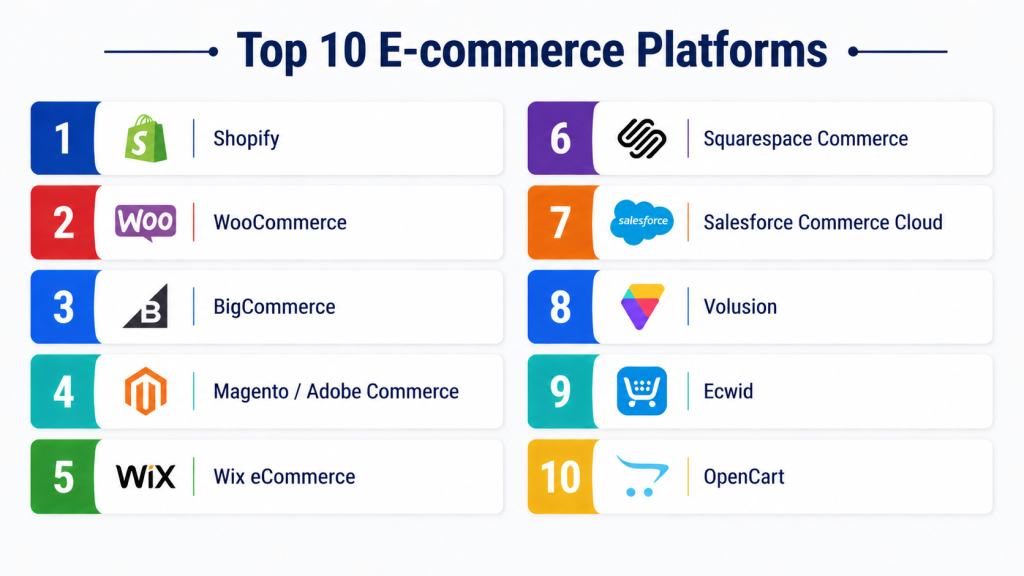
Top 10 E-commerce Platforms
#1 — Shopify
Short description : Shopify is a user-friendly, cloud-based e-commerce platform suitable for SMBs and mid-sized retailers. It offers a comprehensive suite of tools for online store creation, product management, payment processing, and shipping. With a wide range of apps and themes, Shopify enables quick store setup without coding. AI-driven marketing tools, mobile optimization, and multi-channel sales support make it ideal for businesses expanding online. Its simplicity and scalability attract small business owners and growth-stage retailers.
Key Features
- Storefront design and customizable themes
- Product catalog and inventory management
- Payment processing and multi-currency support
- Multi-channel sales integration
- App marketplace for extended functionality
- AI marketing and SEO tools
Pros
- Extremely user-friendly
- Fast setup and deployment
- Large app ecosystem
Cons
- Transaction fees for third-party payments
- Advanced customizations require coding
- Limited control over backend architecture
Platforms / Deployment
- Web / iOS / Android
- Cloud
Security & Compliance
- PCI compliant, encryption, MFA
- Not publicly stated for SOC 2/ISO certifications
Integrations & Ecosystem
Supports CRM, ERP, and marketing integrations:
- Mailchimp, Klaviyo, QuickBooks, Zapier
- APIs for custom integrations
Support & Community
- 24/7 support via chat, email, phone
- Knowledge base, tutorials, and community forums
#2 — WooCommerce
Short description : WooCommerce is a WordPress-based open-source e-commerce platform suitable for small to mid-sized businesses. It integrates directly with WordPress websites, offering full control over product pages, checkout flows, and store design. With thousands of plugins, WooCommerce enables customization for payments, shipping, and marketing automation. Its flexibility is ideal for retailers who want ownership of their platform, along with advanced SEO and content management capabilities.
Key Features
- Product catalog management
- Flexible payment gateways
- Shipping and tax configuration
- Open-source customization
- Extensions for marketing and analytics
- Mobile-responsive design
Pros
- Full control over store functionality
- Cost-effective for SMBs
- Large plugin ecosystem
Cons
- Requires WordPress knowledge
- Hosting and security responsibilities on the user
- Performance depends on hosting provider
Platforms / Deployment
- Web
- Self-hosted
Security & Compliance
- SSL support, user role management
- Not publicly stated: PCI or SOC certifications
Integrations & Ecosystem
- Payment gateways, email marketing, analytics plugins
- REST API for custom integration
Support & Community
- Community-driven support
- Documentation and WordPress forums
#3 — BigCommerce
Short description : BigCommerce is a cloud-based e-commerce platform for SMBs and large retailers. It offers extensive product and order management, multi-channel selling, and SEO tools. Its flexible APIs allow integration with ERP, CRM, and marketing tools. BigCommerce is suitable for businesses seeking scalability without compromising control over store design and functionality. AI features support product recommendations and personalized shopping experiences.
Key Features
- Product catalog and inventory management
- Multi-channel sales support
- SEO and marketing tools
- API-first architecture
- Payment gateway integration
- Analytics and reporting
Pros
- Scalable for growing retailers
- Strong SEO capabilities
- Robust multi-channel integrations
Cons
- Learning curve for advanced features
- Limited free templates
- Costs increase with higher sales volume
Platforms / Deployment
- Web / iOS / Android
- Cloud
Security & Compliance
- PCI compliant, SSL, encryption
- Not publicly stated
Integrations & Ecosystem
- ERP, CRM, email marketing, POS
- API and webhooks for custom workflows
Support & Community
- 24/7 support
- Knowledge base and active community forums
#4 — Magento / Adobe Commerce
Short description : Magento, now Adobe Commerce, is an enterprise-grade e-commerce platform for complex, large-scale retail operations. It offers full control over store architecture, product catalogs, and checkout processes. Its modular structure supports advanced integrations with ERP, CRM, and marketing systems. Magento provides AI-powered personalization, analytics, and multi-store capabilities. Ideal for enterprises needing scalability, customization, and global reach.
Key Features
- Product and catalog management
- AI-driven personalization
- Multi-store and multi-language support
- Advanced analytics and reporting
- Custom checkout and workflows
- API for integrations
Pros
- Highly scalable and flexible
- Enterprise-level customization
- Strong global multi-store capabilities
Cons
- Requires technical expertise
- High total cost of ownership
- Resource-intensive to manage
Platforms / Deployment
- Web
- Cloud / Self-hosted
Security & Compliance
- PCI compliance, encryption, MFA
- GDPR compliant
Integrations & Ecosystem
- ERP, CRM, payment gateways, marketing platforms
- Custom integrations via API
Support & Community
- Enterprise support tiers
- Extensive documentation and developer community
#5 — Wix eCommerce
Short description : Wix eCommerce is a cloud-based platform aimed at small businesses seeking simplicity and visual design flexibility. It provides drag-and-drop store builders, product management, and integrated payment solutions. AI-driven tools help optimize product listings and SEO. Wix is ideal for SMBs looking to launch an online store quickly without technical complexity. Its template-driven approach allows fast deployment and mobile responsiveness.
Key Features
- Drag-and-drop store design
- Product catalog management
- Integrated payment processing
- AI SEO tools
- Inventory and order management
- Mobile optimization
Pros
- Simple and intuitive
- Quick setup for SMBs
- Built-in design flexibility
Cons
- Limited enterprise features
- Fewer integrations than competitors
- Scaling options are restricted
Platforms / Deployment
- Web / iOS / Android
- Cloud
Security & Compliance
- SSL encryption, PCI compliant
- Not publicly stated
Integrations & Ecosystem
- Marketing, CRM, and shipping integrations via plugins
- APIs for custom integrations
Support & Community
- Customer support via chat and phone
- Knowledge base and tutorials
#6 — Squarespace Commerce
Short description : Squarespace Commerce integrates e-commerce into its website builder, targeting small to mid-sized retailers. It offers visually appealing templates, catalog management, and integrated payments. Squarespace enables SEO optimization, social selling, and analytics dashboards. Its platform is ideal for businesses prioritizing design and branding while maintaining essential e-commerce functionalities.
Key Features
- Beautiful store templates
- Catalog and inventory management
- Integrated payments and tax calculations
- SEO and analytics tools
- Social media selling
- Mobile optimization
Pros
- Elegant design and branding
- Easy-to-use interface
- Integrated analytics
Cons
- Limited advanced e-commerce features
- Smaller app ecosystem
- Less suitable for large catalogs
Platforms / Deployment
- Web / iOS / Android
- Cloud
Security & Compliance
- SSL encryption, PCI compliant
- Not publicly stated
Integrations & Ecosystem
- Payment gateways, email marketing, social platforms
- API support limited
Support & Community
- Email and chat support
- Knowledge base and guides
#7 — Salesforce Commerce Cloud
Short description : Salesforce Commerce Cloud is an enterprise-level platform for global retailers. It offers omnichannel selling, AI-driven personalization, inventory management, and robust analytics. The platform integrates seamlessly with Salesforce CRM, enabling enhanced customer experience and targeted marketing. It is ideal for large enterprises seeking advanced features, scalability, and data-driven e-commerce strategies.
Key Features
- Omnichannel sales management
- AI personalization and recommendations
- Inventory and order management
- Salesforce CRM integration
- Advanced reporting and analytics
- Mobile-optimized storefronts
Pros
- Enterprise-grade scalability
- Strong CRM integration
- AI-driven customer insights
Cons
- Complex setup and high cost
- Requires trained resources
- May be overkill for SMBs
Platforms / Deployment
- Web / iOS / Android
- Cloud
Security & Compliance
- PCI compliance, SSL, encryption
- Not publicly stated
Integrations & Ecosystem
- Full Salesforce ecosystem
- API support for third-party integrations
Support & Community
- Enterprise support tiers
- Extensive documentation and developer community
#8 — Volusion
Short description : Volusion is a cloud-based platform for small to mid-sized businesses. It offers product management, payment processing, SEO tools, and analytics dashboards. Volusion provides simple storefront templates and essential e-commerce functionality without complex setup. Its focus on SMBs makes it suitable for retailers seeking a balance of affordability and core features.
Key Features
- Store design templates
- Product catalog and inventory management
- Payment gateway integrations
- SEO and analytics tools
- Order and customer management
- Mobile responsiveness
Pros
- Affordable for SMBs
- Easy setup and management
- Core e-commerce features included
Cons
- Limited advanced capabilities
- Smaller integration ecosystem
- Less suited for enterprise-scale operations
Platforms / Deployment
- Web
- Cloud
Security & Compliance
- SSL, PCI compliant
- Not publicly stated
Integrations & Ecosystem
- Payment processors, shipping providers, email marketing
- Limited API support
Support & Community
- Email and phone support
- Knowledge base
#9 — Ecwid
Short description : Ecwid is a lightweight e-commerce solution for SMBs and website owners. It can be embedded into existing websites, social media, or marketplaces. Ecwid offers catalog management, multi-channel selling, and integrated payments. Its simplicity and cross-platform compatibility make it ideal for businesses expanding their online presence without rebuilding websites.
Key Features
- Embedded e-commerce widget
- Multi-channel selling
- Product catalog and inventory management
- Payment gateway integration
- Mobile-friendly design
- Basic analytics
Pros
- Easy to integrate into existing sites
- Supports marketplaces and social channels
- Simple setup
Cons
- Limited advanced features
- Smaller app ecosystem
- Customization restricted
Platforms / Deployment
- Web / iOS / Android
- Cloud
Security & Compliance
- PCI compliant, SSL encryption
- Not publicly stated
Integrations & Ecosystem
- Social media, marketplaces, payment processors
- API for basic integration
Support & Community
- Email and chat support
- Knowledge base
#10 — OpenCart
Short description : OpenCart is an open-source e-commerce platform ideal for SMBs and developers seeking full control. It offers product management, extensions for payments and shipping, and multi-store capabilities. OpenCart requires hosting setup and technical know-how but provides flexibility and ownership. Its extensibility allows retailers to scale and customize features according to business needs.
Key Features
- Product and catalog management
- Multi-store management
- Payment and shipping extensions
- Open-source customizations
- Reporting and analytics
- SEO optimization
Pros
- Full control and flexibility
- Cost-effective for SMBs
- Large extension marketplace
Cons
- Requires technical knowledge
- Hosting and security responsibilities fall on user
- Limited built-in support
Platforms / Deployment
- Web
- Self-hosted
Security & Compliance
- SSL support
- Not publicly stated
Integrations & Ecosystem
- Payment gateways, shipping providers, extensions
- API support for custom features
Support & Community
- Community-driven support
- Forums and documentation
Comparison Table
| Tool Name | Best For | Platform(s) Supported | Deployment | Standout Feature | Public Rating |
|---|---|---|---|---|---|
| Shopify | SMB/Mid-size retailers | Web / iOS / Android | Cloud | AI-driven personalization | N/A |
| WooCommerce | SMBs on WordPress | Web | Self-hosted | Full customization | N/A |
| BigCommerce | SMBs & enterprise | Web / iOS / Android | Cloud | Multi-channel sales | N/A |
| Magento / Adobe Commerce | Enterprise | Web | Cloud / Self-hosted | Scalability & customization | N/A |
| Wix eCommerce | SMBs | Web / iOS / Android | Cloud | Drag-and-drop storefront | N/A |
| Squarespace Commerce | SMBs | Web / iOS / Android | Cloud | Design-focused templates | N/A |
| Salesforce Commerce Cloud | Enterprise | Web / iOS / Android | Cloud | Omnichannel + CRM integration | N/A |
| Volusion | SMBs | Web | Cloud | Core e-commerce functionality | N/A |
| Ecwid | SMBs/website owners | Web / iOS / Android | Cloud | Embedded widget for existing sites | N/A |
| OpenCart | SMBs / Developers | Web | Self-hosted | Open-source flexibility | N/A |
Evaluation & Scoring of E-commerce Platforms
| Tool Name | Core (25%) | Ease (15%) | Integrations (15%) | Security (10%) | Performance (10%) | Support (10%) | Value (15%) | Weighted Total (0–10) |
|---|---|---|---|---|---|---|---|---|
| Shopify | 9 | 9 | 9 | 8 | 9 | 8 | 8 | 8.7 |
| WooCommerce | 8 | 7 | 8 | 7 | 8 | 7 | 9 | 7.8 |
| BigCommerce | 9 | 8 | 8 | 8 | 9 | 8 | 8 | 8.3 |
| Magento | 10 | 7 | 9 | 9 | 10 | 8 | 7 | 8.8 |
| Wix eCommerce | 7 | 9 | 7 | 7 | 7 | 8 | 8 | 7.7 |
| Squarespace | 7 | 9 | 7 | 7 | 7 | 8 | 8 | 7.7 |
| Salesforce Commerce Cloud | 10 | 7 | 9 | 9 | 10 | 8 | 7 | 8.8 |
| Volusion | 7 | 8 | 7 | 7 | 7 | 8 | 7 | 7.4 |
| Ecwid | 7 | 8 | 7 | 7 | 7 | 7 | 8 | 7.4 |
| OpenCart | 8 | 6 | 7 | 7 | 8 | 6 | 9 | 7.6 |
Which E-commerce Platform Is Right for You?
Solo / Freelancer
Platforms like Wix eCommerce, Squarespace, or Ecwid provide easy setup and mobile-friendly templates for single-person businesses.
SMB
Shopify, WooCommerce, and BigCommerce offer scalability, multi-channel selling, and integrations suitable for growing businesses.
Mid-Market
Platforms like BigCommerce or WooCommerce with extensions provide customization and multi-store support.
Enterprise
Magento / Adobe Commerce and Salesforce Commerce Cloud deliver enterprise-grade scalability, omnichannel selling, and robust analytics for complex catalogs.
Budget vs Premium
Budget-conscious retailers may choose Wix eCommerce or OpenCart, while premium options like Magento or Salesforce Commerce Cloud offer advanced features.
Feature Depth vs Ease of Use
SMBs benefit from user-friendly interfaces, while enterprises prioritize features and scalability.
Integrations & Scalability
Consider POS, ERP, marketing, and shipping integrations before selecting a platform, particularly for multi-location or global operations.
Security & Compliance Needs
Ensure platforms comply with PCI, SSL encryption, and data protection standards to safeguard transactions and customer data.
Frequently Asked Questions (FAQs)
1. How much do e-commerce platforms cost?
Pricing varies based on features and business size. Subscription-based platforms charge monthly fees, while open-source solutions like WooCommerce require hosting and plugins. Costs increase with advanced functionality or multi-store setups.
2. How long does it take to launch a store?
Platforms like Wix or Squarespace allow launch within days. Enterprise solutions such as Magento or Salesforce Commerce Cloud may take weeks due to customizations, integrations, and testing.
3. Can I sell on multiple channels?
Yes, modern platforms support omnichannel selling including marketplaces, social media, and mobile apps. Integration tools synchronize inventory, orders, and promotions across channels.
4. Are payments secure on these platforms?
Top platforms offer PCI compliance, SSL encryption, and fraud prevention features. Payment gateways are integrated to ensure safe and reliable transactions.
5. Can I customize my store design?
Most platforms offer templates, themes, and drag-and-drop builders. Enterprise solutions like Magento allow full customization with development resources for tailored experiences.
6. Do these platforms handle shipping and taxes?
Yes, many provide built-in shipping and tax calculators, carrier integrations, and options for international shipping and multiple tax jurisdictions.
7. Are mobile-friendly storefronts included?
All modern platforms include responsive designs or mobile apps, ensuring seamless customer experiences across devices, which is critical in 2026.
8. Can I integrate marketing and analytics tools?
Yes, integration with email marketing, CRM, social media, and analytics platforms is standard. Some offer AI-driven recommendations and insights.
9. What about scaling my store?
Enterprise platforms like Magento and Salesforce Commerce Cloud support multi-store setups, high transaction volumes, and global markets. SMB-focused platforms scale with add-ons and premium plans.
10. Can I migrate my existing online store?
Most platforms support data import/export or API-based migration, but complexity depends on product catalog size, customizations, and integrations.
Conclusion
E-commerce platforms are vital for retailers seeking to sell online efficiently while providing excellent customer experiences. In 2026, AI-driven personalization, mobile optimization, and omnichannel integration define the most effective platforms. Businesses must consider scalability, integrations, and security alongside usability and cost.
Selecting the right platform depends on business size, complexity, and growth plans. SMBs may prioritize ease of use and quick deployment, while enterprises need advanced customization, analytics, and multi-store capabilities. Features like AI recommendations and integrated marketing tools can significantly enhance revenue and engagement.
A practical approach is to shortlist 2–3 platforms, run pilot tests, validate integration with payment, shipping, and marketing systems, and collect user feedback. This ensures the chosen platform balances functionality, scalability, and cost-effectiveness for long-term e-commerce success.
