Introduction
AI Content Generation Tools are platforms that use artificial intelligence to create written, visual, audio, or video content automatically. These tools leverage large language models, generative AI, and deep learning algorithms to produce high-quality outputs such as blog posts, marketing copy, social media content, and even code.
In today’s digital-first world, AI content tools are transforming how businesses and individuals create content at scale. From marketing automation and SEO writing to product descriptions and email campaigns, these tools help reduce manual effort while increasing speed and efficiency. They also integrate with Identity Management, Cybersecurity frameworks, Zero Trust architectures, and Access Control systems to ensure secure usage in enterprise environments.
Real-world use cases include:
- Blog writing and SEO content creation
- Social media post generation
- Email marketing campaigns
- Product descriptions for e-commerce
- Script writing and storytelling
- Ad copy and landing page content
What buyers should evaluate:
- Content quality and accuracy
- Customization and tone control
- Multilingual support
- Integration with CMS and marketing tools
- Ease of use and workflow automation
- Security and compliance features
- Pricing and scalability
- AI model capabilities
Best for: Marketers, content creators, agencies, startups, enterprises, and developers building AI-powered content workflows.
Not ideal for: Highly specialized or technical writing requiring deep domain expertise without human review.
Key Trends in AI Content Generation Tools
- Large language models driving high-quality content creation
- Multimodal content generation (text, image, video, audio)
- AI copilots integrated into workflows
- Personalized content generation at scale
- SEO optimization built into AI tools
- Real-time collaboration features emerging
- Zero Trust security and data governance for enterprise use
- Integration with marketing automation platforms
- Voice and video content generation gaining traction
- Ethical AI and content authenticity checks becoming important
How We AI Content Generation Tools (Methodology)
We evaluated tools based on:
- Content quality and output accuracy
- Feature completeness (text, media, automation)
- Ease of use and user interface
- Integration capabilities
- Security and compliance readiness
- Performance and scalability
- Pricing flexibility
- Market adoption and reputation
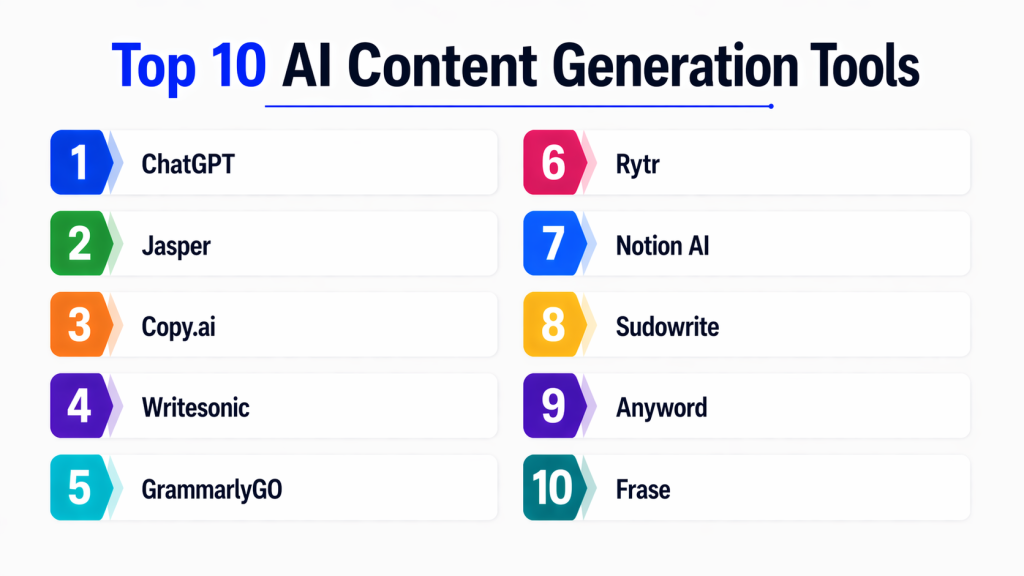
Top 10 AI Content Generation Tools
#1 — ChatGPT
Short description :
ChatGPT is a leading AI content generation tool known for its conversational capabilities. It can generate blogs, emails, scripts, and code. Widely used by individuals and enterprises. Offers high-quality outputs across multiple domains. Suitable for general-purpose content creation.
Key Features
- Text generation
- Conversational AI
- Multi-domain support
- Code generation
- Custom instructions
Pros
- Versatile
- High-quality output
Cons
- Requires prompt tuning
- May need fact-checking
Platforms / Deployment
Web / Mobile
Cloud
Security & Compliance
Varies / enterprise controls available
Integrations & Ecosystem
- APIs
- Productivity tools
Support & Community
Large global community.
#2 — Jasper
Short description :
Jasper is an AI writing assistant focused on marketing content. It helps create blogs, ads, and social media posts. Designed for teams and agencies. Offers templates and workflow automation. Ideal for content marketers.
Key Features
- Marketing templates
- SEO content generation
- Brand voice customization
- Collaboration tools
Pros
- Easy to use
- Marketing-focused
Cons
- Expensive
- Limited non-marketing use
Platforms / Deployment
Web
Cloud
Security & Compliance
Not publicly stated
Integrations & Ecosystem
- CMS tools
- Marketing platforms
Support & Community
Strong support.
#3 — Copy.ai
Short description :
Copy.ai is a content generation tool for marketing and business writing. It offers multiple templates for quick content creation. Easy to use for beginners. Suitable for startups and small teams.
Key Features
- Content templates
- Blog generation
- Social media content
- Workflow automation
Pros
- Beginner-friendly
- Fast output
Cons
- Limited customization
- Quality varies
Platforms / Deployment
Web
Cloud
Security & Compliance
Not publicly stated
Integrations & Ecosystem
- Marketing tools
- APIs
Support & Community
Active user base.
#4 — Writesonic
Short description :
Writesonic is an AI content tool designed for SEO and marketing. It generates blogs, ads, and landing pages. Offers AI chat and automation features. Suitable for businesses scaling content.
Key Features
- SEO content generation
- AI chatbot
- Marketing tools
- Content automation
Pros
- SEO-focused
- Feature-rich
Cons
- Learning curve
- Pricing tiers
Platforms / Deployment
Web
Cloud
Security & Compliance
Not publicly stated
Integrations & Ecosystem
- SEO tools
- APIs
Support & Community
Good support.
#5 — GrammarlyGO
Short description :
GrammarlyGO enhances writing with AI-powered suggestions and content generation. It improves clarity, tone, and grammar. Ideal for professionals and students. Focuses on writing enhancement.
Key Features
- Writing assistance
- Tone detection
- Content suggestions
- Grammar correction
Pros
- Easy to use
- Improves writing quality
Cons
- Limited full content generation
- Subscription required
Platforms / Deployment
Web / Desktop
Security & Compliance
Encryption, enterprise controls (varies)
Integrations & Ecosystem
- Email tools
- Docs
Support & Community
Strong user base.
#6 — Rytr
Short description :
Rytr is a budget-friendly AI writing tool. It supports multiple languages and use cases. Ideal for freelancers and small businesses. Provides quick content generation.
Key Features
- Multi-language support
- Content templates
- Tone customization
Pros
- Affordable
- Easy to use
Cons
- Limited advanced features
- Basic outputs
Platforms / Deployment
Web
Security & Compliance
Not publicly stated
Integrations & Ecosystem
- APIs
Support & Community
Growing community.
#7 — Notion AI
Short description :
Notion AI integrates content generation into productivity workflows. It helps generate notes, summaries, and documents. Ideal for teams and knowledge management. Enhances collaboration.
Key Features
- Content generation
- Summarization
- Collaboration tools
Pros
- Integrated workflow
- Easy to use
Cons
- Limited standalone features
- Requires Notion
Platforms / Deployment
Web / Desktop
Security & Compliance
Varies
Integrations & Ecosystem
- Notion ecosystem
Support & Community
Strong community.
#8 — Sudowrite
Short description :
Sudowrite is designed for creative writing and storytelling. It helps authors generate ideas and improve narratives. Ideal for fiction writers. Focuses on creativity.
Key Features
- Story generation
- Creative writing tools
- Idea suggestions
Pros
- Great for storytelling
- Creative support
Cons
- Not for business content
- Limited use cases
Platforms / Deployment
Web
Security & Compliance
Not publicly stated
Integrations & Ecosystem
- Writing tools
Support & Community
Niche community.
#9 — Anyword
Short description :
Anyword focuses on data-driven content generation. It uses predictive analytics to optimize content. Ideal for marketing teams. Helps improve conversion rates.
Key Features
- Predictive scoring
- Marketing content
- Performance insights
Pros
- Data-driven
- Marketing-focused
Cons
- Expensive
- Limited general use
Platforms / Deployment
Web
Security & Compliance
Not publicly stated
Integrations & Ecosystem
- Marketing tools
Support & Community
Enterprise support.
#10 — Frase
Short description :
Frase is an AI content tool focused on SEO optimization. It helps create optimized content for search engines. Ideal for bloggers and marketers. Combines research and writing.
Key Features
- SEO content generation
- Content research
- AI writing tools
Pros
- SEO-focused
- Easy workflow
Cons
- Limited creative writing
- Learning curve
Platforms / Deployment
Web
Security & Compliance
Not publicly stated
Integrations & Ecosystem
- SEO tools
Support & Community
Active community.
Comparison Table (Top 10)
| Tool Name | Best For | Platform(s) | Deployment | Standout Feature | Public Rating |
|---|---|---|---|---|---|
| ChatGPT | General use | Multi | Cloud | Versatility | N/A |
| Jasper | Marketing | Web | Cloud | Templates | N/A |
| Copy.ai | Startups | Web | Cloud | Simplicity | N/A |
| Writesonic | SEO | Web | Cloud | Automation | N/A |
| GrammarlyGO | Writing | Multi | Cloud | Editing | N/A |
| Rytr | Budget | Web | Cloud | Affordability | N/A |
| Notion AI | Teams | Multi | Cloud | Integration | N/A |
| Sudowrite | Writers | Web | Cloud | Creativity | N/A |
| Anyword | Marketing | Web | Cloud | Analytics | N/A |
| Frase | SEO | Web | Cloud | Optimization | N/A |
Evaluation & Scoring of AI Content Tools
| Tool | Core | Ease | Integration | Security | Performance | Support | Value | Total |
|---|---|---|---|---|---|---|---|---|
| ChatGPT | 10 | 9 | 10 | 8 | 10 | 10 | 9 | 9.4 |
| Jasper | 9 | 9 | 9 | 7 | 9 | 9 | 7 | 8.6 |
| Copy.ai | 8 | 9 | 8 | 7 | 8 | 8 | 8 | 8.1 |
| Writesonic | 9 | 8 | 9 | 7 | 9 | 8 | 8 | 8.4 |
| GrammarlyGO | 8 | 10 | 8 | 8 | 8 | 9 | 7 | 8.3 |
| Rytr | 7 | 9 | 7 | 6 | 7 | 7 | 9 | 7.6 |
| Notion AI | 8 | 9 | 8 | 7 | 8 | 8 | 8 | 8.1 |
| Sudowrite | 7 | 9 | 6 | 6 | 7 | 7 | 8 | 7.3 |
| Anyword | 9 | 8 | 8 | 7 | 8 | 8 | 7 | 8.0 |
| Frase | 8 | 8 | 8 | 7 | 8 | 8 | 8 | 8.0 |
Which AI Content Tool Is Right for You?
Solo / Freelancer
Use Rytr, ChatGPT
SMB
Use Copy.ai, Writesonic
Mid-Market
Use Jasper, Frase
Enterprise
Use ChatGPT, Jasper, Anyword
Budget vs Premium
Budget: Rytr
Premium: Jasper
Feature Depth vs Ease of Use
Depth: ChatGPT
Ease: Copy.ai
Integrations & Scalability
Best: ChatGPT, Jasper
Security & Compliance Needs
Best: Enterprise deployments with managed controls
Frequently Asked Questions (FAQs)
1. What are AI content generation tools?
AI content generation tools are software platforms that use artificial intelligence to create text, images, or other content automatically. They rely on machine learning models trained on large datasets. These tools can generate blogs, emails, and marketing copy. They help improve productivity and reduce manual effort. They are widely used in marketing and business workflows.
2. Are AI content tools accurate?
AI tools can generate high-quality content, but accuracy depends on the input and model used. They may occasionally produce incorrect or outdated information. Human review is recommended for critical content. Advanced tools provide better accuracy and context understanding. Continuous improvements are being made.
3. Can AI tools replace human writers?
AI tools can assist and speed up content creation but cannot fully replace human creativity and expertise. They are best used as productivity tools. Human input is needed for strategy, tone, and fact-checking. Combining AI with human editing gives the best results. They enhance rather than replace writers.
4. Are AI content tools secure?
Security depends on the platform and how it is deployed. Enterprise tools offer encryption and access control features. Data privacy is important when handling sensitive content. Organizations should evaluate compliance requirements. Proper usage ensures secure content generation.
5. What types of content can AI generate?
AI tools can generate blogs, social media posts, emails, product descriptions, scripts, and more. Some tools also support image and video generation. They are versatile across industries. Output quality varies by tool. Customization options improve results.
6. Are AI content tools expensive?
Pricing varies depending on features and usage. Some tools offer free plans with limited capabilities. Premium plans provide advanced features and higher limits. Enterprise solutions are more expensive. Businesses should choose based on needs and budget.
7. Can AI tools be integrated into workflows?
Yes, most AI tools provide APIs and integrations. They can connect with CMS platforms, marketing tools, and productivity apps. Integration helps automate workflows. It improves efficiency and scalability. Compatibility varies by tool.
8. What are common mistakes when using AI content tools?
Common mistakes include relying solely on AI without editing, ignoring SEO optimization, and not customizing outputs. Poor prompts can lead to low-quality results. Overuse without strategy reduces effectiveness. Always review and refine AI-generated content.
9. Do AI tools support multiple languages?
Yes, many AI tools support multiple languages. They can generate content in different languages and tones. Accuracy may vary depending on language complexity. Advanced models perform better. Multilingual support is improving rapidly.
10. How do I choose the right AI content tool?
Choosing the right tool depends on your use case, budget, and required features. Evaluate content quality, ease of use, and integrations. Test multiple tools before deciding. Consider scalability and long-term needs. Select a tool that aligns with your workflow.
Conclusion
AI content generation tools are revolutionizing how individuals and organizations create and manage content. By combining speed, scalability, and automation, these platforms enable users to produce high-quality content across multiple formats with minimal effort. From marketing campaigns to documentation and creative writing, AI tools are becoming an essential part of modern digital workflows.
However, selecting the right tool depends on your specific needs, whether it is ease of use, advanced customization, or enterprise-level integration. Instead of relying on a single solution, it is advisable to test a few tools in real-world scenarios and evaluate their performance, accuracy, and scalability before making a final decision.
