Introduction
AI Image Generation Tools are platforms that use artificial intelligence to create images from text prompts, sketches, or existing visuals. These tools leverage diffusion models, generative adversarial networks (GANs), and multimodal AI systems to produce high-quality visuals for creative and commercial use.
In today’s content-driven digital ecosystem, AI image generation has become a key enabler for design, marketing, gaming, media production, and e-commerce. These tools allow users to generate visuals at scale, reduce dependency on manual design, and accelerate creative workflows. They also integrate with Identity Management, Cybersecurity frameworks, Zero Trust architectures, and Access Control systems to ensure safe and controlled usage in enterprise environments.
Real-world use cases include:
- Marketing creatives and ad visuals
- Social media graphics and thumbnails
- Product mockups and design concepts
- Game and animation assets
- Digital art and illustrations
- UI/UX prototyping
What buyers should evaluate:
- Image quality and realism
- Prompt understanding and customization
- Style diversity and control
- Speed and performance
- Integration with design tools
- Licensing and commercial usage rights
- Security and data privacy
- Pricing and scalability
Best for: Designers, marketers, content creators, developers, agencies, and enterprises building visual content pipelines.
Not ideal for: Highly specialized design work requiring precise manual control or strict regulatory constraints without human oversight.
Key Trends in AI Image Generation Tools
- Diffusion models delivering photorealistic outputs
- Multimodal AI combining text, image, and video generation
- Real-time image generation improving user experience
- Integration with design and creative software ecosystems
- Custom model training for brand-specific visuals
- AI-generated assets for gaming and metaverse applications
- Zero Trust security for creative AI workflows
- AI-powered editing and upscaling tools
- Ethical AI and copyright concerns gaining attention
- Enterprise adoption for scalable design workflows
How We AI Image Generation Tools (Methodology)
We evaluated tools based on:
- Image quality and realism
- Feature completeness (generation, editing, styles)
- Ease of use and interface
- Performance and speed
- Integration capabilities
- Security and compliance readiness
- Pricing and scalability
- Market adoption and reputation
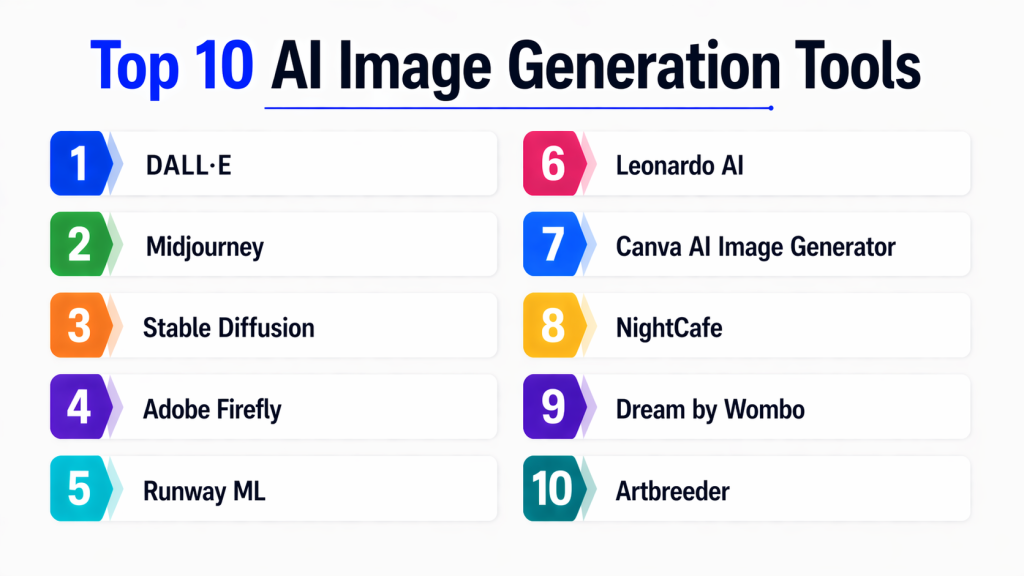
Top 10 AI Image Generation Tools
#1 — DALL·E
Short description :
DALL·E is a powerful AI image generation tool known for producing highly creative and detailed images from text prompts. It supports multiple styles and editing capabilities. Widely used by designers and marketers. Offers high-quality outputs and ease of use. Suitable for both beginners and professionals.
Key Features
- Text-to-image generation
- Image editing and inpainting
- Style customization
- High-resolution outputs
- Prompt-based creativity
Pros
- High-quality images
- Easy to use
Cons
- Limited advanced controls
- Cloud dependency
Platforms / Deployment
Web
Cloud
Security & Compliance
Varies / enterprise controls available
Integrations & Ecosystem
- APIs
- Creative tools
Support & Community
Large user community.
#2 — Midjourney
Short description :
Midjourney is known for producing artistic and visually stunning images. It focuses on creativity and style. Widely used by artists and designers. Offers unique aesthetics compared to other tools. Ideal for creative projects.
Key Features
- Artistic image generation
- Style variations
- High-resolution outputs
- Prompt-based customization
Pros
- Excellent artistic quality
- Unique styles
Cons
- Less control over outputs
- Requires learning prompts
Platforms / Deployment
Web / Discord-based
Cloud
Security & Compliance
Not publicly stated
Integrations & Ecosystem
- Creative workflows
Support & Community
Active creative community.
#3 — Stable Diffusion
Short description :
Stable Diffusion is an open-source AI image generation model. It offers flexibility and customization. Can be deployed locally or in the cloud. Widely used by developers and researchers. Ideal for advanced users.
Key Features
- Open-source model
- Custom model training
- Local deployment
- High-quality outputs
Pros
- Highly customizable
- No vendor lock-in
Cons
- Requires technical setup
- Variable output quality
Platforms / Deployment
Windows / Linux
Cloud / Self-hosted
Security & Compliance
Depends on deployment
Compliance: Not publicly stated
Integrations & Ecosystem
- Developer tools
- APIs
Support & Community
Large open-source community.
#4 — Adobe Firefly
Short description :
Adobe Firefly is an AI image generation tool integrated into Adobe’s creative ecosystem. It focuses on commercial-safe content generation. Ideal for designers and enterprises. Supports seamless integration with Adobe tools.
Key Features
- Text-to-image generation
- Integration with Adobe Creative Cloud
- Commercial-safe outputs
- Editing tools
Pros
- Strong ecosystem
- High-quality outputs
Cons
- Requires Adobe ecosystem
- Subscription cost
Platforms / Deployment
Web / Desktop
Cloud
Security & Compliance
Enterprise-grade controls
Compliance: Varies
Integrations & Ecosystem
- Photoshop
- Illustrator
Support & Community
Enterprise support.
#5 — Runway ML
Short description :
Runway ML provides AI tools for image and video generation. It is widely used in creative industries. Offers advanced editing and generation features. Ideal for content creators and filmmakers.
Key Features
- Image generation
- Video editing
- AI tools
- Real-time processing
Pros
- Versatile
- Creative workflows
Cons
- Learning curve
- Premium pricing
Platforms / Deployment
Web
Cloud
Security & Compliance
Not publicly stated
Integrations & Ecosystem
- Creative tools
Support & Community
Growing community.
#6 — Leonardo AI
Short description :
Leonardo AI focuses on generating assets for games and design. It provides customizable outputs and styles. Ideal for developers and artists. Supports high-quality image creation.
Key Features
- Game asset generation
- Style customization
- High-resolution images
Pros
- Specialized outputs
- Easy to use
Cons
- Limited general use
- Smaller ecosystem
Platforms / Deployment
Web
Cloud
Security & Compliance
Not publicly stated
Integrations & Ecosystem
- Design tools
Support & Community
Growing community.
#7 — Canva AI Image Generator
Short description :
Canva AI integrates image generation into a simple design platform. Ideal for marketers and beginners. Provides easy-to-use tools for quick designs. Suitable for social media content.
Key Features
- Text-to-image
- Design templates
- Easy interface
Pros
- Beginner-friendly
- Fast
Cons
- Limited customization
- Basic outputs
Platforms / Deployment
Web
Security & Compliance
Varies
Integrations & Ecosystem
- Canva tools
Support & Community
Large user base.
#8 — NightCafe
Short description :
NightCafe is an AI art generator focused on creative outputs. It supports multiple AI models. Ideal for digital artists and hobbyists. Offers community features.
Key Features
- AI art generation
- Multiple models
- Community sharing
Pros
- Creative outputs
- Easy to use
Cons
- Limited enterprise features
- Basic controls
Platforms / Deployment
Web
Security & Compliance
Not publicly stated
Integrations & Ecosystem
- Art tools
Support & Community
Active community.
#9 — Dream by Wombo
Short description :
Dream by Wombo is a mobile-friendly AI image generator. It focuses on artistic visuals. Easy to use for casual users. Ideal for quick creative outputs.
Key Features
- Mobile support
- Artistic styles
- Easy interface
Pros
- Simple
- Fast
Cons
- Limited control
- Not enterprise-ready
Platforms / Deployment
Mobile / Web
Security & Compliance
Not publicly stated
Integrations & Ecosystem
- Mobile apps
Support & Community
Casual user base.
#10 — Artbreeder
Short description :
Artbreeder allows users to create images by blending and modifying existing visuals. Focuses on generative art. Ideal for creative experimentation.
Key Features
- Image blending
- Customization
- Generative art
Pros
- Unique outputs
- Creative control
Cons
- Limited commercial use
- Not scalable
Platforms / Deployment
Web
Security & Compliance
Not publicly stated
Integrations & Ecosystem
- Creative tools
Support & Community
Niche community.
Comparison Table (Top 10)
| Tool Name | Best For | Platform(s) | Deployment | Standout Feature | Public Rating |
|---|---|---|---|---|---|
| DALL·E | General | Web | Cloud | Quality | N/A |
| Midjourney | Artists | Web | Cloud | Style | N/A |
| Stable Diffusion | Developers | Multi | Hybrid | Open-source | N/A |
| Firefly | Designers | Multi | Cloud | Integration | N/A |
| Runway | Creators | Web | Cloud | Video tools | N/A |
| Leonardo | Game dev | Web | Cloud | Assets | N/A |
| Canva AI | Beginners | Web | Cloud | Ease | N/A |
| NightCafe | Artists | Web | Cloud | Community | N/A |
| Wombo | Casual | Mobile | Cloud | Simplicity | N/A |
| Artbreeder | Creative | Web | Cloud | Blending | N/A |
Evaluation & Scoring of AI Image Tools
| Tool | Core | Ease | Integration | Security | Performance | Support | Value | Total |
|---|---|---|---|---|---|---|---|---|
| DALL·E | 10 | 9 | 9 | 8 | 9 | 9 | 8 | 9.0 |
| Midjourney | 9 | 8 | 8 | 7 | 9 | 8 | 8 | 8.4 |
| Stable Diffusion | 9 | 7 | 9 | 7 | 9 | 9 | 9 | 8.6 |
| Firefly | 9 | 9 | 10 | 9 | 9 | 9 | 7 | 8.9 |
| Runway | 9 | 8 | 8 | 7 | 9 | 8 | 7 | 8.2 |
| Leonardo | 8 | 9 | 7 | 7 | 8 | 8 | 8 | 8.0 |
| Canva AI | 7 | 10 | 7 | 7 | 8 | 8 | 9 | 8.0 |
| NightCafe | 7 | 9 | 6 | 6 | 7 | 7 | 8 | 7.4 |
| Wombo | 6 | 10 | 6 | 6 | 7 | 7 | 9 | 7.3 |
| Artbreeder | 7 | 8 | 6 | 6 | 7 | 7 | 7 | 7.0 |
Which AI Image Tool Is Right for You?
Solo / Freelancer
Use Canva AI, NightCafe
SMB
Use DALL·E, Leonardo
Mid-Market
Use Runway, Midjourney
Enterprise
Use Adobe Firefly, Stable Diffusion
Budget vs Premium
Budget: Canva AI
Premium: Firefly
Feature Depth vs Ease
Depth: Stable Diffusion
Ease: Canva
Security & Compliance
Best: Adobe Firefly
Frequently Asked Questions (FAQs)
1. What are AI image generation tools?
AI image generation tools are platforms that create images using artificial intelligence based on text prompts or inputs. They use advanced models like diffusion and GANs. These tools can generate realistic or artistic visuals. They are widely used in design and marketing. They help automate creative workflows.
2. Are AI-generated images high quality?
Yes, modern AI tools can produce high-quality and realistic images. Quality depends on the model and prompt used. Some tools specialize in artistic styles, while others focus on realism. Continuous improvements are enhancing quality. Professional use often requires fine-tuning.
3. Can AI replace graphic designers?
AI tools assist designers but do not fully replace them. They help speed up workflows and generate ideas. Human creativity and judgment are still essential. Designers refine and customize outputs. AI acts as a productivity tool.
4. Are AI image tools safe to use?
Most platforms include basic security and privacy controls. Enterprise tools provide stronger safeguards. Users should review data usage policies. Security depends on deployment and usage. Responsible use is important.
5. Can AI images be used commercially?
Some tools allow commercial usage, while others have restrictions. Licensing terms vary by platform. Users should check usage rights before publishing. Enterprise tools often provide safer options. Compliance is important for businesses.
6. Are AI image tools expensive?
Pricing varies from free tiers to premium subscriptions. Costs depend on usage and features. Enterprise tools are more expensive. Budget tools are available for individuals. Evaluate based on needs.
7. Can AI generate images in different styles?
Yes, AI tools support multiple artistic styles and customization options. Users can generate realistic, cartoon, or abstract images. Style control depends on the platform. Advanced tools offer better flexibility. Custom models enhance results.
8. What industries use AI image generation?
Marketing, gaming, media, e-commerce, and design industries use these tools. They are also used in education and entertainment. Adoption is growing rapidly. They enable scalable content creation.
9. What are limitations of AI image tools?
AI tools may struggle with complex prompts and fine details. Outputs may require editing. Some tools have licensing restrictions. Performance depends on training data. Continuous improvement is ongoing.
10. How do I choose the right tool?
Choose based on your use case, budget, and required features. Evaluate quality, ease of use, and integrations. Test multiple tools before deciding. Consider scalability and licensing. Select the tool that fits your workflow.
Conclusion
AI image generation tools are reshaping the creative landscape by enabling users to produce high-quality visuals quickly and efficiently. From marketing campaigns to game design and digital art, these tools are helping individuals and organizations scale their creative output while reducing time and effort. As AI models continue to evolve, the quality and versatility of generated images will only improve.
Selecting the right tool depends on your specific needs, whether it’s ease of use, customization, enterprise integration, or cost efficiency. Instead of relying on a single platform, it is recommended to experiment with a few tools, compare their outputs, and choose the one that aligns best with your creative goals and workflow.
