Introduction
Relational Database Management Systems, or RDBMS, are software platforms used to store, organize, query, secure, and manage structured data in tables. In simple terms, they help businesses keep data consistent, connected, and easy to work with using SQL, relationships, and transactions. They remain essential for business applications, financial systems, ERP platforms, SaaS products, internal tools, and operational reporting because they deliver reliability, structure, and strong data integrity.
These systems matter even more now because organizations need better scalability, stronger security, hybrid deployment flexibility, and smoother integration with modern application stacks. Common use cases include powering transactional applications, handling operational reporting, supporting regulated workloads, managing enterprise master data, and running embedded or local software storage. Buyers should evaluate SQL depth, reliability, performance, security controls, scalability, deployment flexibility, ecosystem maturity, operational complexity, support quality, and long-term value.
Best for: enterprises, SaaS companies, IT teams, software vendors, regulated industries, and any organization that depends on structured transactional data.
Not ideal for: teams working mainly with unstructured content, pure event-stream architectures, or ultra-light local use cases where a simpler embedded database may be sufficient.
Key Trends in Relational Database Management Systems
- AI-readiness is becoming a key buying factor, with vendors adding AI-adjacent features, automation, and intelligent management capabilities.
- Hybrid and multicloud deployments are now common, especially for large organizations modernizing gradually.
- Security expectations are much higher, with stronger focus on encryption, auditing, fine-grained permissions, and privileged access control.
- Open-source RDBMS platforms continue to gain momentum, especially where flexibility and lower lock-in matter.
- Embedded relational databases remain important for software products, local tools, and edge use cases.
- Operational resilience is a top priority, including backup, failover, replication, and concurrency management.
- Buyers increasingly want one platform for transactions and analytics, especially in enterprise environments.
- Deployment flexibility is part of the value story, with teams comparing managed, self-hosted, hybrid, and container-based models more seriously.
- Database ecosystems now matter as much as core engine performance, including tooling, drivers, ORMs, and admin support.
- Cost scrutiny is growing, leading buyers to compare open-source value against premium enterprise capabilities more carefully.
How We Evaluate Relational Database Management Systems (Methodology)
We selected the top systems in this category using a practical evaluation approach:
- Market adoption and mindshare across enterprises, developers, and DBAs
- Core relational strength including SQL maturity, transactions, indexing, and schema support
- Reliability and performance for real production workloads
- Security posture based on documented controls such as authentication, access control, auditing, and encryption
- Deployment flexibility across cloud, self-hosted, hybrid, and embedded models
- Ecosystem maturity including tools, drivers, integrations, and admin support
- Customer fit across segments from solo developers to global enterprises
- Operational manageability including backup, recovery, scaling, and administration
- Strategic relevance for modern application and data architecture needs
- Value relative to complexity because not every team needs a heavyweight enterprise platform
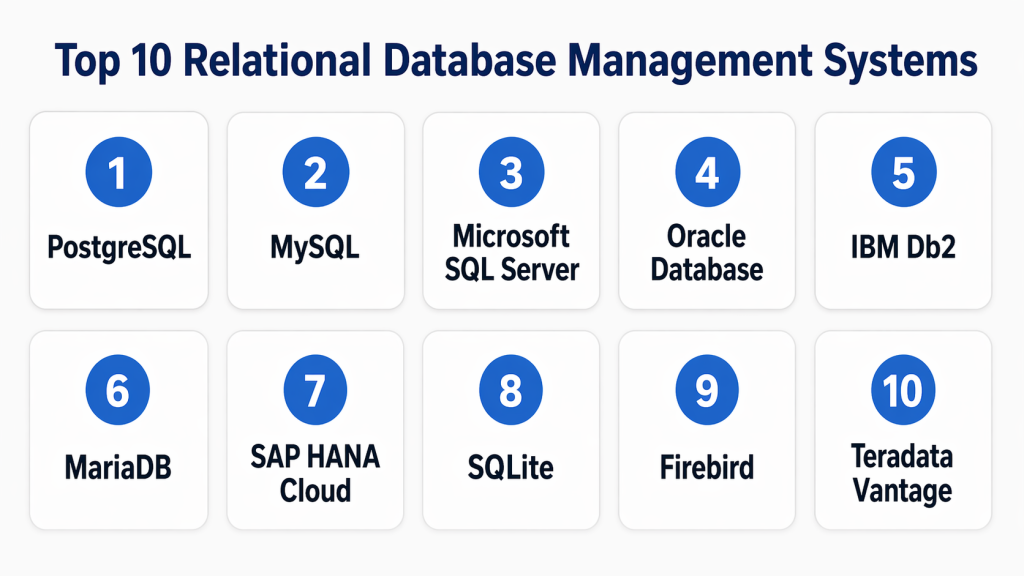
Top 10 Relational Database Management Systems
#1 — PostgreSQL
Short description : PostgreSQL is one of the most respected open-source relational database systems available. It is known for reliability, extensibility, standards support, and strong ecosystem adoption. It works well for startups, mid-market teams, enterprises, SaaS products, and regulated workloads that want flexibility without heavy vendor lock-in. It is especially attractive for teams that need a general-purpose relational platform with room to scale. For many organizations, it is one of the safest modern default choices.
Key Features
- Advanced SQL support
- Strong transactional reliability
- Extensible architecture with custom types and functions
- Broad indexing and optimization support
- Replication and high-availability options
- Large ecosystem of tools and extensions
Pros
- Strong balance of flexibility, power, and value
- Excellent community and ecosystem support
- Suitable for many application and data workloads
Cons
- Large-scale deployments may require experienced administration
- Enterprise tooling can be less unified than premium vendor stacks
- Managed service experience varies by provider
Platforms / Deployment
- Windows / macOS / Linux
- Cloud / Self-hosted / Hybrid
Security & Compliance
Supports roles, permissions, secure administration workflows, and strong production-grade controls. Broad compliance certifications: Not publicly stated.
Integrations & Ecosystem
PostgreSQL has one of the strongest ecosystems in the RDBMS market, with wide support across frameworks, ORMs, admin tools, backup platforms, and analytics connectors.
- Rich extension ecosystem
- Broad developer tooling support
- Strong admin and monitoring ecosystem
- Wide compatibility with modern apps
Support & Community
Documentation is excellent, community depth is outstanding, and commercial support is available through multiple vendors and managed providers.
#2 — MySQL
Short description : MySQL is one of the best-known relational databases for web applications, packaged software, and general-purpose business systems. It is widely used by developers and IT teams that want a familiar SQL platform with broad tooling and hosting support. It remains a practical mainstream choice for operational applications and many transactional workloads. Enterprise editions add more advanced security and operational features. It is a dependable option for organizations that value familiarity and broad support.
Key Features
- Mature SQL engine
- Broad ecosystem and tooling support
- Replication and clustering options
- Enterprise security capabilities in paid editions
- Strong developer familiarity
- Broad backup and monitoring support
Pros
- Very widely adopted and easy to hire for
- Strong fit for business apps and web platforms
- Broad hosting and management ecosystem
Cons
- Some advanced capabilities depend on edition
- Less extensible than PostgreSQL in some scenarios
- Enterprise depth may require commercial investment
Platforms / Deployment
- Windows / macOS / Linux
- Cloud / Self-hosted / Hybrid
Security & Compliance
Supports secure administration, user controls, encryption-related capabilities, and audit-related features in enterprise offerings. Broad compliance certifications: Not publicly stated.
Integrations & Ecosystem
MySQL integrates well across application frameworks, packaged software, hosting environments, and administration tools.
- Strong connector ecosystem
- Broad application compatibility
- Mature admin tooling support
- Popular with transactional business systems
Support & Community
Community familiarity is very strong, documentation is solid, and commercial support is available for enterprise buyers.
#3 — Microsoft SQL Server
Short description : Microsoft SQL Server is a flagship enterprise relational database platform built for transactional systems, analytics, reporting, and critical business applications. It is especially strong in Microsoft-centric environments where integration, governance, and operational control matter. It is widely used in enterprises that want deep security controls, reliable performance, and strong support. It also fits organizations needing a commercially backed platform for mixed operational and reporting workloads. It is a leading enterprise choice where Microsoft alignment is already important.
Key Features
- Enterprise relational engine
- Strong security and access control features
- High availability and failover support
- Performance tuning and workload management
- Deep Microsoft ecosystem integration
- Support for transactional and analytical workloads
Pros
- Excellent fit for Microsoft-focused organizations
- Strong governance and operational tooling
- Mature ecosystem for enterprise deployments
Cons
- Licensing can be expensive
- Best fit is often within Microsoft ecosystems
- May be heavier than smaller teams need
Platforms / Deployment
- Windows / Linux
- Cloud / Self-hosted / Hybrid
Security & Compliance
Supports authentication, access control, encryption-related features, row-level security, masking, and strong administrative governance. Compliance posture: Varies / N/A by edition and deployment.
Integrations & Ecosystem
SQL Server works best where Microsoft infrastructure, analytics, identity, and operations tooling already play a central role.
- Strong Microsoft stack alignment
- Broad BI and reporting ecosystem
- Mature admin tooling
- Strong support for enterprise app integration
Support & Community
Commercial support is strong, documentation is mature, and enterprise familiarity is high.
#4 — Oracle Database
Short description : Oracle Database is one of the most established enterprise RDBMS platforms for mission-critical systems. It is widely used by large enterprises needing mature administration, advanced security, strong governance, and broad workload support. It is designed for demanding operational environments where uptime, auditability, and control matter. Oracle is a premium platform built for serious enterprise needs. It is best suited to organizations that can justify its complexity and cost.
Key Features
- Enterprise relational engine
- Advanced security and auditing features
- High availability and recovery capabilities
- Fine-grained access control
- Strong workload and performance management
- Mature DBA and enterprise tooling
Pros
- Very strong feature depth for enterprise workloads
- Excellent fit for high-governance environments
- Mature platform for mission-critical systems
Cons
- Complex and often expensive
- Higher operational overhead than simpler systems
- Best fit is usually large enterprises
Platforms / Deployment
- Windows / Linux / Unix variants
- Cloud / Self-hosted / Hybrid
Security & Compliance
Supports authentication, authorization, encryption, auditing, and fine-grained security controls. Compliance specifics: Varies / N/A by offering and deployment.
Integrations & Ecosystem
Oracle has a deep enterprise ecosystem spanning ERP, middleware, identity, analytics, and large-scale database operations.
- Broad enterprise integration support
- Strong admin and developer tooling
- Deep Oracle stack alignment
- Large partner ecosystem
Support & Community
Commercial support is strong, documentation is extensive, and enterprise adoption remains very deep.
#5 — IBM Db2
Short description : IBM Db2 is a long-established enterprise relational database platform built for mission-critical workloads and governed enterprise environments. It is positioned around scalability, security, hybrid support, and data management strength. It remains a serious option in organizations that value resilience, governance, and operational maturity. Db2 is especially attractive where IBM infrastructure is already important. It is more specialized than mainstream open-source platforms but still highly credible.
Key Features
- Enterprise relational engine
- Hybrid and multicloud support
- Strong governance and access control capabilities
- Real-time data processing support
- Scalable enterprise workload handling
- Mature operational tooling
Pros
- Strong enterprise governance and security story
- Suitable for large mission-critical environments
- Good fit for hybrid enterprise architectures
Cons
- Less common in smaller organizations
- Can require specialized skills
- Commercial positioning may not suit SMBs
Platforms / Deployment
- Windows / Linux / Unix / Mainframe variants
- Cloud / Self-hosted / Hybrid
Security & Compliance
Supports authentication, authorization, access control, and enterprise security workflows. Compliance specifics: Varies / N/A by deployment and edition.
Integrations & Ecosystem
Db2 fits best inside enterprise estates where IBM infrastructure, governance, and hybrid architecture are already central.
- Strong enterprise integration patterns
- Hybrid operational support
- Governance-focused workflows
- Broad large-scale data ecosystem fit
Support & Community
Commercial support is a strength, though community mindshare is narrower than PostgreSQL or MySQL.
#6 — MariaDB
Short description : MariaDB is a popular relational database platform with strong open-source roots and enterprise product options. It appeals to organizations that want MySQL-like familiarity while keeping open-source flexibility and broader deployment control. It is used for production workloads that need stability, replication, clustering, and cost-conscious scaling. MariaDB is a strong choice where open-source strategy matters. It works especially well for teams that want practical relational database capabilities without heavy vendor lock-in.
Key Features
- Open-source relational engine
- Enterprise production editions
- Replication and clustering support
- Flexible cloud and hybrid deployments
- Security-focused enterprise positioning
- Strong SQL application compatibility
Pros
- Good open-source and enterprise balance
- Strong fit for cost-conscious production teams
- Flexible deployment options
Cons
- Mindshare can be lower than PostgreSQL or MySQL
- Product positioning may feel fragmented
- Compatibility assumptions should be validated carefully
Platforms / Deployment
- Windows / Linux / Containers
- Cloud / Self-hosted / Hybrid
Security & Compliance
Supports secure deployment and enterprise-grade operations. Compliance certifications: Not publicly stated.
Integrations & Ecosystem
MariaDB fits well in open-source application stacks and offers multiple deployment paths for production environments.
- Broad SQL app support
- Enterprise platform options
- Container and Kubernetes alignment
- Good open-source ecosystem fit
Support & Community
Community resources are solid, and commercial support is available for enterprise users.
#7 — SAP HANA Cloud
Short description : SAP HANA Cloud is a cloud database platform with strong relational capabilities and deep SAP ecosystem alignment. It is designed for enterprises that need performance, governance, security, and integration with SAP-driven business processes. It can support both operational and analytical workloads within a broader enterprise platform strategy. It is most compelling for organizations already invested in SAP applications and enterprise data flows. It is less attractive for teams seeking a neutral, general-purpose open ecosystem choice.
Key Features
- Cloud relational database capabilities
- Strong SAP ecosystem integration
- Identity and access management support
- Audit logging and security controls
- Scalable enterprise cloud deployment
- Mixed operational and analytical support
Pros
- Strong fit for SAP-centric organizations
- Good governance and security posture
- Useful for unified enterprise data workflows
Cons
- Best value is usually tied to SAP environments
- More platform-specific than general-purpose alternatives
- Commercial complexity may be high
Platforms / Deployment
- Web / Cloud
- Cloud / Hybrid
Security & Compliance
Supports identity and access management, audit logging, and enterprise data security workflows. Compliance specifics: Varies / N/A by service scope and contract.
Integrations & Ecosystem
SAP HANA Cloud is strongest where SAP applications and business-centric enterprise data workflows are core to the environment.
- SAP application ecosystem
- Enterprise identity integration patterns
- Business workflow data support
- Cloud enterprise data platform alignment
Support & Community
Vendor support is strong for enterprise customers, though community reach is narrower than mainstream open-source databases.
#8 — SQLite
Short description : SQLite is a lightweight relational database engine built for local, embedded, and application-level data storage. It is ACID-compliant, requires no separate server process, and is extremely widely used in software products, browsers, devices, and mobile applications. It is not designed to replace enterprise client-server databases for centralized multi-user workloads. Instead, it excels where simplicity, reliability, and small footprint matter most. It is one of the best choices for embedded and local-first use cases.
Key Features
- ACID transactions
- Zero-configuration deployment
- Embedded SQL engine
- Small footprint
- Strong reliability
- Easy application integration
Pros
- Extremely simple to deploy
- Excellent for embedded and local storage
- Reliable and lightweight
Cons
- Not designed for large centralized multi-user systems
- Limited enterprise governance features
- Less suitable for shared heavy-concurrency workloads
Platforms / Deployment
- Embedded across major OS platforms
- Self-hosted / Embedded
Security & Compliance
Core focus is reliability and embedded operation. Enterprise IAM, RBAC, and compliance features: Varies / N/A.
Integrations & Ecosystem
SQLite’s value comes from how broadly it is embedded into applications, SDKs, tools, and devices rather than from heavyweight enterprise integration.
- Broad language support
- Strong developer familiarity
- Embedded software use cases
- Excellent for offline applications
Support & Community
Documentation is clear, and adoption is enormous across the software ecosystem.
#9 — Firebird
Short description : Firebird is an open-source relational database system with a long history in packaged software, departmental applications, and specialized business deployments. It supports multiple operating systems and offers a stable relational core for teams that want portability and simplicity. It is not as mainstream as PostgreSQL or MySQL, but it remains a credible choice for certain workloads. It often appears in lightweight business software and niche production deployments. It is best for teams valuing maturity and portability over market momentum.
Key Features
- Open-source relational engine
- Cross-platform support
- SQL language support
- Lightweight deployment
- Mature architecture
- Suitable for packaged software scenarios
Pros
- Lightweight and stable
- Cross-platform flexibility
- Good fit for specialized business deployments
Cons
- Smaller ecosystem and hiring pool
- Fewer enterprise tooling options
- Lower general market visibility
Platforms / Deployment
- Windows / Linux / macOS / Unix variants
- Self-hosted / Embedded / Hybrid
Security & Compliance
Supports core relational administration and deployment workflows. Broad enterprise compliance claims: Not publicly stated.
Integrations & Ecosystem
Firebird works best in specialized environments where portability and a stable relational core matter more than large ecosystem breadth.
- Packaged software compatibility
- Cross-platform deployment flexibility
- Lightweight SQL application support
- Third-party driver ecosystem
Support & Community
Community support exists and documentation is available, though the ecosystem is smaller than mainstream leaders.
#10 — Teradata Vantage
Short description : Teradata Vantage is an enterprise data platform with strong relational database foundations and a heritage in large-scale performance-sensitive workloads. It is built for organizations handling complex enterprise data operations where scale, governance, and security matter deeply. It is best suited to large enterprises rather than typical SMB application teams. Teradata is a premium option designed for demanding environments. It is strongest where enterprise-scale relational and analytics workloads overlap.
Key Features
- Enterprise-scale relational platform
- Strong security architecture
- High-performance workload handling
- Advanced operational controls
- Cloud and enterprise deployment options
- Strong support for complex SQL workloads
Pros
- Strong fit for large enterprise environments
- Good security and governance posture
- Suitable for demanding performance scenarios
Cons
- Too heavyweight for many SMB use cases
- Commercial complexity can be high
- Best fit is relatively specialized
Platforms / Deployment
- Cloud / Enterprise appliance environments
- Cloud / Self-hosted / Hybrid
Security & Compliance
Supports authentication, authorization, access logging, and enterprise security workflows. Compliance specifics: Varies / N/A by offering.
Integrations & Ecosystem
Teradata fits best inside large enterprise architectures where scale, governance, and advanced data operations matter more than lightweight application convenience.
- Enterprise analytics alignment
- Strong monitoring and control patterns
- Large SQL workload support
- Hybrid enterprise architecture fit
Support & Community
Commercial support is a major strength, though community familiarity is narrower than mainstream open-source databases.
Comparison Table (Top 10)
| Tool Name | Best For | Platform(s) Supported | Deployment (Cloud/Self-hosted/Hybrid) | Standout Feature | Public Rating |
|---|---|---|---|---|---|
| PostgreSQL | General-purpose open-source production workloads | Windows, macOS, Linux | Cloud / Self-hosted / Hybrid | Extensibility and standards depth | N/A |
| MySQL | Mainstream business apps and web platforms | Windows, macOS, Linux | Cloud / Self-hosted / Hybrid | Broad adoption and ecosystem | N/A |
| Microsoft SQL Server | Microsoft-centric enterprise workloads | Windows, Linux | Cloud / Self-hosted / Hybrid | Enterprise security and tooling | N/A |
| Oracle Database | Mission-critical enterprise systems | Windows, Linux, Unix variants | Cloud / Self-hosted / Hybrid | Deep enterprise governance | N/A |
| IBM Db2 | Large hybrid enterprise environments | Windows, Linux, Unix, Mainframe variants | Cloud / Self-hosted / Hybrid | Enterprise scalability and control | N/A |
| MariaDB | Open-source production deployments | Windows, Linux, Containers | Cloud / Self-hosted / Hybrid | Open-source plus enterprise options | N/A |
| SAP HANA Cloud | SAP-centric enterprise workloads | Web / Cloud | Cloud / Hybrid | SAP ecosystem alignment | N/A |
| SQLite | Embedded and local application storage | Embedded across major OS platforms | Self-hosted / Embedded | Zero-configuration local database | N/A |
| Firebird | Lightweight cross-platform deployments | Windows, Linux, macOS, Unix variants | Self-hosted / Hybrid | Lightweight mature engine | N/A |
| Teradata Vantage | Large-scale enterprise relational workloads | Cloud and enterprise deployment environments | Cloud / Self-hosted / Hybrid | Enterprise-scale performance | N/A |
Evaluation & Scoring of Relational Database Management Systems
| Tool Name | Core (25%) | Ease (15%) | Integrations (15%) | Security (10%) | Performance (10%) | Support (10%) | Value (15%) | Weighted Total (0–10) |
|---|---|---|---|---|---|---|---|---|
| PostgreSQL | 9.5 | 8.0 | 9.0 | 8.5 | 9.0 | 9.0 | 9.5 | 9.00 |
| MySQL | 8.8 | 8.5 | 9.0 | 8.0 | 8.5 | 8.5 | 8.8 | 8.65 |
| Microsoft SQL Server | 9.3 | 8.2 | 8.8 | 9.2 | 9.0 | 9.0 | 7.2 | 8.66 |
| Oracle Database | 9.5 | 7.0 | 8.5 | 9.5 | 9.3 | 9.0 | 6.2 | 8.41 |
| IBM Db2 | 8.8 | 6.8 | 8.0 | 9.0 | 9.0 | 8.5 | 6.5 | 8.00 |
| MariaDB | 8.5 | 8.2 | 8.3 | 7.8 | 8.3 | 8.0 | 8.7 | 8.25 |
| SAP HANA Cloud | 8.8 | 7.2 | 8.0 | 8.8 | 9.0 | 8.5 | 6.0 | 8.00 |
| SQLite | 7.8 | 9.5 | 7.0 | 5.5 | 7.8 | 8.0 | 10.0 | 8.02 |
| Firebird | 7.8 | 7.8 | 6.5 | 6.8 | 7.8 | 7.0 | 8.8 | 7.55 |
| Teradata Vantage | 8.8 | 6.5 | 8.2 | 9.0 | 9.2 | 8.5 | 5.8 | 8.03 |
These scores are comparative, not absolute. A higher score means the system performs better across this specific model, not that it is the best choice for every team. Open-source platforms often score strongly on value and flexibility, while enterprise platforms tend to score better on governance, security, and large-scale operations. Embedded systems like SQLite score differently because they solve a different class of problem. Use this table to narrow your shortlist, then validate with real testing.
Which Relational Database Management System Is Right for You?
Solo / Freelancer
If you are building smaller applications, prototypes, internal tools, or local-first software, SQLite and PostgreSQL are the best starting points. SQLite is excellent for simplicity and embedded use, while PostgreSQL gives you strong growth potential. MySQL is also a practical choice if your stack or hosting environment already supports it well.
SMB
For most SMBs, PostgreSQL, MySQL, and MariaDB offer the best mix of cost control, flexibility, and ecosystem maturity. They are strong enough for serious production use without forcing enterprise-level complexity. The best fit depends on workload type, team familiarity, and deployment plans.
Mid-Market
Mid-market teams usually need stronger governance, better uptime planning, and more structured operations. PostgreSQL is often the most versatile answer. Microsoft SQL Server is especially strong for Microsoft-based environments, while MariaDB works well where open-source strategy matters.
Enterprise
Large enterprises should decide based on security, governance, vendor alignment, and architecture maturity. Microsoft SQL Server is strong for Microsoft estates. Oracle Database and IBM Db2 fit high-governance mission-critical environments. SAP HANA Cloud is strongest in SAP-led organizations, while Teradata Vantage suits large-scale enterprise data operations.
Budget vs Premium
For budget-conscious teams, PostgreSQL, MySQL, MariaDB, and SQLite are the strongest options. For premium enterprise needs, Oracle Database, Microsoft SQL Server, IBM Db2, SAP HANA Cloud, and Teradata Vantage offer more formal enterprise depth, but at higher cost and complexity.
Feature Depth vs Ease of Use
If you want the best balance of power and flexibility, PostgreSQL stands out. If you want broad familiarity and easy mainstream adoption, MySQL remains compelling. If enterprise governance and commercial support matter most, SQL Server and Oracle Database are stronger fits.
Integrations & Scalability
For broad application integration, PostgreSQL, MySQL, and SQL Server are very safe choices. For very large or specialized enterprise architectures, Oracle, Db2, SAP HANA Cloud, and Teradata Vantage may scale more naturally.
Security & Compliance Needs
If security and compliance are central priorities, favor platforms with clearly documented controls and enterprise-grade operational discipline. SQL Server, Oracle Database, IBM Db2, SAP HANA Cloud, and Teradata Vantage are strong here. Open-source options can still be excellent, but the compliance story often depends more on deployment and management model than on the engine alone.
Frequently Asked Questions (FAQs)
1. What is an RDBMS and why is it still important?
An RDBMS is a database system that stores structured data in related tables and lets teams manage that data using SQL. It is still important because many business applications depend on reliable transactions, data integrity, and consistent reporting. These systems are ideal when relationships between records matter. They also support governance and structured operations very well. Even with newer database models, relational systems remain foundational for many production workloads.
2. How is PostgreSQL different from MySQL?
PostgreSQL is often chosen for extensibility, standards depth, and advanced SQL capability, while MySQL is often favored for simplicity, broad familiarity, and mainstream application compatibility. Both are strong options for production use. PostgreSQL usually appeals more to teams wanting flexibility and advanced features. MySQL often works well when ease of adoption and broad ecosystem support are priorities. The right choice depends on your workload and team strengths.
3. When should I choose SQL Server over open-source databases?
SQL Server makes sense when your organization already depends on Microsoft infrastructure, identity, analytics, and enterprise tooling. It is especially attractive for teams wanting strong commercial support and mature governance features. If your workloads are business-critical and Microsoft alignment is already strong, SQL Server is often easier to operationalize. If avoiding licensing cost is more important, open-source choices may be better. The decision depends on ecosystem fit as much as raw database capability.
4. Is Oracle Database only for large enterprises?
Oracle is most naturally suited to larger organizations, but smaller teams can still use it if they have the right needs and resources. The real question is whether you need its advanced enterprise security, governance, and workload features enough to justify the complexity and cost. For many smaller teams, PostgreSQL or MySQL will be simpler and more economical. Oracle becomes more compelling when workloads are highly critical or heavily regulated. It is a premium solution for premium requirements.
5. Is SQLite a serious relational database?
Yes, SQLite is absolutely a serious relational database. It supports ACID transactions and is widely used in applications, devices, browsers, and local software. Its limitation is not quality but scope. It is not designed to be a large centralized multi-user enterprise server. It is excellent for embedded, local, offline, and lightweight software use cases.
6. Which RDBMS is best for startups?
For most startups, PostgreSQL is the safest overall default because it combines flexibility, cost efficiency, extensibility, and room for growth. MySQL is also a strong option when team familiarity or application compatibility leans that way. SQLite is useful for lightweight embedded or local components. Startups should avoid buying more complexity than they need early on. The best choice is the one that fits product direction and team skills.
7. How important are security features when choosing an RDBMS?
Security features are critical because databases hold sensitive operational and business data. Authentication, authorization, encryption, auditing, and access control are foundational for production systems. Even if your business is not heavily regulated today, security needs tend to grow over time. It is easier to start with a platform that supports strong controls than to retrofit them later. Teams should evaluate both the core engine and the deployment model.
8. Are cloud databases replacing self-hosted relational systems?
Cloud deployments are growing, but they are not replacing self-hosted relational systems in every case. Many organizations now run a mix of cloud, on-premises, and hybrid environments. Self-hosted models still matter for performance control, regulation, sovereignty, or legacy integration needs. Cloud services reduce some operational burden, but they do not remove the need to choose the right database engine. In most cases, the future is mixed rather than purely cloud-only.
9. What is the biggest mistake teams make when selecting an RDBMS?
The biggest mistake is choosing based only on popularity instead of workload fit. Teams often underestimate operational complexity, security requirements, growth plans, or integration needs. Some overbuy enterprise complexity that they never fully use. Others underbuy and later struggle with governance, uptime, or scale. A good decision matches the platform to the actual business and technical problem. Real-world testing matters more than marketing reputation.
10. How should teams shortlist RDBMS platforms before deciding?
Start by identifying workload type, growth expectations, compliance requirements, deployment model, and in-house skill level. Then narrow the list to two or three systems that realistically fit those needs. Run a pilot using real data patterns, expected security controls, and representative administration tasks. Compare not just performance but also backup, monitoring, access control, and operational comfort. A focused pilot reveals far more than a feature checklist.
Conclusion
Relational Database Management Systems remain one of the most important infrastructure choices for any organization that depends on structured, reliable data. The category includes open-source leaders like PostgreSQL and MariaDB, mainstream workhorses like MySQL and SQL Server, enterprise specialists like Oracle, Db2, SAP HANA Cloud, and Teradata, and lightweight embedded options like SQLite and Firebird. Each platform offers a different balance of performance, governance, flexibility, cost, and operational complexity.
The best RDBMS is not the one with the biggest name or the longest feature list. It is the one that matches your workload, team maturity, security needs, and long-term operating model. Start by shortlisting two or three realistic options, test them against real application and administration scenarios, and validate integration, security, and scalability before making a final decision.
