Introduction
NoSQL database platforms are built to store and manage data that does not always fit neatly into traditional relational tables. In plain English, they help teams work with documents, key-value data, graphs, wide-column models, and high-scale distributed workloads more efficiently than a conventional relational database would in many scenarios. They are widely used for modern applications that need flexibility, massive scale, real-time performance, global distribution, and support for rapidly changing data models.
These platforms matter because application architectures have become more distributed, user expectations are more real-time, and data types are more varied than before. Common use cases include powering content-heavy applications, managing user profiles and sessions, supporting personalization engines, handling event and telemetry data, running graph-based relationship analysis, and building globally distributed applications. Buyers should evaluate data model fit, scalability, latency, security controls, developer experience, managed service options, operational complexity, ecosystem depth, integration support, and overall long-term value.
Best for: application teams, platform engineers, DevOps teams, data architects, SaaS companies, digital product teams, security analytics teams, and enterprises handling high-scale, flexible, or non-relational data models.
Not ideal for: workloads that depend heavily on complex joins, strict relational consistency across many interdependent tables, or highly structured financial systems where a traditional RDBMS is the better fit.
Key Trends in NoSQL Database Platforms
- AI-oriented application development is increasing demand for flexible data platforms that can support unstructured, semi-structured, graph, and real-time workloads.
- Managed cloud services are becoming the default path for many NoSQL deployments because teams want scale without owning too much operational overhead.
- Security expectations are rising fast, especially around encryption, role-based access, network isolation, and audit visibility.
- Multi-model flexibility is becoming more attractive, particularly where teams want fewer database silos.
- Global distribution and low-latency replication remain major differentiators for customer-facing applications.
- Developer productivity matters more than ever, especially when schema flexibility and rapid iteration are part of the product strategy.
- Operational simplicity is now a key buying factor, with buyers comparing not just performance, but backup, scaling, failover, and upgrade experience.
- Hybrid deployment models still matter, especially for enterprises modernizing gradually instead of shifting everything to one cloud model.
- Platform ecosystems are influencing decisions more strongly, including connectors, APIs, SDKs, admin tooling, and observability integrations.
- Specialized NoSQL models remain highly relevant, with graph, key-value, wide-column, and document platforms each serving distinct needs.
How We Evaluate NoSQL Database Platforms (Methodology)
We selected the top platforms in this category using a practical evaluation model focused on real product and infrastructure needs:
- Market adoption and mindshare across modern application, enterprise, and platform teams
- Strength of the core NoSQL model such as document, key-value, graph, or wide-column fit
- Scalability and performance signals for distributed and production-grade workloads
- Security posture based on clearly documented controls such as encryption, access management, and auditability
- Deployment flexibility across cloud, self-hosted, hybrid, or managed service models
- Developer and operator usability including onboarding, administration, and day-to-day workflows
- Integration ecosystem including APIs, SDKs, connectors, and analytics support
- Customer fit across segments from startups to large enterprises
- Operational maturity around backup, failover, clustering, and resilience
- Value relative to complexity and licensing model
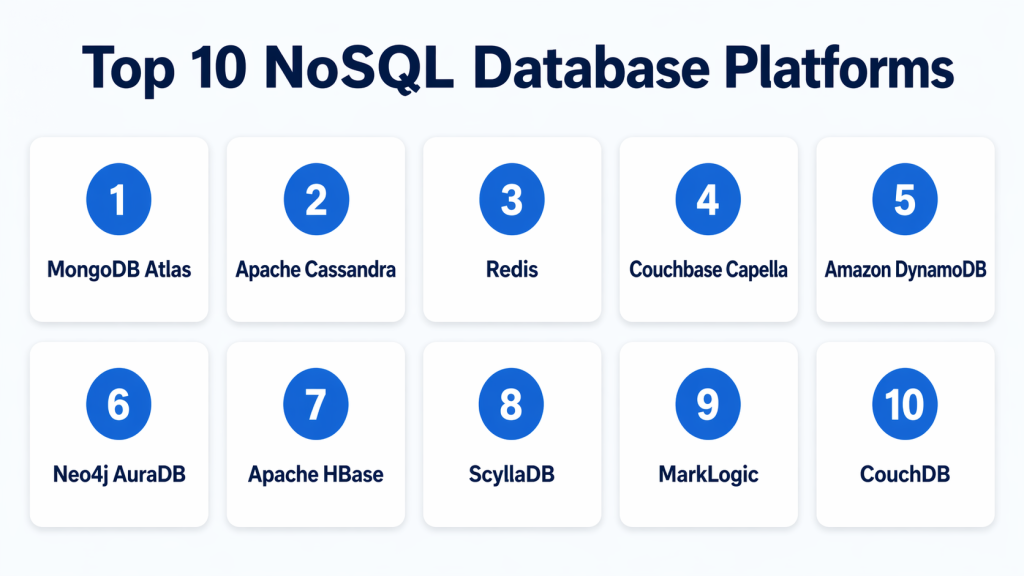
Top 10 NoSQL Database Platforms
#1 — MongoDB Atlas
Short description : MongoDB Atlas is one of the most widely recognized NoSQL platforms and is especially strong for document-oriented applications. It is built for teams that want schema flexibility, scalable application development, and a mature managed service experience. It fits startups, mid-market organizations, and enterprises building modern apps, internal platforms, content systems, and developer-facing services. Atlas is particularly attractive for teams that want a rich ecosystem without managing too much infrastructure directly. It is one of the strongest default choices in the document database category.
Key Features
- Document-oriented data model
- Fully managed cloud deployment option
- Automatic scaling, backup, and resilience features
- Broad developer tooling and drivers
- Search, analytics, and application platform extensions
- Strong network and encryption controls
- Support for modern authentication patterns
Pros
- Very strong ecosystem and developer adoption
- Excellent fit for flexible application data models
- Mature managed experience for teams wanting less ops burden
Cons
- Costs can rise with scale and premium managed usage
- Not the best fit for every strongly relational workload
- Some teams may prefer simpler databases for narrow use cases
Platforms / Deployment
- Web / Cloud
- Cloud / Hybrid
Security & Compliance
Supports authentication and authorization options, TLS encryption in transit, encryption at rest, network access controls, private connectivity options, and enterprise-grade security capabilities. Broad compliance posture varies by service scope and plan.
Integrations & Ecosystem
MongoDB has one of the richest ecosystems in NoSQL, with broad support across application frameworks, language drivers, analytics connectors, and cloud-native workflows.
- Rich language driver ecosystem
- Search and application platform extensions
- Broad cloud integration support
- Strong admin and observability tooling
Support & Community
Documentation is strong, community adoption is massive, and enterprise support options are available. It is one of the easiest NoSQL platforms to justify from a talent and ecosystem perspective.
#2 — Apache Cassandra
Short description : Apache Cassandra is a distributed wide-column NoSQL database designed for high availability, fault tolerance, and large-scale distributed workloads. It is best suited to teams that need predictable scalability across commodity infrastructure or cloud environments. Cassandra is commonly used for event-heavy systems, time-series style patterns, large-scale user data, and globally distributed application workloads. It is especially valuable when uptime and horizontal scale matter more than rich relational querying. It is a serious platform for operationally mature teams.
Key Features
- Distributed wide-column database architecture
- High availability and fault tolerance
- Horizontal scalability across clusters
- Strong write-heavy workload handling
- Multi-node and multi-datacenter deployment support
- Encryption options for client-to-node and node-to-node communication
- Mature production operational model
Pros
- Excellent for large-scale distributed workloads
- Strong resilience and availability profile
- Good fit for massive write-heavy systems
Cons
- Operational complexity is higher than many managed document databases
- Data modeling requires careful planning
- Not ideal for teams wanting simple onboarding
Platforms / Deployment
- Linux / Windows / Cloud environments
- Self-hosted / Hybrid
Security & Compliance
Supports TLS or SSL-style encryption for client-to-node and node-to-node traffic, along with security configuration options appropriate for production clusters. Broader packaged compliance claims are not publicly stated.
Integrations & Ecosystem
Cassandra integrates well into large-scale distributed application environments, especially where custom services, high write throughput, and resilient clusters are core requirements.
- Strong distributed system compatibility
- Good fit for event and telemetry pipelines
- Works well with containerized and cloud infrastructure
- Broad operational tooling ecosystem
Support & Community
The open-source ecosystem is mature, and enterprise-style support is available through commercial vendors. It is strongest for teams with experienced platform engineering capability.
#3 — Redis
Short description : Redis is one of the most popular NoSQL platforms for real-time data access, caching, session management, queues, leaderboards, and ultra-fast application workflows. It is built around an in-memory model and is widely used when latency is critical. While many teams first adopt it as a cache, Redis also plays a broader role as a real-time data platform. It is best for systems needing speed, transient state, and rapid response patterns. It is less appropriate as the only long-term system of record for every workload.
Key Features
- In-memory key-value database
- Extremely low-latency performance
- Broad support for caching and real-time workloads
- Role-based access control in managed and enterprise contexts
- TLS and encryption support
- Replication, clustering, and failover options
- Rich data structure support
Pros
- Excellent performance for real-time applications
- Broad adoption and strong developer familiarity
- Flexible for caching, messaging, and fast-access scenarios
Cons
- Not ideal as the only database for all persistence patterns
- Memory-centric workloads can become expensive
- Security and internet exposure must be handled carefully
Platforms / Deployment
- Linux / Cloud / Containers
- Cloud / Self-hosted / Hybrid
Security & Compliance
Supports access control, TLS, network security controls, encryption-at-rest in managed cloud offerings, and role-based access control in supported editions. Security posture depends on edition and deployment model.
Integrations & Ecosystem
Redis fits naturally into modern app stacks where speed, state, and real-time workflows matter. It also integrates well with observability, streaming, and cloud application environments.
- Broad language client support
- Strong cloud-native integration patterns
- Real-time application compatibility
- Popular in session, cache, and queue architectures
Support & Community
Community adoption is very strong, documentation is broad, and commercial support is available through managed and enterprise offerings.
#4 — Couchbase Capella
Short description : Couchbase Capella is a managed NoSQL platform built around document and operational data use cases, with an emphasis on application performance, flexible data handling, and operational simplicity. It is well suited to organizations building customer-facing applications that need scalability, managed operations, and strong security posture. Couchbase is especially compelling where teams want a database that can support operational use cases with low-latency access and cloud-managed deployment. It is a good fit for mid-market and enterprise teams that want a polished managed service. It is strongest when application performance and operational convenience matter together.
Key Features
- Managed cloud operational database platform
- Document-oriented data handling
- Automated setup, scaling, and backup workflows
- Strong security best-practice guidance
- Zero Trust-oriented security positioning
- Multi-region and application-focused deployment support
- Operational performance for user-facing applications
Pros
- Strong fit for modern operational applications
- Good balance of cloud convenience and platform depth
- Attractive for teams prioritizing managed simplicity
Cons
- Less mainstream than MongoDB in general mindshare
- Commercial cost may be higher than open-source self-managed paths
- Best value is often in managed cloud-centric usage
Platforms / Deployment
- Web / Cloud
- Cloud / Hybrid
Security & Compliance
Supports centralized management, adaptive access, security best practices, and a Zero Trust-oriented security posture in managed environments. Specific compliance scope varies by offering.
Integrations & Ecosystem
Couchbase fits well into customer-facing application stacks, cloud-native development patterns, and modern API-driven architectures.
- Cloud application integration support
- Strong operational app ecosystem fit
- Backup and scaling automation
- Developer-friendly managed workflows
Support & Community
Commercial support is available and documentation is solid. It is strongest for teams looking for vendor-backed operational confidence rather than community-only support.
#5 — Amazon DynamoDB
Short description : Amazon DynamoDB is a fully managed NoSQL key-value and document database service designed for high scale, low latency, and operational simplicity inside AWS environments. It is widely used for serverless architectures, high-throughput application workloads, session stores, and event-driven systems. DynamoDB is particularly strong when teams want a highly scalable database without managing infrastructure directly. It is a leading choice for AWS-native product teams. It is most compelling when cloud-managed convenience is more important than deep cross-platform portability.
Key Features
- Fully managed key-value and document database service
- High-scale, low-latency workload handling
- Automatic scalability and managed operations
- Encryption at rest by default
- Strong IAM-based access control integration
- Backup and global deployment features
- Strong fit for serverless architectures
Pros
- Excellent for AWS-native high-scale applications
- Very low operational burden
- Strong security and encryption defaults
Cons
- Best fit is often within AWS ecosystems
- Cost modeling needs attention at scale
- Data model decisions should be planned carefully up front
Platforms / Deployment
- Web / Cloud
- Cloud
Security & Compliance
Encrypts data at rest, uses AWS KMS-backed encryption options, and integrates tightly with AWS IAM for access control. Broader compliance posture depends on AWS service scope and customer configuration.
Integrations & Ecosystem
DynamoDB works especially well with other AWS services and is a natural fit for event-driven and serverless application architectures.
- Deep AWS ecosystem integration
- Serverless application support
- Strong API-driven access patterns
- Native backup and scaling workflows
Support & Community
AWS documentation is extensive, enterprise support options are available, and the platform is highly credible for teams already standardized on AWS.
#6 — Neo4j AuraDB
Short description : Neo4j AuraDB is a managed graph database platform built for applications and analytics where relationships between entities are the most important part of the data model. It is especially useful for fraud detection, identity graphs, recommendation engines, knowledge graphs, access analysis, and connected-data applications. Neo4j is a strong choice when teams need graph-native querying instead of forcing relationships into a document or relational structure. It is particularly attractive for relationship-rich business problems. It is less suitable when a simple key-value or document model is enough.
Key Features
- Managed graph database platform
- Role-based access control framework
- Fine-grained node and property-level access in supported tiers
- Secure private connectivity options
- Strong fit for connected-data workloads
- Scalable graph querying support
- Developer-friendly graph ecosystem
Pros
- Excellent for relationship-heavy data problems
- Strong security controls for graph use cases
- Very compelling for fraud, identity, and recommendation workloads
Cons
- Not the right fit for every generic application workload
- Graph modeling requires a different mindset than document databases
- Premium managed graph usage may be costly
Platforms / Deployment
- Web / Cloud
- Cloud / Hybrid
Security & Compliance
Supports role-based access control, fine-grained data access controls in supported tiers, secure private connectivity, and enterprise-grade security positioning. Compliance posture varies by tier and deployment path.
Integrations & Ecosystem
Neo4j integrates well into connected-data use cases and is especially powerful when combined with analytics, identity, AI, or relationship-driven application workflows.
- Strong graph developer ecosystem
- Private connectivity options
- Good fit for AI and knowledge graph use cases
- Broad language and API support
Support & Community
Documentation is strong, training resources are mature, and commercial support is available. Community strength is especially good among graph-focused practitioners.
#7 — Apache HBase
Short description : Apache HBase is a distributed wide-column NoSQL database built for large sparse datasets, high-scale serving layers, and big data-oriented environments. It is often used in analytics-heavy, security-event, audit-log, and large keyspace workloads where horizontal scale matters deeply. HBase is particularly valuable when organizations already operate in broader Hadoop-style or distributed data ecosystems. It is a serious platform for large-scale engineering teams. It is less attractive for teams wanting the easiest developer-first NoSQL experience.
Key Features
- Wide-column distributed data model
- Strong fit for sparse and large-scale datasets
- Good support for large keyspaces
- Useful for logs, counters, and event storage
- Security support through enterprise ecosystem implementations
- Strong scale-out architecture
- Suitable for big data-aligned environments
Pros
- Good fit for large sparse data workloads
- Strong scale profile for specialized use cases
- Useful in analytics and event-heavy systems
Cons
- Operational complexity can be significant
- Best value often depends on broader ecosystem alignment
- Less developer-friendly than some modern managed platforms
Platforms / Deployment
- Linux / Distributed cluster environments
- Self-hosted / Hybrid
Security & Compliance
Security support can include strong authentication and secure identification patterns in enterprise implementations. Compliance posture depends heavily on the distribution and deployment model.
Integrations & Ecosystem
HBase is strongest where it is part of a larger distributed data architecture rather than a standalone app database decision.
- Good fit for security analytics and audit-log workloads
- Strong alignment with large distributed data systems
- Useful for sparse and range-scan-heavy workloads
- Enterprise data engineering ecosystem compatibility
Support & Community
Community credibility is strong in big data circles, though onboarding is easier for experienced distributed systems teams than for general developers.
#8 — ScyllaDB
Short description : ScyllaDB is a high-performance distributed NoSQL database designed for low-latency and high-throughput workloads, often positioned as a Cassandra-compatible platform with performance advantages. It is attractive to teams handling demanding real-time applications, telemetry, user events, and other scale-intensive workloads. ScyllaDB is especially useful where teams want wide-column scale characteristics with strong operational performance. It suits technically mature teams that care deeply about performance efficiency. It is not the easiest option for teams seeking a simple plug-and-play entry point.
Key Features
- High-performance distributed NoSQL architecture
- Strong scale-out clustering model
- Backup and restore procedures
- Cluster management and maintenance workflows
- Migration compatibility for Cassandra-style environments
- Good fit for demanding real-time systems
- Operational tooling for performance-sensitive deployments
Pros
- Strong fit for high-throughput, low-latency workloads
- Attractive for performance-conscious infrastructure teams
- Good option for distributed scale scenarios
Cons
- Operationally more demanding than simpler managed platforms
- Best fit is often for technically mature teams
- Ecosystem reach is narrower than leading mainstream NoSQL brands
Platforms / Deployment
- Linux / Containers / Cloud
- Self-hosted / Cloud / Hybrid
Security & Compliance
Supports enterprise operational controls and secure deployment practices, but broad public compliance claims depend on edition and managed offering.
Integrations & Ecosystem
ScyllaDB fits well into observability, distributed tracing, event-heavy applications, and cloud-native performance-sensitive environments.
- Compatible with high-scale app architectures
- Useful in telemetry-heavy systems
- Integration options for monitoring and tracing ecosystems
- Migration-friendly for some Cassandra-style workloads
Support & Community
Commercial support is available and technical documentation is solid. Community mindshare is narrower than MongoDB or Redis, but credibility is high in performance-focused circles.
#9 — MarkLogic
Short description : MarkLogic is an enterprise NoSQL platform built for multi-model, secure, and governance-heavy data workloads. It is especially relevant in industries where complex documents, metadata, sensitive content, and strict access requirements matter. MarkLogic is often chosen for enterprise content, regulated information, and classified or policy-heavy data environments. It is a stronger fit for enterprise governance scenarios than for simple startup app development. It is best for organizations that need security depth and structured enterprise control over complex information assets.
Key Features
- Multi-model NoSQL platform
- Advanced security framework
- Compartment-style security capabilities
- Role and privilege-based access model
- Strong fit for sensitive and regulated content
- Enterprise-oriented operational model
- Telemetry control in self-managed deployments
Pros
- Strong security and governance depth
- Good fit for sensitive enterprise information
- Useful for complex document-centric environments
Cons
- Commercial complexity may be high
- Best value is usually in enterprise and regulated contexts
- Less attractive for lightweight app-first teams
Platforms / Deployment
- Linux / Enterprise server environments / Cloud options
- Self-hosted / Hybrid / Cloud
Security & Compliance
Supports roles, privileges, users, compartment-style security, and strong access-control-oriented architecture. Broader compliance claims depend on edition, deployment, and contract scope.
Integrations & Ecosystem
MarkLogic is strongest where content, metadata, governance, and policy-rich enterprise applications need to work together under tight security controls.
- Enterprise content and metadata workflows
- Strong governance-oriented architecture
- Advanced security ecosystem fit
- Useful for regulated document-heavy applications
Support & Community
Commercial support is a core strength. Community footprint is smaller than more mainstream developer-first NoSQL platforms, but enterprise buyers often value the vendor-backed model.
#10 — CouchDB
Short description : Apache CouchDB is a document-oriented NoSQL database known for replication, offline-friendly synchronization patterns, and a straightforward JSON-based approach. It is especially useful for applications that benefit from distributed document storage and sync-oriented workflows. CouchDB is not always the first choice for massive enterprise scale, but it remains a credible platform for certain application architectures. It works well where document flexibility and replication behavior are key considerations. It is best for teams whose workload aligns with its sync-friendly strengths.
Key Features
- Document-oriented JSON database model
- Replication-focused architecture
- HTTP and API-friendly access model
- Good fit for distributed and sync-aware apps
- Schema flexibility
- Operational simplicity for select use cases
- Open-source deployment model
Pros
- Strong fit for document sync-oriented workflows
- Easy-to-understand JSON-based model
- Good open-source option for specific app patterns
Cons
- Smaller mindshare than MongoDB
- Not always the best choice for very large-scale enterprise use
- Narrower ecosystem compared with top-tier NoSQL leaders
Platforms / Deployment
- Linux / macOS / Windows / Cloud environments
- Self-hosted / Hybrid
Security & Compliance
Supports administrative security and deployment controls appropriate to open-source document databases. Broad compliance certifications are not publicly stated.
Integrations & Ecosystem
CouchDB is best used where REST-friendly document handling and replication behavior matter more than broad enterprise platform depth.
- JSON-centric application compatibility
- Good fit for sync-heavy application designs
- Open-source deployment flexibility
- Developer-friendly document workflows
Support & Community
Community support exists and documentation is available, though the ecosystem is smaller than MongoDB, Redis, or DynamoDB.
Comparison Table (Top 10)
| Tool Name | Best For | Platform(s) Supported | Deployment (Cloud/Self-hosted/Hybrid) | Standout Feature | Public Rating |
|---|---|---|---|---|---|
| MongoDB Atlas | General-purpose document database workloads | Web / Cloud | Cloud / Hybrid | Mature managed document platform | N/A |
| Apache Cassandra | Large-scale distributed wide-column workloads | Linux / Windows / Cloud environments | Self-hosted / Hybrid | High availability and horizontal scale | N/A |
| Redis | Real-time caching and ultra-fast key-value workloads | Linux / Cloud / Containers | Cloud / Self-hosted / Hybrid | Extremely low-latency performance | N/A |
| Couchbase Capella | Managed operational application database use cases | Web / Cloud | Cloud / Hybrid | Managed operational NoSQL platform | N/A |
| Amazon DynamoDB | AWS-native high-scale serverless applications | Web / Cloud | Cloud | Fully managed high-scale NoSQL service | N/A |
| Neo4j AuraDB | Graph and relationship-heavy workloads | Web / Cloud | Cloud / Hybrid | Graph-native relationship modeling | N/A |
| Apache HBase | Sparse, large-scale, analytics-aligned datasets | Linux / Distributed cluster environments | Self-hosted / Hybrid | Wide-column scale for large datasets | N/A |
| ScyllaDB | High-performance distributed real-time workloads | Linux / Containers / Cloud | Self-hosted / Cloud / Hybrid | Performance-focused distributed NoSQL | N/A |
| MarkLogic | Secure enterprise document and multi-model workloads | Linux / Enterprise server environments | Self-hosted / Hybrid / Cloud | Advanced enterprise security model | N/A |
| CouchDB | Replication and sync-oriented document applications | Linux / macOS / Windows | Self-hosted / Hybrid | Replication-friendly document architecture | N/A |
Evaluation & Scoring of NoSQL Database Platforms
| Tool Name | Core (25%) | Ease (15%) | Integrations (15%) | Security (10%) | Performance (10%) | Support (10%) | Value (15%) | Weighted Total (0–10) |
|---|---|---|---|---|---|---|---|---|
| MongoDB Atlas | 9.3 | 8.8 | 9.2 | 8.8 | 8.8 | 9.0 | 7.8 | 8.83 |
| Apache Cassandra | 8.8 | 6.5 | 7.8 | 7.8 | 9.0 | 8.0 | 8.3 | 8.03 |
| Redis | 8.8 | 8.5 | 9.0 | 8.0 | 9.7 | 8.8 | 7.8 | 8.69 |
| Couchbase Capella | 8.6 | 8.2 | 8.2 | 8.5 | 8.7 | 8.4 | 7.5 | 8.25 |
| Amazon DynamoDB | 9.0 | 8.0 | 8.8 | 9.0 | 9.2 | 8.8 | 7.2 | 8.55 |
| Neo4j AuraDB | 8.7 | 7.8 | 8.0 | 8.8 | 8.5 | 8.5 | 7.0 | 8.15 |
| Apache HBase | 8.2 | 6.2 | 7.2 | 7.5 | 8.7 | 7.5 | 7.8 | 7.53 |
| ScyllaDB | 8.7 | 6.8 | 7.6 | 7.8 | 9.3 | 7.8 | 7.8 | 8.00 |
| MarkLogic | 8.6 | 6.8 | 7.5 | 9.0 | 8.5 | 8.2 | 6.5 | 7.88 |
| CouchDB | 7.8 | 7.8 | 7.0 | 6.8 | 7.8 | 7.2 | 8.5 | 7.68 |
These scores are comparative, not absolute. A higher score means the platform performs better within this specific model, not that it is the universal best choice for every use case. Document platforms often score strongly on developer flexibility, while graph and wide-column databases score best when their specific data model is the right fit. Managed services tend to do better on ease and operational simplicity, while self-managed platforms can score strongly on value and control. Use the scoring table as a shortlist guide, then validate with a real pilot.
Which NoSQL Database Platform Is Right for You?
Solo / Freelancer
If you are building smaller apps, prototypes, internal tools, or early-stage products, MongoDB Atlas, Redis, and CouchDB are practical starting points. MongoDB Atlas offers a very approachable document model and managed convenience. Redis is great for fast state, caching, and real-time needs. CouchDB can work well when sync-friendly document workflows matter more than scale-heavy enterprise requirements.
SMB
For most SMBs, MongoDB Atlas, Redis, Couchbase Capella, and Amazon DynamoDB are strong options depending on architecture. MongoDB Atlas is often the easiest general-purpose choice. Redis is excellent for speed-centric workloads. DynamoDB is compelling for AWS-native teams, while Couchbase Capella is attractive for customer-facing operational apps that need managed scale.
Mid-Market
Mid-market teams often need stronger governance, clearer security controls, and better operational resilience. MongoDB Atlas remains a top choice here because of ecosystem depth and platform maturity. DynamoDB is excellent for AWS-heavy teams. Neo4j AuraDB becomes attractive when fraud detection, identity relationships, or recommendation logic are important. Couchbase Capella also fits well where application performance and managed operations matter together.
Enterprise
Enterprises should choose based on data model fit, operational maturity, and governance requirements. MongoDB Atlas is strong for broad document use cases. Apache Cassandra and ScyllaDB are compelling for high-scale distributed systems. MarkLogic is better for governance-heavy enterprise content and secure multi-model needs. Neo4j AuraDB is especially strong for connected-data problems such as access intelligence, fraud, and knowledge graph scenarios.
Budget vs Premium
For budget-conscious teams, open-source or infrastructure-controlled paths such as Apache Cassandra, Redis OSS-style deployments, Apache HBase, CouchDB, and MongoDB self-managed patterns can look attractive. Premium managed services such as MongoDB Atlas, Couchbase Capella, Amazon DynamoDB, Neo4j AuraDB, and MarkLogic make more sense when operational simplicity, enterprise controls, or support quality justify the spend.
Feature Depth vs Ease of Use
If you want the easiest broad document platform, MongoDB Atlas is one of the safest picks. If you want maximum speed for real-time state, Redis stands out. If you want deeply distributed scale, Cassandra and ScyllaDB are stronger. If you need graph-native intelligence, Neo4j AuraDB is the better answer. If governance depth matters most, MarkLogic is more compelling than lighter developer-first platforms.
Integrations & Scalability
For broad application integration, MongoDB Atlas, Redis, and DynamoDB are very strong choices. For specialized scale-out patterns, Cassandra, ScyllaDB, and HBase are better aligned. For graph-centric or enterprise-content-heavy architectures, Neo4j AuraDB and MarkLogic are more strategic choices.
Security & Compliance Needs
If security and compliance are top priorities, focus on platforms with clearly documented controls and strong managed-service security posture. MongoDB Atlas, Amazon DynamoDB, Neo4j AuraDB, Couchbase Capella, and MarkLogic all stand out in different ways. Open-source platforms can still be excellent, but security posture depends more heavily on how you deploy, configure, and operate them.
Frequently Asked Questions (FAQs)
1. What is a NoSQL database platform?
A NoSQL database platform is a system designed to store and manage data outside the rigid table-and-row model of traditional relational databases. It can use document, key-value, graph, or wide-column models depending on the platform. These databases are especially useful when data structures change often or when scale and flexibility matter more than strict relational design. They are widely used in modern applications, real-time systems, and large distributed environments. The term covers several very different database types, so model fit matters a lot.
2. When should I choose NoSQL over a relational database?
Choose NoSQL when your workload benefits from schema flexibility, horizontal scale, low-latency access, or a data model that is not naturally relational. This is common in content systems, user profiles, event storage, recommendation engines, graph relationships, and real-time application state. If your application depends heavily on complex joins and strict relational integrity, a traditional relational database may still be better. Many modern architectures use both. The right answer depends on the workload, not on hype.
3. Which NoSQL model is best for application development?
It depends on the application. Document databases such as MongoDB are often the easiest general-purpose starting point for modern applications. Key-value platforms like Redis work best for speed, caching, and state-heavy use cases. Wide-column platforms like Cassandra and HBase are better for scale-out data patterns. Graph databases like Neo4j are best when relationships are the center of the business problem. The best model is the one that matches how your data is queried and changed.
4. Are managed NoSQL services better than self-hosted ones?
Managed services are often better for teams that want speed of adoption, lower ops burden, and easier scaling. They usually provide backups, failover, monitoring, and security features out of the box. Self-hosted deployments offer more control and may improve cost efficiency for certain steady-state workloads. However, they require more internal expertise and operational discipline. The right model depends on team maturity, compliance needs, budget, and infrastructure strategy.
5. Is MongoDB the best NoSQL database?
MongoDB is one of the strongest general-purpose NoSQL platforms, especially for document-based applications, but it is not the best answer for every workload. Redis is better for ultra-fast real-time data access. Cassandra and ScyllaDB are stronger for certain distributed high-scale patterns. Neo4j is better for graph workloads, and DynamoDB is excellent for AWS-native serverless use cases. “Best” always depends on data model fit, scale, and operational priorities. There is no universal winner.
6. Are NoSQL databases secure enough for enterprise use?
Yes, many NoSQL platforms offer strong enterprise-grade security controls. These can include encryption at rest, TLS in transit, role-based access control, network isolation, audit logging, and identity integration. However, the actual security posture depends heavily on the platform edition, deployment model, and your own configuration practices. A well-managed NoSQL platform can absolutely meet serious enterprise requirements. The key is to evaluate security features and operational discipline together.
7. What is the biggest mistake buyers make with NoSQL?
The biggest mistake is choosing a NoSQL platform because it is popular rather than because its data model fits the workload. Teams also underestimate operational complexity, especially with distributed self-managed systems. Another common mistake is ignoring future query patterns and growth needs. Some teams overbuy a complex platform when a simpler managed option would be enough. Others underbuy and later struggle with performance, security, or scale.
8. Can NoSQL platforms support analytics too?
Some can, but not all in the same way. Certain NoSQL platforms include search, analytics, or integrations with data processing tools. Others are mainly designed for operational application workloads and are best paired with a separate analytics stack. It is important to distinguish between a fast operational database and a system designed for deep analytical querying. Many teams use NoSQL for application data and send selected data into a warehouse or lakehouse for analytics. This hybrid approach is very common.
9. How should teams shortlist NoSQL platforms?
Start with the data model first: document, key-value, graph, or wide-column. Then evaluate scale needs, latency requirements, security expectations, deployment model, and team expertise. Shortlist two or three platforms that genuinely fit the workload rather than comparing every popular NoSQL brand at once. Run a pilot using real queries, realistic security controls, and representative traffic patterns. That gives a much better signal than marketing claims alone.
10. Can one company use multiple NoSQL databases?
Yes, and many do. A company may use Redis for caching and sessions, MongoDB for flexible application data, Neo4j for graph analysis, and Cassandra for high-scale event storage. This is common because NoSQL platforms are often optimized for specific workload patterns. The key is not avoiding variety at all costs, but keeping architecture intentional. Too many databases without clear purpose creates operational overhead, but the right mix can be very effective.
Conclusion
NoSQL database platforms are no longer niche tools used only by a few internet-scale companies. They are now a major part of modern application and data infrastructure, supporting document workloads, graph intelligence, real-time state, globally distributed services, and high-scale event-driven systems. The strongest options in this category each solve a different problem well, from MongoDB Atlas and DynamoDB for flexible managed app development, to Redis for speed, Cassandra and ScyllaDB for distributed scale, Neo4j for graph workloads, and MarkLogic for security-heavy enterprise information use cases.
The best NoSQL platform depends on your workload, not on brand familiarity alone. Start by narrowing the problem you are solving, then shortlist two or three platforms whose data model, security posture, and operating model truly fit that need. From there, run a practical pilot, validate integrations and access controls, and choose the option your team can operate confidently at real scale.
