Introduction
Public Key Infrastructure (PKI) Tools help organizations manage digital certificates, encryption keys, and identity verification systems to secure communications across networks, applications, and devices. PKI is the backbone of modern cybersecurity, enabling SSL/TLS encryption, digital signatures, secure authentication, and trusted communication.
As organizations expand across cloud, mobile, and hybrid environments, securing identities and communications has become critical. PKI tools provide centralized certificate lifecycle management, automation, and compliance support, ensuring trust in digital interactions.
Common use cases include:
- SSL/TLS certificate management
- Secure email communication
- Device and user authentication
- Digital signatures and document security
- API and application security
Key evaluation criteria:
- Certificate lifecycle management
- Automation and key management
- Integration with enterprise systems
- Scalability and performance
- Security and compliance support
- Ease of deployment
- Monitoring and reporting capabilities
- Multi-cloud and hybrid support
Best for: Enterprises, government organizations, financial institutions, and any organization requiring secure digital identity and communication.
Not ideal for: Small teams with minimal encryption or certificate needs.
Key Trends in PKI Tools
- Automation of certificate lifecycle management (CLM)
- Cloud-based PKI solutions replacing legacy systems
- Zero-trust architecture integration
- Increased use of DevSecOps-friendly PKI tools
- Shorter certificate lifespans and auto-renewals
- Integration with identity and access management (IAM)
- Support for multi-cloud PKI environments
- Hardware Security Module (HSM) integration
- Quantum-safe cryptography research and adoption
- API-first certificate management platforms
How We Evaluated PKI Tools (Methodology)
- Assessed certificate lifecycle management capabilities
- Evaluated key generation and cryptographic strength
- Reviewed automation and scalability features
- Considered integration with enterprise systems
- Assessed security standards and compliance support
- Evaluated ease of use and deployment flexibility
- Considered monitoring and reporting capabilities
- Assessed enterprise adoption and reliability
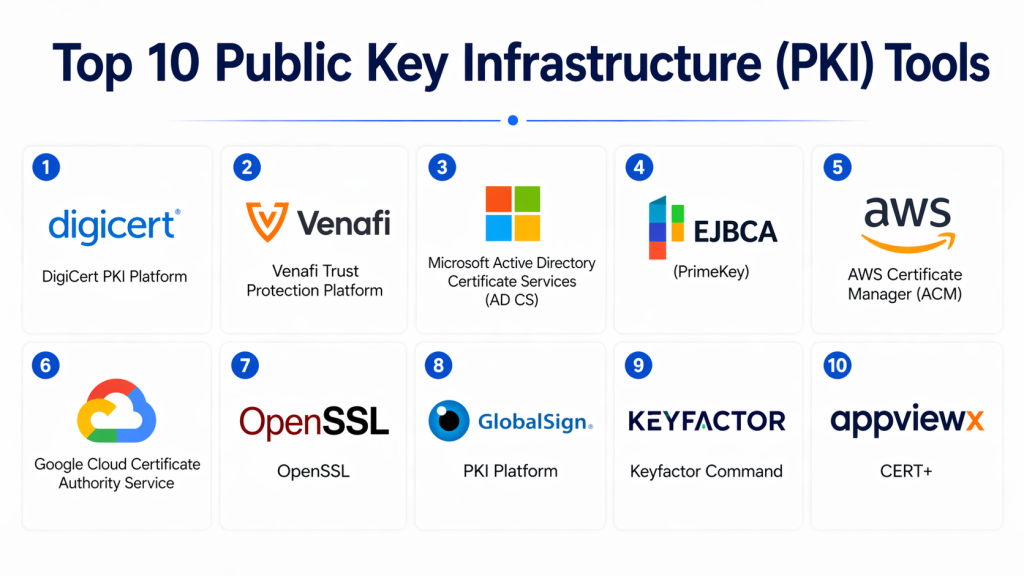
- Top 10 Public Key Infrastructure (PKI) Tools
#1 — DigiCert PKI Platform
Short description: A leading enterprise PKI platform offering certificate lifecycle management and digital trust services. Known for strong SSL/TLS certificate management. Widely used across enterprises for secure communications. Provides automation and compliance-ready features. Ideal for large-scale deployments.
Key Features
- Certificate lifecycle management
- SSL/TLS management
- Automation and renewal
- Key management
- Reporting and monitoring
Pros
- Highly trusted provider
- Strong enterprise adoption
Cons
- Premium pricing
- Complex enterprise setup
Platforms / Deployment
Cloud
Security & Compliance
Industry-standard encryption, audit logs (others not publicly stated)
Integrations & Ecosystem
- Enterprise systems
- APIs
- DevOps tools
Support & Community
Strong enterprise support.
#2 — Venafi Trust Protection Platform
Short description: A specialized PKI and certificate management platform focused on machine identity security. Helps manage TLS/SSL certificates at scale. Designed for enterprise DevOps environments.
Key Features
- Certificate lifecycle automation
- Machine identity management
- Policy enforcement
- Key protection
- Monitoring
Pros
- Strong automation
- Excellent for DevOps
Cons
- Complex setup
- Enterprise-focused pricing
Platforms / Deployment
Cloud / On-prem / Hybrid
Security & Compliance
Enterprise-grade encryption standards
Integrations & Ecosystem
- CI/CD tools
- Cloud platforms
- APIs
Support & Community
Enterprise support.
#3 — Microsoft Active Directory Certificate Services (AD CS)
Short description: A widely used PKI solution integrated with Windows environments. Provides certificate issuance and management for enterprise networks. Ideal for internal authentication systems.
Key Features
- Certificate issuance
- Identity management
- Policy-based control
- Integration with AD
- SSL/TLS support
Pros
- Deep Windows integration
- Cost-effective
Cons
- Limited cloud-native features
- Windows dependency
Platforms / Deployment
On-prem / Hybrid
Security & Compliance
Windows security standards
Integrations & Ecosystem
- Microsoft ecosystem
- Enterprise IT systems
Support & Community
Microsoft enterprise support.
#4 — EJBCA (PrimeKey)
Short description: An open-source enterprise PKI platform offering certificate authority capabilities. Known for flexibility and scalability. Suitable for government and enterprise use.
Key Features
- Certificate authority services
- Key management
- Automation
- Policy control
- API support
Pros
- Open-source flexibility
- Highly customizable
Cons
- Complex setup
- Requires expertise
Platforms / Deployment
On-prem / Cloud
Security & Compliance
Strong cryptographic standards
Integrations & Ecosystem
- DevOps tools
- APIs
Support & Community
Strong community + enterprise support.
#5 — AWS Certificate Manager (ACM)
Short description: A cloud-based PKI tool for managing SSL/TLS certificates in AWS environments. Simplifies certificate provisioning and deployment.
Key Features
- SSL/TLS certificate management
- Automated renewal
- AWS integration
- Load balancer support
- Monitoring
Pros
- Easy AWS integration
- Fully managed
Cons
- AWS ecosystem dependency
- Limited advanced PKI features
Platforms / Deployment
Cloud
Security & Compliance
AWS encryption standards
Integrations & Ecosystem
- AWS services
- APIs
Support & Community
AWS support.
#6 — Google Cloud Certificate Authority Service
Short description: A managed PKI service from Google Cloud offering certificate authority and lifecycle management capabilities.
Key Features
- Certificate authority management
- Key lifecycle control
- Automation
- IAM integration
- Monitoring
Pros
- Cloud-native design
- Strong Google integration
Cons
- GCP dependency
- Limited offline support
Platforms / Deployment
Cloud
Security & Compliance
Industry-standard encryption
Integrations & Ecosystem
- Google Cloud services
- APIs
Support & Community
Google Cloud support.
#7 — OpenSSL
Short description: A widely used open-source cryptographic toolkit for SSL/TLS and PKI operations. Popular among developers and security professionals.
Key Features
- Certificate generation
- Encryption tools
- SSL/TLS support
- Key management
- Command-line utilities
Pros
- Free and open-source
- Highly flexible
Cons
- No GUI
- Requires technical expertise
Platforms / Deployment
Cross-platform
Security & Compliance
Strong cryptographic algorithms
Integrations & Ecosystem
- Developer tools
- Applications
Support & Community
Large open-source community.
#8 — GlobalSign PKI Platform
Short description: A commercial PKI solution offering certificate lifecycle management and digital identity services. Focuses on enterprise-grade security.
Key Features
- Certificate management
- SSL/TLS automation
- Identity management
- Policy control
- Reporting
Pros
- Strong enterprise security
- Trusted provider
Cons
- Premium pricing
- Complex deployment
Platforms / Deployment
Cloud
Security & Compliance
Industry compliance standards
Integrations & Ecosystem
- Enterprise systems
- APIs
Support & Community
Enterprise support.
#9 — Keyfactor Command
Short description: A modern PKI and certificate lifecycle management platform designed for large-scale enterprises. Known for automation and scalability.
Key Features
- Certificate lifecycle automation
- Key management
- Policy enforcement
- Monitoring
- Reporting
Pros
- Strong automation
- Scalable
Cons
- High cost
- Learning curve
Platforms / Deployment
Cloud / Hybrid
Security & Compliance
Enterprise encryption standards
Integrations & Ecosystem
- DevOps tools
- APIs
Support & Community
Strong enterprise support.
#10 — AppViewX CERT+
Short description: A PKI automation platform focusing on certificate lifecycle management and DevOps integration. Designed for enterprise environments.
Key Features
- Certificate lifecycle automation
- Key management
- Policy enforcement
- API integration
- Monitoring
Pros
- Strong DevOps support
- Automation-focused
Cons
- Enterprise pricing
- Setup complexity
Platforms / Deployment
Cloud / Hybrid
Security & Compliance
Enterprise security standards
Integrations & Ecosystem
- DevOps tools
- Cloud platforms
Support & Community
Enterprise support.
Comparison Table (Top 10)
| Tool Name | Best For | Platform(s) | Deployment | Standout Feature | Public Rating |
|---|---|---|---|---|---|
| DigiCert | Enterprise PKI | Web | Cloud | Certificate management | N/A |
| Venafi | Machine identity | Web | Hybrid | Automation | N/A |
| Microsoft AD CS | Windows environments | On-prem | Hybrid | AD integration | N/A |
| EJBCA | Open-source PKI | Web | On-prem/Cloud | Flexibility | N/A |
| AWS ACM | AWS users | Web | Cloud | Auto SSL | N/A |
| Google CAS | GCP users | Web | Cloud | IAM integration | N/A |
| OpenSSL | Developers | CLI | On-prem | Open-source crypto | N/A |
| GlobalSign | Enterprise | Web | Cloud | Digital trust | N/A |
| Keyfactor | Enterprise PKI | Web | Hybrid | Automation | N/A |
| AppViewX | DevOps PKI | Web | Hybrid | Lifecycle automation | N/A |
Evaluation & Scoring of PKI Tools
| Tool | Core | Ease | Integrations | Security | Performance | Support | Value | Total |
|---|---|---|---|---|---|---|---|---|
| DigiCert | 9 | 8 | 9 | 9 | 9 | 9 | 7 | 8.6 |
| Venafi | 9 | 7 | 9 | 9 | 9 | 8 | 7 | 8.3 |
| Microsoft AD CS | 8 | 8 | 8 | 9 | 8 | 8 | 9 | 8.3 |
| EJBCA | 9 | 7 | 8 | 9 | 8 | 8 | 9 | 8.3 |
| AWS ACM | 8 | 9 | 9 | 9 | 9 | 9 | 8 | 8.7 |
| Google CAS | 8 | 9 | 9 | 9 | 9 | 8 | 8 | 8.6 |
| OpenSSL | 8 | 6 | 7 | 9 | 8 | 7 | 10 | 7.9 |
| GlobalSign | 9 | 7 | 8 | 9 | 8 | 8 | 7 | 8.2 |
| Keyfactor | 9 | 7 | 9 | 9 | 9 | 8 | 7 | 8.4 |
| AppViewX | 8 | 7 | 9 | 9 | 8 | 8 | 7 | 8.1 |
Which PKI Tool Is Right for You?
Solo / Freelancer
OpenSSL is best for basic cryptographic needs.
SMB
AWS ACM or Google CAS for simplicity.
Mid-Market
Keyfactor or GlobalSign for scalability.
Enterprise
DigiCert, Venafi, Microsoft AD CS.
Budget vs Premium
- Budget: OpenSSL
- Premium: DigiCert
Feature Depth vs Ease of Use
- Easy: AWS ACM
- Advanced: Venafi
Integrations & Scalability
- Best integrations: Keyfactor, Venafi
Security & Compliance
- Highest security: DigiCert, Venafi
FAQs
1. What is PKI?
PKI (Public Key Infrastructure) is a system used to manage digital certificates and encryption keys. It ensures secure communication over networks. It is essential for SSL/TLS security. It helps verify identities online.
2. Why is PKI important?
PKI ensures secure and trusted digital communication. It prevents unauthorized access and data breaches. It is widely used in enterprise security. It supports encryption and authentication.
3. Who uses PKI tools?
Enterprises, governments, and cloud providers use PKI tools. Developers also use them for secure applications. They are essential for secure infrastructure.
4. Are PKI tools expensive?
Costs vary based on scale and features. Enterprise solutions are expensive. Open-source tools are free.
5. What is a certificate authority (CA)?
A CA issues digital certificates that verify identities. It is a core part of PKI. It ensures trust in digital communication.
6. Can PKI be used in cloud?
Yes, most modern PKI tools support cloud environments. They integrate with AWS, Azure, and GCP. Cloud PKI is widely adopted.
7. Is PKI secure?
Yes, PKI uses strong cryptographic algorithms. It is highly secure when properly implemented. Security depends on key management.
8. What are common challenges?
Challenges include complexity and certificate management. Automation helps reduce issues. Proper configuration is required.
9. What are alternatives to PKI?
Alternatives include basic encryption methods, but they are not scalable. PKI is the industry standard for trust.
10. Does PKI support automation?
Yes, modern PKI tools support automation for certificate lifecycle management. This reduces manual effort and errors.
Conclusion
Public Key Infrastructure (PKI) tools are essential for securing digital identities, encrypting communications, and establishing trust in modern IT environments. As organizations increasingly rely on cloud services, APIs, and distributed systems, PKI ensures that data exchanges remain secure and authenticated. These tools form the foundation of cybersecurity by enabling SSL/TLS, digital signatures, and certificate-based authentication.
Choosing the right PKI solution depends on your infrastructure, scalability needs, and compliance requirements. Enterprises often prefer platforms like DigiCert or Venafi, while cloud-native teams benefit from AWS ACM or Google CAS. The best approach is to evaluate integration needs, automation capabilities, and security requirements before selecting a PKI system.
