Introduction
Consent Management Platforms (CMP) help organizations collect, manage, and document user consent for data collection and processing activities. These tools are essential for complying with privacy regulations such as GDPR, CCPA, and other global data protection laws. CMPs ensure that users have clear control over how their personal data is used, while organizations maintain compliance and transparency.
With increasing reliance on cookies, tracking technologies, and digital marketing tools, consent management has become a critical requirement for businesses operating online. Modern CMPs offer automation, real-time consent tracking, and integration with analytics and marketing platforms, enabling organizations to manage user preferences efficiently.
Common use cases include:
- Cookie consent banners and preference centers
- Managing user consent across websites and apps
- Compliance with privacy regulations
- Tracking consent history for audits
- Integration with marketing and analytics tools
Key evaluation criteria:
- Ease of implementation and customization
- Compliance support across multiple regulations
- User experience and interface design
- Integration with marketing and analytics tools
- Reporting and audit capabilities
- Scalability across regions and platforms
- Automation and real-time updates
- Cost and flexibility
Best for: Businesses with websites or apps collecting user data, digital marketing teams, compliance teams, and enterprises handling global audiences.
Not ideal for: Organizations without digital presence or minimal data collection requirements.
Key Trends in Consent Management Platforms (CMP)
- AI-driven consent optimization and personalization
- Increased focus on user experience and transparency
- Integration with privacy and data governance platforms
- Support for multi-region compliance requirements
- Real-time consent tracking and updates
- Expansion into mobile app consent management
- Automation of compliance workflows
- Granular consent controls for users
- Integration with marketing and analytics ecosystems
- Shift toward privacy-first digital strategies
How We Evaluated Consent Management Platforms (CMP) (Methodology)
- Assessed market adoption and vendor reputation
- Evaluated core consent management capabilities
- Reviewed compliance coverage across regulations
- Considered ease of implementation and customization
- Assessed integration ecosystem (analytics, marketing tools)
- Evaluated user experience and interface quality
- Considered performance and scalability
- Assessed fit across SMB, mid-market, and enterprise use cases
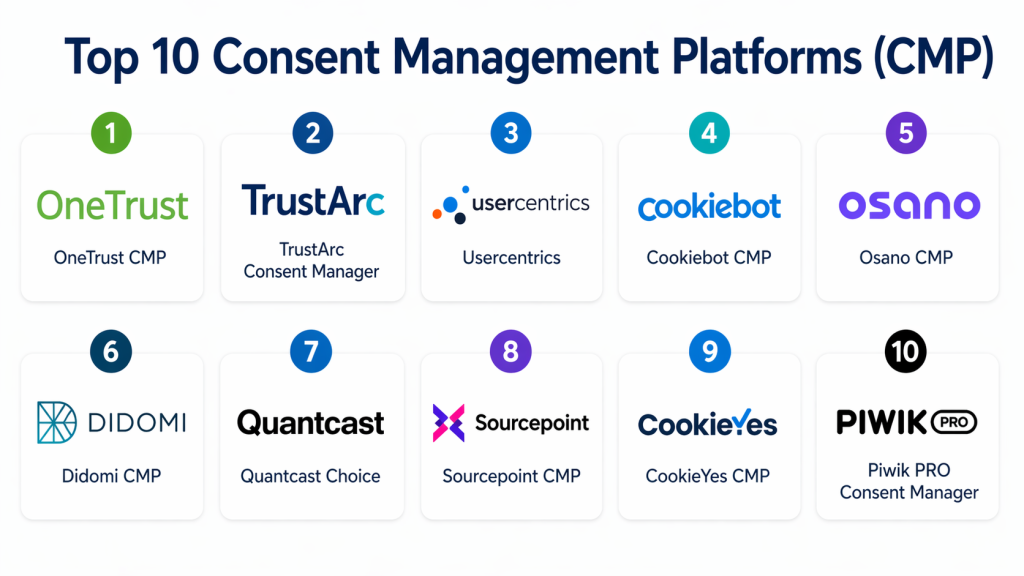
Top 10 Consent Management Platforms (CMP)
#1 — OneTrust CMP
Short description: A leading CMP solution offering comprehensive consent and privacy management capabilities. Widely used by enterprises for global compliance. Provides strong automation and reporting features. Ideal for large-scale deployments.
Key Features
- Cookie consent management
- Preference centers
- Compliance automation
- Reporting and analytics
- Multi-region support
Pros
- Comprehensive platform
- Strong compliance coverage
Cons
- Expensive
- Complex setup
Platforms / Deployment
Web / Cloud
Security & Compliance
Encryption, audit logs, GDPR support (others not publicly stated)
Integrations & Ecosystem
- Marketing platforms
- Analytics tools
- APIs
Support & Community
Strong enterprise support.
#2 — TrustArc Consent Manager
Short description: A well-established CMP focused on compliance and data governance. Offers robust consent tracking and reporting. Suitable for enterprises managing global privacy requirements.
Key Features
- Consent tracking
- Compliance reporting
- Data governance
- Preference management
- Analytics
Pros
- Strong compliance tools
- Reliable reporting
Cons
- UI complexity
- Premium pricing
Platforms / Deployment
Web / Cloud
Security & Compliance
Encryption, audit logs (others not publicly stated)
Integrations & Ecosystem
- Enterprise tools
- APIs
- Analytics platforms
Support & Community
Enterprise support.
#3 — Usercentrics
Short description: A popular CMP for SMBs and mid-market companies. Known for ease of use and strong compliance features. Provides customizable consent banners and integrations.
Key Features
- Consent banners
- Preference management
- Compliance tools
- Analytics integration
- Reporting
Pros
- Easy to use
- Affordable
Cons
- Limited enterprise features
- Smaller ecosystem
Platforms / Deployment
Web / Cloud
Security & Compliance
Encryption (others not publicly stated)
Integrations & Ecosystem
- Analytics tools
- Marketing platforms
- APIs
Support & Community
Good SMB support.
#4 — Cookiebot (Usercentrics CMP)
Short description: A widely used CMP for managing cookie consent and compliance. Offers automated scanning and consent management features. Suitable for websites of all sizes.
Key Features
- Cookie scanning
- Consent banners
- Compliance tools
- Reporting
- Automation
Pros
- Easy implementation
- Automated scanning
Cons
- Limited advanced features
- UI limitations
Platforms / Deployment
Web / Cloud
Security & Compliance
Encryption (others not publicly stated)
Integrations & Ecosystem
- Analytics tools
- Marketing platforms
- APIs
Support & Community
Good documentation.
#5 — Osano CMP
Short description: A user-friendly CMP focused on consent management and compliance automation. Suitable for SMBs and growing businesses. Offers strong reporting and ease of use.
Key Features
- Consent management
- Compliance automation
- Reporting
- Data mapping
- Integration
Pros
- Easy to use
- Affordable
Cons
- Limited enterprise features
- Smaller ecosystem
Platforms / Deployment
Web / Cloud
Security & Compliance
Encryption (others not publicly stated)
Integrations & Ecosystem
- SaaS tools
- APIs
Support & Community
SMB-focused support.
#6 — Didomi
Short description: A modern CMP designed for digital businesses and publishers. Offers strong consent management and analytics integration. Suitable for mid-market and enterprise.
Key Features
- Consent management
- Analytics integration
- Compliance tools
- Reporting
- Automation
Pros
- Strong integrations
- Good user experience
Cons
- Pricing complexity
- Limited SMB focus
Platforms / Deployment
Web / Cloud
Security & Compliance
Encryption, audit logs (others not publicly stated)
Integrations & Ecosystem
- Marketing platforms
- Analytics tools
- APIs
Support & Community
Good support.
#7 — Quantcast Choice
Short description: A free CMP offering basic consent management features. Suitable for small websites and publishers. Provides compliance support for major regulations.
Key Features
- Consent banners
- Compliance tools
- Reporting
- Analytics integration
- Automation
Pros
- Free tier available
- Easy to deploy
Cons
- Limited advanced features
- Basic reporting
Platforms / Deployment
Web / Cloud
Security & Compliance
Not publicly stated
Integrations & Ecosystem
- Analytics tools
- APIs
Support & Community
Community support available.
#8 — Sourcepoint
Short description: A CMP designed for publishers and enterprises managing digital content. Offers consent management and monetization features. Strong focus on user experience.
Key Features
- Consent management
- Preference centers
- Reporting
- Analytics
- Automation
Pros
- Strong UX
- Publisher-focused
Cons
- Limited SMB use
- Pricing complexity
Platforms / Deployment
Web / Cloud
Security & Compliance
Encryption (others not publicly stated)
Integrations & Ecosystem
- Marketing tools
- Analytics platforms
- APIs
Support & Community
Enterprise support.
#9 — CookieYes
Short description: A simple CMP focused on cookie consent and compliance. Suitable for SMBs and websites needing basic functionality. Easy to deploy and manage.
Key Features
- Cookie consent
- Compliance tools
- Reporting
- Automation
- Customization
Pros
- Easy setup
- Affordable
Cons
- Limited advanced features
- Basic analytics
Platforms / Deployment
Web / Cloud
Security & Compliance
Not publicly stated
Integrations & Ecosystem
- Website tools
- APIs
Support & Community
SMB support.
#10 — Piwik PRO Consent Manager
Short description: A CMP integrated with analytics platform, offering strong privacy-focused tracking and consent management. Suitable for organizations prioritizing privacy-first analytics.
Key Features
- Consent management
- Analytics integration
- Compliance tools
- Reporting
- Data protection
Pros
- Privacy-focused
- Integrated analytics
Cons
- Limited standalone use
- Smaller ecosystem
Platforms / Deployment
Web / Cloud
Security & Compliance
Encryption, audit logs (others not publicly stated)
Integrations & Ecosystem
- Analytics tools
- APIs
Support & Community
Good support.
Comparison Table (Top 10)
| Tool Name | Best For | Platform(s) | Deployment | Standout Feature | Public Rating |
|---|---|---|---|---|---|
| OneTrust | Enterprise | Web | Cloud | Compliance coverage | N/A |
| TrustArc | Compliance | Web | Cloud | Reporting | N/A |
| Usercentrics | SMB | Web | Cloud | Ease of use | N/A |
| Cookiebot | Websites | Web | Cloud | Auto scanning | N/A |
| Osano | SMB | Web | Cloud | Simplicity | N/A |
| Didomi | Mid-market | Web | Cloud | Integrations | N/A |
| Quantcast | Free use | Web | Cloud | Free CMP | N/A |
| Sourcepoint | Publishers | Web | Cloud | UX focus | N/A |
| CookieYes | SMB | Web | Cloud | Affordability | N/A |
| Piwik PRO | Analytics | Web | Cloud | Privacy analytics | N/A |
Evaluation & Scoring of Consent Management Platforms (CMP)
| Tool | Core | Ease | Integrations | Security | Performance | Support | Value | Total |
|---|---|---|---|---|---|---|---|---|
| OneTrust | 9 | 7 | 9 | 9 | 9 | 9 | 7 | 8.6 |
| TrustArc | 8 | 7 | 8 | 8 | 8 | 8 | 7 | 7.9 |
| Usercentrics | 7 | 9 | 8 | 7 | 8 | 7 | 9 | 8.0 |
| Cookiebot | 7 | 9 | 7 | 7 | 7 | 7 | 9 | 7.8 |
| Osano | 7 | 9 | 7 | 7 | 7 | 7 | 9 | 7.8 |
| Didomi | 8 | 8 | 9 | 8 | 8 | 8 | 8 | 8.2 |
| Quantcast | 6 | 9 | 6 | 6 | 7 | 6 | 10 | 7.5 |
| Sourcepoint | 8 | 8 | 8 | 8 | 8 | 8 | 7 | 8.0 |
| CookieYes | 6 | 9 | 6 | 6 | 7 | 6 | 9 | 7.4 |
| Piwik PRO | 8 | 8 | 7 | 8 | 8 | 7 | 8 | 8.0 |
Interpretation:
Higher scores indicate stronger capabilities across compliance, integrations, and scalability. Enterprise CMPs score higher in security and features, while SMB tools perform better in ease of use and value.
Which Consent Management Platform (CMP) Is Right for You?
Solo / Freelancer
CookieYes or Quantcast Choice are simple and cost-effective options.
SMB
Usercentrics or Osano provide ease of use and affordability.
Mid-Market
Didomi or Sourcepoint offer strong features and integrations.
Enterprise
OneTrust and TrustArc are top choices for compliance and scalability.
Budget vs Premium
- Budget: Quantcast, CookieYes
- Premium: OneTrust
Feature Depth vs Ease of Use
- Easy: Cookiebot
- Advanced: OneTrust
Integrations & Scalability
- Best integrations: Didomi, OneTrust
Security & Compliance
- High compliance: OneTrust, TrustArc
FAQs
1. What is a Consent Management Platform (CMP)?
A CMP is a tool that helps businesses collect and manage user consent for data processing. It ensures compliance with privacy regulations. It allows users to control how their data is used. CMPs are essential for websites using cookies and tracking technologies.
2. Why do businesses need CMPs?
CMPs help organizations comply with privacy laws like GDPR and CCPA. They ensure transparency and build trust with users. They also help avoid legal penalties. Managing consent manually is not practical at scale.
3. Are CMPs difficult to implement?
Most CMPs are designed for easy implementation with minimal coding. Setup time depends on the platform and requirements. Many tools offer templates and automation. Larger organizations may need more customization.
4. Do CMPs support multiple regulations?
Yes, most CMPs support multiple global regulations. They can adapt consent banners based on user location. This ensures compliance across regions. Capabilities vary by vendor.
5. Can CMPs integrate with marketing tools?
Yes, CMPs integrate with analytics and marketing platforms. This ensures data is collected only after consent. It improves compliance and data accuracy. Integration is a key feature.
6. Are CMPs expensive?
Pricing varies based on features and scale. Some tools offer free plans. Enterprise solutions are more expensive. Businesses should choose based on needs.
7. Do CMPs affect website performance?
Modern CMPs are optimized for performance. However, poorly configured tools may impact load time. Choosing the right platform helps minimize impact.
8. Can CMPs manage mobile app consent?
Yes, many CMPs support mobile applications. They provide SDKs for integration. This ensures consistent consent management across platforms.
9. What are common challenges?
Challenges include compliance complexity and integration issues. Proper configuration is important. Regular updates are required.
10. What are alternatives to CMPs?
Alternatives include manual consent management or basic scripts. However, they are not scalable. CMPs provide automation and compliance support.
Conclusion
Consent Management Platforms (CMPs) are a foundational component of modern privacy and compliance strategies, especially for organizations operating in digital ecosystems. As regulations continue to evolve and user awareness around data privacy increases, CMPs help businesses maintain transparency, build trust, and avoid regulatory risks. From cookie consent banners to advanced preference management and analytics integrations, these tools ensure that user data is handled responsibly and legally.
Choosing the right CMP depends on your organization’s size, regulatory exposure, and technical needs. Enterprises may benefit from robust platforms like OneTrust or TrustArc, while SMBs can opt for simpler solutions like Usercentrics or CookieYes. The best approach is to test a few platforms, evaluate their ease of implementation, integration capabilities, and compliance coverage, and then select the one that aligns with your long-term privacy strategy.
