Introduction
GRC (Governance, Risk & Compliance) platforms help organizations manage policies, identify risks, and ensure compliance with regulatory requirements in a structured and scalable way. These tools unify governance frameworks, risk assessments, audit processes, and compliance workflows into a single platform, enabling better visibility and control across the enterprise.
As businesses operate in increasingly complex environments with strict regulations, cybersecurity threats, and global operations, GRC platforms have become essential. Modern solutions leverage automation, AI-driven risk analytics, and real-time monitoring to streamline compliance and reduce operational risk. They are widely used by enterprises to maintain transparency, improve decision-making, and avoid regulatory penalties.
Common use cases include:
- Managing regulatory compliance (ISO, SOC, GDPR, etc.)
- Risk assessment and mitigation
- Internal audits and policy management
- Vendor and third-party risk management
- Business continuity and incident tracking
Key evaluation criteria:
- Risk management and assessment capabilities
- Compliance framework coverage
- Workflow automation and reporting
- Integration with enterprise systems
- Scalability and performance
- Ease of use and customization
- Audit and documentation features
- Security and data protection
Best for: Enterprises, compliance teams, risk managers, and organizations operating in regulated industries such as finance, healthcare, and technology.
Not ideal for: Small businesses with minimal compliance requirements or simple operational structures.
Key Trends in GRC Platforms
- AI-driven risk analytics and predictive insights
- Automation of compliance workflows and audits
- Integration with cybersecurity and IT risk tools
- Cloud-native GRC platforms gaining adoption
- Real-time risk monitoring and dashboards
- Focus on third-party and vendor risk management
- Expansion of global regulatory coverage
- Integration with ESG and sustainability reporting
- Centralized governance frameworks
- User-friendly interfaces and low-code customization
How We Evaluated GRC Platforms (Methodology)
- Assessed market adoption and enterprise usage
- Evaluated core GRC capabilities (governance, risk, compliance)
- Reviewed automation and analytics features
- Considered integration ecosystem and scalability
- Assessed security and compliance support
- Evaluated ease of deployment and customization
- Considered performance and reliability
- Assessed fit across SMB, mid-market, and enterprise
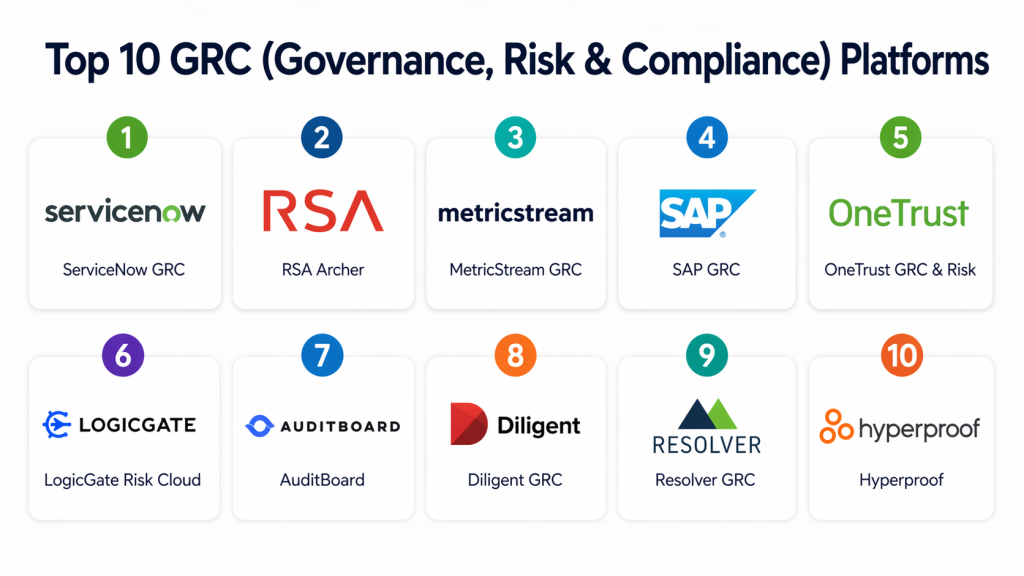
Top 10 GRC (Governance, Risk & Compliance) Platforms
#1 — ServiceNow GRC
Short description: A comprehensive GRC platform integrated within the ServiceNow ecosystem. Offers strong automation, risk management, and compliance workflows. Ideal for enterprises with complex IT environments. Provides real-time visibility and reporting. Widely adopted across industries.
Key Features
- Risk management
- Policy management
- Compliance tracking
- Workflow automation
- Reporting and dashboards
Pros
- Strong automation capabilities
- Scalable enterprise solution
Cons
- Expensive
- Complex implementation
Platforms / Deployment
Cloud
Security & Compliance
Encryption, audit logs, RBAC (others not publicly stated)
Integrations & Ecosystem
- ITSM tools
- Enterprise systems
- APIs
Support & Community
Strong enterprise support.
#2 — RSA Archer
Short description: A well-established GRC platform providing comprehensive risk and compliance management capabilities. Known for flexibility and customization. Suitable for large enterprises.
Key Features
- Risk management
- Compliance tracking
- Audit management
- Reporting
- Workflow automation
Pros
- Highly customizable
- Strong risk management
Cons
- Complex UI
- Requires expertise
Platforms / Deployment
Cloud / On-prem
Security & Compliance
Encryption, audit logs (others not publicly stated)
Integrations & Ecosystem
- Enterprise tools
- APIs
Support & Community
Enterprise support.
#3 — MetricStream GRC
Short description: A robust GRC platform offering integrated risk, compliance, and audit management. Known for scalability and enterprise adoption. Suitable for global organizations.
Key Features
- Risk assessment
- Compliance management
- Audit workflows
- Reporting
- Analytics
Pros
- Comprehensive features
- Scalable
Cons
- Complex setup
- Higher cost
Platforms / Deployment
Cloud
Security & Compliance
Encryption, audit logs (others not publicly stated)
Integrations & Ecosystem
- Enterprise systems
- APIs
Support & Community
Enterprise-level support.
#4 — SAP GRC
Short description: A GRC solution integrated within SAP ecosystem, focusing on governance and compliance for enterprise operations. Ideal for organizations using SAP systems.
Key Features
- Access control
- Risk management
- Compliance tracking
- Audit tools
- Reporting
Pros
- Strong SAP integration
- Enterprise-grade features
Cons
- Limited outside SAP ecosystem
- Complex deployment
Platforms / Deployment
Cloud / On-prem
Security & Compliance
Encryption, audit logs (others not publicly stated)
Integrations & Ecosystem
- SAP ecosystem
- APIs
Support & Community
Enterprise support.
#5 — OneTrust GRC & Risk
Short description: An extension of OneTrust platform focusing on risk and compliance management. Offers strong automation and regulatory coverage. Suitable for enterprises managing privacy and risk together.
Key Features
- Risk management
- Compliance automation
- Data governance
- Reporting
- Analytics
Pros
- Strong compliance coverage
- Integrated platform
Cons
- Expensive
- Complex setup
Platforms / Deployment
Cloud
Security & Compliance
Encryption, audit logs (others not publicly stated)
Integrations & Ecosystem
- Enterprise tools
- APIs
Support & Community
Strong enterprise support.
#6 — LogicGate Risk Cloud
Short description: A modern GRC platform offering flexible workflows and automation. Known for ease of customization and user-friendly interface. Suitable for mid-market and enterprises.
Key Features
- Risk workflows
- Automation
- Compliance tracking
- Reporting
- Integration
Pros
- Flexible platform
- Easy customization
Cons
- Limited advanced features
- Smaller ecosystem
Platforms / Deployment
Cloud
Security & Compliance
Encryption, audit logs (others not publicly stated)
Integrations & Ecosystem
- APIs
- Enterprise tools
Support & Community
Good support.
#7 — AuditBoard
Short description: A GRC platform focused on audit and compliance management. Offers strong reporting and collaboration features. Ideal for finance and compliance teams.
Key Features
- Audit management
- Compliance tracking
- Reporting
- Collaboration
- Workflow automation
Pros
- User-friendly
- Strong audit features
Cons
- Limited risk management depth
- Premium pricing
Platforms / Deployment
Cloud
Security & Compliance
Encryption, audit logs (others not publicly stated)
Integrations & Ecosystem
- Enterprise tools
- APIs
Support & Community
Good support.
#8 — Diligent GRC
Short description: A governance-focused platform providing tools for board management, risk, and compliance. Suitable for enterprises with strong governance needs.
Key Features
- Governance tools
- Risk management
- Compliance tracking
- Reporting
- Analytics
Pros
- Strong governance features
- Scalable
Cons
- Complex interface
- High cost
Platforms / Deployment
Cloud
Security & Compliance
Encryption, audit logs (others not publicly stated)
Integrations & Ecosystem
- Enterprise tools
- APIs
Support & Community
Enterprise support.
#9 — Resolver GRC
Short description: A risk intelligence platform focusing on risk and incident management. Provides strong analytics and reporting. Suitable for mid-market and enterprise.
Key Features
- Risk intelligence
- Incident management
- Analytics
- Reporting
- Automation
Pros
- Strong analytics
- Good reporting
Cons
- Limited compliance features
- UI complexity
Platforms / Deployment
Cloud
Security & Compliance
Encryption, audit logs (others not publicly stated)
Integrations & Ecosystem
- APIs
- Enterprise tools
Support & Community
Good support.
#10 — Hyperproof
Short description: A modern GRC platform focused on compliance automation and ease of use. Ideal for growing companies managing multiple frameworks.
Key Features
- Compliance automation
- Risk tracking
- Reporting
- Integration
- Workflow management
Pros
- Easy to use
- Affordable
Cons
- Limited enterprise features
- Smaller ecosystem
Platforms / Deployment
Cloud
Security & Compliance
Encryption, audit logs (others not publicly stated)
Integrations & Ecosystem
- SaaS tools
- APIs
Support & Community
SMB-focused support.
Comparison Table (Top 10)
| Tool Name | Best For | Platform(s) | Deployment | Standout Feature | Public Rating |
|---|---|---|---|---|---|
| ServiceNow | Enterprise | Web | Cloud | Workflow automation | N/A |
| RSA Archer | Enterprise | Web | Cloud/On-prem | Customization | N/A |
| MetricStream | Enterprise | Web | Cloud | Scalability | N/A |
| SAP GRC | SAP users | Web | Cloud/On-prem | SAP integration | N/A |
| OneTrust | Compliance | Web | Cloud | Regulatory coverage | N/A |
| LogicGate | Mid-market | Web | Cloud | Flexibility | N/A |
| AuditBoard | Audit teams | Web | Cloud | Audit workflows | N/A |
| Diligent | Governance | Web | Cloud | Board tools | N/A |
| Resolver | Risk analytics | Web | Cloud | Risk intelligence | N/A |
| Hyperproof | SMB | Web | Cloud | Ease of use | N/A |
Evaluation & Scoring of GRC Platforms
| Tool | Core | Ease | Integrations | Security | Performance | Support | Value | Total |
|---|---|---|---|---|---|---|---|---|
| ServiceNow | 9 | 7 | 9 | 9 | 9 | 9 | 7 | 8.6 |
| RSA Archer | 9 | 6 | 8 | 9 | 8 | 8 | 7 | 8.1 |
| MetricStream | 9 | 6 | 8 | 9 | 8 | 8 | 7 | 8.1 |
| SAP GRC | 8 | 6 | 9 | 9 | 8 | 8 | 7 | 8.0 |
| OneTrust | 8 | 7 | 8 | 9 | 8 | 8 | 7 | 8.0 |
| LogicGate | 8 | 8 | 7 | 8 | 8 | 7 | 8 | 7.9 |
| AuditBoard | 8 | 9 | 7 | 8 | 8 | 8 | 8 | 8.2 |
| Diligent | 8 | 7 | 7 | 8 | 8 | 8 | 7 | 7.9 |
| Resolver | 7 | 7 | 7 | 8 | 7 | 7 | 8 | 7.5 |
| Hyperproof | 7 | 9 | 7 | 7 | 7 | 7 | 9 | 7.8 |
Interpretation:
Higher scores indicate stronger capabilities across governance, risk, and compliance. Enterprise platforms excel in scalability and integrations, while modern tools offer better usability and value.
Which GRC Platform Is Right for You?
Solo / Freelancer
Not typically required unless handling compliance-heavy operations.
SMB
Hyperproof or LogicGate are simple and cost-effective.
Mid-Market
AuditBoard or Resolver offer balanced features.
Enterprise
ServiceNow, RSA Archer, and MetricStream are top choices.
Budget vs Premium
- Budget: Hyperproof
- Premium: ServiceNow
Feature Depth vs Ease of Use
- Easy: AuditBoard
- Advanced: RSA Archer
Integrations & Scalability
- Best integrations: ServiceNow, SAP
Security & Compliance
- High compliance: OneTrust, MetricStream
FAQs
1. What is a GRC platform?
A GRC platform is a tool that helps organizations manage governance, risk, and compliance processes in one place. It centralizes policies, risk assessments, and audits. This improves visibility and decision-making across teams. It is widely used in regulated industries to ensure compliance and reduce operational risks.
2. Who should use GRC tools?
GRC tools are mainly used by enterprises, compliance officers, risk managers, and audit teams. Organizations dealing with strict regulations benefit the most. Industries like finance, healthcare, and technology rely heavily on them. They help manage complex compliance and risk environments efficiently.
3. Are GRC platforms expensive?
The cost of GRC platforms varies depending on features, scale, and vendor. Enterprise-grade solutions are usually expensive due to advanced capabilities. Smaller or modern tools offer more affordable pricing options. Organizations should evaluate cost based on risk reduction and compliance needs.
4. How long does it take to implement a GRC platform?
Implementation time depends on the size and complexity of the organization. Large enterprises may take weeks or even months to fully deploy. Cloud-based solutions are generally faster to implement. Proper planning and configuration are key to a successful rollout.
5. Do GRC platforms support multiple regulations?
Yes, most GRC platforms support multiple global regulations such as GDPR, ISO standards, and industry-specific frameworks. They help organizations track compliance requirements across regions. This reduces the risk of penalties and ensures consistent governance practices.
6. Can GRC tools integrate with other systems?
GRC tools commonly integrate with enterprise systems like ERP, CRM, and security platforms. APIs allow seamless data exchange and automation. Integration improves efficiency and reduces manual effort. It also helps create a unified risk and compliance view.
7. Are GRC platforms secure?
Most GRC platforms include strong security features such as encryption, access controls, and audit logs. These features help protect sensitive compliance and risk data. Security capabilities may vary by vendor. Organizations should evaluate security standards before selecting a tool.
8. What are common challenges when using GRC tools?
Common challenges include complex implementation, customization requirements, and user adoption issues. Organizations may also face integration difficulties. Proper training and planning can help overcome these challenges. Choosing the right tool simplifies the process.
9. What are alternatives to GRC platforms?
Alternatives include manual processes, spreadsheets, or standalone compliance tools. However, these approaches lack automation and scalability. GRC platforms provide a centralized and efficient solution. They are better suited for modern enterprise environments.
10. Do GRC platforms use AI?
Yes, many modern GRC platforms use AI for risk analysis and predictive insights. AI helps identify potential risks and automate compliance tasks. This improves accuracy and efficiency. It also supports better decision-making for organizations.
Conclusion
GRC platforms have become a foundational component for organizations managing governance, risk, and compliance in complex regulatory environments. As businesses expand across regions and industries, the need for centralized visibility, automated workflows, and real-time risk monitoring continues to grow. Modern GRC tools provide a unified approach to managing compliance requirements, mitigating risks, and improving organizational transparency.
Choosing the right GRC platform depends on your organization’s size, regulatory requirements, and operational complexity. Enterprises may require robust platforms like ServiceNow or RSA Archer, while mid-market and SMB organizations can benefit from more flexible and cost-effective solutions like LogicGate or Hyperproof. The best approach is to evaluate multiple tools, run pilot implementations, and ensure they align with your governance and compliance strategy before making a final decision.
