Introduction
Privacy Management Tools help organizations manage, protect, and govern personal data in compliance with global data protection regulations such as GDPR, CCPA, and other privacy laws. These platforms enable businesses to track data flows, manage consent, automate privacy workflows, and ensure regulatory compliance across systems and geographies.
As organizations increasingly rely on cloud platforms, customer data platforms, and digital services, managing privacy has become more complex and critical. Modern privacy tools use automation, AI-driven classification, and real-time monitoring to help organizations reduce risk and maintain trust with customers and regulators.
Common use cases include:
- Managing user consent and preferences
- Data mapping and inventory tracking
- Privacy impact assessments (PIA/DPIA)
- Compliance reporting and audits
- Handling data subject access requests (DSARs)
Key evaluation criteria:
- Data discovery and classification capabilities
- Consent and preference management
- Automation of privacy workflows
- Integration with enterprise systems
- Compliance support across regulations
- Reporting and audit features
- Scalability and performance
- Ease of use and deployment
Best for: Enterprises, legal teams, compliance officers, and organizations handling customer or employee data at scale.
Not ideal for: Small businesses with minimal data collection or simple compliance needs.
Key Trends in Privacy Management Tools
- AI-driven data discovery and classification
- Automation of DSAR and compliance workflows
- Integration with cloud and SaaS ecosystems
- Real-time consent and preference management
- Expansion of global privacy regulations support
- Privacy-by-design frameworks gaining adoption
- Centralized data governance platforms
- Enhanced reporting and audit capabilities
- Integration with security and risk management tools
- Focus on customer trust and transparency
How We Evaluated Privacy Management Tools (Methodology)
- Assessed market adoption and enterprise usage
- Evaluated core privacy management capabilities
- Reviewed automation and AI features
- Considered integration ecosystem and scalability
- Assessed compliance and regulatory coverage
- Evaluated ease of use and deployment
- Considered performance and reliability
- Assessed fit across SMB, mid-market, and enterprise
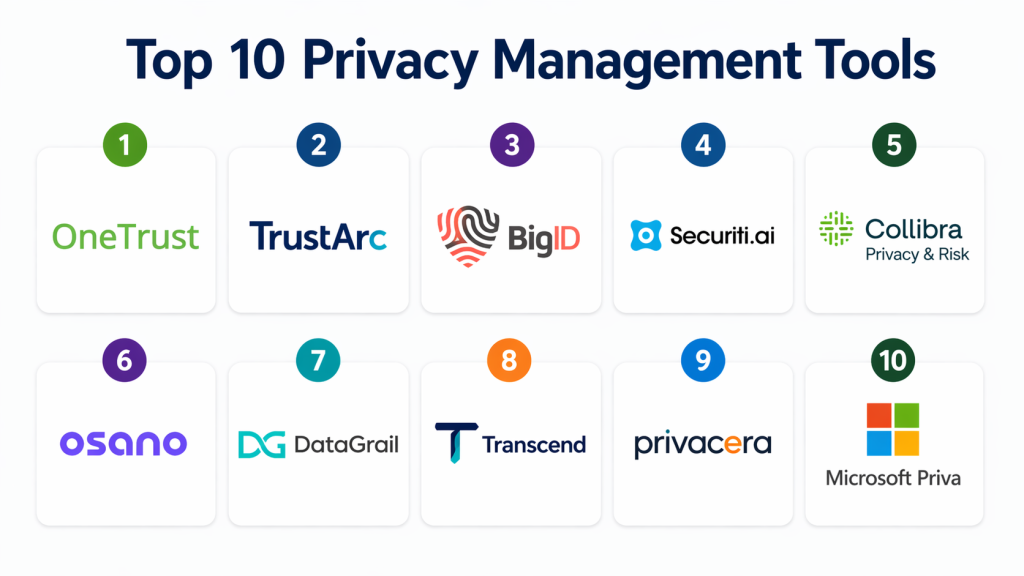
Top 10 Privacy Management Tools
#1 — OneTrust
Short description: A leading privacy management platform offering comprehensive tools for compliance, consent management, and data governance. Widely used by enterprises globally. Known for scalability and regulatory coverage. Supports multiple privacy frameworks. Ideal for large organizations.
Key Features
- Consent management
- Data mapping
- DSAR automation
- Compliance reporting
- Risk management
Pros
- Comprehensive platform
- Strong compliance coverage
Cons
- Expensive
- Complex setup
Platforms / Deployment
Cloud
Security & Compliance
Encryption, audit logs, GDPR support (others not publicly stated)
Integrations & Ecosystem
- Cloud platforms
- Enterprise tools
- APIs
Support & Community
Strong enterprise support.
#2 — TrustArc
Short description: A well-established privacy platform providing tools for compliance, data governance, and risk management. Known for strong analytics and regulatory expertise. Suitable for enterprises.
Key Features
- Privacy assessments
- Data governance
- Risk analytics
- Compliance management
- Reporting
Pros
- Strong analytics
- Regulatory expertise
Cons
- UI complexity
- Premium pricing
Platforms / Deployment
Cloud
Security & Compliance
Encryption, audit logs (others not publicly stated)
Integrations & Ecosystem
- Enterprise tools
- APIs
- Cloud platforms
Support & Community
Enterprise support.
#3 — BigID
Short description: A data-centric privacy and security platform focusing on data discovery and classification. Uses AI to identify sensitive data across systems. Ideal for large enterprises.
Key Features
- Data discovery
- Classification
- Risk analysis
- Compliance tools
- Automation
Pros
- Strong AI capabilities
- Deep data visibility
Cons
- Complex deployment
- High cost
Platforms / Deployment
Cloud / Hybrid
Security & Compliance
Encryption, audit logs (others not publicly stated)
Integrations & Ecosystem
- Data platforms
- Cloud services
- APIs
Support & Community
Enterprise support.
#4 — Securiti.ai
Short description: A modern privacy platform offering automation and AI-driven data intelligence. Provides tools for compliance and governance. Suitable for cloud-first organizations.
Key Features
- Data intelligence
- Automation
- Compliance management
- Risk assessment
- Reporting
Pros
- AI-driven features
- Easy deployment
Cons
- Emerging platform
- Limited ecosystem
Platforms / Deployment
Cloud
Security & Compliance
Encryption, audit logs (others not publicly stated)
Integrations & Ecosystem
- Cloud platforms
- APIs
Support & Community
Growing support ecosystem.
#5 — Collibra Privacy & Risk
Short description: Part of Collibra’s data governance platform, offering privacy management and risk assessment tools. Suitable for organizations already using Collibra.
Key Features
- Data governance
- Privacy workflows
- Risk management
- Compliance
- Reporting
Pros
- Strong governance integration
- Scalable
Cons
- Requires Collibra ecosystem
- Complex setup
Platforms / Deployment
Cloud
Security & Compliance
Encryption, audit logs (others not publicly stated)
Integrations & Ecosystem
- Data platforms
- APIs
Support & Community
Enterprise support.
#6 — Osano
Short description: A privacy platform focused on consent management and compliance automation. Known for ease of use and affordability. Suitable for SMBs and mid-market.
Key Features
- Consent management
- Compliance tools
- Data mapping
- Automation
- Reporting
Pros
- Easy to use
- Affordable
Cons
- Limited enterprise features
- Smaller ecosystem
Platforms / Deployment
Cloud
Security & Compliance
Encryption (others not publicly stated)
Integrations & Ecosystem
- SaaS tools
- APIs
Support & Community
SMB-focused support.
#7 — DataGrail
Short description: A privacy management platform designed to automate data privacy workflows. Provides strong DSAR automation and integrations. Ideal for modern SaaS companies.
Key Features
- DSAR automation
- Data mapping
- Integrations
- Compliance
- Reporting
Pros
- Strong automation
- Easy integration
Cons
- Limited advanced analytics
- Premium pricing
Platforms / Deployment
Cloud
Security & Compliance
Encryption, audit logs (others not publicly stated)
Integrations & Ecosystem
- SaaS platforms
- APIs
Support & Community
Good support.
#8 — Transcend
Short description: A privacy platform focusing on data subject rights and automation. Provides tools for consent and data management. Suitable for modern digital businesses.
Key Features
- Data rights management
- Automation
- Consent tools
- Integrations
- Reporting
Pros
- Strong automation
- Developer-friendly
Cons
- Limited enterprise features
- Smaller ecosystem
Platforms / Deployment
Cloud
Security & Compliance
Encryption (others not publicly stated)
Integrations & Ecosystem
- SaaS tools
- APIs
Support & Community
Growing support.
#9 — Privacera
Short description: A privacy and data governance platform focusing on access control and compliance. Suitable for enterprises managing large datasets.
Key Features
- Access control
- Data governance
- Compliance
- Monitoring
- Reporting
Pros
- Strong data governance
- Scalable
Cons
- Complex setup
- Enterprise-focused
Platforms / Deployment
Cloud / Hybrid
Security & Compliance
Encryption, RBAC, audit logs (others not publicly stated)
Integrations & Ecosystem
- Data platforms
- Cloud services
- APIs
Support & Community
Enterprise support.
#10 — Microsoft Priva
Short description: Microsoft’s privacy management solution integrated within its ecosystem. Provides tools for data protection and compliance. Ideal for organizations using Microsoft services.
Key Features
- Data protection
- Risk management
- Compliance tools
- Analytics
- Integration
Pros
- Deep Microsoft integration
- Easy for existing users
Cons
- Limited outside Microsoft ecosystem
- Dependency on Microsoft tools
Platforms / Deployment
Cloud
Security & Compliance
Encryption, audit logs (others not publicly stated)
Integrations & Ecosystem
- Microsoft ecosystem
- Cloud services
- APIs
Support & Community
Strong enterprise support.
Comparison Table (Top 10)
| Tool Name | Best For | Platform(s) | Deployment | Standout Feature | Public Rating |
|---|---|---|---|---|---|
| OneTrust | Enterprise | Web | Cloud | Compliance coverage | N/A |
| TrustArc | Compliance | Web | Cloud | Analytics | N/A |
| BigID | Data discovery | Web | Cloud/Hybrid | AI classification | N/A |
| Securiti | Cloud-first | Web | Cloud | Automation | N/A |
| Collibra | Governance | Web | Cloud | Integration | N/A |
| Osano | SMB | Web | Cloud | Ease of use | N/A |
| DataGrail | SaaS | Web | Cloud | DSAR automation | N/A |
| Transcend | Automation | Web | Cloud | Data rights | N/A |
| Privacera | Data governance | Web | Cloud/Hybrid | Access control | N/A |
| Microsoft Priva | Microsoft users | Web | Cloud | Integration | N/A |
Evaluation & Scoring of Privacy Management Tools
| Tool | Core | Ease | Integrations | Security | Performance | Support | Value | Total |
|---|---|---|---|---|---|---|---|---|
| OneTrust | 9 | 7 | 9 | 9 | 9 | 9 | 7 | 8.6 |
| TrustArc | 8 | 7 | 8 | 8 | 8 | 8 | 7 | 7.9 |
| BigID | 9 | 6 | 8 | 9 | 8 | 8 | 7 | 8.1 |
| Securiti | 8 | 8 | 7 | 8 | 8 | 7 | 8 | 8.0 |
| Collibra | 8 | 7 | 9 | 9 | 8 | 8 | 7 | 8.1 |
| Osano | 7 | 9 | 7 | 7 | 7 | 7 | 9 | 7.9 |
| DataGrail | 8 | 8 | 8 | 8 | 8 | 8 | 8 | 8.0 |
| Transcend | 7 | 8 | 8 | 7 | 7 | 7 | 8 | 7.6 |
| Privacera | 8 | 6 | 9 | 9 | 8 | 8 | 7 | 8.0 |
| Microsoft Priva | 8 | 8 | 9 | 9 | 8 | 9 | 8 | 8.4 |
Interpretation:
Higher scores indicate stronger capabilities across core features, integrations, and compliance. Enterprise tools typically score higher in security and scalability, while simpler tools excel in ease of use and value.
Which Privacy Management Tool Is Right for You?
Solo / Freelancer
Not typically required unless handling large-scale personal data.
SMB
Osano or Transcend are simple and cost-effective options.
Mid-Market
DataGrail or Securiti provide balanced features.
Enterprise
OneTrust, BigID, and Collibra are top choices.
Budget vs Premium
- Budget: Osano
- Premium: OneTrust
Feature Depth vs Ease of Use
- Easy: Osano
- Advanced: BigID
Integrations & Scalability
- Best integrations: Microsoft Priva, Collibra
Security & Compliance
- High compliance: OneTrust, Privacera
FAQs
1. What are privacy management tools?
Privacy management tools help organizations handle personal data responsibly and comply with regulations. They manage consent, track data usage, and automate compliance workflows. These tools reduce risk and improve transparency. They are essential for modern data-driven businesses.
2. Who should use privacy management tools?
These tools are used by enterprises, legal teams, and compliance officers. Organizations handling customer or employee data benefit the most. They are especially important in regulated industries. Smaller businesses may not need advanced solutions.
3. Are privacy tools expensive?
Pricing varies depending on features and scale. Enterprise tools are typically expensive. SMB tools offer more affordable options. Organizations should choose based on their needs.
4. Do these tools support global regulations?
Yes, most tools support regulations like GDPR and CCPA. They help organizations maintain compliance across regions. Capabilities vary by vendor.
5. How long does implementation take?
Implementation can take days to weeks. It depends on organization size and complexity. Cloud tools are faster to deploy.
6. Do privacy tools use AI?
Yes, many tools use AI for data discovery and classification. This improves efficiency and accuracy. It reduces manual effort.
7. Can these tools integrate with existing systems?
Yes, most tools integrate with cloud platforms and enterprise systems. APIs allow customization. Integration improves efficiency.
8. Are they secure?
Most tools include encryption and access controls. Security features depend on the vendor. Compliance support is important.
9. What are common challenges?
Challenges include complex deployment and integration. Training may be required. Proper planning helps overcome issues.
10. What are alternatives?
Alternatives include manual processes or basic tools. However, they lack automation. Privacy tools provide better efficiency.
Conclusion
Privacy management tools have become essential for organizations navigating the growing complexity of data protection regulations and customer expectations. As businesses collect and process increasing amounts of personal data across cloud platforms, these tools provide the structure, automation, and visibility needed to maintain compliance and reduce risk. From consent management to data mapping and DSAR automation, modern platforms enable organizations to implement privacy-by-design principles effectively.
Choosing the right privacy management tool depends on your organization’s size, regulatory exposure, and technical ecosystem. Enterprises may benefit from comprehensive platforms like OneTrust or BigID, while smaller teams can opt for simpler tools like Osano or Transcend. The best approach is to evaluate a few options, run pilot implementations, and ensure they align with your compliance workflows, integrations, and long-term privacy strategy.
