Introduction
eDiscovery software helps organizations identify, collect, process, review, and produce electronically stored information (ESI) for legal cases, investigations, and compliance requirements. It plays a crucial role in modern litigation, regulatory audits, and internal investigations by ensuring that relevant data is handled efficiently and defensibly.
With the explosion of emails, cloud data, collaboration tools, and digital records, eDiscovery has become more complex and essential. Modern platforms now leverage AI, machine learning, and automation to speed up document review, reduce costs, and improve accuracy. These tools are widely used by legal teams, compliance officers, and enterprises dealing with large volumes of sensitive data.
Common use cases include:
- Legal case preparation and litigation support
- Regulatory compliance and audits
- Internal investigations and HR cases
- Data governance and retention management
- Email and document review
Key evaluation criteria:
- Data collection and processing capabilities
- AI-powered review and analytics
- Scalability for large datasets
- Integration with cloud platforms and tools
- Security and compliance features
- Ease of use and collaboration
- Reporting and audit trails
- Cost and licensing flexibility
Best for: Law firms, corporate legal teams, compliance departments, and enterprises managing large volumes of digital data.
Not ideal for: Small businesses with minimal legal or compliance requirements.
Key Trends in eDiscovery Software
- AI-powered document review reducing manual effort
- Cloud-native eDiscovery platforms gaining adoption
- Automation of legal workflows and case management
- Integration with collaboration tools like email and messaging platforms
- Advanced analytics and predictive coding
- Focus on data privacy and compliance regulations
- Cross-border data handling capabilities
- Real-time collaboration and case sharing
- Cost optimization through automation
- Scalable solutions for enterprise environments
How We Evaluated eDiscovery Software (Methodology)
- Assessed market adoption and legal industry usage
- Evaluated core eDiscovery capabilities (collection, review, production)
- Reviewed AI and automation features
- Considered performance and scalability
- Assessed security and compliance capabilities
- Evaluated ease of use and collaboration features
- Considered integration ecosystem (cloud, email, storage)
- Assessed fit across law firms, enterprises, and compliance teams
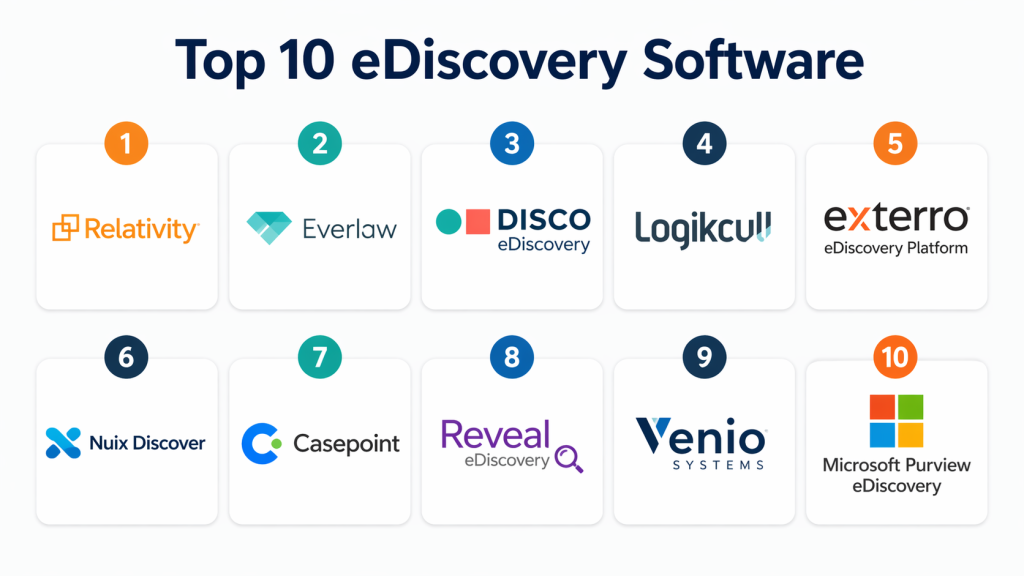
Top 10 eDiscovery Software
#1 — Relativity
Short description: A leading eDiscovery platform widely used by law firms and enterprises. Offers end-to-end capabilities from data collection to review and production. Known for scalability and advanced analytics. Supports complex legal workflows and large datasets. Ideal for enterprise litigation and compliance.
Key Features
- End-to-end eDiscovery
- AI-powered document review
- Case management
- Data analytics
- Workflow automation
Pros
- Highly scalable
- Strong AI capabilities
Cons
- Expensive
- Complex setup
Platforms / Deployment
Cloud / Hybrid
Security & Compliance
Encryption, audit logs, RBAC (others not publicly stated)
Integrations & Ecosystem
- Cloud storage platforms
- Legal tools
- APIs
Support & Community
Strong enterprise support and community.
#2 — Everlaw
Short description: A modern cloud-native eDiscovery platform designed for ease of use and collaboration. Offers powerful analytics and intuitive interface. Ideal for legal teams seeking efficiency.
Key Features
- Cloud-based review
- AI analytics
- Collaboration tools
- Case management
- Data processing
Pros
- User-friendly
- Strong collaboration features
Cons
- Premium pricing
- Limited offline capabilities
Platforms / Deployment
Cloud
Security & Compliance
Encryption, audit logs (others not publicly stated)
Integrations & Ecosystem
- Cloud platforms
- Legal tools
- APIs
Support & Community
Good documentation and support.
#3 — Logikcull
Short description: A simplified eDiscovery platform focused on automation and ease of use. Ideal for smaller legal teams. Provides fast data processing and document review.
Key Features
- Automated processing
- Document review
- Data filtering
- Reporting
- Cloud-based
Pros
- Easy to use
- Cost-effective
Cons
- Limited advanced features
- Not ideal for large enterprises
Platforms / Deployment
Cloud
Security & Compliance
Encryption, audit logs (others not publicly stated)
Integrations & Ecosystem
- Cloud storage
- APIs
Support & Community
Good SMB support.
#4 — Nuix Discover
Short description: A powerful eDiscovery platform offering advanced data processing and analytics. Known for handling complex datasets. Suitable for large enterprises and investigations.
Key Features
- Data processing
- Advanced analytics
- Document review
- Case management
- Reporting
Pros
- Strong processing power
- Scalable
Cons
- Complex interface
- Expensive
Platforms / Deployment
Cloud / On-prem
Security & Compliance
Encryption, audit logs (others not publicly stated)
Integrations & Ecosystem
- Enterprise tools
- APIs
Support & Community
Enterprise support available.
#5 — OpenText Axcelerate
Short description: An enterprise-grade eDiscovery solution providing end-to-end legal workflows. Known for strong analytics and compliance features.
Key Features
- AI review
- Data analytics
- Case management
- Workflow automation
- Reporting
Pros
- Comprehensive features
- Strong compliance support
Cons
- Expensive
- Requires training
Platforms / Deployment
Cloud / Hybrid
Security & Compliance
Encryption, audit logs (others not publicly stated)
Integrations & Ecosystem
- Enterprise platforms
- APIs
Support & Community
Enterprise support.
#6 — Exterro eDiscovery
Short description: A comprehensive eDiscovery platform combining legal workflows, data privacy, and compliance. Suitable for enterprises managing complex investigations.
Key Features
- Legal workflows
- Data privacy tools
- Analytics
- Automation
- Reporting
Pros
- Strong compliance features
- Integrated platform
Cons
- Complex setup
- Higher cost
Platforms / Deployment
Cloud / Hybrid
Security & Compliance
Encryption, audit logs (others not publicly stated)
Integrations & Ecosystem
- Legal tools
- Cloud platforms
- APIs
Support & Community
Strong enterprise support.
#7 — Disco eDiscovery
Short description: A cloud-based eDiscovery platform focusing on AI-powered document review. Known for speed and simplicity. Ideal for modern legal teams.
Key Features
- AI review
- Document search
- Case management
- Cloud-based
- Reporting
Pros
- Fast processing
- Easy to use
Cons
- Limited enterprise features
- Pricing transparency issues
Platforms / Deployment
Cloud
Security & Compliance
Encryption, audit logs (others not publicly stated)
Integrations & Ecosystem
- Cloud tools
- APIs
Support & Community
Good support availability.
#8 — Casepoint
Short description: A scalable eDiscovery platform offering data management and legal workflows. Known for performance and cost efficiency.
Key Features
- Data management
- Document review
- Analytics
- Reporting
- Automation
Pros
- Scalable
- Cost-effective
Cons
- UI limitations
- Learning curve
Platforms / Deployment
Cloud
Security & Compliance
Encryption, audit logs (others not publicly stated)
Integrations & Ecosystem
- Cloud platforms
- APIs
Support & Community
Enterprise support.
#9 — Onna
Short description: Focuses on data collection and processing from modern collaboration tools. Ideal for organizations using Slack, Teams, and cloud apps.
Key Features
- Data collection
- Integration with SaaS tools
- Analytics
- Processing
- Reporting
Pros
- Strong integrations
- Modern platform
Cons
- Limited review features
- Niche focus
Platforms / Deployment
Cloud
Security & Compliance
Encryption, audit logs (others not publicly stated)
Integrations & Ecosystem
- SaaS tools
- APIs
Support & Community
Growing support ecosystem.
#10 — ZyLAB ONE
Short description: An AI-driven eDiscovery platform offering analytics and document review. Known for automation and compliance capabilities.
Key Features
- AI analytics
- Document review
- Compliance tools
- Reporting
- Data processing
Pros
- Strong AI features
- Good compliance support
Cons
- Complex setup
- Limited ecosystem
Platforms / Deployment
Cloud
Security & Compliance
Encryption, audit logs (others not publicly stated)
Integrations & Ecosystem
- Enterprise tools
- APIs
Support & Community
Enterprise support.
Comparison Table (Top 10)
| Tool Name | Best For | Platform(s) | Deployment | Standout Feature | Public Rating |
|---|---|---|---|---|---|
| Relativity | Enterprise | Web | Cloud/Hybrid | AI review | N/A |
| Everlaw | Legal teams | Web | Cloud | Collaboration | N/A |
| Logikcull | SMB | Web | Cloud | Ease of use | N/A |
| Nuix | Large datasets | Web | Cloud/On-prem | Processing power | N/A |
| OpenText | Enterprise | Web | Cloud/Hybrid | Compliance | N/A |
| Exterro | Compliance | Web | Cloud/Hybrid | Legal workflows | N/A |
| Disco | Modern teams | Web | Cloud | Speed | N/A |
| Casepoint | Scalable | Web | Cloud | Cost efficiency | N/A |
| Onna | SaaS data | Web | Cloud | Integrations | N/A |
| ZyLAB | AI analytics | Web | Cloud | Automation | N/A |
Evaluation & Scoring of eDiscovery Software
| Tool | Core | Ease | Integrations | Security | Performance | Support | Value | Total |
|---|---|---|---|---|---|---|---|---|
| Relativity | 9 | 7 | 8 | 9 | 9 | 9 | 7 | 8.5 |
| Everlaw | 8 | 9 | 8 | 8 | 8 | 8 | 8 | 8.3 |
| Logikcull | 7 | 9 | 7 | 7 | 7 | 7 | 9 | 7.8 |
| Nuix | 9 | 6 | 8 | 9 | 9 | 8 | 7 | 8.3 |
| OpenText | 9 | 7 | 8 | 9 | 8 | 8 | 7 | 8.2 |
| Exterro | 8 | 7 | 8 | 9 | 8 | 8 | 7 | 8.1 |
| Disco | 8 | 9 | 7 | 8 | 8 | 8 | 8 | 8.2 |
| Casepoint | 8 | 8 | 7 | 8 | 8 | 7 | 8 | 8.0 |
| Onna | 7 | 8 | 9 | 8 | 7 | 7 | 8 | 7.9 |
| ZyLAB | 8 | 7 | 7 | 8 | 8 | 7 | 7 | 7.8 |
Interpretation:
Higher scores indicate stronger capabilities across core features, performance, and integrations. Enterprise tools tend to score higher in security and scalability, while simpler tools excel in ease of use and value.
Which eDiscovery Software Is Right for You?
Solo / Freelancer
Not typically required unless handling legal cases or compliance work.
SMB
Logikcull or Disco are simple and cost-effective.
Mid-Market
Everlaw or Casepoint provide balanced features.
Enterprise
Relativity, Nuix, and OpenText are top choices.
Budget vs Premium
- Budget: Logikcull
- Premium: Relativity
Feature Depth vs Ease of Use
- Easy: Everlaw
- Advanced: Nuix
Integrations & Scalability
- Best integrations: Onna, Relativity
Security & Compliance
- High compliance: OpenText, Exterro
FAQs
1. What is eDiscovery software?
eDiscovery software helps organizations manage electronic data for legal and compliance purposes. It supports data collection, processing, and review. It ensures data is handled in a legally defensible way. It is widely used in litigation and investigations.
2. Who uses eDiscovery tools?
Law firms, corporate legal teams, and compliance departments use these tools. They help manage large volumes of digital data. They are essential for legal cases and audits.
3. Are eDiscovery tools expensive?
Pricing varies depending on features and scale. Enterprise tools are usually expensive. SMB tools offer affordable options.
4. How long does implementation take?
Implementation can take days to weeks. It depends on data volume and complexity. Cloud tools are faster to deploy.
5. What integrations are important?
Integration with cloud storage, email, and collaboration tools is important. It improves efficiency and automation.
6. Do these tools use AI?
Yes, many tools use AI for document review and analytics. This reduces manual effort. It improves accuracy and speed.
7. Can eDiscovery tools handle cloud data?
Yes, modern tools support cloud platforms and SaaS applications. Capabilities vary by vendor.
8. Are they secure?
Most tools include encryption and access controls. Security features depend on the vendor. Compliance support is important.
9. What are common challenges?
Handling large datasets and complex workflows can be challenging. Proper planning helps. Training is often required.
10. What are alternatives?
Manual processes or basic tools can be used. However, they are less efficient. eDiscovery tools provide better automation and accuracy.
Conclusion
eDiscovery software has become an essential component for organizations dealing with legal, regulatory, and compliance requirements in a digital-first world. As data volumes continue to grow across emails, cloud platforms, and collaboration tools, these solutions provide the necessary structure and automation to manage complex investigations efficiently. With features like AI-powered review, advanced analytics, and scalable cloud deployment, modern eDiscovery tools significantly reduce the time and cost involved in legal processes while improving accuracy.
Choosing the right eDiscovery platform depends on your organization’s size, data complexity, and compliance needs. Enterprises may require robust solutions like Relativity or Nuix, while smaller teams can benefit from simpler platforms like Logikcull or Disco. The best approach is to shortlist a few tools, run pilot projects, and evaluate their performance, integrations, and usability before making a final decision.
