Introduction
Deception Technology tools are cybersecurity solutions designed to detect, mislead, and trap attackers inside a network by deploying decoys such as fake servers, credentials, applications, and data. Instead of relying solely on prevention, deception tools assume that attackers may breach defenses and focus on early detection, lateral movement tracking, and threat intelligence gathering.
In modern cybersecurity environments, where advanced persistent threats (APTs), ransomware, and insider attacks are increasing, deception technology plays a critical role in strengthening Zero Trust architectures. It enables security teams to identify malicious activity before real assets are compromised, reducing dwell time and limiting damage.
Common use cases include:
- Detecting lateral movement inside networks
- Identifying insider threats and compromised credentials
- Protecting high-value assets with decoy environments
- Enhancing threat intelligence and attacker behavior analysis
- Strengthening SOC and incident response workflows
Key evaluation criteria:
- Ease of deployment and automation
- Realism of decoys and deception artifacts
- Integration with SIEM, EDR, and SOC tools
- Scalability across hybrid and cloud environments
- Threat detection accuracy and response speed
- Visibility into attacker behavior
- Compliance and audit capabilities
- Cost-effectiveness
Best for: Enterprises, security teams, SOC analysts, and organizations handling sensitive data (finance, healthcare, government).
Not ideal for: Small businesses with limited security infrastructure or organizations not yet mature in cybersecurity operations.
Key Trends in Deception Technology Tools
- AI-driven deception environments improving realism and detection
- Integration with Zero Trust and XDR platforms
- Automated deployment of decoys across cloud and endpoints
- Use of deception in ransomware defense strategies
- Real-time attacker tracking and behavioral analytics
- Expansion into cloud-native deception environments
- Increased adoption in SOC automation workflows
- Deception-as-a-Service models emerging
- Integration with threat intelligence platforms
- Focus on reducing false positives
How We Evaluated Deception Technology Tools (Methodology)
- Assessed market leadership and adoption trends
- Evaluated deception capabilities and realism of decoys
- Reviewed threat detection and response effectiveness
- Considered integration ecosystem (SIEM, EDR, XDR)
- Evaluated deployment flexibility (cloud, on-prem, hybrid)
- Assessed ease of management and automation
- Considered performance and scalability
- Evaluated fit across SMB, mid-market, and enterprise
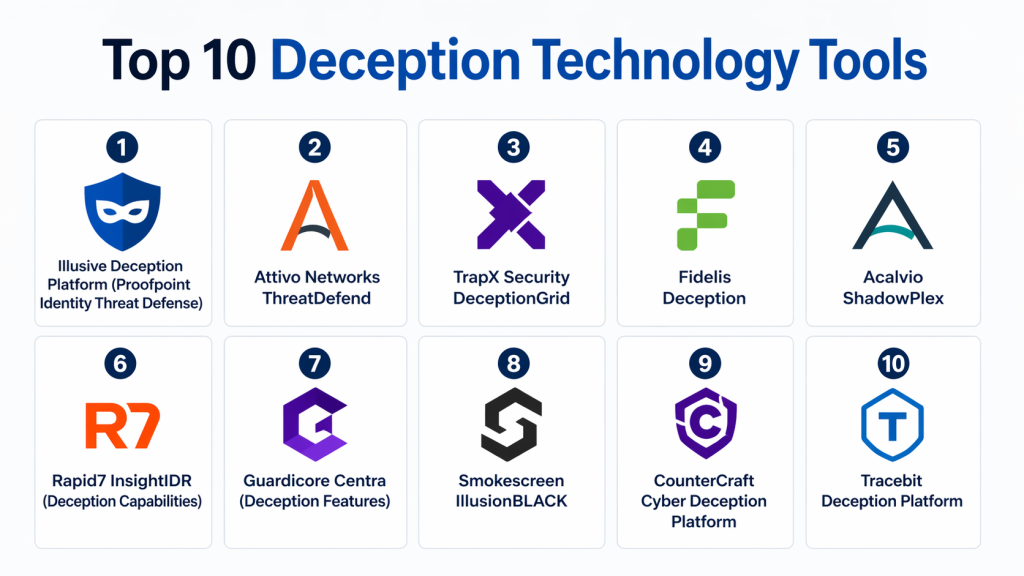
Top 10 Deception Technology Tools
#1 — Illusive Networks Deception Platform
Short description: A leading deception platform focused on identity-based deception and lateral movement detection. It deploys fake credentials and assets across endpoints to trap attackers. Ideal for enterprises seeking strong insider threat protection. Offers deep visibility into attacker behavior. Highly scalable for large environments.
Key Features
- Credential deception
- Lateral movement detection
- Automated deployment
- Threat analytics
- Endpoint integration
- Identity protection
Pros
- Strong identity-focused approach
- High detection accuracy
Cons
- Complex setup
- Enterprise-focused pricing
Platforms / Deployment
Cloud / Hybrid
Security & Compliance
Encryption, audit logs, RBAC (others not publicly stated)
Integrations & Ecosystem
- SIEM tools
- EDR platforms
- Identity systems
Support & Community
Enterprise-level support with strong documentation.
#2 — Attivo Networks ThreatDefend
Short description: A comprehensive deception solution designed to detect insider threats and external attackers. Provides real-time alerts and integrates with SOC workflows. Known for strong identity and endpoint deception capabilities. Suitable for large enterprises.
Key Features
- Deception grids
- Identity protection
- Threat detection
- Real-time alerts
- Behavioral analytics
Pros
- Strong insider threat detection
- Good SOC integration
Cons
- Learning curve
- Premium pricing
Platforms / Deployment
Cloud / Hybrid
Security & Compliance
Encryption, audit logs (others not publicly stated)
Integrations & Ecosystem
- SIEM tools
- Identity providers
- Security platforms
Support & Community
Strong enterprise support.
#3 — TrapX Security DeceptionGrid
Short description: A deception platform focused on protecting critical infrastructure and detecting advanced threats. Uses decoy systems to trap attackers. Offers strong analytics and reporting. Ideal for industrial and enterprise environments.
Key Features
- DeceptionGrid technology
- Threat detection
- Asset protection
- Analytics
- Automated deployment
Pros
- Strong industrial security focus
- Effective detection
Cons
- Complex deployment
- Limited SMB use
Platforms / Deployment
Cloud / Hybrid
Security & Compliance
Encryption, audit logs (others not publicly stated)
Integrations & Ecosystem
- Security tools
- Cloud platforms
- APIs
Support & Community
Enterprise-focused support.
#4 — Rapid7 InsightIDR (Deception Capabilities)
Short description: A SIEM and detection platform with built-in deception capabilities. Provides visibility into attacker behavior using decoys. Ideal for organizations already using Rapid7 ecosystem. Combines detection and response features.
Key Features
- Deception alerts
- User behavior analytics
- Threat detection
- SIEM integration
- Automation
Pros
- Integrated platform
- Easy to deploy
Cons
- Limited standalone deception features
- Depends on SIEM usage
Platforms / Deployment
Cloud
Security & Compliance
Encryption, audit logs (others not publicly stated)
Integrations & Ecosystem
- SIEM tools
- Endpoint security
- Cloud apps
Support & Community
Good support and documentation.
#5 — Fidelis Deception
Short description: Provides advanced deception capabilities combined with threat detection and response. Focuses on identifying attackers early in the kill chain. Suitable for enterprise security teams.
Key Features
- Deception decoys
- Threat detection
- Analytics
- Automation
- Incident response
Pros
- Strong detection capabilities
- Integrated security features
Cons
- Complex UI
- Limited SMB focus
Platforms / Deployment
Cloud / Hybrid
Security & Compliance
Encryption, audit logs (others not publicly stated)
Integrations & Ecosystem
- SIEM
- Security platforms
- APIs
Support & Community
Enterprise support.
#6 — Cymmetria MazeRunner
Short description: A deception platform designed for threat detection and attacker engagement. Uses realistic decoys to detect and analyze attackers. Ideal for organizations seeking detailed threat intelligence.
Key Features
- Deception environments
- Threat intelligence
- Analytics
- Detection
- Reporting
Pros
- Strong analytics
- Realistic decoys
Cons
- Limited scalability
- Niche adoption
Platforms / Deployment
Cloud / Hybrid
Security & Compliance
Encryption, audit logs (others not publicly stated)
Integrations & Ecosystem
- Security tools
- APIs
- Cloud apps
Support & Community
Moderate support availability.
#7 — Guardicore Centra (Deception Features)
Short description: Primarily a microsegmentation platform with deception capabilities. Provides visibility into lateral movement and detects threats. Ideal for hybrid environments.
Key Features
- Microsegmentation
- Deception traps
- Threat detection
- Visibility
- Analytics
Pros
- Strong segmentation
- Hybrid support
Cons
- Not dedicated deception tool
- Complexity
Platforms / Deployment
Cloud / Hybrid
Security & Compliance
Encryption, audit logs (others not publicly stated)
Integrations & Ecosystem
- Cloud platforms
- Security tools
- APIs
Support & Community
Enterprise support.
#8 — Acalvio ShadowPlex
Short description: A deception platform focusing on autonomous deception and threat detection. Uses AI to deploy decoys dynamically. Ideal for modern cloud environments.
Key Features
- Autonomous deception
- AI-driven detection
- Threat analytics
- Automated deployment
- Risk scoring
Pros
- AI-driven approach
- Easy deployment
Cons
- Emerging platform
- Limited ecosystem
Platforms / Deployment
Cloud
Security & Compliance
Encryption, audit logs (others not publicly stated)
Integrations & Ecosystem
- APIs
- Security tools
- Cloud apps
Support & Community
Growing support ecosystem.
#9 — Smokescreen IllusionBLACK
Short description: Focuses on endpoint deception and ransomware defense. Deploys decoys to detect attackers early. Suitable for organizations prioritizing endpoint security.
Key Features
- Endpoint deception
- Ransomware detection
- Threat alerts
- Analytics
- Automation
Pros
- Strong endpoint focus
- Good ransomware defense
Cons
- Limited enterprise features
- Smaller ecosystem
Platforms / Deployment
Cloud / Hybrid
Security & Compliance
Encryption, audit logs (others not publicly stated)
Integrations & Ecosystem
- Endpoint tools
- Security platforms
- APIs
Support & Community
Moderate support availability.
#10 — Check Point Deception (formerly TrapX integration)
Short description: Integrated deception capabilities within Check Point security ecosystem. Provides decoy environments and threat detection. Ideal for organizations using Check Point solutions.
Key Features
- Deception environments
- Threat detection
- Analytics
- Integration
- Automation
Pros
- Strong ecosystem integration
- Reliable performance
Cons
- Requires Check Point ecosystem
- Limited standalone flexibility
Platforms / Deployment
Cloud
Security & Compliance
Encryption, audit logs (others not publicly stated)
Integrations & Ecosystem
- Check Point tools
- SIEM
- APIs
Support & Community
Enterprise-level support.
Comparison Table (Top 10)
| Tool Name | Best For | Platform(s) | Deployment | Standout Feature | Public Rating |
|---|---|---|---|---|---|
| Illusive | Identity protection | Web | Cloud/Hybrid | Credential deception | N/A |
| Attivo | Insider threats | Web | Cloud/Hybrid | Deception grid | N/A |
| TrapX | Industrial security | Web | Cloud/Hybrid | DeceptionGrid | N/A |
| Rapid7 | SIEM users | Web | Cloud | Integrated detection | N/A |
| Fidelis | Enterprise SOC | Web | Cloud/Hybrid | Early detection | N/A |
| Cymmetria | Threat intel | Web | Cloud/Hybrid | Realistic decoys | N/A |
| Guardicore | Hybrid env | Web | Cloud/Hybrid | Microsegmentation | N/A |
| Acalvio | AI deception | Web | Cloud | Autonomous traps | N/A |
| Smokescreen | Endpoint security | Web | Cloud/Hybrid | Ransomware defense | N/A |
| Check Point | Ecosystem users | Web | Cloud | Integrated deception | N/A |
Evaluation & Scoring of Deception Technology Tools
| Tool | Core | Ease | Integrations | Security | Performance | Support | Value | Total |
|---|---|---|---|---|---|---|---|---|
| Illusive | 9 | 7 | 8 | 9 | 8 | 8 | 7 | 8.3 |
| Attivo | 9 | 7 | 8 | 9 | 8 | 8 | 7 | 8.3 |
| TrapX | 8 | 6 | 7 | 8 | 8 | 7 | 7 | 7.6 |
| Rapid7 | 8 | 8 | 8 | 8 | 8 | 8 | 8 | 8.0 |
| Fidelis | 8 | 6 | 7 | 8 | 8 | 7 | 7 | 7.6 |
| Cymmetria | 7 | 7 | 6 | 7 | 7 | 6 | 7 | 6.9 |
| Guardicore | 8 | 6 | 8 | 8 | 8 | 7 | 7 | 7.7 |
| Acalvio | 8 | 8 | 7 | 8 | 7 | 7 | 8 | 7.9 |
| Smokescreen | 7 | 8 | 6 | 7 | 7 | 7 | 8 | 7.4 |
| Check Point | 8 | 7 | 8 | 8 | 8 | 8 | 7 | 8.0 |
Interpretation:
Higher scores indicate stronger overall capabilities. Enterprise tools typically perform better in security and integrations, while emerging tools may offer better ease of use and innovation.
Which Deception Technology Tool Is Right for You?
Solo / Freelancer
Not typically required unless working in high-risk environments.
SMB
Smokescreen or Acalvio are simpler options.
Mid-Market
Rapid7 or Guardicore offer balanced capabilities.
Enterprise
Illusive, Attivo, and TrapX are strong choices.
Budget vs Premium
- Budget: Smokescreen
- Premium: Illusive
Feature Depth vs Ease
- Easy: Acalvio
- Advanced: Attivo
Integrations & Scalability
- Best integrations: Rapid7, Check Point
Security & Compliance
- High compliance: Illusive, Attivo
FAQs
1. What is deception technology?
Deception technology uses fake assets such as decoy servers, credentials, and applications to detect attackers. When attackers interact with these traps, it immediately signals malicious intent. This approach helps security teams identify threats early. It is especially useful against advanced attacks that bypass traditional defenses.
2. How does deception technology improve cybersecurity?
It enhances security by detecting threats inside the network rather than just blocking them at the perimeter. It reduces attacker dwell time and provides early alerts. Security teams gain visibility into attacker behavior and tactics. This leads to faster and more effective incident response.
3. Is deception technology suitable for all organizations?
Deception tools are best suited for organizations with mature security operations and dedicated SOC teams. Enterprises benefit the most due to complex environments. Smaller businesses may find them unnecessary unless dealing with high-risk data. It works best when combined with other security solutions.
4. How is deception technology deployed?
Deployment can be cloud-based, on-premises, or hybrid depending on the tool. Many modern solutions offer automated deployment of decoys across endpoints and networks. Setup complexity varies based on infrastructure size. Proper planning ensures smooth implementation.
5. Does deception technology generate false positives?
Deception tools generally produce very low false positives. Any interaction with a decoy asset is considered suspicious by design. This makes alerts highly reliable compared to traditional detection systems. It helps reduce alert fatigue for security teams.
6. What integrations are important for deception tools?
Integration with SIEM, EDR, and SOAR platforms is essential for effective threat response. These integrations enable centralized monitoring and automated workflows. APIs also allow customization and scalability. Strong integration improves overall security posture.
7. Is deception technology expensive?
Pricing varies depending on vendor, deployment size, and features. Enterprise-grade solutions tend to be more expensive due to advanced capabilities. Some newer platforms offer cost-effective options. Organizations should evaluate ROI based on risk reduction.
8. Can deception technology prevent ransomware attacks?
While it does not directly block ransomware, it helps detect attackers early in the attack chain. By identifying malicious activity before execution, it reduces the chances of damage. It works best alongside endpoint and network security tools. This layered approach improves defense.
9. How long does it take to implement deception tools?
Implementation time depends on the organization’s size and complexity. Some cloud-based tools can be deployed within days. Larger enterprise deployments may take weeks. Proper configuration and testing are essential for effectiveness.
10. What are alternatives to deception technology?
Alternatives include SIEM, EDR, IDS, and firewall solutions. However, these tools focus on detection or prevention rather than deception. Deception technology adds a proactive layer by misleading attackers. It is best used as part of a multi-layered security strategy.
Conclusion
Deception technology tools are becoming an essential layer in modern cybersecurity strategies, especially as attackers grow more sophisticated and capable of bypassing traditional defenses. By deploying decoys and misleading attackers, these tools provide early detection, reduce dwell time, and offer valuable insights into attacker behavior. This makes them highly effective for organizations aiming to strengthen their Zero Trust and threat detection capabilities.
Choosing the right deception platform depends on your organization’s security maturity, infrastructure, and integration needs. Enterprises may benefit from advanced platforms like Illusive or Attivo, while mid-market and SMB organizations may prefer simpler solutions like Acalvio or Smokescreen. The best approach is to evaluate a few tools, run controlled tests, and ensure they align with your existing security stack before full deployment.
