Introduction
Knowledge Base Software helps organizations create, manage, and share information in a structured and searchable format. It enables teams to build internal documentation for employees or external help centers for customers, reducing support load and improving user experience.
In the modern digital environment, where users expect instant answers and self-service options, knowledge bases have become a critical component of customer support and internal operations. They empower organizations to centralize information, improve consistency, and scale support without increasing headcount.
Common use cases include:
- Customer self-service help centers
- Internal employee documentation and SOPs
- Product documentation and onboarding guides
- IT and HR knowledge repositories
- Training and learning portals
What buyers should evaluate:
- Ease of content creation and editing
- Search functionality and AI capabilities
- Customization and branding options
- Integration with support tools (CRM, chat, ticketing)
- Collaboration and workflow features
- Analytics and reporting
- Scalability and performance
- Security and access control
Best for: Customer support teams, IT departments, SaaS companies, and enterprises needing scalable documentation systems.
Not ideal for: Very small teams with minimal documentation needs or those relying only on informal communication tools.
Key Trends in Knowledge Base Software for the Future
- AI-powered search and answer generation
- Integration with chatbots and virtual assistants
- Real-time collaboration and version control
- Headless knowledge base architectures
- Personalized content delivery
- Multilingual and localization support
- Automation in content creation and tagging
- Embedded analytics for content performance
- API-first and integration-ready platforms
- Self-healing knowledge bases with AI suggestions
How We Selected These Tools (Methodology)
- Evaluated market adoption and popularity
- Assessed ease of use for both technical and non-technical users
- Compared search capabilities and AI features
- Reviewed integration ecosystems with support tools
- Considered scalability and performance
- Analyzed collaboration and workflow features
- Checked security and access control mechanisms
- Included a mix of SMB, enterprise, and flexible platforms
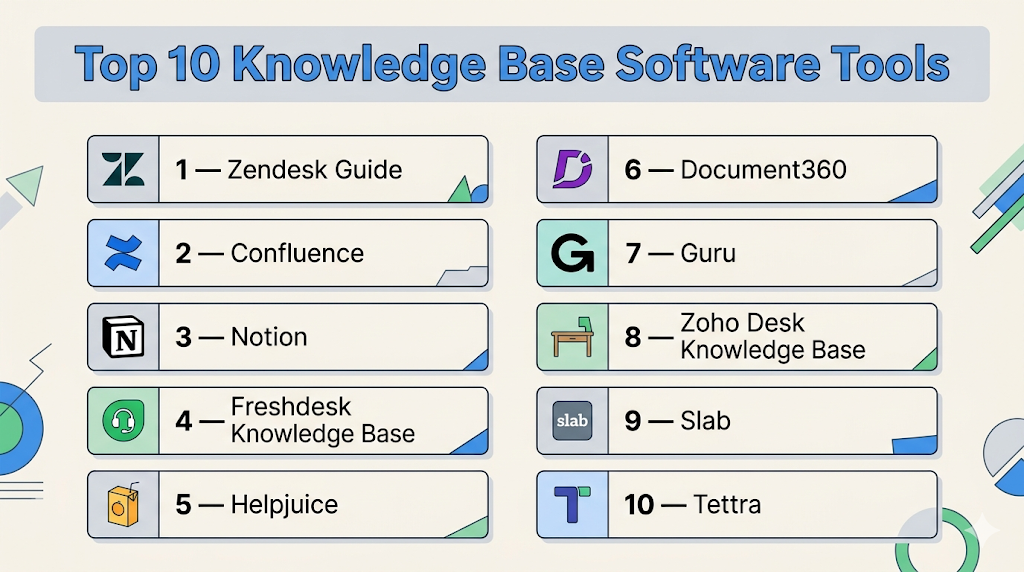
Top 10 Knowledge Base Software Tools
#1 — Zendesk Guide
Short description: A powerful knowledge base solution integrated with Zendesk’s customer support ecosystem.
Key Features
- Help center creation
- AI-powered search
- Content recommendations
- Multi-language support
- Workflow automation
- Analytics and reporting
- Integration with Zendesk Suite
Pros
- Strong integration with support tools
- Scalable for enterprises
Cons
- Requires Zendesk ecosystem
- Pricing can be high
Platforms / Deployment
Cloud
Security & Compliance
SSO, RBAC, GDPR (others not publicly stated)
Integrations & Ecosystem
Deep integration within Zendesk and third-party tools.
- CRM systems
- Chat and ticketing tools
- APIs and webhooks
Support & Community
Strong enterprise support and documentation.
#2 — Confluence
Short description: A widely used team collaboration and knowledge management platform.
Key Features
- Rich content editor
- Team collaboration
- Version control
- Templates
- Permissions management
- Integration with Jira
- Content organization
Pros
- Great for internal documentation
- Strong collaboration features
Cons
- Can become cluttered
- Requires organization discipline
Platforms / Deployment
Cloud / Self-hosted
Security & Compliance
SSO, RBAC (others not publicly stated)
Integrations & Ecosystem
Extensive ecosystem within Atlassian tools.
- Jira integration
- APIs
- Plugins
Support & Community
Large global community and support.
#3 — Notion
Short description: Flexible all-in-one workspace for notes, docs, and knowledge bases.
Key Features
- Block-based editor
- Templates
- Databases
- Collaboration tools
- Content linking
- Custom workflows
- Integration support
Pros
- Easy to use
- Highly flexible
Cons
- Limited enterprise features
- Performance issues at scale
Platforms / Deployment
Web / Windows / macOS / iOS / Android
Security & Compliance
Basic controls (details not publicly stated)
Integrations & Ecosystem
Growing ecosystem.
- APIs
- Third-party integrations
- Automation tools
Support & Community
Large and active community.
#4 — Freshdesk Knowledge Base
Short description: Knowledge base integrated with Freshdesk support platform.
Key Features
- Self-service portals
- Content categorization
- AI-powered suggestions
- Multi-language support
- Analytics
- Workflow tools
- SEO optimization
Pros
- Easy integration with support
- User-friendly interface
Cons
- Limited customization
- Requires Freshdesk ecosystem
Platforms / Deployment
Cloud
Security & Compliance
SSO, RBAC (others not publicly stated)
Integrations & Ecosystem
Integrated with Freshworks tools.
- CRM
- Chat tools
- APIs
Support & Community
Good documentation and support.
#5 — Helpjuice
Short description: Dedicated knowledge base software focused on analytics and customization.
Key Features
- Advanced search
- Custom themes
- Analytics dashboard
- Multi-language support
- API access
- Content collaboration
- SEO optimization
Pros
- Strong analytics
- Highly customizable
Cons
- Expensive
- Smaller ecosystem
Platforms / Deployment
Cloud
Security & Compliance
Not publicly stated
Integrations & Ecosystem
Moderate integrations.
- APIs
- Third-party tools
Support & Community
Good support, smaller community.
#6 — Document360
Short description: Modern knowledge base platform with strong UX and analytics.
Key Features
- Markdown editor
- Category management
- Analytics
- Version control
- API documentation support
- SEO tools
- Workflow management
Pros
- Clean UI
- Developer-friendly
Cons
- Pricing tiers
- Limited customization
Platforms / Deployment
Cloud
Security & Compliance
SSO, RBAC (others not publicly stated)
Integrations & Ecosystem
Growing ecosystem.
- APIs
- Integration tools
Support & Community
Good support resources.
#7 — Guru
Short description: Knowledge management platform with AI-driven knowledge delivery.
Key Features
- AI-powered suggestions
- Browser extension
- Knowledge verification workflows
- Slack integration
- Content cards
- Analytics
- Role-based permissions
Pros
- AI-driven knowledge delivery
- Great for internal teams
Cons
- Limited external KB features
- Pricing
Platforms / Deployment
Web
Security & Compliance
SSO, RBAC (others not publicly stated)
Integrations & Ecosystem
Strong integrations.
- Slack
- CRM tools
- APIs
Support & Community
Good support and adoption.
#8 — Zoho Desk Knowledge Base
Short description: Affordable knowledge base solution integrated with Zoho ecosystem.
Key Features
- Help center creation
- Multi-language support
- Workflow automation
- Analytics
- Customization
- Role permissions
- Integration with Zoho apps
Pros
- Cost-effective
- Integrated ecosystem
Cons
- Limited advanced features
- UI limitations
Platforms / Deployment
Cloud
Security & Compliance
RBAC, authentication (others not publicly stated)
Integrations & Ecosystem
Zoho ecosystem integrations.
- CRM
- Analytics
- APIs
Support & Community
Strong Zoho community.
#9 — Slab
Short description: Simple and clean knowledge base for internal teams.
Key Features
- Clean editor
- Search functionality
- Collaboration tools
- Integrations
- Version control
- Permissions
- Content organization
Pros
- Easy to use
- Clean UI
Cons
- Limited advanced features
- Not ideal for external KB
Platforms / Deployment
Web
Security & Compliance
Basic controls (not publicly stated)
Integrations & Ecosystem
Moderate integrations.
- APIs
- Third-party tools
Support & Community
Growing community.
#10 — Tettra
Short description: Lightweight knowledge base designed for teams using Slack.
Key Features
- Slack integration
- Content verification workflows
- Templates
- Search
- Permissions
- Collaboration tools
- Internal documentation
Pros
- Simple setup
- Slack-focused
Cons
- Limited scalability
- Basic features
Platforms / Deployment
Web
Security & Compliance
Basic security (not publicly stated)
Integrations & Ecosystem
Slack-centric integrations.
- APIs
- Slack
Support & Community
Small but focused community.
Comparison Table (Top 10)
| Tool Name | Best For | Platform(s) Supported | Deployment | Standout Feature | Public Rating |
|---|---|---|---|---|---|
| Zendesk Guide | Enterprise support | Web | Cloud | AI support integration | N/A |
| Confluence | Internal teams | Web | Cloud/Self-hosted | Collaboration tools | N/A |
| Notion | Flexible teams | Web/Desktop/Mobile | Cloud | All-in-one workspace | N/A |
| Freshdesk KB | Support teams | Web | Cloud | Helpdesk integration | N/A |
| Helpjuice | Custom KB | Web | Cloud | Advanced analytics | N/A |
| Document360 | SaaS docs | Web | Cloud | Clean UI + analytics | N/A |
| Guru | Internal knowledge | Web | Cloud | AI suggestions | N/A |
| Zoho Desk KB | SMB | Web | Cloud | Cost-effective | N/A |
| Slab | Internal docs | Web | Cloud | Simplicity | N/A |
| Tettra | Slack teams | Web | Cloud | Slack integration | N/A |
Evaluation & Scoring of Knowledge Base Software
| Tool Name | Core (25%) | Ease (15%) | Integrations (15%) | Security (10%) | Performance (10%) | Support (10%) | Value (15%) | Weighted Total |
|---|---|---|---|---|---|---|---|---|
| Zendesk Guide | 9 | 7 | 9 | 8 | 8 | 9 | 6 | 8.2 |
| Confluence | 8 | 7 | 9 | 8 | 8 | 9 | 7 | 8.1 |
| Notion | 7 | 9 | 7 | 6 | 7 | 8 | 9 | 7.9 |
| Freshdesk KB | 8 | 8 | 8 | 7 | 8 | 8 | 8 | 8.0 |
| Helpjuice | 7 | 8 | 6 | 6 | 7 | 7 | 7 | 7.1 |
| Document360 | 8 | 8 | 7 | 7 | 8 | 8 | 7 | 7.8 |
| Guru | 8 | 8 | 8 | 7 | 8 | 8 | 7 | 7.9 |
| Zoho Desk KB | 7 | 8 | 7 | 7 | 7 | 7 | 9 | 7.6 |
| Slab | 7 | 9 | 6 | 6 | 7 | 7 | 8 | 7.4 |
| Tettra | 6 | 9 | 6 | 6 | 7 | 7 | 8 | 7.2 |
Interpretation:
Scores reflect relative performance across features, usability, and value. Enterprise tools rank higher in integrations and scalability, while simpler tools score better in ease of use and affordability. Choose based on your operational needs.
Which Knowledge Base Software Is Right for You?
Solo / Freelancer
- Best: Notion, Slab
- Simple and flexible tools
SMB
- Best: Zoho Desk, Document360
- Balance cost and features
Mid-Market
- Best: Freshdesk, Guru
- Integration and collaboration
Enterprise
- Best: Zendesk Guide, Confluence
- Scalability and ecosystem
Budget vs Premium
- Budget: Zoho Desk, Slab
- Premium: Zendesk, Helpjuice
Feature Depth vs Ease of Use
- Feature-heavy: Confluence, Zendesk
- Easy-to-use: Notion, Tettra
Integrations & Scalability
- Strong: Zendesk, Confluence
- Moderate: Slab, Tettra
Security & Compliance Needs
- Enterprise-grade: Zendesk, Confluence
- Basic: Slab, Tettra
Frequently Asked Questions (FAQs)
What is knowledge base software?
It is a tool used to create and manage structured documentation for internal teams or customers.
Is knowledge base software necessary?
Yes, it improves support efficiency and enables self-service.
Can knowledge bases be public and private?
Yes, most tools support both internal and external documentation.
Do knowledge base tools support AI?
Many modern tools include AI search and suggestions.
How much does knowledge base software cost?
Pricing ranges from free to enterprise-level subscriptions.
Can I integrate knowledge base software with CRM?
Yes, most tools support CRM and support integrations.
Is coding required?
No, most tools are no-code or low-code.
Can I migrate from one tool to another?
Yes, but it may require data restructuring.
Are knowledge bases secure?
Security depends on the platform and configuration.
What industries use knowledge base software?
SaaS, IT, healthcare, finance, and customer support teams.
Conclusion
Knowledge base software plays a crucial role in modern organizations by enabling efficient information sharing, reducing support workload, and improving both employee and customer experiences. From enterprise-grade solutions like Zendesk Guide and Confluence to flexible tools like Notion and Document360, there is a wide range of options tailored to different needs and budgets. The right choice depends on your team size, use case, and integration requirements. While some platforms excel in internal collaboration, others are optimized for customer-facing help centers. To make the best decision, shortlist a few tools, test their search capabilities, evaluate integrations, and ensure they align with your workflow and scalability goals before implementation.
