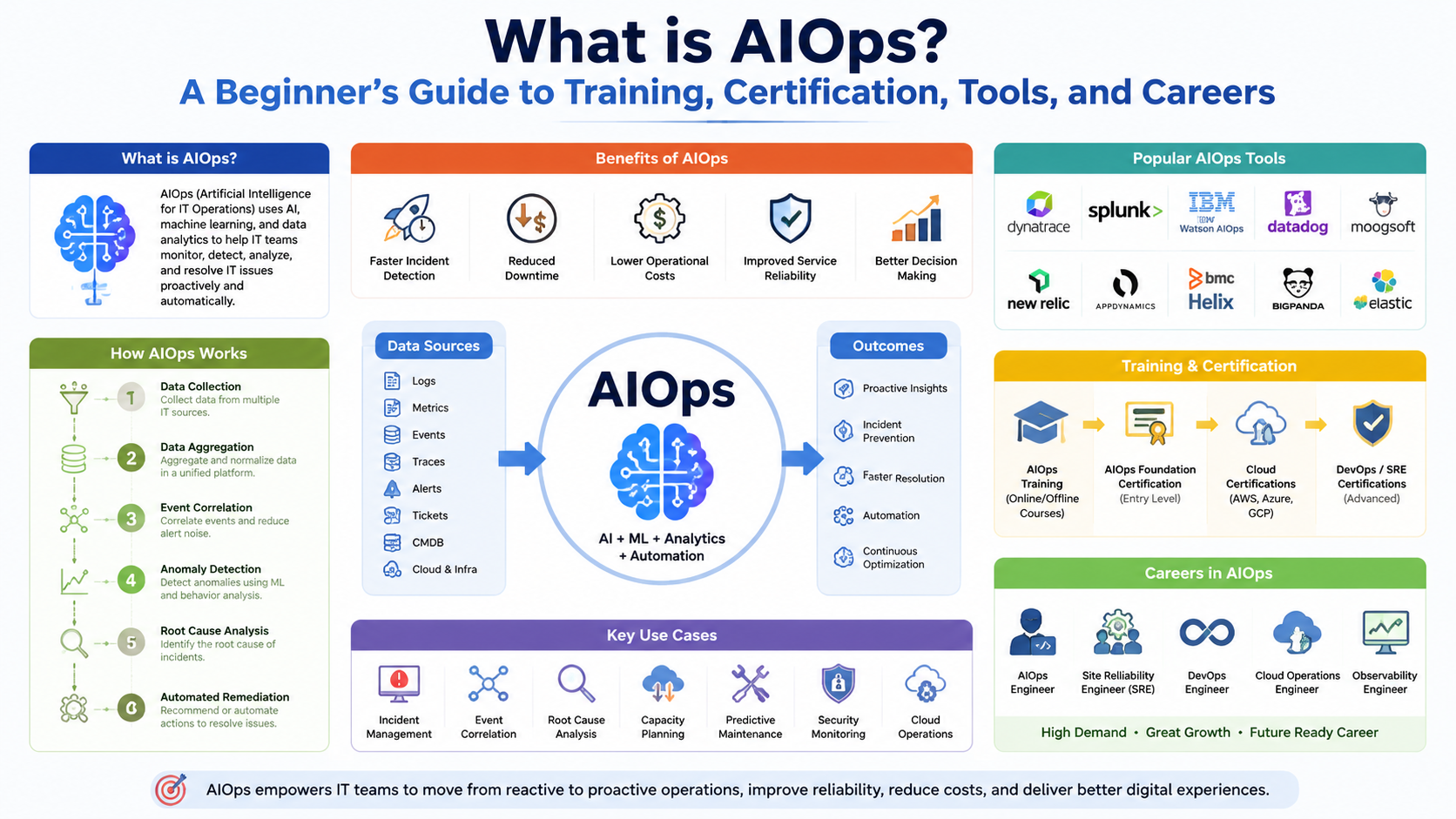
Introduction
Modern IT environments have become increasingly complex. Organizations now manage applications across cloud platforms, on-premises infrastructure, containers, microservices, and distributed systems. As businesses grow, the amount of operational data generated by these systems also increases dramatically. Traditional monitoring and IT operations approaches often struggle to keep up with the volume, variety, and velocity of this data.
This is where AIOps comes into the picture.
AIOps, short for Artificial Intelligence for IT Operations, combines artificial intelligence, machine learning, data analytics, and automation to improve IT operations. By analyzing massive amounts of operational data in real time, AIOps helps organizations detect anomalies, identify root causes, predict incidents, and automate responses before problems impact users.
As enterprises continue their digital transformation journeys, the demand for AIOps professionals is growing rapidly. Organizations need skilled engineers who can leverage AI-driven tools to improve reliability, reduce downtime, and optimize operational efficiency.
This guide explains what AIOps is, how it works, the skills required, available training and certification options, popular tools, career opportunities, and the future of AI-powered IT operations.
What is AIOps?
AIOps stands for Artificial Intelligence for IT Operations. The term was introduced to describe the application of machine learning and artificial intelligence techniques to IT operations processes.
The primary objective of AIOps is to help IT teams manage increasingly complex environments by automatically analyzing operational data and generating actionable insights.
AIOps platforms collect and process data from multiple sources, including:
- Infrastructure monitoring tools
- Application performance monitoring systems
- Network monitoring solutions
- Cloud platforms
- Security tools
- Log management systems
- Service desk applications
- Event management platforms
Using advanced analytics and machine learning algorithms, AIOps platforms identify patterns, detect anomalies, correlate events, and recommend or automate corrective actions.
In simple terms, AIOps helps IT teams move from reactive operations to proactive and predictive operations.
Why AIOps Matters in Modern IT Operations
Modern enterprises generate millions of logs, events, metrics, and alerts every day. Managing this data manually is difficult and often inefficient.
Some of the key challenges faced by IT operations teams include:
Alert Fatigue
Monitoring tools often generate thousands of alerts daily. Many alerts are duplicates or false positives, making it difficult for teams to identify genuine issues.
Complex Infrastructure
Hybrid cloud, multi-cloud, containers, Kubernetes, and microservices have significantly increased operational complexity.
Slow Incident Resolution
Traditional troubleshooting often requires multiple teams to manually investigate incidents, resulting in longer resolution times.
Limited Visibility
Data is frequently scattered across multiple monitoring and management tools.
Rising Customer Expectations
Users expect applications and services to be available at all times. Even short outages can affect business operations and revenue.
AIOps addresses these challenges by automating data analysis, reducing noise, identifying root causes, and accelerating incident response.
How AIOps Works
AIOps platforms follow a structured process to transform raw operational data into actionable insights.
Data Collection
The platform gathers information from various IT systems and monitoring tools, including:
- Logs
- Metrics
- Events
- Traces
- Alerts
- Performance data
Data Aggregation
Collected data is centralized into a unified platform where it can be analyzed consistently.
Event Correlation
Machine learning algorithms identify relationships between seemingly unrelated events and alerts.
This helps reduce alert noise and provides a clearer understanding of system health.
Anomaly Detection
AIOps continuously learns normal behavior patterns and detects unusual activities automatically.
Examples include:
- Unexpected CPU spikes
- Network latency increases
- Application performance degradation
- Database response delays
Root Cause Analysis
Instead of simply reporting symptoms, AIOps helps identify the actual source of problems.
For example:
A database slowdown may trigger multiple application alerts. AIOps can correlate these alerts and identify the database as the root cause.
Automated Remediation
Advanced AIOps platforms can automatically execute predefined actions such as:
- Restarting services
- Scaling resources
- Running scripts
- Creating support tickets
- Triggering workflows
Key Components of AIOps
A successful AIOps implementation typically includes several core capabilities.
Machine Learning
Machine learning models analyze historical and real-time operational data to identify patterns and predict future events.
Big Data Analytics
AIOps platforms process large volumes of structured and unstructured data.
Automation
Automation reduces manual effort and speeds up incident resolution.
Observability
Observability provides visibility into applications, infrastructure, networks, and user experiences.
Event Intelligence
Event intelligence helps correlate alerts and identify meaningful operational insights.
Predictive Analytics
Predictive capabilities allow organizations to anticipate failures before they occur.
Benefits of AIOps
Organizations adopt AIOps because it delivers measurable operational improvements.
Faster Incident Detection
AIOps identifies problems in real time, reducing detection delays.
Reduced Downtime
Predictive analytics and automated remediation minimize service disruptions.
Lower Operational Costs
Automation reduces the need for repetitive manual tasks.
Improved Service Reliability
Continuous monitoring and intelligent analysis improve system availability.
Enhanced Productivity
Engineers spend less time investigating alerts and more time focusing on strategic initiatives.
Better Customer Experience
Faster issue resolution leads to improved application performance and user satisfaction.
Common AIOps Use Cases
Incident Management
AIOps accelerates incident detection, prioritization, and resolution.
Root Cause Analysis
Machine learning helps identify the underlying causes of system failures.
Event Correlation
Related alerts are grouped together to reduce noise and improve visibility.
Capacity Planning
Historical trends help predict future infrastructure requirements.
Predictive Maintenance
Potential issues are detected before they cause outages.
Cloud Operations
AIOps optimizes cloud resource utilization and performance.
Security Monitoring
Some platforms use AI techniques to detect unusual activities and potential threats.
Service Reliability Engineering
AIOps supports SRE teams by improving observability and reducing operational complexity.
AIOps for Beginners
For newcomers, AIOps may seem like a combination of multiple disciplines.
A beginner should understand the following foundational areas:
IT Operations Fundamentals
Learn:
- Infrastructure management
- Server administration
- Networking basics
- Incident management
- Monitoring concepts
Cloud Computing
Understanding cloud platforms is essential because most modern applications run in cloud environments.
Popular platforms include:
- Amazon Web Services
- Microsoft Azure
- Google Cloud Platform
Monitoring and Observability
Learn how monitoring tools collect and analyze operational data.
Automation
Automation skills are critical for implementing AIOps workflows.
Data Analytics
Basic data analysis skills help professionals understand operational trends and anomalies.
Machine Learning Basics
A foundational understanding of machine learning concepts can be valuable for interpreting AIOps outputs.
AIOps Training: What Should You Learn?
A structured AIOps training program typically covers:
Introduction to AIOps
- History of AIOps
- Core concepts
- Industry adoption
Monitoring and Observability
- Metrics
- Logs
- Traces
- Dashboards
Event Management
- Event correlation
- Alert reduction
- Incident prioritization
Machine Learning Fundamentals
- Supervised learning
- Unsupervised learning
- Anomaly detection
Automation and Orchestration
- Workflow automation
- Runbooks
- Automated remediation
Cloud and Container Operations
- Kubernetes
- Docker
- Hybrid cloud environments
AIOps Tools
Practical exposure to industry-leading tools is a critical component of training.
AIOps Certification Options
Certifications help validate knowledge and demonstrate professional credibility.
Popular certification paths may include:
AIOps Foundation Certification
An entry-level certification that introduces core AIOps concepts, terminology, benefits, and implementation approaches.
Vendor-Specific Certifications
Many technology vendors provide certifications related to:
- Observability
- Monitoring
- Automation
- Cloud operations
Cloud Certifications
Cloud expertise complements AIOps skills.
Examples include certifications focused on:
- AWS
- Azure
- Google Cloud
DevOps and SRE Certifications
These certifications provide valuable operational knowledge that aligns closely with AIOps practices.
Popular AIOps Tools
Many organizations use specialized AIOps platforms to improve operational efficiency.
IBM Watson AIOps
Provides event correlation, anomaly detection, and automated remediation capabilities.
Dynatrace
Offers AI-powered observability and performance monitoring.
Splunk IT Service Intelligence
Uses machine learning to analyze operational data and improve service reliability.
Datadog
Provides monitoring, observability, and intelligent alerting capabilities.
Moogsoft
Focuses on event correlation and incident management.
New Relic
Combines observability, monitoring, and analytics.
PagerDuty
Supports intelligent incident response and operational automation.
BigPanda
Specializes in event intelligence and alert correlation.
AppDynamics
Provides application performance monitoring and operational insights.
Elastic Observability
Offers log analytics, monitoring, and machine learning capabilities.
AIOps vs DevOps
Although closely related, AIOps and DevOps serve different purposes.
| Aspect | AIOps | DevOps |
|---|---|---|
| Primary Focus | IT Operations Intelligence | Software Delivery |
| Core Technology | AI and Machine Learning | Automation and Collaboration |
| Objective | Improve Operations | Accelerate Development |
| Key Outcome | Incident Reduction | Faster Releases |
| Users | Operations Teams | Development and Operations Teams |
AIOps complements DevOps by improving operational visibility and automation.
AIOps vs MLOps
AIOps and MLOps both involve artificial intelligence but address different domains.
| Aspect | AIOps | MLOps |
|---|---|---|
| Focus Area | IT Operations | Machine Learning Lifecycle |
| Primary Users | IT Operations Teams | Data Scientists |
| Goal | Operational Intelligence | Model Management |
| Data Sources | Logs, Metrics, Events | Training Data |
| Outcome | System Reliability | Model Performance |
Organizations often implement both disciplines as part of broader digital transformation initiatives.
AIOps for SRE Teams
Site Reliability Engineering teams are among the biggest beneficiaries of AIOps.
AIOps helps SRE teams by:
- Reducing alert fatigue
- Improving observability
- Accelerating root cause analysis
- Supporting error budget management
- Enabling predictive operations
- Automating repetitive tasks
These capabilities allow SRE teams to focus more on reliability engineering and less on manual troubleshooting.
Career Opportunities in AIOps
The demand for AIOps professionals continues to grow across industries.
Popular job roles include:
AIOps Engineer
Designs and manages AIOps platforms and automation workflows.
Site Reliability Engineer
Ensures service reliability using observability and automation practices.
DevOps Engineer
Integrates AIOps capabilities into CI/CD and operational workflows.
Cloud Operations Engineer
Uses AIOps to manage cloud infrastructure efficiently.
Platform Engineer
Builds and maintains scalable internal platforms using intelligent operational practices.
IT Operations Analyst
Analyzes operational data and improves service performance.
Observability Engineer
Focuses on monitoring, telemetry, and operational intelligence.
Skills Required for an AIOps Career
Professionals pursuing AIOps careers should develop skills in:
- Linux administration
- Networking fundamentals
- Cloud computing
- Monitoring tools
- Observability platforms
- Automation scripting
- Python programming
- Kubernetes
- DevOps practices
- Data analytics
- Machine learning fundamentals
- Incident management
Combining these skills creates a strong foundation for long-term career growth.
Future of AIOps
The future of AIOps is closely connected to advancements in artificial intelligence and automation.
Emerging trends include:
- Generative AI-powered operations
- Autonomous incident response
- Predictive infrastructure management
- Intelligent observability
- AI-driven capacity planning
- Self-healing systems
- Advanced root cause analysis
- Automated operational decision-making
As organizations continue adopting cloud-native architectures and digital services, AIOps will become an increasingly important component of enterprise IT operations.
Conclusion
AIOps is transforming how organizations manage modern IT environments. By combining artificial intelligence, machine learning, analytics, and automation, AIOps enables faster incident detection, intelligent event correlation, automated remediation, and proactive operations management. It helps organizations reduce downtime, improve reliability, and optimize operational efficiency in increasingly complex technology ecosystems.
