Introduction
Workspace Analytics Tools help organizations understand how office spaces, meeting rooms, and workplace resources are being used. These platforms collect and analyze data from bookings, sensors, employee behavior, and collaboration tools to provide actionable insights for better space planning and productivity.
In modern hybrid work environments, companies are rethinking how office spaces are utilized. Workspace analytics tools enable data-driven decisions to optimize seating, reduce costs, and improve employee experience. With features like real-time occupancy tracking, predictive analytics, and integration with workplace systems, these tools are becoming essential for efficient workplace management.
Common use cases:
- Tracking office and desk utilization
- Optimizing meeting room usage
- Planning hybrid workplace strategies
- Monitoring occupancy and footfall
- Improving workplace efficiency and cost management
What buyers should evaluate:
- Data accuracy and analytics depth
- Integration with workplace tools and IoT devices
- Ease of use and dashboard design
- Real-time tracking capabilities
- Security and data privacy controls
- Scalability across multiple locations
- Reporting and visualization features
- Support and onboarding
Best for: Enterprises, facility managers, and organizations managing hybrid or large office environments.
Not ideal for: Small teams with limited workspace complexity or minimal analytics needs.
Key Trends in Workspace Analytics Tools
- AI-driven workplace insights and forecasting
- Integration with IoT sensors for real-time occupancy tracking
- Hybrid work optimization tools
- Predictive analytics for space planning
- Mobile dashboards for workplace monitoring
- Integration with booking and collaboration tools
- Focus on employee experience metrics
- Data privacy and security enhancements
How We Evaluate Workspace Analytics Tools (Methodology)
- Market adoption and industry presence
- Feature completeness and analytics depth
- Ease of use and visualization quality
- Integration ecosystem
- Performance and reliability
- Security capabilities
- Scalability across organizations
- Customer support and onboarding
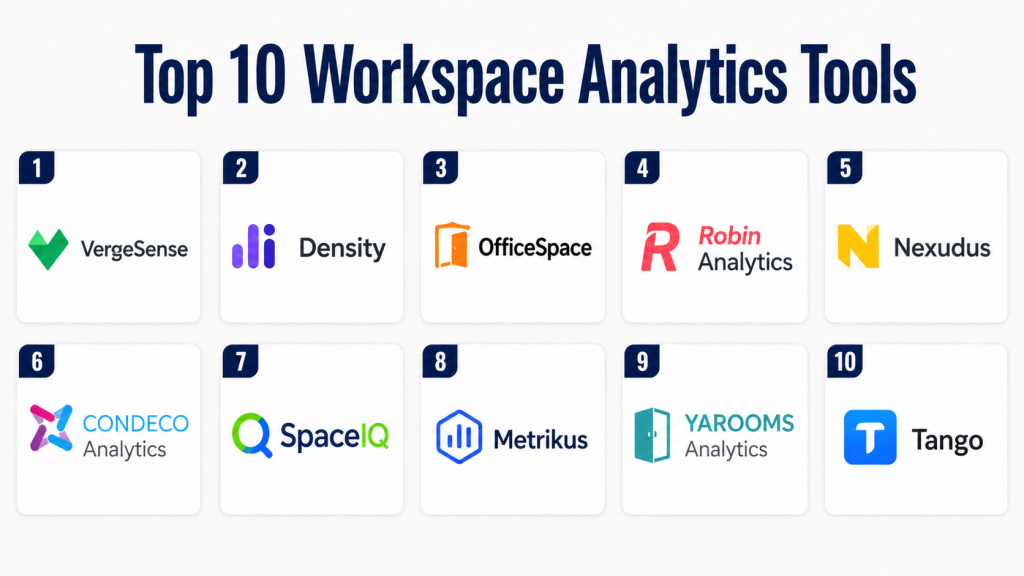
Top 10 Workspace Analytics Tools
#1 — VergeSense
Short description:
VergeSense is a workplace analytics platform that uses AI and sensors to track space utilization. It provides real-time occupancy insights and helps optimize office layouts. The platform is ideal for enterprises managing large workspaces. It delivers accurate data and actionable insights.
Key Features
- Real-time occupancy tracking
- AI-powered analytics
- Space utilization reports
- Sensor-based data collection
Pros
- High accuracy
- Strong analytics
Cons
- Hardware dependency
- Higher cost
Platforms / Deployment
Web / Cloud
Security & Compliance
Not publicly stated
Integrations & Ecosystem
Integrates with workplace systems and sensors.
- IoT devices
- Workplace platforms
Support & Community
Enterprise-level support.
#2 — Density
Short description:
Density provides sensor-based workplace analytics to measure how spaces are used. It helps organizations optimize office layouts and reduce costs. The platform offers detailed insights into occupancy trends. It is suitable for large enterprises.
Key Features
- Space utilization tracking
- Occupancy analytics
- Real-time insights
- Sensor integration
Pros
- Accurate data
- Scalable
Cons
- Hardware requirement
- Expensive
Platforms / Deployment
Web / Cloud
Security & Compliance
Not publicly stated
Integrations & Ecosystem
Integrates with workplace and analytics tools.
- IoT systems
- Data platforms
Support & Community
Strong enterprise support.
#3 — OfficeSpace
Short description:
OfficeSpace is a workplace management and analytics platform. It provides insights into space usage and planning. The platform supports hybrid workplace strategies. It is suitable for large organizations. It combines booking and analytics features.
Key Features
- Space analytics
- Desk and room booking
- Reporting dashboards
- Planning tools
Pros
- Comprehensive features
- Scalable
Cons
- Complex setup
- Higher pricing
Platforms / Deployment
Web / Cloud
Security & Compliance
Not publicly stated
Integrations & Ecosystem
Integrates with workplace systems.
- Calendar tools
- Workplace platforms
Support & Community
Enterprise support.
#4 — Robin Analytics
Short description:
Robin Analytics provides insights into workplace usage and employee behavior. It helps organizations optimize hybrid work environments. The platform offers real-time dashboards. It is easy to use and integrates well with scheduling tools.
Key Features
- Workplace analytics
- Real-time dashboards
- Utilization reports
- Integration with booking tools
Pros
- Easy to use
- Good integrations
Cons
- Limited advanced analytics
- Pricing varies
Platforms / Deployment
Web / Cloud
Security & Compliance
Not publicly stated
Integrations & Ecosystem
Integrates with scheduling and workplace tools.
- Calendar tools
- Collaboration apps
Support & Community
Good support.
#5 — Nexudus
Short description:
Nexudus is a workspace management platform with analytics capabilities. It is widely used in co-working spaces. The platform provides insights into usage and performance. It supports bookings and billing. It is ideal for flexible workspaces.
Key Features
- Workspace analytics
- Booking management
- Reporting tools
- Billing integration
Pros
- Flexible
- Suitable for co-working
Cons
- Limited enterprise features
- Learning curve
Platforms / Deployment
Web / Cloud
Security & Compliance
Not publicly stated
Integrations & Ecosystem
Supports integrations with business tools.
- Payment systems
- CRM tools
Support & Community
Reliable support.
#6 — Condeco Analytics
Short description:
Condeco Analytics provides insights into meeting room and workspace usage. It helps organizations optimize space utilization. The platform integrates with scheduling systems. It is suitable for enterprise environments.
Key Features
- Workspace analytics
- Meeting room insights
- Reporting dashboards
- Integration with booking tools
Pros
- Enterprise-ready
- Scalable
Cons
- Complex setup
- Higher cost
Platforms / Deployment
Web / Cloud
Security & Compliance
Not publicly stated
Integrations & Ecosystem
Integrates with workplace systems.
- Calendar tools
- Scheduling platforms
Support & Community
Enterprise support.
#7 — SpaceIQ
Short description:
SpaceIQ is a workplace analytics and space management platform. It helps organizations plan and optimize office layouts. The platform provides data-driven insights. It is suitable for large offices. It supports strategic planning.
Key Features
- Space planning
- Analytics dashboards
- Reporting tools
- Workplace insights
Pros
- Strong planning tools
- Scalable
Cons
- Complex interface
- Pricing varies
Platforms / Deployment
Web / Cloud
Security & Compliance
Not publicly stated
Integrations & Ecosystem
Supports integrations with workplace tools.
- Calendar systems
- Data tools
Support & Community
Good support.
#8 — Metrikus
Short description:
Metrikus is a smart building analytics platform. It provides insights into occupancy and environmental data. The platform uses IoT sensors. It is suitable for smart offices. It helps improve efficiency and sustainability.
Key Features
- Occupancy tracking
- Environmental analytics
- IoT integration
- Reporting tools
Pros
- Smart building insights
- Real-time data
Cons
- Hardware dependency
- Limited customization
Platforms / Deployment
Web / Cloud
Security & Compliance
Not publicly stated
Integrations & Ecosystem
Integrates with IoT systems.
- Sensor platforms
- Data tools
Support & Community
Enterprise support.
#9 — YAROOMS Analytics
Short description:
YAROOMS Analytics provides insights into meeting room usage and scheduling. It helps optimize space utilization. The platform is easy to use. It is suitable for small to mid-sized businesses. It offers good value.
Key Features
- Room analytics
- Scheduling insights
- Reporting tools
- Dashboard
Pros
- Affordable
- Easy setup
Cons
- Limited features
- Basic analytics
Platforms / Deployment
Web / Cloud
Security & Compliance
Not publicly stated
Integrations & Ecosystem
Supports integrations with calendars.
- Calendar systems
Support & Community
Good support.
#10 — Tango
Short description:
Tango is a workplace management platform with analytics capabilities. It provides insights into space usage and employee experience. The platform supports hybrid workplaces. It is suitable for enterprises. It improves workplace efficiency.
Key Features
- Workspace analytics
- Desk booking
- Reporting dashboards
- Employee insights
Pros
- Strong analytics
- Scalable
Cons
- Complex setup
- Higher pricing
Platforms / Deployment
Web / Cloud
Security & Compliance
Not publicly stated
Integrations & Ecosystem
Integrates with enterprise tools.
- Workplace systems
- Data platforms
Support & Community
Enterprise support.
Comparison Table
| Tool Name | Best For | Platform(s) | Deployment | Standout Feature | Public Rating |
|---|---|---|---|---|---|
| VergeSense | Enterprises | Web | Cloud | Sensor analytics | N/A |
| Density | Large offices | Web | Cloud | Occupancy tracking | N/A |
| OfficeSpace | Enterprises | Web | Cloud | Space planning | N/A |
| Robin Analytics | Hybrid teams | Web | Cloud | Ease of use | N/A |
| Nexudus | Co-working | Web | Cloud | Flexibility | N/A |
| Condeco Analytics | Enterprises | Web | Cloud | Integration | N/A |
| SpaceIQ | Large offices | Web | Cloud | Planning tools | N/A |
| Metrikus | Smart offices | Web | Cloud | IoT analytics | N/A |
| YAROOMS Analytics | SMB | Web | Cloud | Affordability | N/A |
| Tango | Enterprises | Web | Cloud | Employee insights | N/A |
Evaluation & Scoring Table
| Tool | Core | Ease | Integrations | Security | Performance | Support | Value | Total |
|---|---|---|---|---|---|---|---|---|
| VergeSense | 9 | 7 | 8 | 7 | 9 | 8 | 7 | 8.1 |
| Density | 9 | 7 | 8 | 7 | 9 | 8 | 7 | 8.1 |
| OfficeSpace | 9 | 7 | 8 | 7 | 9 | 8 | 7 | 8.1 |
| Robin Analytics | 8 | 9 | 7 | 6 | 8 | 8 | 8 | 7.9 |
| Nexudus | 8 | 8 | 7 | 6 | 8 | 7 | 8 | 7.7 |
| Condeco Analytics | 9 | 7 | 8 | 7 | 9 | 8 | 7 | 8.1 |
| SpaceIQ | 8 | 7 | 7 | 6 | 8 | 7 | 7 | 7.4 |
| Metrikus | 8 | 7 | 7 | 6 | 8 | 7 | 7 | 7.4 |
| YAROOMS Analytics | 7 | 9 | 6 | 6 | 7 | 7 | 8 | 7.4 |
| Tango | 9 | 7 | 8 | 7 | 9 | 8 | 7 | 8.1 |
How to interpret:
These scores are comparative and based on weighted evaluation criteria. Higher scores indicate stronger overall capabilities. However, the best choice depends on your organization’s needs. Smaller teams may prioritize ease of use, while enterprises require scalability and advanced analytics.
Which Workspace Analytics Tool Is Right for You?
Solo / Small Teams
If you are a small team or startup, you don’t need complex analytics platforms. Tools like YAROOMS Analytics or basic workplace dashboards are sufficient. These tools provide simple insights into room usage and scheduling. They are easy to set up and affordable. Focus on ease of use rather than deep analytics. For small environments, simplicity delivers better ROI.
SMB
Small to mid-sized businesses should look for tools like Robin Analytics or Nexudus. These platforms offer a balance of usability and insights. They help track workspace usage, employee behavior, and booking trends. They also integrate with calendars and collaboration tools. This makes them ideal for growing teams managing hybrid work.
Mid-Market
Mid-sized organizations benefit from tools like OfficeSpace or SpaceIQ. These platforms provide deeper analytics and reporting capabilities. They help optimize office layouts and predict future workspace needs. They also support multiple locations and advanced dashboards. This level is ideal for companies scaling operations.
Enterprise
Large enterprises should choose platforms like VergeSense, Density, or Condeco Analytics. These tools offer advanced analytics, sensor-based tracking, and predictive insights. They help manage large office portfolios and complex environments. Enterprise tools provide scalability, accuracy, and strong reporting capabilities. They are essential for data-driven decision-making.
Budget vs Premium
Budget tools focus on basic reporting and scheduling insights. Premium tools provide advanced analytics, AI-driven insights, and predictive forecasting. If your goal is simple tracking, budget tools are enough. If you want optimization and strategic planning, invest in premium solutions.
Feature Depth vs Ease of Use
Some tools offer advanced analytics but require training and setup. Others are simple and easy to use but provide limited insights. Choose based on your team’s technical capability. Simpler tools are better for quick adoption, while advanced tools suit data-driven organizations.
Integrations & Scalability
Workspace analytics tools rely on multiple data sources like booking systems, sensors, and calendars Choose platforms with strong integrations to ensure accurate insights. Scalability is important if your organization is expanding or managing multiple offices.
Security & Compliance Needs
Workspace analytics tools collect sensitive data such as attendance and usage patterns, so security is critical. Ensure the platform offers encryption, access control, and privacy-focused data handling. Organizations should also anonymize data when possible to maintain employee trust.
Frequently Asked Questions (FAQs)
1. What are workspace analytics tools?
Workspace analytics tools are software platforms that analyze how office spaces are used. They provide insights into occupancy and utilization. They help optimize workspace planning. They improve efficiency and reduce costs.
2. Do small businesses need these tools?
Small businesses may not require advanced analytics tools. Basic tracking may be enough. However, growing companies benefit from insights. These tools help improve space usage. They support better decisions.
3. How do these tools collect data?
Most tools use sensors, booking data, and integrations. Some rely on IoT devices. Others use software-based tracking. Data collection methods vary. Accuracy depends on implementation.
4. Are these tools secure?
Security depends on the provider. Some offer encryption and access controls. Others provide basic security. It is important to evaluate security features. Enterprise tools usually offer stronger protection.
5. What features should I look for?
Look for analytics dashboards, integrations, and reporting. Real-time tracking is important. Ease of use matters. Choose tools based on your needs. Scalability is also key.
6. Can they integrate with booking systems?
Yes, most tools integrate with booking systems. This improves data accuracy. It helps automate processes. Integration is essential. It enhances efficiency.
7. Are these tools scalable?
Yes, many tools are designed for scalability. They support multiple locations. Enterprise tools offer better scalability. Choose based on growth needs.
8. How much do they cost?
Pricing varies depending on features. Some tools are premium. Others are affordable. Compare options carefully. Choose based on budget.
9. Can they improve workplace productivity?
Yes, these tools provide insights into usage patterns. This helps optimize space. It improves employee experience. It supports better planning. Productivity increases.
10. What are alternatives?
Alternatives include manual tracking or spreadsheets. These are less effective. Analytics tools provide automation. They improve accuracy. They save time.
Conclusion
Workspace Analytics Tools are becoming essential in modern workplaces, especially with hybrid work models. They provide valuable insights into space usage, helping organizations optimize resources and improve efficiency. From occupancy tracking to predictive analytics, these tools enable data-driven decision-making.
Choosing the right solution depends on your organization’s size, goals, and complexity. Smaller teams may prioritize simplicity, while larger enterprises need advanced analytics and scalability. Security, integrations, and usability should also be considered.
Start by evaluating your requirements, shortlist a few tools, and test their capabilities. A well-implemented workspace analytics solution can significantly enhance workplace efficiency, reduce costs, and improve employee experience.
