Introduction
Workforce Management Software helps businesses plan, schedule, track, and optimize employee labor across locations, departments, and shifts. These platforms combine scheduling, attendance, leave management, forecasting, compliance, and workforce analytics into one system.
As organizations manage hybrid work, hourly labor shortages, multi-location teams, and rising compliance expectations, workforce management tools have become essential. They help reduce overtime costs, improve staffing coverage, automate schedules, and give managers real-time visibility into workforce operations.
Common use cases include:
- Employee shift scheduling
- Attendance and clock-in tracking
- Leave and absence management
- Labor cost forecasting
- Compliance and overtime control
What buyers should evaluate:
- Scheduling flexibility
- Mobile employee self-service
- Attendance accuracy
- Payroll integrations
- Forecasting tools
- Compliance controls
- Reporting dashboards
- Multi-location support
- Ease of use
- Pricing scalability
Best for: Retail, healthcare, hospitality, manufacturing, logistics, call centers, HR teams, and enterprises with shift-based staff.
Not ideal for: Very small office teams with fixed schedules that only need a simple calendar or attendance sheet.
Key Trends in Workforce Management Software
- AI-powered demand forecasting
- Auto-generated shift schedules
- Mobile-first employee self-service apps
- Real-time overtime prevention alerts
- Skills-based scheduling
- Integrated payroll and HR workflows
- Stronger compliance automation
- Multi-location workforce dashboards
- Predictive absenteeism analytics
- Flexible modular pricing models
How We Selected These Tools (Methodology)
- Market recognition and adoption
- Scheduling and attendance capabilities
- Ease of use for staff and managers
- Forecasting and optimization features
- Reporting and analytics quality
- Integration ecosystem strength
- Security/admin controls
- Scalability for multi-site operations
- Vendor maturity and support quality
- Overall value for money
Top 10 Workforce Management Software Tools
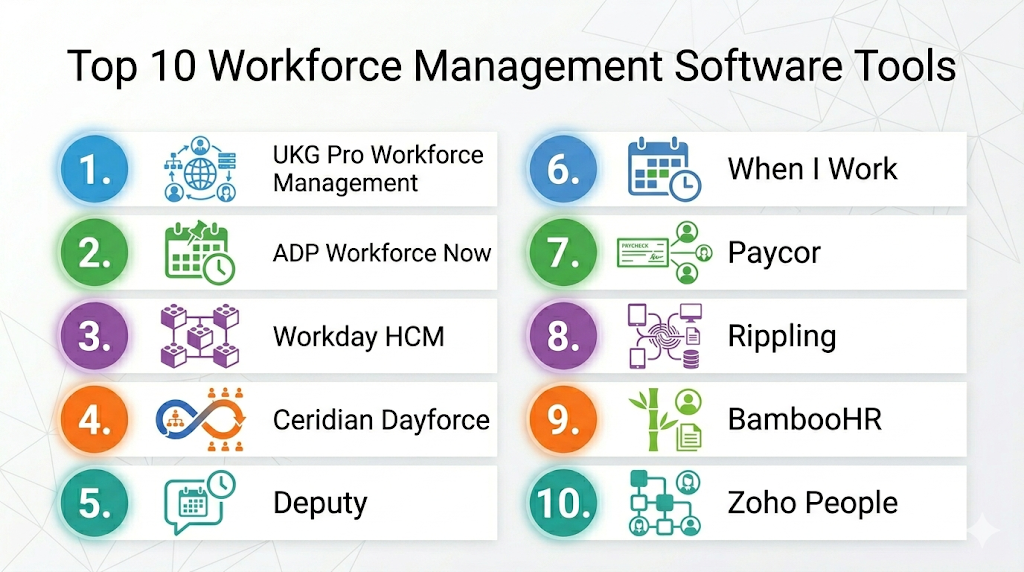
Top 10 Tool Names
- UKG Pro Workforce Management
- ADP Workforce Now
- Workday HCM
- Ceridian Dayforce
- Deputy
- When I Work
- Paycor
- Rippling
- BambooHR
- Zoho People
#1 — UKG Pro Workforce Management
Short description (2–3 lines): UKG is one of the leading enterprise workforce management platforms for scheduling, labor optimization, and compliance.
Key Features
- Advanced scheduling
- Time and attendance
- Labor forecasting
- Leave management
- Compliance controls
- Workforce analytics
- Mobile self-service
Pros
- Strong enterprise depth
- Excellent scheduling tools
- Global scalability
Cons
- Complex implementation
- Premium pricing
Platforms / Deployment
Web / Mobile
Cloud
Security & Compliance
SSO, RBAC, audit controls, enterprise security features.
Integrations & Ecosystem
- Payroll systems
- ERP platforms
- HR suites
- API
Support & Community
Strong enterprise onboarding and support tiers.
#2 — ADP Workforce Now
Short description (2–3 lines): ADP combines workforce management, payroll, and HR operations in one widely adopted platform.
Key Features
- Scheduling
- Attendance tracking
- Payroll integration
- Benefits admin
- Compliance workflows
- Reporting
- Employee self-service
Pros
- Strong payroll reputation
- Broad business functionality
- Good scalability
Cons
- Pricing may rise with modules
- Interface can feel dense
Platforms / Deployment
Web / Mobile
Cloud
Security & Compliance
Permissions, encryption, enterprise controls.
Integrations & Ecosystem
- Accounting tools
- HR apps
- Benefits providers
- API
Support & Community
Large customer base and mature support network.
#3 — Workday HCM
Short description (2–3 lines): Workday is a leading enterprise HCM suite with strong workforce planning and analytics.
Key Features
- Workforce planning
- Scheduling tools
- Attendance support
- Analytics dashboards
- Talent management
- Payroll options
- Global HR workflows
Pros
- Strong enterprise ecosystem
- Excellent reporting
- Global readiness
Cons
- Complex rollouts
- Premium pricing
Platforms / Deployment
Web / Mobile
Cloud
Security & Compliance
SSO, permissions, enterprise-grade controls.
Integrations & Ecosystem
- ERP systems
- Finance tools
- HR apps
- API
Support & Community
Best for structured enterprise deployments.
#4 — Ceridian Dayforce
Short description (2–3 lines): Dayforce provides payroll, scheduling, attendance, and workforce intelligence in one platform.
Key Features
- Scheduling
- Payroll
- Attendance
- Compliance alerts
- Workforce analytics
- Leave management
- Mobile access
Pros
- Unified HR + WFM model
- Strong compliance support
- Scalable platform
Cons
- Setup can take time
- Higher enterprise costs
Platforms / Deployment
Web / Mobile
Cloud
Security & Compliance
SSO, audit controls, permissions.
Integrations & Ecosystem
- HR systems
- Finance tools
- API
Support & Community
Strong enterprise support model.
#5 — Deputy
Short description (2–3 lines): Deputy is a modern workforce platform focused on shift scheduling, attendance, and hourly teams.
Key Features
- Smart scheduling
- Time clock
- Leave management
- Shift swaps
- Compliance alerts
- Mobile app
- Reporting
Pros
- Excellent for shift teams
- Easy to use
- Fast setup
Cons
- Less enterprise depth
- Advanced analytics limited vs giants
Platforms / Deployment
Web / iOS / Android
Cloud
Security & Compliance
Permissions, encryption, admin controls.
Integrations & Ecosystem
- Payroll tools
- POS systems
- HR apps
- API
Support & Community
Strong SMB and mid-market popularity.
#6 — When I Work
Short description (2–3 lines): When I Work is built for scheduling, attendance, and hourly workforce communication.
Key Features
- Employee scheduling
- Clock-in tools
- Shift swaps
- Team messaging
- Availability management
- Reports
- Mobile apps
Pros
- Easy adoption
- Great for hourly teams
- Affordable entry point
Cons
- Less enterprise complexity
- Limited deep forecasting tools
Platforms / Deployment
Web / Mobile
Cloud
Security & Compliance
Permissions and encryption.
Integrations & Ecosystem
- Payroll systems
- HR tools
- POS apps
Support & Community
Popular among SMB operations teams.
#7 — Paycor
Short description (2–3 lines): Paycor combines HR, payroll, and workforce management for growing businesses.
Key Features
- Scheduling
- Attendance
- Payroll
- Recruiting tools
- Reporting
- Mobile self-service
- Compliance workflows
Pros
- Strong HR + payroll bundle
- Good mid-market fit
- Broad features
Cons
- Pricing varies by modules
- Less global depth than large enterprise vendors
Platforms / Deployment
Web / Mobile
Cloud
Security & Compliance
Permissions, admin controls.
Integrations & Ecosystem
- Payroll ecosystem
- HR tools
- Finance apps
- API
Support & Community
Good support for growing businesses.
#8 — Rippling
Short description (2–3 lines): Rippling unifies HR, IT, payroll, and workforce management in a modern platform.
Key Features
- Scheduling support
- Payroll
- Time tracking
- Device management
- Automation workflows
- HR records
- Reporting
Pros
- Strong automation
- Modern interface
- Broad platform vision
Cons
- Pricing depends on modules
- Best value when using multiple products
Platforms / Deployment
Web / Mobile
Cloud
Security & Compliance
SSO, permissions, admin controls.
Integrations & Ecosystem
- IT tools
- HR systems
- Finance apps
- API
Support & Community
Rapidly growing ecosystem.
#9 — BambooHR
Short description (2–3 lines): BambooHR is a people management platform with attendance, leave, and workforce tools for SMBs.
Key Features
- Employee records
- Time-off tracking
- Attendance tools
- Performance tools
- Reporting
- Mobile access
- Workflow approvals
Pros
- Easy to use
- Great SMB fit
- Clean interface
Cons
- Less advanced scheduling depth
- Enterprise operations may outgrow it
Platforms / Deployment
Web / Mobile
Cloud
Security & Compliance
Permissions and admin controls.
Integrations & Ecosystem
- Payroll tools
- HR apps
- API
Support & Community
Strong SMB customer reputation.
#10 — Zoho People
Short description (2–3 lines): Zoho People offers attendance, leave, and workforce workflows inside the Zoho ecosystem.
Key Features
- Attendance tracking
- Shift scheduling
- Leave management
- Employee portal
- Reports
- Workflow automation
- Mobile access
Pros
- Strong value pricing
- Great for Zoho users
- Broad HR toolkit
Cons
- Best fit inside Zoho ecosystem
- Less enterprise complexity
Platforms / Deployment
Web / Mobile
Cloud
Security & Compliance
Permissions and encryption.
Integrations & Ecosystem
- Zoho apps
- CRM tools
- Finance tools
- API
Support & Community
Large ecosystem and docs.
Comparison Table (Top 10)
| Tool Name | Best For | Platform(s) Supported | Deployment | Standout Feature | Public Rating |
|---|---|---|---|---|---|
| UKG Pro | Enterprise labor ops | Web/Mobile | Cloud | Advanced scheduling | N/A |
| ADP Workforce Now | Payroll-driven firms | Web/Mobile | Cloud | Payroll integration | N/A |
| Workday HCM | Global enterprise | Web/Mobile | Cloud | Workforce analytics | N/A |
| Dayforce | Unified HR + WFM | Web/Mobile | Cloud | Real-time payroll model | N/A |
| Deputy | Shift teams | Web/Mobile | Cloud | Smart scheduling | N/A |
| When I Work | SMB hourly teams | Web/Mobile | Cloud | Team scheduling | N/A |
| Paycor | Mid-market HR teams | Web/Mobile | Cloud | HR + payroll bundle | N/A |
| Rippling | Modern operations | Web/Mobile | Cloud | HR + IT automation | N/A |
| BambooHR | SMB HR teams | Web/Mobile | Cloud | Easy people management | N/A |
| Zoho People | Value buyers | Web/Mobile | Cloud | Zoho ecosystem fit | N/A |
Evaluation & Scoring of Workforce Management Software
| Tool Name | Core | Ease | Integrations | Security | Performance | Support | Value | Weighted Total |
|---|---|---|---|---|---|---|---|---|
| UKG Pro | 9 | 7 | 8 | 9 | 9 | 8 | 6 | 8.00 |
| ADP Workforce Now | 8 | 7 | 8 | 8 | 8 | 8 | 7 | 7.75 |
| Workday HCM | 9 | 6 | 9 | 9 | 9 | 8 | 6 | 8.00 |
| Dayforce | 9 | 7 | 8 | 8 | 8 | 8 | 7 | 8.00 |
| Deputy | 8 | 9 | 7 | 8 | 8 | 8 | 9 | 8.20 |
| When I Work | 7 | 9 | 6 | 7 | 8 | 7 | 9 | 7.70 |
| Paycor | 8 | 8 | 7 | 8 | 8 | 8 | 8 | 7.95 |
| Rippling | 8 | 8 | 9 | 8 | 8 | 8 | 7 | 8.00 |
| BambooHR | 7 | 9 | 7 | 8 | 8 | 8 | 8 | 7.85 |
| Zoho People | 7 | 8 | 8 | 7 | 7 | 7 | 9 | 7.70 |
Scores are comparative and help with shortlisting. Smaller businesses may prefer ease of use over enterprise feature depth.
Which Workforce Management Software Tool Is Right for You?
Solo / Freelancer
Usually not necessary. Use a simple attendance or scheduling tool instead.
SMB
Choose Deputy, BambooHR, Zoho People, or When I Work.
Mid-Market
Choose Paycor, Rippling, or ADP Workforce Now.
Enterprise
Choose UKG Pro, Workday, or Dayforce.
Budget vs Premium
Budget: Zoho People, When I Work, Deputy
Premium: UKG Pro, Workday, Dayforce
Feature Depth vs Ease of Use
Ease: Deputy, BambooHR
Depth: UKG Pro, Workday
Integrations & Scalability
Choose ADP, Rippling, Workday.
Security & Compliance Needs
Choose enterprise vendors with RBAC, SSO, audit logs, and strong admin controls.
Frequently Asked Questions (FAQs)
1. What is workforce management software?
It helps businesses schedule, track, and optimize employee labor operations.
2. Is it only for hourly workers?
No. It can support salaried, hourly, remote, and hybrid teams.
3. Does it connect with payroll?
Many platforms integrate directly with payroll systems.
4. Can employees swap shifts?
Many modern tools support self-service shift swaps.
5. Is mobile access common?
Yes. Most vendors provide mobile apps.
6. How long does implementation take?
Simple SMB tools may take days. Enterprise rollouts can take months.
7. Does it help reduce overtime?
Yes. Forecasting and alerts can lower overtime costs.
8. Can it support multiple locations?
Yes. Many platforms are designed for multi-site operations.
9. What is the biggest buying mistake?
Choosing software that is too complex for your team size.
10. Is data secure?
Most vendors provide permissions, encryption, and admin controls.
Conclusion
Workforce management software helps organizations improve staffing efficiency, attendance accuracy, labor cost control, and employee scheduling. The right platform depends on company size, workforce complexity, payroll needs, and compliance requirements. Small teams often benefit from Deputy or BambooHR, while enterprises may need UKG Pro, Workday, or Dayforce. Shortlist two or three tools, test real scheduling workflows, verify integrations, and confirm adoption before making a final decision.
