Introduction
Voice AI Agent Platforms are software systems that allow businesses and developers to create conversational agents that interact with users through spoken language. These platforms combine automatic speech recognition, natural language understanding, text-to-speech, and dialog management to make human-computer conversations more natural and efficient.
Voice AI Agents are increasingly important for applications like customer support, smart devices, accessibility tools, and voice-enabled IoT systems. They help organizations automate interactions, improve user experience, and reduce operational costs.
Real-world use cases include:
- Automating customer support to handle routine queries and transactions
- Guiding users through purchases via voice commerce
- Controlling smart home appliances or vehicles using voice
- Supporting accessibility for users with visual or motor impairments
- Facilitating enterprise operations like IT helpdesk or HR queries
Key evaluation criteria for buyers:
- Speech recognition accuracy and language support
- Natural language understanding capabilities
- Dialog design flexibility
- Integrations with CRM, analytics, and contact center platforms
- Deployment options including cloud, on-premises, or hybrid
- Security and compliance features
- Scalability and performance
- Ease of development and management
- Analytics and monitoring capabilities
- Pricing and cost flexibility
Best for: Product managers, developers, CTOs, and digital transformation teams in mid-sized and enterprise organizations across industries like healthcare, retail, banking, automotive, and customer support.
Not ideal for: Teams with minimal technical resources or small-scale projects that do not require customized conversational capabilities.
Key Trends in Voice AI Agent Platforms
- Multilingual support with accurate recognition of accents and dialects
- Context-aware conversations that retain long-term context and preferences
- Emotion and sentiment analysis for more human-like interactions
- Hybrid deployments to address latency and privacy concerns
- Low-code/no-code interfaces for faster prototyping
- Expanding integration ecosystems with CRM, analytics, and telephony systems
- Enhanced security and compliance features including encryption and audit trails
- Conversational analytics dashboards with predictive insights
- Personalized voice experiences adapting speech style and vocabulary
- Large language model augmentation for complex queries and creative responses
How We Selected These Tools
Our top 10 selection is based on:
- Market adoption and industry mindshare
- Feature completeness including ASR, NLU, TTS, and dialog management
- Reliability, uptime, and performance benchmarks
- Security posture and enterprise compliance
- Integration capabilities and ecosystem support
- Suitability for various customer segments from developers to enterprises
- Innovation in AI and analytics features
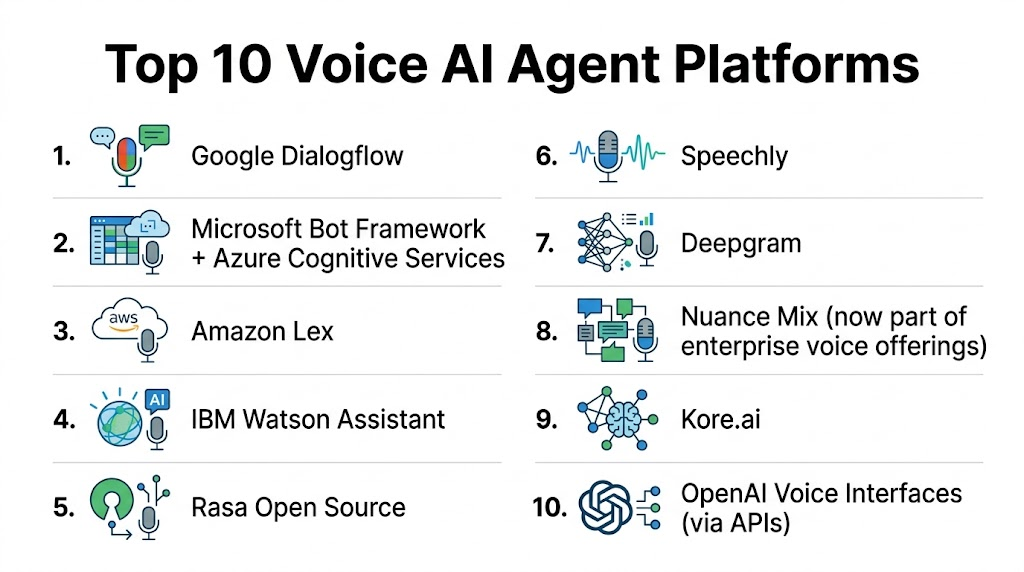
Top 10 Voice AI Agent Platforms
#1 — Google Dialogflow
Short description: A platform to build voice and chat agents with strong natural language understanding, suited for contact centers and applications.
Key Features
- Intent and entity recognition
- Speech recognition and text-to-speech
- Prebuilt templates and agents
- Google Cloud integration
- Analytics dashboard
- Multilingual support
Pros
- Accurate NLU powered by Google AI
- Easy integration with cloud services
Cons
- Pricing can increase with volume
- Requires technical expertise for deep customization
Platforms / Deployment
Cloud
Security & Compliance
Not publicly stated
Integrations & Ecosystem
- Google Cloud services
- Contact center platforms
- CRM systems
- Analytics tools
Support & Community
Extensive documentation and active community forums
#2 — Microsoft Bot Framework + Azure Cognitive Services
Short description: A toolkit for creating voice and chatbots using Azure AI services including speech and language understanding.
Key Features
- Modular bot development
- Integrated ASR and NLU
- Neural text-to-speech
- Enterprise identity and security integration
- Visual bot design tools
Pros
- Enterprise-grade security and compliance
- Strong developer and DevOps support
Cons
- Complexity for small teams
- Requires Azure familiarity
Platforms / Deployment
Cloud / Hybrid
Security & Compliance
SSO, RBAC, encryption; compatible with enterprise standards
Integrations & Ecosystem
- Azure services and storage
- CRM and ERP systems
- Telephony and contact centers
Support & Community
Comprehensive documentation, tech community, and paid support
#3 — Amazon Lex
Short description: AWS-based conversational AI platform for building voice interfaces, often used in contact centers.
Key Features
- Built-in ASR and NLU
- Dialog session management
- AWS Lambda and CloudWatch integration
- Real-time speech processing
Pros
- Scales easily within AWS
- Tight integration with enterprise systems
Cons
- Vendor lock-in with AWS
- Steep learning curve for non-AWS users
Platforms / Deployment
Cloud
Security & Compliance
Encryption and IAM supported
Integrations & Ecosystem
- AWS Lambda and services
- CRM systems
- Telephony providers
Support & Community
AWS documentation and enterprise support
#4 — IBM Watson Assistant
Short description: Conversational AI platform with voice support for enterprise applications, offering hybrid deployment and advanced dialog logic.
Key Features
- Intent classification
- Voice channel support
- Multichannel deployment
- Analytics and insights
- Hybrid deployment options
Pros
- Flexible deployment
- Strong enterprise focus
Cons
- Can be expensive
- Tooling may feel dated
Platforms / Deployment
Cloud / Hybrid
Security & Compliance
Enterprise-grade security; compliance varies by plan
Integrations & Ecosystem
- Enterprise systems
- Analytics tools
- Telephony providers
Support & Community
Formal support and professional services
#5 — Rasa Open Source
Short description: Open-source platform allowing fully customizable voice agent creation using external speech engines.
Key Features
- ML and rule-based NLU
- Customizable dialogs
- Open-source extensibility
- Integrates with speech recognition engines
Pros
- Full control over models
- No licensing cost
Cons
- Requires engineering resources
- Speech setup is external
Platforms / Deployment
Self-hosted / Cloud
Security & Compliance
User-managed
Integrations & Ecosystem
- Speech providers
- Messaging channels
- Enterprise systems
Support & Community
Active open-source community; commercial support available
#6 — Speechly
Short description: Platform for real-time voice interfaces with low-latency client-side processing.
Key Features
- Real-time voice understanding
- Client-side processing
- Intent and entity extraction
- SDKs for web and mobile
Pros
- Fast and responsive
- Developer-friendly
Cons
- Smaller ecosystem
- Limited enterprise support
Platforms / Deployment
Web / iOS / Android
Security & Compliance
Not publicly stated
Integrations & Ecosystem
- Frontend frameworks
- Custom backends
Support & Community
Documentation and forums
#7 — Deepgram
Short description: Speech-to-text platform with customizable models, used to power voice agents.
Key Features
- Accurate speech recognition
- Custom acoustic models
- Real-time and batch processing
- Multilingual support
Pros
- High transcription accuracy
- Flexible deployment
Cons
- Focused on ASR, needs dialog integration
- Engineering required for full bots
Platforms / Deployment
Cloud / Self-hosted
Security & Compliance
Varies by plan
Integrations & Ecosystem
- Voice bots
- Analytics pipelines
- Data integration
Support & Community
Documentation and enterprise support
#8 — Nuance Mix
Short description: Mature conversational AI suite with advanced speech recognition and voice experience for enterprises.
Key Features
- ASR and voice biometrics
- Dialog orchestration
- Industry-specific templates
Pros
- Excellent speech performance
- Industry focus
Cons
- Less flexible for general use
- Enterprise pricing
Platforms / Deployment
Cloud / Hybrid
Security & Compliance
Enterprise-grade controls
Integrations & Ecosystem
- Clinical and enterprise systems
- Contact center platforms
Support & Community
Professional services available
#9 — Kore.ai
Short description: Enterprise conversational AI platform for voice and chat with omnichannel support.
Key Features
- Voice and chat bot builder
- Contextual dialogs
- Analytics suite
- Omnichannel deployment
Pros
- Enterprise deployment controls
- Analytics insights
Cons
- Complexity for smaller teams
- Learning curve
Platforms / Deployment
Cloud / On-premises
Security & Compliance
Enterprise security
Integrations & Ecosystem
- CRM/ERP systems
- Messaging platforms
- Contact centers
Support & Community
Enterprise support and knowledge base
#10 — OpenAI Voice APIs
Short description: API-driven voice AI leveraging large language models for custom voice agent creation.
Key Features
- Speech-to-text and text-to-speech APIs
- Flexible NLU
- Customizable responses
Pros
- Cutting-edge language understanding
- High customization
Cons
- Requires engineering investment
- Not out-of-the-box
Platforms / Deployment
Cloud
Security & Compliance
Varies by implementation
Integrations & Ecosystem
- Developer workflows
- Backend systems
- Custom integrations
Support & Community
Active developer community
Comparison Table
| Tool Name | Best For | Platform(s) Supported | Deployment | Standout Feature | Public Rating |
|---|---|---|---|---|---|
| Google Dialogflow | Contact centers | Cloud | Cloud | Strong NLU | N/A |
| Microsoft Bot Framework | Enterprise bots | Cloud / Hybrid | Cloud/Hybrid | Azure AI integration | N/A |
| Amazon Lex | AWS-centric bots | Cloud | Cloud | AWS ecosystem | N/A |
| IBM Watson Assistant | Enterprise workflows | Cloud / Hybrid | Cloud/Hybrid | Hybrid deployment | N/A |
| Rasa Open Source | Developers | Cloud / Self-hosted | Self-hosted / Cloud | Full control | N/A |
| Speechly | Real-time UI | Web / iOS / Android | Cloud | Low latency | N/A |
| Deepgram | ASR foundation | Cloud / Self-hosted | Cloud / Self-hosted | High accuracy | N/A |
| Nuance Mix | Industry apps | Cloud / Hybrid | Cloud / Hybrid | Voice performance | N/A |
| Kore.ai | Enterprise bots | Cloud / On-prem | Cloud / On-prem | Omnichannel support | N/A |
| OpenAI Voice APIs | Custom AI voice | Cloud | Cloud | LLM-powered | N/A |
Evaluation & Scoring
| Tool Name | Core | Ease | Integrations | Security | Performance | Support | Value | Weighted Total |
|---|---|---|---|---|---|---|---|---|
| Google Dialogflow | 8 | 7 | 7 | 7 | 8 | 7 | 7 | 7.6 |
| Microsoft Bot Framework | 8 | 6 | 8 | 8 | 8 | 8 | 7 | 7.7 |
| Amazon Lex | 7 | 6 | 7 | 8 | 8 | 7 | 6 | 7.2 |
| IBM Watson Assistant | 7 | 6 | 7 | 8 | 7 | 7 | 6 | 7.1 |
| Rasa Open Source | 7 | 5 | 6 | 7 | 7 | 6 | 8 | 7.0 |
| Speechly | 6 | 8 | 6 | 6 | 7 | 6 | 7 | 6.7 |
| Deepgram | 7 | 7 | 6 | 7 | 9 | 6 | 7 | 7.4 |
| Nuance Mix | 7 | 5 | 6 | 8 | 8 | 7 | 6 | 7.0 |
| Kore.ai | 7 | 6 | 7 | 8 | 7 | 7 | 6 | 7.1 |
| OpenAI Voice APIs | 8 | 6 | 7 | 7 | 8 | 7 | 7 | 7.5 |
Scores show relative strengths across categories and help shortlist the best fit depending on specific business needs.
Which Tool Is Right for You
Solo / Freelancer
Use Speechly, Rasa, or OpenAI Voice APIs for small-scale or experimental projects.
SMB
Google Dialogflow and Amazon Lex offer easy integration, templates, and cloud-based simplicity.
Mid-Market
Microsoft Bot Framework and Deepgram provide enterprise features with flexibility.
Enterprise
Choose IBM Watson Assistant, Kore.ai, or Microsoft Bot Framework for hybrid deployment, compliance, and support.
Budget vs Premium
Open-source options like Rasa reduce cost but require technical resources. Premium platforms provide enterprise support and prebuilt capabilities.
Feature Depth vs Ease of Use
Balance enterprise features and ease of implementation with Dialogflow and Microsoft Bot Framework. Use Rasa or OpenAI APIs for deep customization.
Integrations & Scalability
Cloud ecosystems like AWS Lex and Azure Bot Framework offer strong scaling and connectivity options.
Security & Compliance Needs
Enterprise-grade controls and hybrid deployments are ideal for regulated industries.
Frequently Asked Questions
1. What pricing models are typical?
Pricing can be subscription-based, usage-based, or free for open-source platforms. Evaluate costs including infrastructure and licensing.
2. How long does it take to build a voice agent?
Simple agents can be built in days. Enterprise solutions with integrations may require weeks.
3. Can these platforms handle multiple languages?
Most platforms support multiple languages. Accuracy may vary by dialect and accent.
4. How important is speech recognition accuracy?
High accuracy is essential for good user experience and reducing misunderstandings.
5. Do voice agents require continuous training?
Yes, analyzing interaction data improves performance and user satisfaction over time.
6. What integrations should I prioritize?
CRM, analytics, telephony, and contact center systems are usually critical.
7. Are there privacy concerns with voice agents?
Yes, ensure encryption, access controls, and compliance with regulations.
8. Can I switch platforms later?
Migration is possible but requires careful planning and modular integrations.
9. Do I need developers to use these tools?
Most custom deployments require technical expertise, except for simple templates.
10. What’s the difference between ASR and NLU?
ASR converts speech to text, NLU interprets the meaning and intent.
Conclusion
Voice AI Agent Platforms are essential for creating natural, accessible, and efficient interactions across customer support, smart devices, and enterprise operations. Selection should be based on organizational needs, technical resources, integration requirements, and compliance standards. A practical approach is to shortlist 2–3 platforms, run a pilot, and assess integration and performance before full deployment.
