Introduction
Unit Testing Frameworks are essential tools used by developers to test individual components or units of code. They help verify that each part of an application works as expected, ensuring code quality and reducing bugs in production.
With the rise of agile and DevOps practices, automated unit testing has become critical for faster release cycles, continuous integration, and maintaining high-quality software standards. Unit testing frameworks allow for structured, repeatable, and maintainable test cases.
Real-world use cases:
- Testing functions, methods, or classes in isolation
- Validating business logic before integration
- Supporting test-driven development (TDD)
- Ensuring stability during refactoring
- Integrating with CI/CD pipelines for automated testing
What buyers should evaluate:
- Supported programming languages
- Integration with IDEs and CI/CD tools
- Ease of writing and running tests
- Mocking and stubbing support
- Reporting and analytics
- Community and support
- Maintenance and scalability
- Cross-platform support
Best for: Developers, QA engineers, DevOps teams, and teams practicing TDD
Not ideal for: Projects without structured codebases or very small scripts
Key Trends in Unit Testing Frameworks
- Greater integration with CI/CD pipelines
- Support for multiple programming languages
- Advanced mocking and stubbing tools
- AI-assisted test generation
- Parallel and asynchronous test execution
- Cloud-native and distributed testing
- Reporting and analytics dashboards
- Test coverage measurement integration
- Strong open-source community contributions
How We Selected These Tools
- Popularity and industry adoption
- Language support and ecosystem compatibility
- Ease of writing and maintaining tests
- CI/CD integration and automation support
- Performance and execution speed
- Reporting and coverage analytics
- Community and vendor support
- Documentation and learning resources
- Reliability in production environments
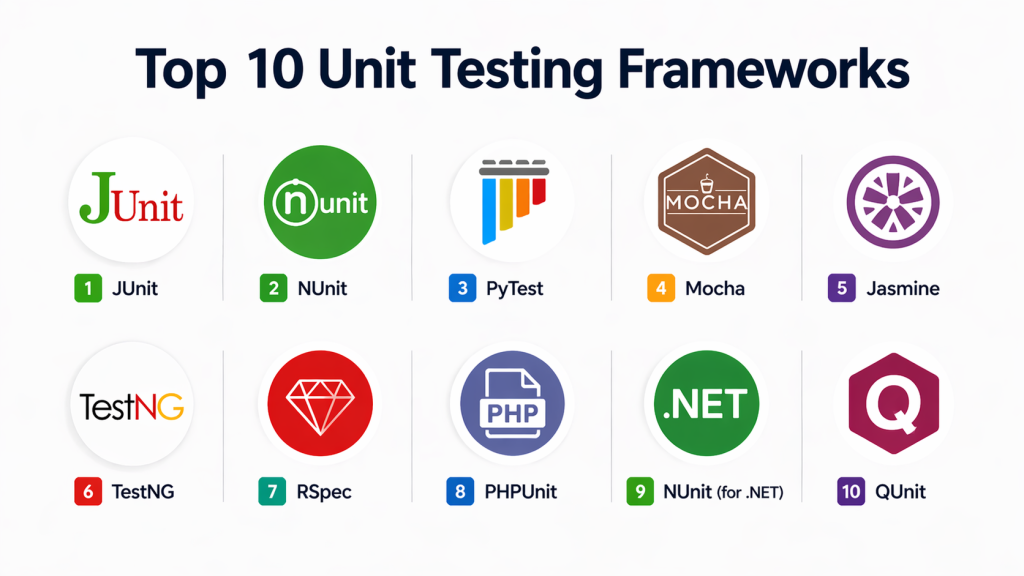
Top 10 Unit Testing Frameworks
#1 — JUnit
Short description:
JUnit is a widely used open-source unit testing framework for Java applications. It allows developers to write and run repeatable tests for individual components. Ideal for TDD and continuous integration setups.
Key Features
- Annotation-based testing
- Test suites and runners
- Integration with IDEs and CI tools
- Exception and timeout testing
- Parameterized tests
Pros
- Open-source and widely adopted
- Strong community support
Cons
- Java-only
- Limited mocking capabilities without extensions
Platforms / Deployment
Cross-platform / Cloud / Local
Security & Compliance
Not publicly stated
Integrations & Ecosystem
- Maven, Gradle
- Jenkins, GitLab CI
- Mocking libraries like Mockito
Support & Community
Large global community
#2 — NUnit
Short description:
NUnit is a unit testing framework for .NET languages. It provides a rich set of assertions and supports test-driven development. Ideal for .NET developers and enterprise applications.
Key Features
- Attribute-based testing
- Parameterized and data-driven tests
- Test runners and reporting
- Integration with IDEs
- Exception handling
Pros
- Mature .NET framework support
- Open-source
Cons
- .NET only
- Limited GUI support
Platforms / Deployment
Windows / Cross-platform with .NET Core
Security & Compliance
Not publicly stated
Integrations & Ecosystem
- Visual Studio
- Azure DevOps
- CI/CD tools
Support & Community
Strong community and documentation
#3 — PyTest
Short description:
PyTest is a popular Python unit testing framework known for simplicity and powerful features. It allows for concise test definitions and easy integration with automation pipelines.
Key Features
- Simple syntax for tests
- Fixtures for setup/teardown
- Parameterized testing
- Assertions and plugins
- Test discovery
Pros
- Easy to learn
- Extensive plugin ecosystem
Cons
- Python-only
- Some advanced features require plugins
Platforms / Deployment
Cross-platform / Cloud
Security & Compliance
Not publicly stated
Integrations & Ecosystem
- CI/CD tools
- Selenium, API testing libraries
- Mocking frameworks
Support & Community
Large and active open-source community
#4 — Mocha
Short description:
Mocha is a JavaScript testing framework that runs on Node.js and browsers. It is highly flexible, supporting asynchronous tests and behavior-driven development (BDD).
Key Features
- Asynchronous test support
- BDD and TDD style
- Hooks for setup and teardown
- Flexible reporting
- Integration with assertion libraries
Pros
- Flexible and lightweight
- Supports async testing
Cons
- Requires configuration
- Needs assertion library like Chai
Platforms / Deployment
Cross-platform / Cloud
Security & Compliance
Not publicly stated
Integrations & Ecosystem
- Chai, Sinon
- CI/CD pipelines
- Browser testing tools
Support & Community
Strong JavaScript community
#5 — Jasmine
Short description:
Jasmine is a behavior-driven development framework for JavaScript. It allows writing human-readable test cases for front-end and back-end JavaScript applications.
Key Features
- BDD syntax
- Asynchronous testing
- Mocking and spies
- No external dependencies
- Test reporting
Pros
- Simple and expressive
- No dependencies
Cons
- JavaScript-only
- Limited reporting without extensions
Platforms / Deployment
Cross-platform / Cloud
Security & Compliance
Not publicly stated
Integrations & Ecosystem
- Karma, Protractor
- CI/CD tools
Support & Community
Active open-source community
#6 — TestNG
Short description:
TestNG is a testing framework inspired by JUnit but with more powerful features for Java applications. It supports multi-threaded execution and dependency management for complex test cases.
Key Features
- Annotations and grouping
- Parallel test execution
- Dependency testing
- Data-driven testing
- Flexible configuration
Pros
- Supports complex Java testing
- Parallel execution
Cons
- Java-only
- Slight learning curve
Platforms / Deployment
Cross-platform / Cloud
Security & Compliance
Not publicly stated
Integrations & Ecosystem
- Maven, Gradle
- Jenkins, CI/CD tools
Support & Community
Strong developer community
#7 — RSpec
Short description:
RSpec is a testing framework for Ruby that supports behavior-driven development. It allows developers to write readable and structured unit tests for Ruby applications.
Key Features
- BDD syntax
- Mocks and stubs
- Test grouping and hooks
- Readable test outputs
- Integration with Ruby tools
Pros
- Expressive syntax
- Well-suited for Ruby apps
Cons
- Ruby-only
- Limited multi-language support
Platforms / Deployment
Cross-platform / Cloud
Security & Compliance
Not publicly stated
Integrations & Ecosystem
- Rails, Ruby gems
- CI/CD pipelines
Support & Community
Active Ruby community
#8 — PHPUnit
Short description:
PHPUnit is a unit testing framework for PHP applications. It supports automated testing of classes and functions and integrates with PHP development workflows.
Key Features
- Test case definitions
- Assertions and fixtures
- Test suites and runners
- Mock objects
- Reporting and logs
Pros
- PHP-specific features
- Widely adopted
Cons
- PHP-only
- Learning curve for beginners
Platforms / Deployment
Cross-platform / Cloud
Security & Compliance
Not publicly stated
Integrations & Ecosystem
- CI/CD tools
- PHP frameworks
Support & Community
Strong PHP developer community
#9 — NUnit (for .NET)
Short description:
NUnit is a mature unit testing framework for .NET applications. It supports data-driven and parameterized tests for reliable testing workflows.
Key Features
- Attribute-based test configuration
- Data-driven testing
- Parameterized tests
- Reporting
- Integration with .NET IDEs
Pros
- Mature framework
- Open-source
Cons
- Limited to .NET
- Requires knowledge of C#
Platforms / Deployment
Windows / Cross-platform (.NET Core)
Security & Compliance
Not publicly stated
Integrations & Ecosystem
- Visual Studio
- Azure DevOps
Support & Community
Strong .NET community
#10 — QUnit
Short description:
QUnit is a JavaScript testing framework used primarily for jQuery and front-end applications. It provides lightweight and fast unit testing capabilities.
Key Features
- Simple syntax
- Fast execution
- Assertions and test suites
- Asynchronous testing
- Reporting
Pros
- Lightweight
- Easy integration
Cons
- JavaScript-only
- Limited reporting
Platforms / Deployment
Cross-platform / Cloud
Security & Compliance
Not publicly stated
Integrations & Ecosystem
- jQuery, JavaScript libraries
- CI/CD pipelines
Support & Community
Active community
Comparison Table
| Tool | Best For | Platform | Deployment | Standout Feature | Rating |
|---|---|---|---|---|---|
| JUnit | Java | Cross-platform | Hybrid | TDD support | N/A |
| NUnit | .NET | Windows / .NET Core | Hybrid | Data-driven tests | N/A |
| PyTest | Python | Cross-platform | Hybrid | Easy syntax | N/A |
| Mocha | JavaScript | Cross-platform | Cloud | Async testing | N/A |
| Jasmine | JavaScript | Cross-platform | Cloud | BDD syntax | N/A |
| TestNG | Java | Cross-platform | Hybrid | Parallel execution | N/A |
| RSpec | Ruby | Cross-platform | Cloud | Expressive syntax | N/A |
| PHPUnit | PHP | Cross-platform | Cloud | PHP-specific | N/A |
| QUnit | JavaScript | Cross-platform | Cloud | Lightweight | N/A |
| PyTest | Python | Cross-platform | Hybrid | Parameterized tests | N/A |
Evaluation & Scoring
| Tool | Core | Ease | Integrations | Security | Performance | Support | Value | Total |
|---|---|---|---|---|---|---|---|---|
| JUnit | 9 | 8 | 9 | 8 | 9 | 9 | 9 | 8.7 |
| NUnit | 8 | 8 | 8 | 8 | 8 | 8 | 8 | 8.0 |
| PyTest | 9 | 9 | 8 | 8 | 9 | 9 | 9 | 8.7 |
| Mocha | 8 | 8 | 8 | 8 | 8 | 8 | 8 | 8.0 |
| Jasmine | 8 | 8 | 8 | 8 | 8 | 8 | 8 | 8.0 |
| TestNG | 9 | 7 | 9 | 8 | 9 | 8 | 8 | 8.3 |
| RSpec | 8 | 8 | 8 | 8 | 8 | 8 | 8 | 8.0 |
| PHPUnit | 8 | 8 | 8 | 8 | 8 | 8 | 8 | 8.0 |
| QUnit | 8 | 8 | 7 | 8 | 8 | 8 | 8 | 7.9 |
Frequently Asked Questions (FAQs)
1. What are unit testing frameworks?
Frameworks that allow developers to write tests for individual code units. They ensure components work as expected.
2. Why use unit testing frameworks?
They improve code quality, detect bugs early, and support TDD practices.
3. Are they free?
Many frameworks like JUnit, PyTest, and Mocha are open-source. Some enterprise tools are paid.
4. Which framework is easiest for beginners?
PyTest and QUnit are beginner-friendly due to simple syntax and easy setup.
5. Can they integrate with CI/CD?
Yes, most frameworks integrate with CI/CD pipelines for automated testing.
6. Do they support multiple languages?
Some frameworks are language-specific (JUnit for Java, PyTest for Python).
7. Are these frameworks scalable?
Yes, they can run parallel tests and integrate with distributed testing tools.
8. What is TDD?
Test-Driven Development involves writing tests before coding, ensuring better design and coverage.
9. Can frameworks test APIs?
Some frameworks support API testing, especially when combined with additional libraries.
10. When should unit tests be written?
Unit tests should be written during development and maintained throughout the lifecycle.
Conclusion
Unit Testing Frameworks are critical for ensuring reliable, maintainable, and high-quality software. They help detect defects early and improve development efficiency.
From open-source frameworks like JUnit and PyTest to specialized tools for JavaScript or .NET, each framework offers unique capabilities for different programming environments.
Selecting the right framework depends on your language, project needs, and team expertise.
A well-implemented unit testing strategy enhances software reliability, supports continuous delivery, and reduces production issues.
