Introduction
Speech Recognition Platforms are AI-powered systems that convert spoken language into text. These tools use advanced machine learning, deep learning, and natural language processing (NLP) to interpret human speech with high accuracy. They are widely used in industries like healthcare, customer support, media, education, and cybersecurity.
In the modern digital ecosystem, speech recognition is no longer just about transcription. It now powers voice assistants, real-time translation, meeting intelligence, accessibility tools, and AI-driven automation systems. As organizations adopt Zero Trust security models and Identity Management systems, speech data is also increasingly governed for compliance and privacy.
Real-world use cases include:
- Transcribing meetings and interviews
- Voice assistants and chatbots
- Customer support call analysis
- Medical dictation and healthcare documentation
- Real-time language translation
- Security and voice authentication
What buyers should evaluate:
- Accuracy across accents and languages
- Real-time vs batch processing capability
- Noise handling and audio clarity
- Integration with applications and APIs
- Scalability and latency performance
- Security and compliance (HIPAA, GDPR, etc.)
- Deployment options (cloud, on-premise, hybrid)
- Cost and pricing model
Best for: Enterprises, developers, call centers, healthcare providers, media companies, and AI product teams.
Not ideal for: Simple offline transcription needs or non-voice-based workflows.
Key Trends in Speech Recognition Platforms
- AI-powered real-time transcription improvements
- Multilingual and accent-aware speech models
- Edge-based speech recognition for low latency
- Integration with conversational AI and chatbots
- Voice biometrics for identity verification
- Noise-robust deep learning models
- Zero Trust security for voice data processing
- Cloud-native speech APIs becoming standard
- Emotion and sentiment detection from voice
- Domain-specific speech models (medical, legal, finance)
How We Speech Recognition Platforms (Methodology)
We evaluated platforms based on:
- Speech-to-text accuracy across languages and accents
- Real-time processing performance
- Scalability and enterprise readiness
- Security and compliance capabilities
- API flexibility and integration ecosystem
- Ease of use and developer experience
- Deployment options
- Market adoption and reliability
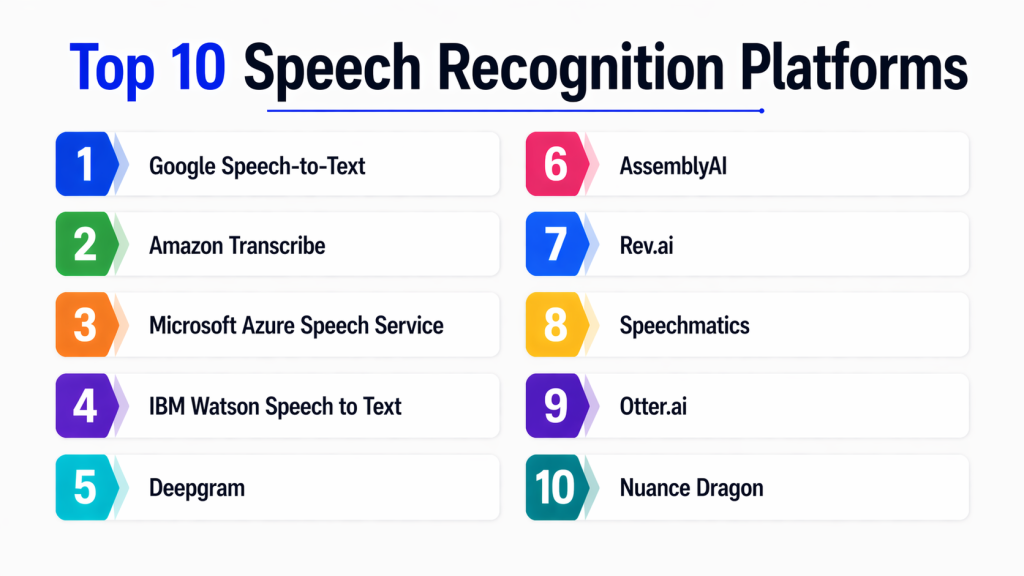
Top 10 Speech Recognition Platforms
#1 — Google Speech-to-Text
Short description :
Google Speech-to-Text is a highly scalable speech recognition service powered by Google’s AI infrastructure. It supports real-time and batch transcription across multiple languages. Widely used in enterprise applications. Known for high accuracy and fast processing. Ideal for developers and large-scale applications.
Key Features
- Real-time transcription
- Multi-language support
- Speaker diarization
- Noise robustness
- API-based integration
- Custom language models
Pros
- High accuracy
- Scalable infrastructure
Cons
- Cloud dependency
- Pricing varies with usage
Platforms / Deployment
Web
Cloud
Security & Compliance
Encryption, IAM controls
Compliance: Varies
Integrations & Ecosystem
- Google Cloud services
- AI pipelines
- APIs
Support & Community
Strong enterprise support.
#2 — Amazon Transcribe
Short description :
Amazon Transcribe is AWS’s speech recognition platform designed for scalable transcription. It supports real-time and batch processing. Commonly used in call analytics and media applications. Strong integration with AWS ecosystem. Suitable for enterprise workloads.
Key Features
- Real-time transcription
- Call analytics
- Speaker identification
- Custom vocabulary support
- Multi-language support
Pros
- Highly scalable
- AWS integration
Cons
- AWS lock-in
- Pricing complexity
Platforms / Deployment
Web
Cloud
Security & Compliance
IAM, encryption
Compliance: Varies
Integrations & Ecosystem
- AWS services
- Data lakes
- ML pipelines
Support & Community
Enterprise-level support.
#3 — Microsoft Azure Speech Service
Short description :
Azure Speech Service provides speech-to-text, text-to-speech, and voice translation capabilities. It is part of Microsoft Cognitive Services. Ideal for enterprise applications and AI systems. Strong security and compliance features. Integrates well with Microsoft ecosystem.
Key Features
- Speech-to-text
- Real-time translation
- Custom voice models
- Speaker recognition
- Noise reduction
Pros
- Enterprise security
- Strong integration
Cons
- Requires Azure ecosystem
- Learning curve
Platforms / Deployment
Web
Cloud
Security & Compliance
Azure AD, encryption
Compliance: Varies
Integrations & Ecosystem
- Microsoft 365
- Azure AI tools
- APIs
Support & Community
Enterprise support.
#4 — IBM Watson Speech to Text
Short description :
IBM Watson Speech to Text provides AI-powered transcription services for enterprise use. It supports multiple languages and customization. Known for enterprise-grade security. Suitable for regulated industries. Focuses on accuracy and reliability.
Key Features
- Real-time transcription
- Language customization
- Speaker labeling
- Noise handling
- API integration
Pros
- Strong enterprise focus
- Reliable performance
Cons
- Complex setup
- Higher cost
Platforms / Deployment
Cloud / Hybrid
Security & Compliance
Enterprise-grade encryption
Compliance: Varies
Integrations & Ecosystem
- IBM Cloud
- Data platforms
- APIs
Support & Community
Enterprise support.
#5 — Deepgram
Short description :
Deepgram is an AI speech recognition platform designed for developers. It offers high-speed transcription using deep learning models. Known for low latency and scalability. Ideal for real-time applications. Widely used in call centers and media platforms.
Key Features
- Real-time transcription
- AI-based models
- Speaker diarization
- Custom training
- API-first design
Pros
- Fast processing
- Developer-friendly
Cons
- Smaller ecosystem
- Limited offline support
Platforms / Deployment
Cloud
Security & Compliance
Encryption, access control
Compliance: Not publicly stated
Integrations & Ecosystem
- APIs
- Cloud tools
Support & Community
Growing developer community.
#6 — AssemblyAI
Short description :
AssemblyAI provides advanced speech-to-text and audio intelligence APIs. It includes transcription, summarization, and sentiment analysis. Ideal for developers building AI-powered applications. Focuses on ease of integration. Strong performance for real-time use cases.
Key Features
- Speech-to-text API
- Audio intelligence
- Sentiment detection
- Summarization
- Real-time processing
Pros
- Easy to integrate
- Feature-rich
Cons
- API-dependent
- Limited offline use
Platforms / Deployment
Cloud
Security & Compliance
Encryption
Compliance: Not publicly stated
Integrations & Ecosystem
- APIs
- AI tools
Support & Community
Strong developer support.
#7 — Rev.ai
Short description :
Rev.ai provides automated speech recognition services with high accuracy. It is widely used for transcription in media and enterprise workflows. Supports real-time and batch processing. Known for simplicity and reliability.
Key Features
- Speech-to-text API
- Real-time transcription
- Batch processing
- Speaker identification
Pros
- Accurate transcription
- Easy to use
Cons
- Limited advanced AI features
- API-only model
Platforms / Deployment
Cloud
Security & Compliance
Encryption
Compliance: Not publicly stated
Integrations & Ecosystem
- APIs
- Media tools
Support & Community
Good developer support.
#8 — Speechmatics
Short description :
Speechmatics is a global speech recognition platform supporting many languages and accents. It focuses on accuracy and flexibility. Suitable for enterprise applications. Offers real-time transcription capabilities.
Key Features
- Multi-language support
- Real-time transcription
- AI-driven accuracy
- Custom models
Pros
- Strong language support
- High accuracy
Cons
- Enterprise pricing
- Complex setup
Platforms / Deployment
Cloud / On-premise
Security & Compliance
Enterprise security controls
Compliance: Varies
Integrations & Ecosystem
- APIs
- Enterprise tools
Support & Community
Enterprise support.
#9 — Otter.ai
Short description :
Otter.ai is a popular speech-to-text platform focused on meetings and collaboration. It provides real-time transcription and note-taking. Widely used in business meetings and education. Simple and user-friendly interface.
Key Features
- Real-time transcription
- Meeting notes
- Speaker identification
- Cloud storage
Pros
- Easy to use
- Great for meetings
Cons
- Limited enterprise customization
- Internet required
Platforms / Deployment
Web / Mobile
Cloud
Security & Compliance
Basic encryption
Compliance: Not publicly stated
Integrations & Ecosystem
- Zoom
- Meeting tools
Support & Community
Strong user base.
#10 — Nuance Dragon
Short description :
Nuance Dragon is a professional speech recognition tool widely used in healthcare and legal industries. Known for high accuracy and domain-specific customization. Supports voice dictation workflows. Strong enterprise adoption.
Key Features
- Voice dictation
- Domain-specific models
- High accuracy transcription
- Custom vocabulary
- Desktop integration
Pros
- Very accurate
- Industry-specific solutions
Cons
- Expensive
- Limited cloud flexibility
Platforms / Deployment
Windows / Desktop
Security & Compliance
Enterprise-grade controls
Compliance: Healthcare-ready (varies)
Integrations & Ecosystem
- Enterprise software
- Medical systems
Support & Community
Enterprise support.
Comparison Table (Top 10)
| Tool Name | Best For | Platform(s) | Deployment | Standout Feature | Public Rating |
|---|---|---|---|---|---|
| Google STT | Developers | Multi | Cloud | Accuracy | N/A |
| Amazon Transcribe | AWS users | Web | Cloud | Call analytics | N/A |
| Azure Speech | Enterprise | Web | Cloud | Microsoft integration | N/A |
| IBM Watson | Enterprise | Multi | Hybrid | Security | N/A |
| Deepgram | Real-time apps | Cloud | Cloud | Low latency | N/A |
| AssemblyAI | Developers | Cloud | Cloud | Audio intelligence | N/A |
| Rev.ai | Media | Cloud | Cloud | Simplicity | N/A |
| Speechmatics | Global apps | Multi | Hybrid | Language support | N/A |
| Otter.ai | Meetings | Web/Mobile | Cloud | Meeting notes | N/A |
| Nuance Dragon | Healthcare | Desktop | On-premise | Accuracy | N/A |
Evaluation & Scoring of Speech Recognition Platforms
| Tool | Core | Ease | Integration | Security | Performance | Support | Value | Total |
|---|---|---|---|---|---|---|---|---|
| Google STT | 10 | 8 | 10 | 9 | 10 | 9 | 8 | 9.1 |
| Amazon Transcribe | 10 | 7 | 10 | 9 | 9 | 9 | 7 | 8.7 |
| Azure Speech | 10 | 7 | 10 | 9 | 9 | 9 | 7 | 8.7 |
| IBM Watson | 9 | 7 | 8 | 9 | 8 | 8 | 7 | 8.0 |
| Deepgram | 9 | 9 | 9 | 8 | 10 | 8 | 8 | 8.7 |
| AssemblyAI | 9 | 9 | 9 | 8 | 9 | 8 | 8 | 8.6 |
| Rev.ai | 8 | 9 | 8 | 8 | 8 | 8 | 8 | 8.1 |
| Speechmatics | 9 | 7 | 8 | 9 | 9 | 8 | 7 | 8.2 |
| Otter.ai | 8 | 10 | 7 | 7 | 8 | 8 | 9 | 8.0 |
| Nuance Dragon | 9 | 7 | 8 | 9 | 9 | 9 | 6 | 8.3 |
Which Speech Recognition Platform Is Right for You?
Solo / Freelancer
Use Otter.ai, Rev.ai
SMB
Use Deepgram, AssemblyAI
Mid-Market
Use Speechmatics, IBM Watson
Enterprise
Use Google STT, Azure Speech, Amazon Transcribe
Budget vs Premium
Budget: Otter.ai
Premium: Nuance Dragon
Real-time vs Batch
Real-time: Deepgram
Batch: Google STT
Security & Compliance
Best: IBM Watson, Azure Speech
Frequently Asked Questions (FAQs)
1. What is speech recognition?
Speech recognition is a technology that converts spoken language into written text using artificial intelligence. It relies on machine learning and natural language processing to understand speech patterns. These systems continuously improve with more data and training. They are widely used in voice assistants, transcription tools, and automation systems. It plays a key role in modern AI-driven applications.
2. Where is speech recognition used?
Speech recognition is used across multiple industries including healthcare, customer support, education, and media. It helps automate documentation, transcribe conversations, and improve accessibility. Businesses use it for call analytics and voice assistants. It is also widely used in mobile apps and enterprise systems. Its adoption continues to grow with AI advancements.
3. Is speech recognition accurate?
Modern speech recognition platforms are highly accurate, especially in controlled environments. Accuracy depends on factors like audio quality, background noise, and speaker accent. Advanced AI models improve recognition over time. Enterprise platforms provide better accuracy through customization. However, no system is perfect and edge cases still exist.
4. Is speech recognition secure?
Most enterprise-grade platforms include strong security features such as encryption, access control, and compliance support. Security depends on how the system is deployed and managed. Cloud providers offer built-in safeguards for data protection. Organizations handling sensitive data must evaluate compliance requirements carefully. Proper configuration is essential for maintaining security.
5. Can speech recognition work offline?
Some speech recognition tools support offline functionality, especially desktop-based solutions. However, most modern platforms rely on cloud infrastructure for better accuracy and scalability. Offline systems may have limitations in performance. They are useful in restricted environments where internet access is limited. Cloud-based tools remain more advanced overall.
6. Can speech recognition handle multiple languages?
Yes, many platforms support multiple languages and dialects. Advanced systems can detect and switch languages automatically. Accuracy may vary depending on language complexity and available training data. Enterprise platforms typically support a wider range of languages. Multilingual support is a key feature for global applications.
7. Is speech recognition expensive?
The cost of speech recognition tools varies depending on usage, features, and deployment model. Some platforms offer free tiers for limited use. Enterprise solutions often follow usage-based pricing models. Costs can increase with real-time processing and large-scale deployments. It is important to evaluate pricing against business needs.
8. Can speech recognition be integrated into applications?
Yes, most modern speech recognition platforms provide APIs and SDKs for easy integration. Developers can embed speech capabilities into mobile apps, web platforms, and enterprise systems. Integration helps automate workflows and improve user experience. Compatibility with existing systems is an important consideration. Most platforms support flexible integration options.
9. What factors affect speech recognition accuracy?
Several factors impact accuracy, including background noise, microphone quality, speaker accent, and language complexity. High-quality audio input improves performance significantly. AI models trained on diverse datasets perform better. Custom vocabulary can also enhance accuracy. Continuous tuning helps achieve better results over time.
10. What are the limitations of speech recognition?
Speech recognition systems may struggle with heavy accents, noisy environments, or domain-specific terminology. Some platforms require internet connectivity, which can limit offline use. Real-time processing may introduce latency in certain cases. Privacy concerns can also arise with voice data. Despite these limitations, the technology continues to improve rapidly.
Conclusion
Speech recognition platforms have evolved into powerful AI systems that enable seamless communication between humans and machines. From real-time transcription to voice-enabled automation, these tools are transforming industries by improving efficiency, accessibility, and user experience. Businesses are increasingly adopting speech recognition to automate workflows, enhance customer interactions, and unlock insights from voice data.
Choosing the right platform depends on your specific requirements such as accuracy, scalability, security, and integration capabilities. Instead of selecting a single “best” solution, it is recommended to evaluate a few platforms based on real-world use cases, test their performance, and validate how well they fit into your existing ecosystem.
