Introduction
Smart Thermostat Apps allow users to control heating and cooling systems remotely using smartphones or web interfaces. These apps connect with smart thermostats and IoT devices to provide automation, scheduling, temperature control, and energy optimization.
With increasing energy costs and demand for smarter homes, thermostat apps have evolved into intelligent systems. They now use AI, occupancy detection, and learning algorithms to adjust temperatures automatically. This helps reduce energy consumption, improve comfort, and support sustainability goals.
Common use cases:
- Controlling home temperature remotely
- Scheduling heating and cooling cycles
- Monitoring energy usage
- Automating climate control
- Integrating with smart home ecosystems
What buyers should evaluate:
- Device compatibility
- Ease of use and interface
- Automation and scheduling features
- Energy-saving capabilities
- Integration with smart home systems
- Mobile and voice control
- Security and privacy
- Performance and reliability
Best for: Homeowners, smart home users, and businesses optimizing energy usage.
Not ideal for: Users without compatible smart thermostat devices.
Key Trends in Smart Thermostat Apps
- AI-based temperature optimization
- Integration with smart home ecosystems
- Voice assistant compatibility
- Energy usage analytics and reporting
- Geofencing for automatic adjustments
- Mobile-first control experiences
- Sustainability and energy-saving focus
- IoT-based automation
How We Evaluate Smart Thermostat Apps (Methodology)
- Market adoption and popularity
- Feature completeness and usability
- Device compatibility
- Integration ecosystem
- Performance and reliability
- Security features
- Ease of setup and onboarding
- Customer support and updates
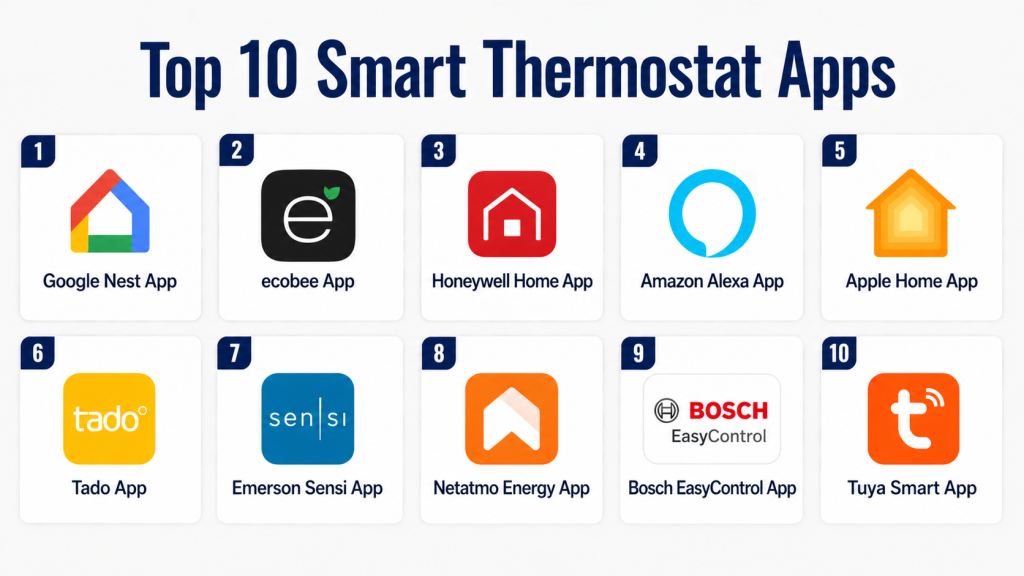
Top 10 Smart Thermostat Apps
#1 — Google Nest App
Short description:
Google Nest App provides smart thermostat control with AI-based automation. It learns user preferences and adjusts temperature automatically. The app offers remote control and scheduling. It integrates with smart home devices. It is ideal for connected homes.
Key Features
- AI learning
- Remote control
- Scheduling
- Energy reports
Pros
- Smart automation
- Easy integration
Cons
- Requires Nest devices
- Limited customization
Platforms / Deployment
iOS, Android / Cloud
Security & Compliance
Not publicly stated
Integrations & Ecosystem
Integrates with smart home platforms.
- Smart devices
- Voice assistants
Support & Community
Strong support.
#2 — ecobee App
Short description:
ecobee App controls ecobee thermostats with advanced automation. It uses sensors for occupancy detection. The app provides energy insights. It is suitable for smart homes. It improves efficiency and comfort.
Key Features
- Occupancy sensors
- Scheduling
- Energy reports
- Remote control
Pros
- Energy efficient
- Smart features
Cons
- Requires ecobee devices
- Premium pricing
Platforms / Deployment
iOS, Android / Cloud
Security & Compliance
Not publicly stated
Integrations & Ecosystem
Supports smart home integrations.
- Voice assistants
- IoT systems
Support & Community
Good support.
#3 — Honeywell Home App
Short description:
Honeywell Home App provides smart thermostat control and automation. It allows remote temperature management. The app supports scheduling and alerts. It is suitable for residential and commercial use. It ensures comfort and efficiency.
Key Features
- Temperature control
- Scheduling
- Alerts
- Energy tracking
Pros
- Reliable
- Easy to use
Cons
- Limited advanced features
- UI improvements needed
Platforms / Deployment
iOS, Android / Cloud
Security & Compliance
Not publicly stated
Integrations & Ecosystem
Integrates with smart home devices.
- IoT systems
- Smart platforms
Support & Community
Reliable support.
#4 — Tado App
Short description:
Tado App offers smart climate control with automation and geofencing. It adjusts temperature based on location. The app provides energy-saving insights. It is suitable for modern homes. It enhances efficiency.
Key Features
- Geofencing
- Automation
- Energy reports
- Remote control
Pros
- Smart automation
- Energy savings
Cons
- Requires Tado devices
- Subscription features
Platforms / Deployment
iOS, Android / Cloud
Security & Compliance
Not publicly stated
Integrations & Ecosystem
Supports smart home integrations.
- Smart devices
- Voice assistants
Support & Community
Good support.
#5 — Emerson Sensi App
Short description:
Sensi App provides smart thermostat control with scheduling and alerts. It is easy to use and reliable. The app supports energy-saving features. It is suitable for homeowners. It improves comfort and efficiency.
Key Features
- Scheduling
- Alerts
- Remote control
- Energy tracking
Pros
- Simple interface
- Affordable
Cons
- Limited advanced features
- Basic analytics
Platforms / Deployment
iOS, Android / Cloud
Security & Compliance
Not publicly stated
Integrations & Ecosystem
Integrates with smart home systems.
- IoT devices
- Voice assistants
Support & Community
Good support.
#6 — Netatmo Energy App
Short description:
Netatmo Energy App provides smart thermostat control and energy monitoring. It supports automation and reporting. The app is suitable for smart homes. It helps reduce energy usage. It is easy to use.
Key Features
- Energy monitoring
- Automation
- Scheduling
- Reports
Pros
- Good analytics
- Easy setup
Cons
- Limited ecosystem
- Device dependency
Platforms / Deployment
iOS, Android / Cloud
Security & Compliance
Not publicly stated
Integrations & Ecosystem
Supports integrations with smart devices.
- IoT systems
- Smart platforms
Support & Community
Moderate support.
#7 — Bosch EasyControl App
Short description:
Bosch EasyControl App offers smart thermostat management with automation features. It provides remote control and scheduling. The app is suitable for residential use. It improves efficiency and comfort.
Key Features
- Remote control
- Scheduling
- Automation
- Energy tracking
Pros
- Reliable
- Easy to use
Cons
- Limited features
- Device dependency
Platforms / Deployment
iOS, Android / Cloud
Security & Compliance
Not publicly stated
Integrations & Ecosystem
Supports smart integrations.
- IoT systems
- Smart devices
Support & Community
Reliable support.
#8 — Hive App
Short description:
Hive App controls Hive thermostats and smart home devices. It offers automation and scheduling. The app is user-friendly. It is suitable for smart homes. It improves energy efficiency.
Key Features
- Scheduling
- Automation
- Remote control
- Energy tracking
Pros
- Easy to use
- Good integration
Cons
- Limited advanced features
- Subscription features
Platforms / Deployment
iOS, Android / Cloud
Security & Compliance
Not publicly stated
Integrations & Ecosystem
Integrates with smart home platforms.
- IoT systems
- Voice assistants
Support & Community
Good support.
#9 — Tuya Smart App
Short description:
Tuya Smart App supports a wide range of smart thermostat devices. It provides centralized control and automation. The app is flexible and widely used. It is suitable for smart homes. It supports multiple devices.
Key Features
- Device control
- Automation
- Scheduling
- Integration
Pros
- Wide compatibility
- Flexible
Cons
- Data privacy concerns
- UI complexity
Platforms / Deployment
iOS, Android / Cloud
Security & Compliance
Not publicly stated
Integrations & Ecosystem
Supports multiple integrations.
- IoT devices
- Smart platforms
Support & Community
Large community.
#10 — Home Assistant
Short description:
Home Assistant is an open-source platform for smart home automation. It supports advanced thermostat control. The platform is highly customizable. It is suitable for advanced users. It offers flexibility and scalability.
Key Features
- Automation
- Custom control
- Integration support
- Open-source
Pros
- Highly customizable
- Strong community
Cons
- Complex setup
- Requires technical knowledge
Platforms / Deployment
Web, Linux / Self-hosted
Security & Compliance
Not publicly stated
Integrations & Ecosystem
Supports extensive integrations.
- IoT devices
- Smart systems
Support & Community
Strong community.
Comparison Table
| Tool Name | Best For | Platform(s) | Deployment | Standout Feature | Public Rating |
|---|---|---|---|---|---|
| Google Nest | Smart homes | Mobile | Cloud | AI automation | N/A |
| ecobee | Energy saving | Mobile | Cloud | Sensors | N/A |
| Honeywell Home | General use | Mobile | Cloud | Reliability | N/A |
| Tado | Automation | Mobile | Cloud | Geofencing | N/A |
| Sensi | Budget users | Mobile | Cloud | Simplicity | N/A |
| Netatmo | Analytics | Mobile | Cloud | Reporting | N/A |
| Bosch EasyControl | Homes | Mobile | Cloud | Control | N/A |
| Hive | Smart homes | Mobile | Cloud | Integration | N/A |
| Tuya Smart | Multi-device | Mobile | Cloud | Flexibility | N/A |
| Home Assistant | Advanced users | Web | Self-hosted | Customization | N/A |
Evaluation & Scoring Table
| Tool | Core | Ease | Integrations | Security | Performance | Support | Value | Total |
|---|---|---|---|---|---|---|---|---|
| Google Nest | 9 | 9 | 9 | 7 | 9 | 9 | 8 | 8.6 |
| ecobee | 9 | 8 | 8 | 7 | 9 | 8 | 8 | 8.3 |
| Honeywell | 8 | 9 | 7 | 7 | 8 | 8 | 8 | 8.0 |
| Tado | 8 | 8 | 8 | 7 | 8 | 8 | 7 | 7.9 |
| Sensi | 7 | 9 | 6 | 6 | 7 | 7 | 8 | 7.4 |
| Netatmo | 8 | 8 | 7 | 6 | 8 | 7 | 7 | 7.6 |
| Bosch | 7 | 8 | 6 | 6 | 7 | 7 | 7 | 7.2 |
| Hive | 8 | 8 | 7 | 6 | 8 | 7 | 7 | 7.6 |
| Tuya | 8 | 8 | 9 | 6 | 8 | 7 | 8 | 7.9 |
| Home Assistant | 9 | 6 | 10 | 8 | 9 | 9 | 9 | 8.7 |
Which Smart Thermostat App Is Right for You?
Solo / Basic Home Users
If you are new to smart thermostats, apps like Honeywell Home or Emerson Sensi are great starting points. They offer simple interfaces and easy setup. You can control temperature, set schedules, and monitor usage without complexity. These apps are affordable and reliable. For basic comfort and control, simplicity matters more than advanced features.
SMB / Smart Home Users
For users managing multiple smart devices, Google Nest or ecobee apps are ideal. These platforms offer automation, scheduling, and energy insights. They integrate well with smart home ecosystems and voice assistants. This allows centralized control of multiple devices. They provide a strong balance of convenience and intelligent automation.
Mid-Market / Advanced Users
Users looking for more control and customization should consider Tado or Netatmo Energy apps. These platforms provide advanced features like geofencing and detailed energy analytics. They help optimize heating and cooling based on behavior. These apps are suitable for growing smart home setups. They offer better efficiency and control.
Power Users / Tech Enthusiasts
Advanced users should choose Home Assistant for full customization and automation. It allows deep integration with various devices and systems. However, it requires technical knowledge and setup. It is ideal for users who want complete control. This platform offers maximum flexibility and scalability.
Budget vs Premium
Budget apps like Tuya Smart or Sensi provide essential features at a lower cost. Premium apps like Google Nest and ecobee offer advanced automation and analytics. If your needs are simple, budget apps are enough. For long-term energy optimization, premium tools are better. Choose based on your budget and goals.
Feature Depth vs Ease of Use
Some apps provide advanced features but require learning and setup. Others are simple but limited in functionality. Beginners should prioritize ease of use and quick setup. Advanced users can benefit from feature-rich platforms. The right balance depends on your experience and needs.
Integrations & Scalability
If you plan to expand your smart home, choose apps with strong integrations. Platforms like Google Nest and Home Assistant support multiple devices. Scalability ensures your system grows with your needs. Integration compatibility is essential for long-term usability. Always check supported ecosystems before choosing.
Security & Privacy Needs
Smart thermostat apps collect data about your home and usage patterns. Choose platforms that offer secure connections and data protection. Privacy policies should be carefully reviewed. Enterprise or advanced users should prioritize secure platforms. Protecting your data is essential for long-term use.
Frequently Asked Questions (FAQs)
1. What is a smart thermostat app?
A smart thermostat app allows you to control your heating and cooling system using a smartphone or web interface. It connects to a smart thermostat device. You can adjust temperature, set schedules, and monitor energy usage remotely. These apps improve convenience and efficiency. They are widely used in modern smart homes.
2. Do I need a smart thermostat device to use these apps?
Yes, these apps require compatible smart thermostat hardware. The app acts as the control interface, while the device manages the system. Without the device, the app cannot function properly. Always check compatibility before purchasing. Hardware and software must work together.
3. Can these apps help reduce energy costs?
Yes, smart thermostat apps can significantly reduce energy consumption. They optimize heating and cooling based on usage patterns. Features like scheduling and automation help avoid energy waste. Over time, this leads to lower utility bills. Energy savings are one of the main benefits.
4. Are smart thermostat apps secure?
Security depends on the platform you choose. Many apps offer encrypted connections and secure access. Some also provide user authentication features. It is important to use trusted apps and update them regularly. Protecting your home network is essential.
5. Can I control my thermostat remotely?
Yes, most smart thermostat apps allow remote control from anywhere. You can adjust temperature using your smartphone. This adds convenience and flexibility. It is useful when traveling or managing multiple locations. Remote access is a key feature.
6. Do these apps support voice control?
Yes, many smart thermostat apps integrate with voice assistants. You can control temperature using voice commands. This makes operation hands-free and convenient. Voice integration is widely supported. It enhances the user experience.
7. How much do smart thermostat apps cost?
Most apps are free, but the devices require investment. Some apps may offer premium features through subscriptions. Costs vary depending on brand and features. Budget options are available. Choose based on your needs and budget.
8. Can I automate temperature settings?
Yes, automation is a core feature of smart thermostat apps. You can schedule temperature changes based on time or conditions. Some apps use AI to learn your preferences. Automation improves comfort and efficiency. It reduces manual effort.
9. What features should I look for?
Look for scheduling, automation, and energy monitoring features. Integration with smart home systems is important. Ease of use should also be considered. Choose features based on your lifestyle. Scalability is also important.
10. What are alternatives to smart thermostat apps?
Alternatives include manual thermostats or programmable thermostats. These offer limited control and flexibility. Smart apps provide automation and remote access. They improve efficiency and convenience. They are better suited for modern homes.
Conclusion
Smart Thermostat Apps have transformed how users manage home climate systems, offering automation, energy efficiency, and remote control. These tools play a key role in modern smart homes and energy optimization strategies.
Choosing the right app depends on your device compatibility, budget, and technical expertise. Beginners should focus on ease of use, while advanced users can explore customizable platforms.
Start by identifying your requirements, testing a few apps, and selecting the one that fits your setup. The right smart thermostat app can significantly improve comfort, reduce energy costs, and enhance overall efficiency.
