Introduction
Shift Marketplace Platforms help businesses fill open shifts by connecting available workers with employers that need flexible staffing support. These platforms are commonly used in industries like healthcare, hospitality, retail, logistics, warehousing, events, food service, customer support, and field operations.
Instead of relying only on traditional staffing agencies, phone calls, spreadsheets, or manual scheduling, companies can use shift marketplace platforms to post open shifts, invite workers, manage approvals, track attendance, and handle payments or workforce records. For workers, these platforms make it easier to find flexible work opportunities based on availability, skills, location, and preferred schedule.
Shift marketplace platforms are useful for last-minute staffing gaps, seasonal demand, part-time workforce planning, gig-style work, temporary coverage, and high-volume shift operations.
Buyers should evaluate worker quality, shift-fill speed, compliance support, payroll handling, worker verification, mobile experience, scheduling tools, location coverage, reporting, security, and customer support.
Best for: HR teams, operations managers, staffing teams, retail chains, healthcare facilities, logistics companies, hospitality businesses, event companies, and organizations with frequent shift-based workforce needs.
Not ideal for: companies with only fixed full-time employees, businesses with very low staffing changes, or teams that already manage shifts effectively through internal workforce scheduling software.
Key Trends in Shift Marketplace Platforms
- On-demand staffing is becoming more structured, helping businesses fill urgent shifts without depending only on traditional staffing agencies.
- Mobile-first worker experience is now important because shift workers need quick access to available shifts, alerts, confirmations, and schedule changes.
- AI-assisted shift matching helps connect workers to shifts based on skills, location, availability, past performance, and job requirements.
- Compliance and worker verification are becoming critical, especially in healthcare, logistics, food service, and regulated work environments.
- Internal talent pools are growing, allowing companies to reuse trusted shift workers instead of sourcing new workers every time.
- Real-time attendance tracking is becoming more important for reducing no-shows, managing late arrivals, and improving shift accountability.
- Flexible payment expectations are increasing, with workers preferring faster payment options and transparent earning details.
- Integration with workforce management systems is becoming more important for companies that need scheduling, payroll, HR, and reporting alignment.
- Location-based shift discovery helps workers find nearby shifts and helps businesses improve fill rates.
- Quality scoring and performance visibility are helping businesses choose reliable workers for repeated shift coverage.
How We Selected These Tools
The platforms in this list were selected based on their usefulness for shift-based hiring, on-demand staffing, workforce flexibility, and operational management. The focus is on practical tools that help companies fill, manage, and track shifts more efficiently.
Selection logic included:
- Market recognition in shift-based staffing and flexible workforce management
- Strength of shift posting, worker matching, and schedule management features
- Suitability for industries such as healthcare, hospitality, retail, logistics, and events
- Support for worker verification, compliance, and onboarding workflows
- Ease of use for both businesses and workers
- Mobile accessibility and real-time communication capabilities
- Ability to manage payments, timesheets, approvals, or workforce records
- Reporting and visibility into shift performance
- Flexibility for SMBs, mid-market businesses, and enterprise operations
- Support quality, documentation, and customer onboarding resources
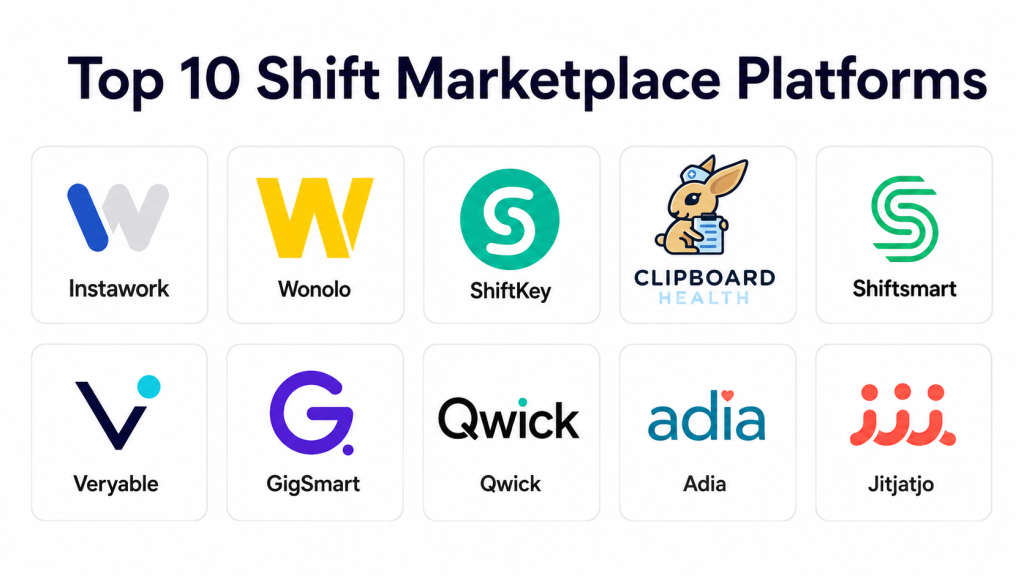
Top 10 Shift Marketplace Platforms
1. Instawork
Short description: Instawork is a flexible staffing platform that connects businesses with hourly workers for shifts in hospitality, warehousing, events, retail, and related industries. It is useful for companies that need fast access to local workers for short-term or recurring shift needs.
Key Features
- Shift posting for hourly workforce needs
- Access to a large pool of flexible workers
- Worker profiles, ratings, and work history signals
- Mobile-first shift acceptance and communication
- Attendance and shift tracking support
- Suitable for hospitality, events, warehousing, and retail
- Support for recurring and last-minute shift coverage
Pros
- Strong option for businesses that need fast shift coverage.
- Useful for industries with high staffing fluctuation.
- Mobile experience helps workers respond quickly to open shifts.
Cons
- Coverage and worker availability may vary by location.
- May not fit highly specialized roles without proper screening.
- Costs can vary depending on shift type, demand, and region.
Platforms / Deployment
Web / iOS / Android
Cloud-based deployment
Security & Compliance
Worker verification and platform trust features are available. Specific enterprise security certifications, SSO, audit logs, or compliance details should be verified directly for regulated use cases.
Integrations & Ecosystem
Instawork supports businesses that need flexible staffing without building a full internal staffing operation. It fits companies that need quick access to shift workers and basic operational visibility.
- Shift posting
- Worker matching
- Mobile worker app
- Attendance tracking
- Worker ratings
- Business dashboard
Support & Community
Instawork provides support resources for both businesses and workers. Support quality may vary by location, business size, and service requirements.
2. Wonolo
Short description: Wonolo is an on-demand staffing platform that helps companies find workers for hourly jobs and shift-based work. It is commonly used for warehousing, fulfillment, delivery support, merchandising, event work, and general labor needs.
Key Features
- On-demand shift and job posting
- Worker matching based on availability and requirements
- Mobile app for workers
- Business dashboard for shift management
- Support for recurring and temporary labor needs
- Worker performance and reliability signals
- Useful for logistics, warehouse, retail, and operations teams
Pros
- Good for filling operational labor gaps quickly.
- Useful for short-term and recurring shift needs.
- Helps reduce manual coordination for hourly work.
Cons
- Worker availability may depend on location and demand.
- Not ideal for roles requiring deep specialization.
- Businesses still need clear job instructions to avoid confusion.
Platforms / Deployment
Web / iOS / Android
Cloud-based deployment
Security & Compliance
Worker screening and operational controls may be available depending on role and region. Specific certifications and enterprise-grade security controls should be verified directly.
Integrations & Ecosystem
Wonolo works well for businesses that need shift-based labor with fast worker access and simple operational controls.
- Shift posting
- Worker mobile access
- Business dashboard
- Job instructions
- Worker performance visibility
- Operational staffing workflows
Support & Community
Wonolo provides platform support and guidance for customers and workers. Support levels may vary depending on business requirements and service model.
3. ShiftKey
Short description: ShiftKey is a healthcare-focused shift marketplace that helps licensed professionals find available shifts and helps healthcare facilities fill staffing needs. It is especially relevant for nursing, long-term care, and healthcare workforce support.
Key Features
- Healthcare shift marketplace
- Access to licensed healthcare professionals
- Facility shift posting and worker selection
- Worker credential visibility
- Mobile shift discovery and acceptance
- Schedule flexibility for healthcare workers
- Useful for facilities with urgent or recurring staffing gaps
Pros
- Strong fit for healthcare shift coverage.
- Helps facilities access licensed professionals more flexibly.
- Useful for workers who want control over shift selection.
Cons
- Industry focus is mainly healthcare, not general staffing.
- Compliance and credential requirements must be carefully verified.
- Availability may vary by region and role type.
Platforms / Deployment
Web / iOS / Android
Cloud-based deployment
Security & Compliance
Healthcare worker credentialing and compliance-related processes are important parts of the platform. Specific certifications, HIPAA-related controls, audit logs, and enterprise security details should be verified directly.
Integrations & Ecosystem
ShiftKey focuses on healthcare staffing workflows and helps facilities connect with professionals for open shifts.
- Healthcare shift posting
- Credential-related workflows
- Worker mobile access
- Facility dashboard
- Shift selection
- Workforce visibility
Support & Community
ShiftKey provides support for healthcare facilities and professionals. Support depth may depend on facility type, location, and service requirements.
4. Clipboard Health
Short description: Clipboard Health is a healthcare staffing marketplace that connects healthcare facilities with professionals looking for available shifts. It is commonly used by nursing facilities and care providers that need flexible staffing support.
Key Features
- Healthcare-focused shift marketplace
- Facility shift posting
- Worker profile and availability visibility
- Mobile access for healthcare professionals
- Shift confirmation and management
- Support for urgent staffing needs
- Useful for care facilities and nursing-related roles
Pros
- Strong fit for healthcare facilities with changing staffing needs.
- Helps workers find flexible healthcare shifts.
- Useful for filling short-notice scheduling gaps.
Cons
- Mainly focused on healthcare use cases.
- Facilities must carefully manage credential and compliance requirements.
- Availability can vary based on location and worker supply.
Platforms / Deployment
Web / iOS / Android
Cloud-based deployment
Security & Compliance
Healthcare staffing workflows may include credential and document-related processes. Specific HIPAA, SOC 2, ISO 27001, audit log, RBAC, or encryption details should be verified directly.
Integrations & Ecosystem
Clipboard Health supports shift-based healthcare staffing and helps facilities access available professionals.
- Healthcare shift posting
- Worker mobile app
- Facility dashboard
- Shift confirmation
- Worker profiles
- Staffing workflow support
Support & Community
Clipboard Health provides support for facilities and healthcare workers. Support experience may vary depending on region, role, and facility requirements.
5. Shiftsmart
Short description: Shiftsmart is a labor marketplace and workforce platform that helps companies manage flexible workers for shift-based and task-based work. It is used across industries such as retail, customer experience, logistics, and field operations.
Key Features
- Flexible workforce marketplace
- Shift and task assignment workflows
- Worker mobile app
- Workforce quality and performance tracking
- Support for distributed field operations
- Useful for high-volume labor programs
- Reporting and operational visibility
Pros
- Good fit for businesses with distributed shift-based work.
- Supports task-based and shift-based workforce models.
- Useful for companies needing scale and operational visibility.
Cons
- May require setup and process planning for larger programs.
- Not ideal for small one-off staffing needs.
- Some capabilities may depend on customer requirements.
Platforms / Deployment
Web / iOS / Android
Cloud-based deployment
Security & Compliance
Platform security and workforce governance controls may be available. Specific certifications and advanced enterprise security controls should be verified directly.
Integrations & Ecosystem
Shiftsmart supports flexible labor programs that involve many workers, locations, or tasks.
- Worker marketplace
- Shift assignment
- Task management
- Mobile worker experience
- Performance tracking
- Workforce analytics
Support & Community
Shiftsmart provides business support and operational guidance. Support depth may vary based on program size and service model.
6. Veryable
Short description: Veryable is an on-demand labor marketplace focused on manufacturing, warehousing, logistics, and industrial operations. It helps businesses access flexible workers for operational shifts and production needs.
Key Features
- On-demand labor for industrial operations
- Worker pool access for warehousing and manufacturing
- Shift and work opportunity posting
- Mobile worker acceptance
- Operational workforce flexibility
- Support for variable production demand
- Business dashboard and workforce visibility
Pros
- Strong fit for manufacturing and warehouse environments.
- Helps businesses respond to changing production demand.
- Useful for operational teams needing flexible labor capacity.
Cons
- Industry fit is stronger for operations than office-based work.
- Worker availability may vary by region.
- Businesses need clear task instructions and safety processes.
Platforms / Deployment
Web / iOS / Android
Cloud-based deployment
Security & Compliance
Worker verification, operational controls, and safety-related processes may be available depending on work type. Specific compliance certifications should be verified directly.
Integrations & Ecosystem
Veryable supports industrial workforce flexibility and helps companies manage variable labor demand.
- Labor marketplace
- Work opportunity posting
- Worker mobile access
- Operations dashboard
- Workforce availability
- Production support workflows
Support & Community
Veryable provides support for businesses and workers. Support may vary by region and operational needs.
7. GigSmart
Short description: GigSmart is a staffing and gig marketplace that helps businesses find workers for shifts, projects, and short-term labor needs. It supports multiple industries including labor, events, retail, hospitality, and general services.
Key Features
- Shift and gig posting
- Access to local workers
- Mobile app for workers
- Business hiring dashboard
- Support for temporary and part-time work
- Worker profiles and availability
- Suitable for varied gig and shift-based roles
Pros
- Flexible for different types of short-term work.
- Useful for local labor and event staffing needs.
- Easy for businesses to post shift-based opportunities.
Cons
- Quality and availability may vary by location.
- May not be ideal for regulated or highly specialized roles.
- Requires strong job descriptions for better matching.
Platforms / Deployment
Web / iOS / Android
Cloud-based deployment
Security & Compliance
Worker-related verification and platform controls may be available. Specific certifications and compliance controls are not publicly stated for all use cases.
Integrations & Ecosystem
GigSmart supports flexible hiring for businesses needing quick access to short-term workers.
- Gig posting
- Shift hiring
- Worker mobile access
- Local workforce discovery
- Business dashboard
- Worker profiles
Support & Community
GigSmart provides help resources and customer support for business users and workers. Community strength may vary by region and industry.
8. Qwick
Short description: Qwick is a hospitality-focused shift marketplace that connects food and beverage businesses with experienced hospitality professionals. It is useful for restaurants, hotels, catering companies, event venues, and hospitality operators.
Key Features
- Hospitality shift marketplace
- Access to food and beverage professionals
- Shift posting and worker selection
- Mobile shift discovery
- Worker ratings and experience signals
- Support for event and hospitality staffing
- Useful for last-minute or seasonal coverage
Pros
- Strong fit for hospitality and food service staffing.
- Helps fill urgent shifts for restaurants and events.
- Worker experience signals can support better selection.
Cons
- Industry focus is narrower than general staffing platforms.
- Coverage may vary by city and region.
- Not ideal for non-hospitality roles.
Platforms / Deployment
Web / iOS / Android
Cloud-based deployment
Security & Compliance
Worker verification and platform trust features may be available. Businesses should verify compliance and documentation requirements for their location and role type.
Integrations & Ecosystem
Qwick focuses on hospitality shift coverage and helps businesses connect with available professionals.
- Hospitality shift posting
- Worker mobile app
- Facility or business dashboard
- Worker ratings
- Shift confirmations
- Event staffing support
Support & Community
Qwick provides support for hospitality businesses and workers. Support availability may depend on location and service requirements.
9. Adia
Short description: Adia is a staffing platform that helps businesses find temporary and shift-based workers for industries such as hospitality, events, warehousing, and general labor. It supports flexible hiring for short-term workforce needs.
Key Features
- Temporary staffing marketplace
- Shift posting and worker matching
- Mobile worker access
- Business dashboard for workforce management
- Support for event, hospitality, warehouse, and general labor roles
- Worker availability and job matching
- Useful for short-term and seasonal staffing
Pros
- Good for businesses needing temporary shift support.
- Useful across multiple operational industries.
- Helps reduce manual staffing coordination.
Cons
- Worker availability depends on region and demand.
- May not be suitable for highly specialized roles.
- Businesses should verify worker screening and compliance fit.
Platforms / Deployment
Web / iOS / Android
Cloud-based deployment
Security & Compliance
Worker screening and compliance-related workflows may vary by customer need. Specific certifications and advanced security details should be verified directly.
Integrations & Ecosystem
Adia supports short-term staffing workflows for companies needing fast access to available workers.
- Shift posting
- Worker matching
- Mobile app
- Business dashboard
- Temporary labor support
- Workforce visibility
Support & Community
Adia provides staffing support and customer service for business users. Support depth may depend on location and service model.
10. Jitjatjo
Short description: Jitjatjo is a shift-based staffing platform focused on hospitality, event, and service industry workforce needs. It helps businesses connect with available workers for flexible and short-term shifts.
Key Features
- Shift marketplace for hospitality and service roles
- Worker mobile app
- Business shift posting dashboard
- Support for events and food service staffing
- Talent matching based on shift requirements
- Worker availability and schedule flexibility
- Operational support for high-demand staffing periods
Pros
- Good fit for hospitality and event staffing.
- Useful for businesses with fluctuating shift demand.
- Mobile workflows help improve shift visibility.
Cons
- Stronger fit for service industries than general enterprise staffing.
- Location coverage may vary.
- Businesses should validate worker quality and role requirements carefully.
Platforms / Deployment
Web / iOS / Android
Cloud-based deployment
Security & Compliance
Worker verification and platform trust controls may be available. Specific security certifications and compliance details should be verified directly.
Integrations & Ecosystem
Jitjatjo supports hospitality and service businesses that need flexible shift workers.
- Shift posting
- Worker matching
- Mobile worker access
- Hospitality staffing
- Event workforce support
- Business dashboard
Support & Community
Jitjatjo provides support for businesses and workers. Support experience may vary by region, role type, and service level.
Comparison Table
| Tool Name | Best For | Platform(s) Supported | Deployment | Standout Feature | Public Rating |
|---|---|---|---|---|---|
| Instawork | Hospitality, warehousing, retail, and events staffing | Web, iOS, Android | Cloud | Fast access to flexible hourly workers | N/A |
| Wonolo | Warehouse, retail, logistics, and general labor shifts | Web, iOS, Android | Cloud | On-demand operational labor marketplace | N/A |
| ShiftKey | Healthcare shift coverage | Web, iOS, Android | Cloud | Healthcare professional shift marketplace | N/A |
| Clipboard Health | Nursing and care facility staffing | Web, iOS, Android | Cloud | Healthcare facility shift filling | N/A |
| Shiftsmart | Distributed shift and task-based workforce programs | Web, iOS, Android | Cloud | Flexible workforce and task management | N/A |
| Veryable | Manufacturing, warehouse, and industrial labor | Web, iOS, Android | Cloud | On-demand industrial workforce support | N/A |
| GigSmart | Local gigs, shifts, and temporary work | Web, iOS, Android | Cloud | Broad local gig and shift marketplace | N/A |
| Qwick | Hospitality and food service staffing | Web, iOS, Android | Cloud | Food and beverage shift marketplace | N/A |
| Adia | Temporary staffing for operations and events | Web, iOS, Android | Cloud | Short-term staffing marketplace | N/A |
| Jitjatjo | Hospitality, events, and service staffing | Web, iOS, Android | Cloud | Service industry shift matching | N/A |
Evaluation & Scoring of Shift Marketplace Platforms
| Tool Name | Core (25%) | Ease (15%) | Integrations (15%) | Security (10%) | Performance (10%) | Support (10%) | Value (15%) | Weighted Total (0–10) |
|---|---|---|---|---|---|---|---|---|
| Instawork | 9 | 8 | 7 | 7 | 8 | 8 | 8 | 8.00 |
| Wonolo | 8 | 8 | 7 | 7 | 8 | 7 | 8 | 7.65 |
| ShiftKey | 9 | 8 | 6 | 8 | 8 | 8 | 7 | 7.85 |
| Clipboard Health | 8 | 8 | 6 | 8 | 8 | 8 | 7 | 7.60 |
| Shiftsmart | 8 | 7 | 7 | 7 | 8 | 8 | 7 | 7.45 |
| Veryable | 8 | 8 | 6 | 7 | 8 | 7 | 8 | 7.55 |
| GigSmart | 7 | 8 | 6 | 6 | 7 | 7 | 8 | 7.00 |
| Qwick | 8 | 8 | 6 | 7 | 8 | 7 | 8 | 7.50 |
| Adia | 7 | 8 | 6 | 6 | 7 | 7 | 7 | 6.85 |
| Jitjatjo | 7 | 8 | 6 | 6 | 7 | 7 | 7 | 6.85 |
These scores are comparative and should be used as a practical decision guide, not as fixed public ratings. A higher score shows stronger overall fit across shift marketplace needs, but the right platform depends on industry, location, worker type, compliance requirements, and staffing volume. Healthcare companies may prefer ShiftKey or Clipboard Health, while hospitality teams may prefer Qwick, Instawork, or Jitjatjo. Industrial and warehouse teams may find Veryable or Wonolo more suitable.
Which Shift Marketplace Platform Is Right for You?
Solo / Freelancer
Individual workers usually want a platform that offers easy shift discovery, clear earning details, flexible scheduling, and mobile access. Instawork, Wonolo, Qwick, GigSmart, and Veryable can be useful depending on the worker’s skill area and local availability.
Healthcare workers may prefer ShiftKey or Clipboard Health because these platforms focus more on healthcare shifts. Hospitality workers may find better fit with Qwick, Instawork, or Jitjatjo.
SMB
Small businesses often need fast staffing help without building a large HR or staffing department. Instawork, GigSmart, Qwick, Adia, and Wonolo can be practical options for filling urgent shifts.
Restaurants, event organizers, retail stores, and small warehouse teams should choose platforms based on local worker supply, ease of posting shifts, worker reliability, and total cost.
Mid-Market
Mid-market companies usually need more structure around shift management, reporting, location coverage, and repeat worker usage. Instawork, Wonolo, Shiftsmart, Veryable, and Qwick can be useful depending on industry fit.
At this stage, companies should evaluate attendance tracking, worker quality signals, approval workflows, reporting, and whether the platform can support multiple locations or departments.
Enterprise
Enterprises need scale, compliance, reporting, security, and stronger operational control. Shiftsmart, Instawork, Wonolo, Veryable, ShiftKey, and Clipboard Health may be better fits depending on industry.
Enterprise buyers should verify platform coverage, contract terms, worker screening, compliance documentation, data protection, reporting depth, and internal process alignment before rollout.
Budget vs Premium
Budget-focused teams should compare platform fees, worker rates, minimum commitments, payment terms, and cancellation policies. GigSmart, Adia, and Wonolo may be practical for flexible local staffing, depending on availability.
Premium-focused teams may prioritize reliability, worker quality, compliance, and managed support over the lowest cost. Healthcare and enterprise teams should avoid choosing only by price because compliance and worker quality matter more.
Feature Depth vs Ease of Use
Simple platforms are better for small businesses that need to post shifts quickly. More advanced platforms are better for companies that need reporting, large workforce programs, compliance workflows, or multiple-location staffing.
If your team only needs occasional shift help, choose ease of use. If your team manages high-volume staffing, choose feature depth and operational visibility.
Integrations & Scalability
For a single location, built-in shift posting and worker communication may be enough. For larger companies, integration with scheduling, payroll, HR, workforce management, and reporting tools becomes more important.
Before choosing a platform, confirm whether it can support multiple locations, manager permissions, worker records, attendance visibility, and workforce reporting.
Security & Compliance Needs
Security and compliance are especially important in healthcare, logistics, manufacturing, food service, and any environment where workers need access to equipment, facilities, customers, or sensitive information.
Companies should verify worker screening, credential checks, documentation, insurance requirements, data access controls, audit needs, and role-specific compliance workflows before selecting a shift marketplace platform.
Frequently Asked Questions
1. What is a Shift Marketplace Platform?
A Shift Marketplace Platform connects businesses that need workers with people available for shift-based work. It helps companies post shifts, find workers, manage schedules, and track workforce activity.
2. How is a shift marketplace different from a staffing agency?
A shift marketplace usually uses a technology platform for faster shift posting, worker matching, and mobile communication. A staffing agency may provide more manual recruiting, screening, and account management.
3. Which industries use shift marketplace platforms most?
Common industries include healthcare, hospitality, retail, warehousing, logistics, events, food service, manufacturing, and customer support. Any business with changing shift demand can benefit.
4. Are shift marketplace platforms good for last-minute staffing?
Yes, many platforms are designed to help fill urgent shifts. However, success depends on local worker availability, job requirements, pay rate, and how clearly the shift details are written.
5. Do these platforms handle worker payments?
Many shift marketplace platforms support payment workflows, but the exact process varies. Businesses should confirm who pays the worker, payment timing, invoices, fees, and tax-related responsibilities.
6. Are workers on these platforms verified?
Many platforms include worker profiles, ratings, background checks, credential workflows, or verification steps. The level of verification varies, so businesses should confirm requirements before using the platform.
7. Can shift marketplace platforms support multiple locations?
Yes, many platforms support multi-location staffing. Larger businesses should check manager permissions, location-level reporting, shift approval workflows, and workforce visibility before selecting a platform.
8. What are common mistakes businesses make with shift marketplaces?
Common mistakes include unclear shift descriptions, low pay compared with market demand, poor worker instructions, weak onboarding, and not reviewing compliance requirements before posting shifts.
9. Can shift marketplace platforms integrate with payroll or scheduling tools?
Some platforms may support integrations or export options, but integration depth varies. Businesses should verify compatibility with payroll, HR, scheduling, finance, and workforce systems before adoption.
10. What is the best Shift Marketplace Platform?
There is no single best platform for every business. Instawork and Wonolo are strong general options, ShiftKey and Clipboard Health fit healthcare, Qwick fits hospitality, and Veryable fits industrial operations.
Conclusion
Shift Marketplace Platforms help businesses manage flexible staffing needs with better speed, visibility, and control. They are especially useful for companies that face last-minute absences, seasonal demand, high-volume shifts, event staffing, healthcare coverage, or operational labor gaps. The best platform depends on industry, location, worker type, compliance needs, and shift volume. A restaurant may need Qwick or Instawork, while a healthcare facility may prefer ShiftKey or Clipboard Health, and a warehouse operation may benefit from Veryable or Wonolo. The smartest next step is to shortlist two or three platforms, test them with a small group of shifts, compare worker reliability, review costs, validate compliance requirements, and then scale the platform that fits your real staffing process.
