Introduction
Security Orchestration, Automation & Response (SOAR) tools are platforms that help organizations automate security operations, streamline incident response, and integrate multiple security tools into a unified workflow. Instead of manually handling alerts and incidents, SOAR enables teams to respond faster and more efficiently through automation.
In modern cybersecurity environments, security teams face alert fatigue due to the massive volume of threats and logs. SOAR addresses this challenge by orchestrating workflows, automating repetitive tasks, and improving response times. It also plays a critical role in enabling Zero Trust security models and improving SOC efficiency.
Real-world use cases:
- Automating incident response workflows
- Managing and prioritizing security alerts
- Integrating SIEM, EDR, and threat intelligence tools
- Reducing manual workload in SOC teams
- Accelerating threat investigation and remediation
What buyers should evaluate:
- Workflow automation capabilities
- Integration with security tools
- Ease of playbook creation
- Incident response features
- Scalability across environments
- AI and automation capabilities
- Reporting and analytics
- Deployment flexibility
- User interface and usability
- Pricing and licensing
Best for: SOC teams, enterprises, cybersecurity professionals, and organizations handling large volumes of security alerts
Not ideal for: Small teams with minimal security operations
Key Trends in Security Orchestration, Automation & Response (SOAR)
- Increased use of AI-driven automation and decision-making
- Integration with SIEM, EDR, XDR, and NDR platforms
- Low-code and no-code playbook development
- Cloud-native SOAR platforms
- Automated threat response workflows
- Improved incident management dashboards
- Integration with threat intelligence feeds
- Expansion into DevSecOps environments
- Focus on reducing alert fatigue
- Unified security operations platforms
How We Selected These Tools (Methodology)
- Market adoption and industry reputation
- Strength of automation and orchestration features
- Integration with security ecosystems
- Ease of use and playbook creation
- Scalability and performance
- Support for modern security workflows
- Vendor maturity and innovation
- Reliability and performance
- Support and community strength
- Fit across SMB and enterprise environments
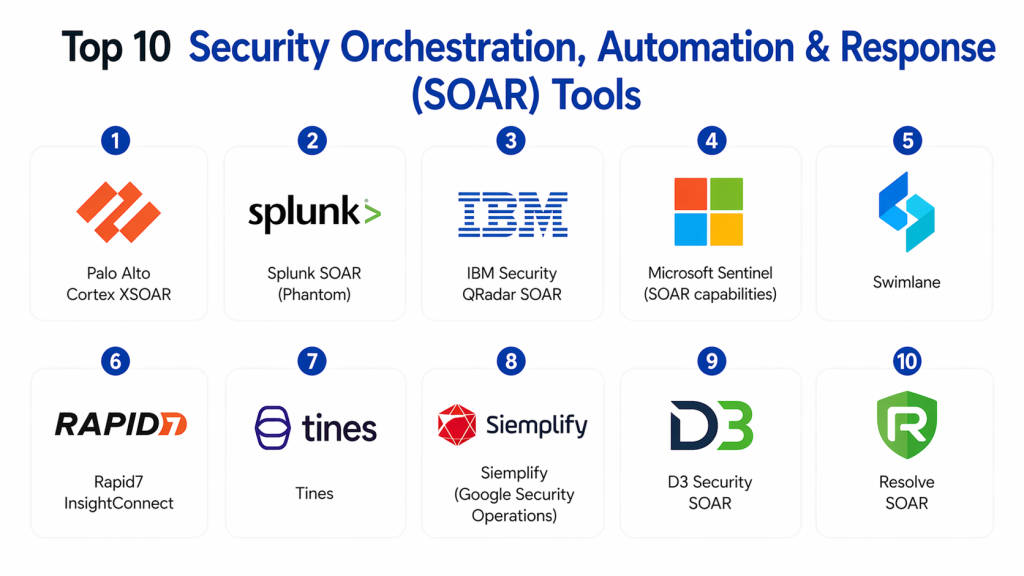
Top 10 Security Orchestration, Automation & Response (SOAR) Tools
#1 — Palo Alto Cortex XSOAR
Short description :
Cortex XSOAR is a leading SOAR platform offering strong automation and orchestration capabilities. It integrates with multiple security tools. It provides advanced playbook automation. It is widely used in enterprises. It supports incident management. It is scalable and powerful.
Key Features
- Workflow automation
- Playbook creation
- Incident management
- Integration
- Threat intelligence
Pros
- Advanced automation
- Scalable
- Strong ecosystem
Cons
- Complex setup
- Expensive
Platforms / Deployment
- Cloud / On-prem
Security & Compliance
- RBAC, encryption
- Compliance: Not publicly stated
Integrations & Ecosystem
- SIEM tools
- EDR tools
- APIs
Support & Community
- Enterprise support
#2 — Splunk SOAR (Phantom)
Short description :
Splunk SOAR provides automation and orchestration capabilities for security teams. It integrates with Splunk ecosystem. It supports playbook automation. It is scalable. It offers strong analytics. It is suitable for enterprises.
Key Features
- Automation
- Playbooks
- Incident response
- Integration
- Analytics
Pros
- Strong integration
- Scalable
- Flexible
Cons
- Complex
- Expensive
Platforms / Deployment
- Cloud / On-prem
Security & Compliance
- RBAC
- Compliance: Not publicly stated
#3 — IBM Security SOAR
Short description :
IBM Security SOAR offers incident response automation and orchestration. It supports workflow management and integration. It is scalable. It is widely used in enterprises. It provides strong analytics. It enhances SOC efficiency.
Key Features
- Incident response
- Workflow automation
- Integration
- Reporting
- Analytics
Pros
- Enterprise-ready
- Strong analytics
- Scalable
Cons
- Complex
- Costly
Platforms / Deployment
- Cloud / On-prem
Security & Compliance
- RBAC
- Compliance: Not publicly stated
#4 — Microsoft Sentinel (SOAR)
Short description :
Microsoft Sentinel includes SOAR capabilities through automation and playbooks. It integrates with Microsoft ecosystem. It provides cloud-native automation. It is scalable. It supports security workflows. It is widely used.
Key Features
- Automation
- Playbooks
- Integration
- Analytics
- Incident response
Pros
- Cloud-native
- Scalable
- Easy integration
Cons
- Microsoft dependency
- Configuration needed
Platforms / Deployment
- Cloud
Security & Compliance
- MFA, RBAC
- Compliance: Not publicly stated
#5 — Swimlane
Short description :
Swimlane is a SOAR platform focused on automation and orchestration. It offers strong playbook capabilities. It integrates with security tools. It is scalable. It is suitable for enterprises. It provides flexibility.
Key Features
- Automation
- Playbooks
- Integration
- Workflow management
- Reporting
Pros
- Flexible
- Scalable
- Strong automation
Cons
- Complex UI
- Learning curve
Platforms / Deployment
- Cloud / Hybrid
Security & Compliance
- RBAC
- Compliance: Not publicly stated
#6 — Rapid7 InsightConnect
Short description :
Rapid7 InsightConnect provides SOAR capabilities for automating security workflows. It integrates with Rapid7 ecosystem. It supports playbook automation. It is scalable. It is easy to deploy. It is suitable for SMB and enterprise.
Key Features
- Automation
- Playbooks
- Integration
- Incident response
- Reporting
Pros
- Easy deployment
- Scalable
- Good integration
Cons
- Limited customization
- Smaller ecosystem
Platforms / Deployment
- Cloud
Security & Compliance
- RBAC
- Compliance: Not publicly stated
#7 — Tines
Short description :
Tines is a modern SOAR platform focused on automation and simplicity. It provides no-code automation workflows. It integrates with various tools. It is scalable. It is suitable for security teams. It offers flexibility.
Key Features
- Automation
- No-code workflows
- Integration
- Monitoring
- Reporting
Pros
- Easy to use
- Flexible
- Scalable
Cons
- Limited enterprise features
- Smaller ecosystem
Platforms / Deployment
- Cloud
Security & Compliance
- RBAC
- Compliance: Not publicly stated
#8 — Siemplify (Google Security Operations)
Short description :
Siemplify provides SOAR capabilities with strong incident management and automation. It integrates with Google security tools. It offers playbooks. It is scalable. It supports enterprises. It enhances SOC operations.
Key Features
- Incident management
- Automation
- Playbooks
- Integration
- Analytics
Pros
- Strong integration
- Scalable
- Enterprise-ready
Cons
- Complex
- Requires expertise
Platforms / Deployment
- Cloud
Security & Compliance
- RBAC
- Compliance: Not publicly stated
#9 — D3 Security SOAR
Short description :
D3 Security provides SOAR capabilities with automation and orchestration features. It supports incident response workflows. It integrates with security tools. It is scalable. It is suitable for enterprises. It offers flexibility.
Key Features
- Automation
- Incident response
- Integration
- Playbooks
- Reporting
Pros
- Flexible
- Scalable
- Strong features
Cons
- Complex
- UI improvements needed
Platforms / Deployment
- Cloud / On-prem
Security & Compliance
- RBAC
- Compliance: Not publicly stated
#10 — Resolve SOAR
Short description :
Resolve SOAR provides automation and orchestration capabilities for security teams. It supports workflow automation and integration. It is scalable. It is suitable for enterprises. It offers strong visibility. It improves response time.
Key Features
- Automation
- Workflow management
- Integration
- Monitoring
- Reporting
Pros
- Scalable
- Flexible
- Good automation
Cons
- Limited ecosystem
- Requires setup
Platforms / Deployment
- Cloud / Hybrid
Security & Compliance
- RBAC
- Compliance: Not publicly stated
Comparison Table
| Tool | Best For | Platform | Deployment | Feature | Rating |
|---|---|---|---|---|---|
| Cortex | Enterprise | Multi | Hybrid | Automation | N/A |
| Splunk | Enterprise | Multi | Hybrid | Integration | N/A |
| IBM | Enterprise | Multi | Hybrid | Response | N/A |
| Microsoft | Enterprise | Cloud | Cloud | Playbooks | N/A |
| Swimlane | Enterprise | Multi | Hybrid | Workflow | N/A |
| Rapid7 | SMB | Cloud | Cloud | Simplicity | N/A |
| Tines | SMB | Cloud | Cloud | No-code | N/A |
| Siemplify | Enterprise | Cloud | Cloud | Analytics | N/A |
| D3 | Enterprise | Multi | Hybrid | Flexibility | N/A |
| Resolve | Enterprise | Multi | Hybrid | Automation | N/A |
Evaluation & Scoring of SOAR Tools
| Tool | Core | Ease | Integration | Security | Performance | Support | Value | Total |
|---|---|---|---|---|---|---|---|---|
| Cortex | 10 | 7 | 9 | 10 | 9 | 9 | 7 | 8.9 |
| Splunk | 9 | 7 | 9 | 9 | 8 | 8 | 7 | 8.2 |
| IBM | 9 | 7 | 8 | 9 | 8 | 8 | 7 | 8.1 |
| Microsoft | 9 | 9 | 10 | 9 | 9 | 9 | 9 | 9.2 |
| Swimlane | 9 | 8 | 8 | 9 | 8 | 8 | 8 | 8.5 |
| Rapid7 | 8 | 9 | 8 | 8 | 8 | 8 | 9 | 8.5 |
| Tines | 8 | 9 | 8 | 8 | 8 | 8 | 9 | 8.5 |
| Siemplify | 9 | 7 | 8 | 9 | 8 | 8 | 7 | 8.2 |
| D3 | 8 | 7 | 8 | 8 | 8 | 7 | 8 | 8.0 |
| Resolve | 8 | 7 | 7 | 8 | 8 | 7 | 8 | 7.9 |
Which SOAR Tool Is Right for You?
Solo / Freelancer
- Not required
SMB
- Rapid7, Tines
Mid-Market
- Swimlane
Enterprise
- Cortex, Microsoft, Splunk
Budget vs Premium
- Budget → Tines
- Premium → Cortex
Feature Depth vs Ease
- Easy → Tines
- Advanced → Cortex
Integrations & Scalability
- Best → Microsoft
Security Needs
- High security → Cortex
Frequently Asked Questions (FAQs)
1. What is Security Orchestration, Automation & Response (SOAR)?
SOAR is a cybersecurity platform that helps automate and manage security operations. It connects different security tools and allows teams to respond to threats more efficiently. SOAR uses playbooks to automate repetitive tasks. This reduces manual effort and improves response speed.
2. Why is SOAR important for organizations?
SOAR is important because it helps reduce alert fatigue and improves incident response times. Security teams often deal with a high volume of alerts, and SOAR helps prioritize and automate responses. It also improves consistency in handling incidents. This leads to better overall security operations.
3. How does SOAR work?
SOAR works by integrating multiple security tools into a single platform. It uses predefined workflows or playbooks to automate tasks such as alert triage and response. When a threat is detected, SOAR can trigger automated actions. This helps contain threats quickly and efficiently.
4. Who should use SOAR solutions?
SOAR solutions are mainly used by Security Operations Centers (SOCs) and enterprise security teams. Organizations with high volumes of security alerts benefit the most. It is also useful for companies with complex security environments. SOAR helps teams manage incidents more effectively.
5. Is SOAR scalable for large environments?
Yes, modern SOAR platforms are highly scalable and designed for large enterprises. They can handle thousands of alerts and integrate with multiple tools. Cloud-based SOAR solutions make scaling easier. This ensures consistent performance across large environments.
6. What is the difference between SOAR and SIEM?
SIEM focuses on collecting and analyzing security data to detect threats. SOAR focuses on automating the response to those threats. SIEM generates alerts, while SOAR helps act on them. Both tools work together to improve security operations.
7. Does SOAR support automated response?
Yes, automation is a core feature of SOAR platforms. They can automatically respond to threats using predefined playbooks. This includes actions like isolating systems or blocking malicious activity. Automation reduces response time and improves efficiency.
8. Is SOAR enough for complete security?
SOAR is not a standalone security solution and works best when combined with other tools. It enhances the capabilities of SIEM, EDR, and XDR platforms. A layered approach provides better protection. SOAR plays a key role in automation and orchestration.
9. Is SOAR difficult to implement?
SOAR implementation can be complex depending on the organization’s environment. It requires integration with existing security tools and proper workflow design. However, many modern solutions offer user-friendly interfaces. Proper planning makes implementation easier.
10. What are alternatives to SOAR?
SOAR works alongside tools like SIEM, XDR, and EDR rather than replacing them. These tools focus on detection and monitoring. SOAR focuses on automation and response. Together, they create a complete security ecosystem.
Conclusion
Security Orchestration, Automation & Response (SOAR) tools are essential for modern security operations, enabling organizations to automate workflows, reduce manual effort, and respond to threats more efficiently. As cyber threats continue to increase, SOAR platforms play a critical role in improving SOC productivity and security posture.
The right SOAR solution depends on your organization’s needs and scale. Enterprise tools like Cortex XSOAR and Microsoft Sentinel offer advanced automation capabilities, while tools like Tines and Rapid7 provide flexibility and ease of use. Organizations should evaluate their requirements, test platforms, and implement SOAR as part of a comprehensive cybersecurity strategy.
