Introduction
SBOM (Software Bill of Materials) Generation Tools are designed to create a detailed inventory of all components, libraries, and dependencies within a software application. These tools scan codebases, containers, and artifacts to produce structured lists that help organizations understand exactly what their software contains.
With increasing software supply chain risks and compliance requirements, SBOM generation has become a critical part of modern DevSecOps. Organizations need continuous visibility into dependencies to identify vulnerabilities, ensure licensing compliance, and respond quickly to emerging threats.
Common real-world use cases:
- Generating SBOMs for compliance and audits
- Identifying vulnerable dependencies
- Securing container images and cloud workloads
- Supporting software supply chain transparency
- Automating dependency tracking in CI/CD pipelines
What buyers should evaluate:
- SBOM format support (SPDX, CycloneDX)
- Dependency detection accuracy
- Integration with CI/CD pipelines
- Multi-language and container support
- Automation capabilities
- Performance on large codebases
- Security enrichment capabilities
- Ease of use and onboarding
- Reporting and visibility
Best for: DevSecOps teams, security engineers, compliance teams, and enterprises managing complex software supply chains.
Not ideal for: Small projects with minimal dependencies or teams that do not require compliance tracking.
Key Trends in SBOM Generation Tools
- SBOM adoption becoming mandatory for compliance
- Automation within CI/CD pipelines for continuous updates
- Standardization around SPDX and CycloneDX formats
- Increased focus on container-based SBOM generation
- AI-assisted prioritization of vulnerabilities
- Integration with SCA and DevSecOps tools
- Real-time dependency tracking and monitoring
- Cloud-native SBOM platforms gaining traction
- Policy-driven supply chain security enforcement
- Enhanced reporting and visualization tools
How We Selected These Tools (Methodology)
- Market adoption and industry relevance
- SBOM generation capabilities and standards support
- Integration with modern DevOps pipelines
- Accuracy in dependency detection
- Scalability for enterprise use cases
- Security and compliance readiness
- Developer experience and usability
- Balance between open-source and enterprise tools
- Community and vendor support
- Continuous innovation and updates
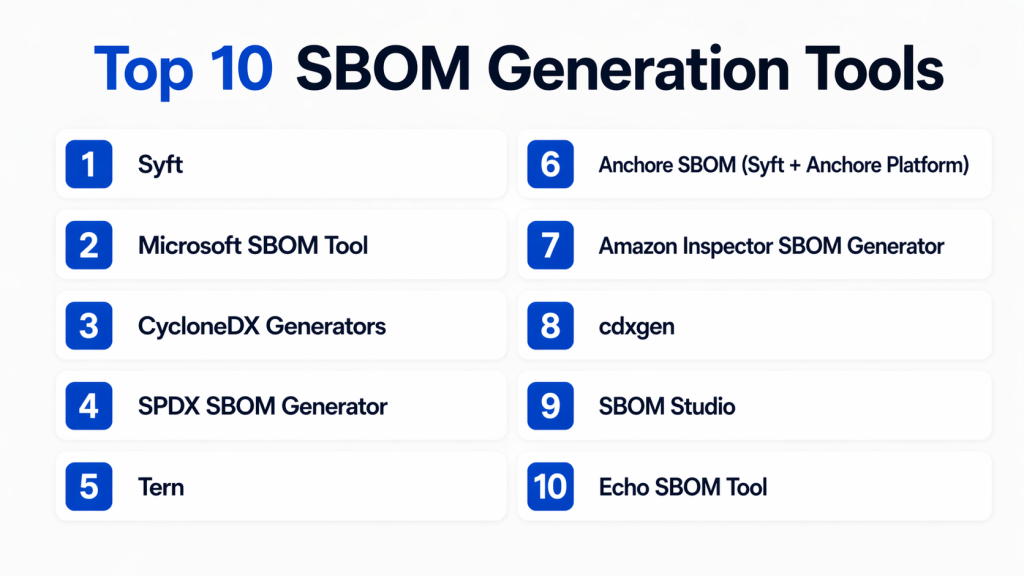
Top 10 SBOM Generation Tools
#1 — Syft
Short description: Syft is a widely used open-source SBOM generator that scans container images and filesystems to produce detailed inventories. It is known for speed, flexibility, and strong support for modern development workflows.
Key Features
- SBOM generation for containers and filesystems
- Supports SPDX and CycloneDX formats
- Fast and efficient scanning
- CLI and API support
- Multi-language detection
- CI/CD integration
Pros
- Lightweight and fast
- Open-source flexibility
Cons
- Limited enterprise features
- Requires manual setup
Platforms / Deployment
- Local / Cloud
Security & Compliance
- Not publicly stated
Integrations & Ecosystem
Syft integrates well into container and DevOps environments.
- CI/CD pipelines
- Container platforms
- Developer tools
Support & Community
Strong open-source community with active development.
#2 — Microsoft SBOM Tool
Short description: Microsoft SBOM Tool enables automated SBOM generation across software artifacts. It is designed for enterprise environments with strong compliance and scalability requirements.
Key Features
- SPDX-compliant SBOM generation
- Component detection libraries
- License enrichment
- Scalable architecture
- CI/CD integration
Pros
- Enterprise-grade reliability
- Strong compliance capabilities
Cons
- Limited user interface
- Requires configuration
Platforms / Deployment
- Local / CI environments
Security & Compliance
- Not publicly stated
Integrations & Ecosystem
Works with modern development pipelines and build systems.
- DevOps pipelines
- Build tools
- APIs
Support & Community
Backed by enterprise ecosystem with good documentation.
#3 — CycloneDX Generators
Short description: CycloneDX generators provide standardized SBOM creation across multiple programming languages and ecosystems, making them ideal for organizations requiring interoperability.
Key Features
- CycloneDX format support
- Multi-language support
- Plugin ecosystem
- Build tool integration
- Dependency analysis
Pros
- Standardized format support
- Wide ecosystem compatibility
Cons
- Requires plugins per ecosystem
- Setup complexity
Platforms / Deployment
- Local / CI
Security & Compliance
- Not publicly stated
Integrations & Ecosystem
Highly extensible across development stacks.
- Build tools
- CI/CD pipelines
Support & Community
Strong community-driven ecosystem.
#4 — SPDX SBOM Generator
Short description: SPDX-based tools generate SBOMs using a widely accepted industry standard, focusing on compliance, interoperability, and license tracking.
Key Features
- SPDX format generation
- License tracking
- Dependency analysis
- Compliance support
- Open-source ecosystem
Pros
- Industry-standard format
- Strong compliance focus
Cons
- Limited flexibility
- Requires expertise
Platforms / Deployment
- Local
Security & Compliance
- Not publicly stated
Integrations & Ecosystem
Supports integration with development and compliance tools.
- Dev pipelines
- Compliance platforms
Support & Community
Active industry and open-source support.
#5 — Tern
Short description: Tern focuses on generating SBOMs for container images, providing detailed insights into each layer and dependency within containerized applications.
Key Features
- Container SBOM generation
- Layer-by-layer analysis
- SPDX format support
- Dockerfile parsing
- Dependency tracking
Pros
- Deep container insights
- Detailed dependency mapping
Cons
- Limited to container environments
- Slower scanning performance
Platforms / Deployment
- Local / CI
Security & Compliance
- Not publicly stated
Integrations & Ecosystem
Focused on container workflows and DevOps pipelines.
- Docker environments
- CI/CD pipelines
Support & Community
Growing open-source community.
#6 — Anchore SBOM (Syft + Anchore Platform)
Short description: Anchore combines SBOM generation with container security capabilities, offering deep visibility and policy enforcement for software supply chains.
Key Features
- Container SBOM generation
- Policy enforcement
- Vulnerability scanning
- CI/CD integration
- SBOM lifecycle management
Pros
- Strong container security capabilities
- Integrated platform approach
Cons
- Focused mainly on containers
- Setup complexity
Platforms / Deployment
- Cloud / Self-hosted
Security & Compliance
- Not publicly stated
Integrations & Ecosystem
Deep integration with cloud-native and DevOps environments.
- Kubernetes
- CI/CD pipelines
- Container platforms
Support & Community
Enterprise support with active open-source community.
#7 — Amazon Inspector SBOM Generator
Short description: Amazon Inspector provides SBOM generation within cloud environments, enabling automated analysis of artifacts and dependencies in AWS-based workloads.
Key Features
- SBOM generation for cloud workloads
- Container and artifact scanning
- Dependency extraction
- Integration with cloud services
- Automated analysis
Pros
- Strong cloud integration
- Scalable architecture
Cons
- Limited outside cloud ecosystem
- Vendor dependency
Platforms / Deployment
- Cloud
Security & Compliance
- IAM, encryption
Integrations & Ecosystem
Works seamlessly within cloud-native environments.
- Cloud services
- CI/CD pipelines
Support & Community
Enterprise-grade support.
#8 — cdxgen
Short description: cdxgen is a lightweight open-source tool for generating CycloneDX SBOMs across multiple languages and development environments.
Key Features
- CycloneDX SBOM generation
- Multi-language support
- CLI-based usage
- CI/CD integration
- Fast scanning
Pros
- Lightweight and efficient
- Open-source
Cons
- CLI-focused
- Limited UI
Platforms / Deployment
- Local / CI
Security & Compliance
- Not publicly stated
Integrations & Ecosystem
Integrates easily with development pipelines.
- CI/CD tools
- Developer environments
Support & Community
Active contributor community.
#9 — SBOM Studio
Short description: SBOM Studio focuses on validating, managing, and improving SBOM accuracy across different tools and formats.
Key Features
- SBOM validation
- Error correction
- Visualization dashboards
- Multi-format support
- Automation capabilities
Pros
- Improves SBOM quality
- Tool-agnostic approach
Cons
- Not a primary generator
- Limited direct scanning
Platforms / Deployment
- Cloud
Security & Compliance
- Not publicly stated
Integrations & Ecosystem
Works alongside SBOM generation tools.
- SBOM tools
- Dev pipelines
Support & Community
Growing niche adoption.
#10 — Echo SBOM Tool
Short description: Echo provides SBOM generation with a focus on container environments, offering visibility into dependencies and continuous monitoring capabilities.
Key Features
- Container SBOM generation
- Dependency visibility
- CI/CD integration
- Continuous monitoring
- Reporting dashboards
Pros
- Strong container visibility
- Good monitoring capabilities
Cons
- Limited outside container environments
- Emerging ecosystem
Platforms / Deployment
- Cloud
Security & Compliance
- Not publicly stated
Integrations & Ecosystem
Integrates with modern DevOps and container tools.
- CI/CD pipelines
- Container platforms
Support & Community
Emerging support with growing adoption.
Comparison Table (Top 10)
| Tool Name | Best For | Platform(s) Supported | Deployment | Standout Feature | Public Rating |
|---|---|---|---|---|---|
| Syft | DevOps teams | CLI | Hybrid | Fast SBOM generation | N/A |
| Microsoft SBOM Tool | Enterprises | CLI | Local | SPDX compliance | N/A |
| CycloneDX | Multi-language | CLI | Local | Standard format | N/A |
| SPDX Generator | Compliance | CLI | Local | License tracking | N/A |
| Tern | Containers | CLI | Local | Layer analysis | N/A |
| Anchore | Container security | Web/CLI | Hybrid | Policy enforcement | N/A |
| Amazon Inspector | Cloud teams | Web | Cloud | Cloud integration | N/A |
| cdxgen | Developers | CLI | Local | Lightweight | N/A |
| SBOM Studio | Validation | Web | Cloud | SBOM correction | N/A |
| Echo | Container security | Web | Cloud | Dependency visibility | N/A |
Evaluation & Scoring of SBOM Generation Tools
| Tool Name | Core (25%) | Ease (15%) | Integrations (15%) | Security (10%) | Performance (10%) | Support (10%) | Value (15%) | Weighted Total (0–10) |
|---|---|---|---|---|---|---|---|---|
| Syft | 9 | 8 | 8 | 7 | 9 | 8 | 9 | 8.5 |
| Microsoft SBOM Tool | 8 | 7 | 8 | 8 | 8 | 8 | 8 | 8.0 |
| CycloneDX | 8 | 7 | 9 | 7 | 8 | 8 | 8 | 8.0 |
| SPDX Generator | 7 | 6 | 7 | 8 | 7 | 7 | 8 | 7.3 |
| Tern | 7 | 6 | 7 | 7 | 7 | 7 | 8 | 7.2 |
| Anchore | 8 | 7 | 9 | 8 | 8 | 8 | 7 | 8.0 |
| Amazon Inspector | 8 | 8 | 8 | 9 | 8 | 8 | 7 | 8.1 |
| cdxgen | 7 | 8 | 7 | 7 | 8 | 7 | 9 | 7.8 |
| SBOM Studio | 7 | 8 | 8 | 7 | 7 | 7 | 8 | 7.6 |
| Echo | 8 | 7 | 8 | 8 | 8 | 7 | 7 | 7.9 |
How to interpret scores:
These scores provide a comparative benchmark across tools. Higher scores indicate stronger overall capabilities, but selection should be based on your specific use case. Some tools excel in containers, while others focus on compliance or automation. Always validate tools in your environment before making a decision.
Which SBOM Generation Tool Is Right for You?
Solo / Freelancer
Syft and cdxgen are ideal due to their simplicity, speed, and open-source nature. They require minimal setup and can be easily integrated into local workflows. These tools are cost-effective and provide sufficient functionality for smaller projects. They are best suited for developers managing limited dependencies.
SMB
CycloneDX tools and Microsoft SBOM Tool offer a balance between functionality and usability. They support standard formats and integrate well with CI/CD pipelines. These tools provide enough automation without overwhelming complexity. SMB teams benefit from their scalability and compliance support.
Mid-Market
Anchore and SBOM Studio provide better control, visibility, and management capabilities. They support advanced workflows and integration with DevOps pipelines. These tools help manage growing complexity in dependencies. They are suitable for organizations scaling their security practices.
Enterprise
Amazon Inspector and Anchore platforms are ideal for large-scale environments with strict compliance needs. They offer deep integration, automation, and scalability. Enterprises benefit from their robust security and reporting features. These tools support complex infrastructure and governance requirements.
Budget vs Premium
- Budget: Syft, cdxgen
- Premium: Anchore, Amazon Inspector
Feature Depth vs Ease of Use
- Easy: Syft, cdxgen
- Advanced: Anchore, Tern
Integrations & Scalability
Choose tools that integrate with CI/CD pipelines and support container environments. Scalability is critical for growing applications and distributed systems. Ensure the tool can handle large codebases and frequent updates. Integration flexibility is key for long-term success.
Security & Compliance Needs
Prioritize tools that support SPDX or CycloneDX standards and provide vulnerability insights. Compliance requirements vary by industry, so choose accordingly. Tools with policy enforcement and reporting capabilities offer better governance. Security visibility should be continuous and automated.
Frequently Asked Questions (FAQs)
1. What is an SBOM generation tool?
An SBOM generation tool creates a structured inventory of all components and dependencies within a software application. This helps organizations understand what their software contains and identify potential risks. It provides visibility into the software supply chain, which is critical for security and compliance. These tools are widely used in modern DevSecOps practices.
2. Why are SBOM tools important?
SBOM tools provide transparency into software dependencies, helping teams detect vulnerabilities and outdated components. They enable faster incident response by identifying affected components quickly. This is essential in environments relying heavily on third-party libraries. They also support compliance and regulatory requirements.
3. What formats do SBOM tools support?
Most tools support standard formats like SPDX and CycloneDX. These formats ensure compatibility across tools and organizations. They make it easier to share and analyze software component data. Choosing tools that support these formats is important for interoperability.
4. Can SBOM tools integrate with CI/CD pipelines?
Yes, most modern SBOM tools integrate with CI/CD pipelines for automated generation. This ensures SBOMs are created during build and deployment processes. Continuous integration keeps SBOMs up to date. It also reduces manual effort and improves efficiency.
5. Are SBOM tools only for security teams?
No, SBOM tools are useful for developers, DevOps teams, and compliance professionals. Developers use them to understand dependencies, while security teams identify vulnerabilities. Compliance teams rely on SBOMs for audits and reporting. They benefit the entire development lifecycle.
6. Do SBOM tools detect vulnerabilities?
Some tools only generate SBOMs, while others integrate with vulnerability databases. When combined with SCA tools, they provide deeper insights into risks. Many modern platforms include both capabilities. This enhances overall security visibility.
7. Are open-source SBOM tools reliable?
Yes, many open-source SBOM tools are reliable and widely used. They offer flexibility and cost advantages. However, they may lack enterprise support and advanced features. Organizations should evaluate their needs before choosing.
8. How difficult is SBOM implementation?
Implementation depends on the tool and environment. Some tools are simple CLI-based solutions, while others require pipeline integration. Proper planning and onboarding can simplify the process. Starting with small projects helps ease adoption.
9. Can SBOM tools work with containers?
Yes, many SBOM tools are designed for container environments. They analyze container images and layers to identify dependencies. This is critical for cloud-native applications. Container-focused tools provide deeper insights.
10. What are alternatives to SBOM tools?
Alternatives include manual dependency tracking and basic SCA tools. However, these methods lack automation and scalability. SBOM tools provide structured and continuous visibility. Combining SBOM and SCA tools offers the best results.
Conclusion
SBOM generation tools are now essential for maintaining transparency, security, and compliance in modern software development. They provide a clear view of all dependencies, helping teams identify vulnerabilities and manage risks effectively. As software supply chains become more complex, these tools play a critical role in ensuring accountability and resilience. Whether you choose open-source tools like Syft or enterprise platforms like Anchore, the key is alignment with your workflow and security goals. Start by integrating SBOM generation into your CI/CD pipeline, validate its effectiveness, and gradually scale across your organization. The right tool will strengthen your security posture and improve overall software governance.
