Introduction
Revenue Recognition Software helps businesses accurately track, manage, and report revenue in compliance with accounting standards such as ASC 606 and IFRS 15. Instead of manually calculating revenue across contracts, subscriptions, or milestones, these tools automate the recognition process based on predefined rules and schedules.
As subscription-based business models, SaaS billing, and complex contracts grow, revenue recognition has become critical for financial accuracy and compliance. Modern platforms now integrate AI, automation, and strong cybersecurity frameworks such as Identity Management, Zero Trust access, and role-based controls to ensure both financial integrity and data security.
Common use cases:
- Subscription revenue recognition
- Deferred revenue tracking
- Multi-element contract accounting
- Compliance reporting (ASC 606 / IFRS 15)
- Financial forecasting and analytics
Key evaluation criteria:
- Compliance with accounting standards
- Automation of revenue schedules
- Integration with ERP and billing systems
- Scalability for complex revenue models
- Security features like RBAC, MFA, audit logs
- Reporting and audit readiness
- Ease of implementation and usability
- Pricing and ROI
Best for: SaaS companies, finance teams, enterprises, subscription-based businesses, and organizations handling complex contracts.
Not ideal for: Small businesses with simple one-time billing and minimal compliance requirements.
Key Trends in Revenue Recognition Software
- AI-driven revenue forecasting and analytics
- Automation of complex revenue schedules
- Real-time compliance monitoring
- Cloud-based financial platforms replacing legacy systems
- Zero Trust security frameworks for financial data protection
- Integration with billing, ERP, and CRM systems
- Subscription and usage-based billing support
- Audit-ready reporting and compliance dashboards
- Multi-currency and global revenue tracking
- API-first architecture for extensibility
How We Selected These Revenue Recognition Tools (Methodology)
- Evaluated market adoption and financial software leadership
- Assessed compliance capabilities (ASC 606 / IFRS 15)
- Reviewed automation and revenue scheduling features
- Analyzed security posture including RBAC and encryption
- Considered integration ecosystem and APIs
- Evaluated usability and onboarding complexity
- Assessed fit across SMB, mid-market, enterprise
- Reviewed reporting, audit readiness, and analytics capabilities
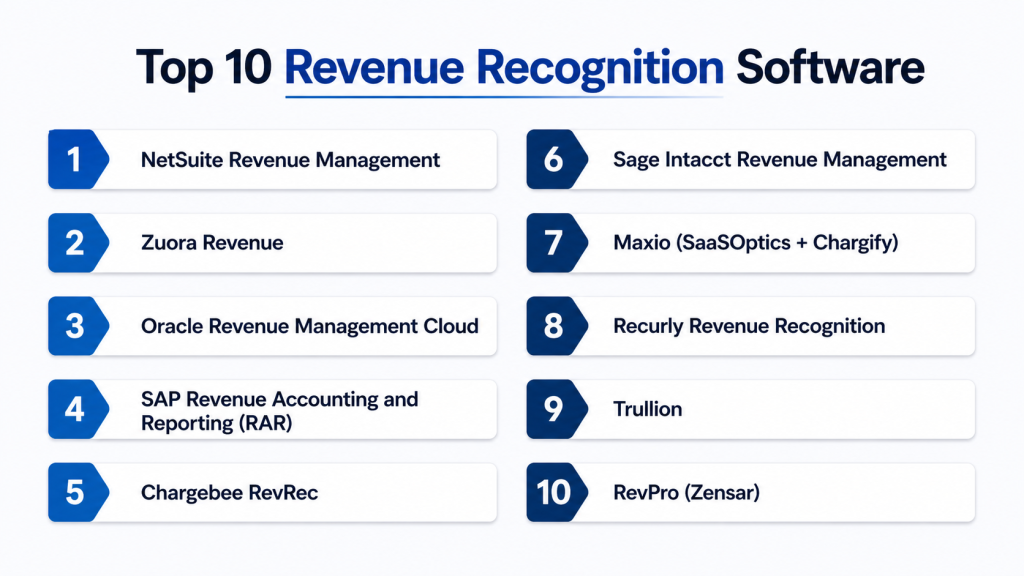
Top 10 Revenue Recognition Software
#1 — NetSuite Revenue Management
Short description: NetSuite Revenue Management is a comprehensive solution designed for enterprises and growing businesses. It automates revenue recognition processes and ensures compliance with accounting standards. Offers real-time reporting and analytics. Integrates deeply with NetSuite ERP. Suitable for subscription and contract-based businesses. Scalable for global operations. Known for strong automation and financial visibility.
Key Features
- Automated revenue schedules
- Compliance management
- Real-time reporting
- Multi-currency support
- Integration with ERP
Pros
- Strong ERP integration
- Scalable for enterprises
Cons
- Expensive
- Requires training
Platforms / Deployment
Cloud
Security & Compliance
RBAC, encryption, audit logs
Integrations & Ecosystem
- NetSuite ERP
- Billing systems
- APIs
Support & Community
Strong enterprise support
#2 — Zuora Revenue
Short description: Zuora Revenue is built for subscription-based businesses and SaaS companies. It provides automated revenue recognition aligned with ASC 606 and IFRS 15. Known for handling complex billing models. Offers strong analytics and reporting. Integrates with Zuora Billing. Ideal for enterprises managing recurring revenue.
Key Features
- Subscription revenue management
- Compliance automation
- Revenue analytics
- Billing integration
Pros
- Strong subscription support
- Compliance-ready
Cons
- Complex implementation
- Premium pricing
Platforms / Deployment
Cloud
Security & Compliance
RBAC, encryption
Integrations & Ecosystem
- Billing systems
- ERP tools
- APIs
Support & Community
Enterprise support
#3 — SAP Revenue Accounting and Reporting (RAR)
Short description: SAP RAR is an enterprise-grade revenue recognition solution designed for large organizations. It provides compliance with global accounting standards. Integrates with SAP ERP systems. Offers automation and advanced reporting. Suitable for complex revenue scenarios. Known for scalability and reliability.
Key Features
- Compliance automation
- Revenue allocation
- Reporting tools
- ERP integration
Pros
- Enterprise-grade
- Strong compliance features
Cons
- Complex setup
- High cost
Platforms / Deployment
Cloud / On-prem
Security & Compliance
SSO, RBAC, encryption
Integrations & Ecosystem
- SAP ecosystem
- APIs
Support & Community
Enterprise support
#4 — Oracle Revenue Management Cloud
Short description: Oracle Revenue Management Cloud provides automated revenue recognition and compliance features. Designed for enterprises with complex financial processes. Integrates with Oracle ERP. Offers real-time insights and analytics. Supports global operations. Ideal for large organizations.
Key Features
- Revenue automation
- Compliance tracking
- Analytics dashboards
- ERP integration
Pros
- Scalable
- Strong integration
Cons
- Expensive
- Learning curve
Platforms / Deployment
Cloud
Security & Compliance
RBAC, MFA, encryption
Integrations & Ecosystem
- Oracle ERP
- APIs
Support & Community
Enterprise support
#5 — Chargebee RevRec
Short description: Chargebee RevRec is designed for SaaS and subscription-based businesses. It automates revenue recognition and ensures compliance. Offers real-time reporting and analytics. Integrates with billing systems. Easy to use compared to enterprise tools. Suitable for mid-market companies.
Key Features
- Revenue automation
- Compliance tracking
- Subscription billing support
- Reporting tools
Pros
- Easy to use
- Strong SaaS focus
Cons
- Limited enterprise features
- Pricing varies
Platforms / Deployment
Cloud
Security & Compliance
RBAC, encryption
Integrations & Ecosystem
- Billing platforms
- APIs
Support & Community
Good support
#6 — Sage Intacct Revenue Management
Short description: Sage Intacct provides revenue recognition features as part of its financial management platform. Designed for SMBs and mid-market businesses. Offers automation and compliance tools. Provides reporting and analytics. Easy to implement. Ideal for growing organizations.
Key Features
- Revenue automation
- Compliance tools
- Reporting
- Integration with accounting
Pros
- Easy implementation
- Strong SMB focus
Cons
- Limited advanced features
- Not ideal for large enterprises
Platforms / Deployment
Cloud
Security & Compliance
RBAC, encryption
Integrations & Ecosystem
- Accounting systems
- APIs
Support & Community
Good support
#7 — Maxio (SaaSOptics + Chargify)
Short description: Maxio combines subscription billing and revenue recognition capabilities. Designed for SaaS companies. Provides automation and analytics. Supports subscription and usage-based models. Offers integration with billing tools. Ideal for growing SaaS businesses.
Key Features
- Subscription management
- Revenue recognition
- Analytics tools
- Billing integration
Pros
- Strong SaaS features
- Integrated billing
Cons
- Limited enterprise capabilities
- Requires setup
Platforms / Deployment
Cloud
Security & Compliance
RBAC
Integrations & Ecosystem
- SaaS platforms
- APIs
Support & Community
Moderate support
#8 — Recurly Revenue Recognition
Short description: Recurly offers revenue recognition as part of its subscription billing platform. Designed for SaaS businesses. Provides automation and compliance support. Integrates with billing workflows. Easy to use. Suitable for mid-sized companies.
Key Features
- Subscription revenue tracking
- Compliance tools
- Billing integration
- Reporting
Pros
- Easy integration
- SaaS-focused
Cons
- Limited advanced analytics
- Not enterprise-grade
Platforms / Deployment
Cloud
Security & Compliance
RBAC, encryption
Integrations & Ecosystem
- Billing systems
- APIs
Support & Community
Good support
#9 — RevPro (Zensar)
Short description: RevPro is a specialized revenue recognition platform designed for enterprises. It supports complex revenue scenarios and compliance requirements. Offers automation and analytics. Integrates with ERP systems. Suitable for large organizations.
Key Features
- Revenue automation
- Compliance tracking
- Analytics tools
Pros
- Strong enterprise features
- Flexible
Cons
- Complex setup
- Requires expertise
Platforms / Deployment
Cloud
Security & Compliance
RBAC
Integrations & Ecosystem
- ERP systems
- APIs
Support & Community
Moderate support
#10 — Trullion
Short description: Trullion is a modern accounting automation platform with revenue recognition capabilities. It uses AI to automate compliance and reporting. Designed for finance teams. Offers real-time insights. Easy to use. Suitable for mid-market businesses.
Key Features
- AI-driven automation
- Compliance reporting
- Real-time analytics
Pros
- Modern UI
- AI capabilities
Cons
- Limited enterprise features
- Pricing varies
Platforms / Deployment
Cloud
Security & Compliance
RBAC, encryption
Integrations & Ecosystem
- Accounting systems
- APIs
Support & Community
Good support
Comparison Table (Top 10)
| Tool Name | Best For | Platform(s) | Deployment | Standout Feature | Public Rating |
|---|---|---|---|---|---|
| NetSuite | Enterprise | Web | Cloud | ERP integration | N/A |
| Zuora | SaaS | Web | Cloud | Subscription billing | N/A |
| SAP RAR | Enterprise | Web | Hybrid | Compliance | N/A |
| Oracle | Enterprise | Web | Cloud | ERP integration | N/A |
| Chargebee | SaaS | Web | Cloud | Ease of use | N/A |
| Sage Intacct | SMB/Mid | Web | Cloud | Simplicity | N/A |
| Maxio | SaaS | Web | Cloud | Billing integration | N/A |
| Recurly | SaaS | Web | Cloud | Subscription support | N/A |
| RevPro | Enterprise | Web | Cloud | Flexibility | N/A |
| Trullion | Mid | Web | Cloud | AI automation | N/A |
Evaluation & Scoring of Revenue Recognition Software
| Tool | Core | Ease | Integrations | Security | Performance | Support | Value | Total |
|---|---|---|---|---|---|---|---|---|
| NetSuite | 9 | 7 | 9 | 9 | 9 | 9 | 7 | 8.6 |
| Zuora | 9 | 6 | 9 | 9 | 9 | 8 | 7 | 8.4 |
| SAP RAR | 9 | 6 | 9 | 9 | 9 | 9 | 6 | 8.5 |
| Oracle | 9 | 6 | 9 | 9 | 9 | 9 | 6 | 8.5 |
| Chargebee | 8 | 8 | 8 | 8 | 8 | 8 | 8 | 8.0 |
| Sage Intacct | 8 | 8 | 8 | 8 | 8 | 8 | 8 | 8.0 |
| Maxio | 7 | 8 | 7 | 7 | 7 | 7 | 8 | 7.4 |
| Recurly | 7 | 8 | 7 | 7 | 7 | 7 | 8 | 7.4 |
| RevPro | 8 | 6 | 8 | 8 | 8 | 7 | 7 | 7.6 |
| Trullion | 7 | 9 | 7 | 7 | 7 | 7 | 8 | 7.6 |
Which Revenue Recognition Software Is Right for You?
SMB
Sage Intacct, Chargebee
Mid-Market
Trullion, Recurly
Enterprise
NetSuite, SAP, Oracle
SaaS Businesses
Zuora, Chargebee, Maxio
Budget vs Premium
Budget = Chargebee, Trullion
Premium = SAP, Oracle
Feature Depth vs Ease of Use
Advanced = SAP, Oracle
Simple = Chargebee, Trullion
Frequently Asked Questions (FAQs)
1. What is revenue recognition software?
Revenue recognition software automates how revenue is recorded. It ensures compliance with accounting standards. Businesses use it to manage subscriptions and contracts. It improves accuracy and reporting. Helps avoid manual errors.
2. Why is it important?
It ensures financial compliance and accuracy. Helps meet regulations like ASC 606. Improves reporting transparency. Reduces manual effort. Supports business scalability.
3. Who needs it?
SaaS companies, enterprises, and subscription businesses. Any company with complex revenue models benefits. Finance teams use it extensively. Helps growing businesses scale.
4. Is it difficult to implement?
Enterprise tools can be complex. SMB tools are easier. Implementation depends on integration needs. Training is often required. Planning is essential.
5. Does it integrate with ERP?
Yes, most tools integrate with ERP systems. APIs enable connectivity. Integration ensures data consistency. Enterprise tools offer deeper integration.
6. Is it secure?
Modern tools include encryption and RBAC. Enterprise tools offer advanced security. Zero Trust is emerging. Always verify vendor security features.
7. Can it handle subscriptions?
Yes, many tools support subscription billing. SaaS-focused tools excel here. Automates recurring revenue. Helps manage growth.
8. What are alternatives?
Spreadsheets or accounting software. However, they lack automation. Not scalable. Risk of errors. Dedicated tools are better.
9. Can I switch tools later?
Switching is possible but complex. Data migration is required. Integration must be updated. Costs may increase. Plan carefully.
10. What industries use it?
SaaS, telecom, finance, and manufacturing. Any business with recurring revenue benefits. Adoption is growing. Helps ensure compliance.
Conclusion
Revenue recognition software plays a critical role in ensuring financial accuracy, compliance, and scalability in modern businesses. As organizations adopt subscription-based models and complex contracts, manual revenue tracking becomes inefficient and error-prone. These tools automate revenue schedules, provide real-time insights, and ensure compliance with global accounting standards, making them essential for finance teams and enterprises.
Choosing the right solution depends on your business model, revenue complexity, and integration needs. SaaS companies may prefer tools like Zuora or Chargebee, while enterprises benefit from NetSuite, SAP, or Oracle. Instead of focusing solely on features, evaluate usability, scalability, and compliance capabilities. Start by shortlisting a few tools, run pilot tests, and validate integration and reporting accuracy before finalizing your decision.
