Introduction
Product Information Management (PIM) Tools are platforms that help organizations centralize, manage, enrich, and distribute product data across multiple channels. These tools ensure that product information such as descriptions, specifications, images, and pricing remains consistent, accurate, and up-to-date across e-commerce platforms, marketplaces, and internal systems.
In today’s omnichannel commerce environment, PIM tools are critical for retailers, manufacturers, distributors, and e-commerce businesses. With growing product catalogs and multiple sales channels, managing product data manually is inefficient and error-prone. Modern PIM solutions integrate with ERP, DAM, CMS, and e-commerce platforms, while also aligning with Identity Management, Cybersecurity frameworks, Zero Trust architectures, and Access Control systems to ensure secure and governed data handling.
Real-world use cases include:
- Managing product catalogs across multiple channels
- Enriching product data with media and attributes
- Synchronizing product information across systems
- Improving e-commerce product listings
- Supporting global product data management
What buyers should evaluate:
- Data modeling and product catalog management
- Workflow automation and approval processes
- Integration with ERP, e-commerce, and DAM systems
- Scalability and performance
- Localization and multi-language support
- Data quality and validation features
- Security and compliance capabilities
- Ease of use and customization
Best for: E-commerce businesses, retailers, manufacturers, and enterprises managing large product catalogs.
Not ideal for: Small businesses with limited product data complexity.
Key Trends in PIM Tools
- Cloud-based PIM solutions becoming standard
- AI-driven product data enrichment and automation
- Integration with e-commerce and marketplace platforms
- Real-time product data synchronization
- Multi-channel and omnichannel support
- Advanced data governance and compliance features
- Localization and global catalog management
- Headless commerce integration
- Improved user experience and collaboration tools
- Scalable solutions for large product catalogs
How We PIM Tools (Methodology)
We evaluated tools based on:
- Product data management capabilities
- Workflow automation and data enrichment
- Integration with enterprise systems
- Performance and scalability
- Security and compliance readiness
- Ease of use and customization
- Vendor ecosystem and support
- Industry adoption and reliability
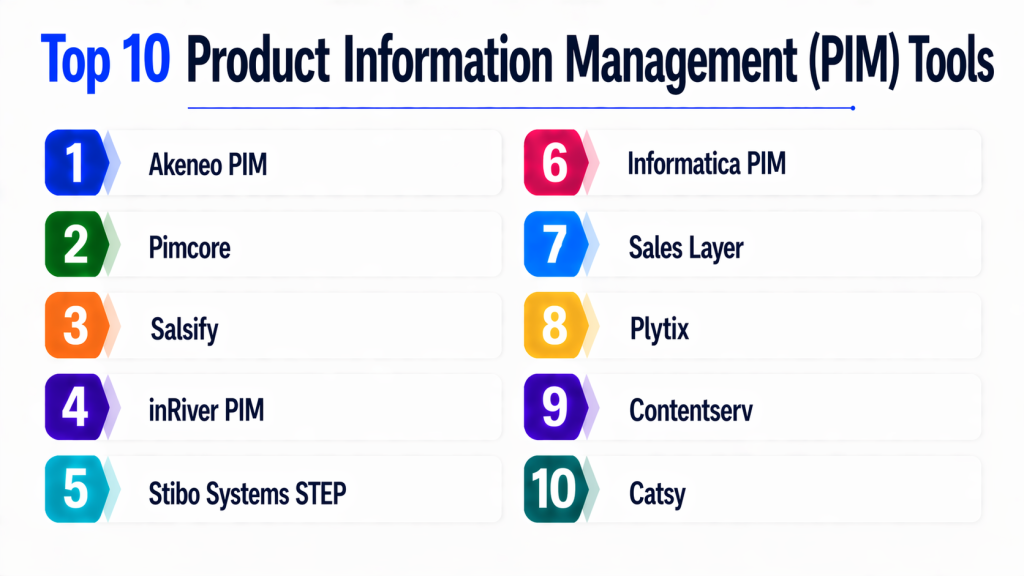
Top 10 Product Information Management (PIM) Tools
#1 — Akeneo PIM
Short description :
Akeneo PIM is a leading open-source and enterprise-grade PIM platform. It helps businesses centralize and enrich product data. Widely used in e-commerce environments. Supports multi-channel distribution. Ideal for mid to large enterprises.
Key Features
- Product data management
- Workflow automation
- Multi-channel support
- Data enrichment
- API integration
Pros
- Flexible
- Strong ecosystem
Cons
- Requires setup
- Cost for enterprise
Platforms / Deployment
Cloud / On-premise
Security & Compliance
RBAC, encryption
Compliance: Varies
Integrations & Ecosystem
- ERP systems
- E-commerce platforms
Support & Community
Large community.
#2 — Pimcore
Short description :
Pimcore is an open-source PIM platform combined with DAM and CMS capabilities. It offers flexible data management and integration. Suitable for enterprises needing customization.
Key Features
- PIM + DAM + CMS
- Data modeling
- Workflow automation
Pros
- Highly customizable
- Open-source
Cons
- Complex setup
- Requires expertise
Platforms / Deployment
Cloud / On-premise
Security & Compliance
Varies
Integrations & Ecosystem
- APIs
- Enterprise systems
Support & Community
Strong community.
#3 — Salsify
Short description :
Salsify is a cloud-based PIM platform focused on digital commerce. It helps brands manage and distribute product content across channels. Ideal for retail and e-commerce.
Key Features
- Content syndication
- Data management
- Analytics
Pros
- Easy to use
- Strong commerce features
Cons
- Premium pricing
- Limited customization
Platforms / Deployment
Cloud
Security & Compliance
Enterprise controls
Integrations & Ecosystem
- E-commerce platforms
Support & Community
Enterprise support.
#4 — inRiver PIM
Short description :
inRiver is a PIM platform designed for enterprise product information management. It focuses on product marketing and syndication. Suitable for large businesses.
Key Features
- Product lifecycle management
- Workflow tools
- Data syndication
Pros
- Enterprise-ready
- Scalable
Cons
- Expensive
- Complex
Platforms / Deployment
Cloud
Security & Compliance
Enterprise controls
Integrations & Ecosystem
- ERP systems
Support & Community
Strong support.
#5 — Stibo Systems (STEP)
Short description :
Stibo Systems offers a master data management platform with PIM capabilities. It supports large-scale data operations. Ideal for enterprises.
Key Features
- Data governance
- Product data management
- Analytics
Pros
- Scalable
- Reliable
Cons
- Complex
- Cost
Platforms / Deployment
Cloud / On-premise
Security & Compliance
Enterprise controls
Integrations & Ecosystem
- MDM systems
Support & Community
Enterprise support.
#6 — Informatica PIM
Short description :
Informatica PIM is part of Informatica’s data management suite. It provides enterprise-grade product data management. Suitable for large organizations.
Key Features
- Data integration
- Product data management
- Analytics
Pros
- Strong data capabilities
- Enterprise-ready
Cons
- Complex
- Expensive
Platforms / Deployment
Cloud / On-premise
Security & Compliance
Enterprise controls
Integrations & Ecosystem
- Data platforms
Support & Community
Strong support.
#7 — Sales Layer
Short description :
Sales Layer is a cloud-based PIM platform designed for simplicity and speed. It helps businesses manage product catalogs efficiently. Ideal for SMBs.
Key Features
- Catalog management
- Data synchronization
- Multi-channel support
Pros
- Easy to use
- Quick implementation
Cons
- Limited advanced features
- Smaller ecosystem
Platforms / Deployment
Cloud
Security & Compliance
Varies
Integrations & Ecosystem
- E-commerce tools
Support & Community
Growing support.
#8 — Plytix
Short description :
Plytix is a PIM platform focused on SMBs. It provides tools for managing and distributing product information. Easy to use and affordable.
Key Features
- Product data management
- Workflow tools
- Reporting
Pros
- Affordable
- User-friendly
Cons
- Limited scalability
- Basic features
Platforms / Deployment
Cloud
Security & Compliance
Varies
Integrations & Ecosystem
- E-commerce platforms
Support & Community
Active community.
#9 — Contentserv
Short description :
Contentserv is a PIM platform for product content management and marketing. It supports omnichannel distribution. Suitable for enterprises.
Key Features
- Content management
- Product data
- Analytics
Pros
- Scalable
- Feature-rich
Cons
- Complex
- Cost
Platforms / Deployment
Cloud
Security & Compliance
Enterprise controls
Integrations & Ecosystem
- Marketing tools
Support & Community
Enterprise support.
#10 — Catsy
Short description :
Catsy is a PIM platform designed for product content management and syndication. It helps businesses manage product data across channels. Suitable for mid-sized companies.
Key Features
- Product content management
- Syndication tools
- Data management
Pros
- Easy to use
- Flexible
Cons
- Limited enterprise features
- Cost
Platforms / Deployment
Cloud
Security & Compliance
Varies
Integrations & Ecosystem
- E-commerce systems
Support & Community
Growing support.
Comparison Table (Top 10)
| Tool Name | Best For | Platform(s) | Deployment | Standout Feature | Public Rating |
|---|---|---|---|---|---|
| Akeneo | Enterprise | Multi | Hybrid | Flexibility | N/A |
| Pimcore | Custom | Multi | Hybrid | Open-source | N/A |
| Salsify | Commerce | Cloud | Cloud | Syndication | N/A |
| inRiver | Enterprise | Cloud | Cloud | Lifecycle | N/A |
| Stibo | Enterprise | Multi | Hybrid | Governance | N/A |
| Informatica | Enterprise | Multi | Hybrid | Data integration | N/A |
| Sales Layer | SMB | Cloud | Cloud | Simplicity | N/A |
| Plytix | SMB | Cloud | Cloud | Cost | N/A |
| Contentserv | Enterprise | Cloud | Cloud | Omnichannel | N/A |
| Catsy | Mid-market | Cloud | Cloud | Content mgmt | N/A |
Evaluation & Scoring of PIM Tools
| Tool | Core | Ease | Integration | Security | Performance | Support | Value | Total |
|---|---|---|---|---|---|---|---|---|
| Akeneo | 9 | 8 | 9 | 8 | 9 | 9 | 8 | 8.7 |
| Pimcore | 9 | 7 | 9 | 8 | 9 | 8 | 9 | 8.6 |
| Salsify | 8 | 9 | 8 | 9 | 8 | 9 | 7 | 8.3 |
| inRiver | 9 | 7 | 9 | 9 | 9 | 9 | 7 | 8.6 |
| Stibo | 10 | 6 | 10 | 9 | 9 | 9 | 7 | 8.7 |
| Informatica | 10 | 6 | 10 | 9 | 9 | 9 | 7 | 8.7 |
| Sales Layer | 7 | 9 | 7 | 7 | 8 | 8 | 9 | 7.9 |
| Plytix | 7 | 10 | 7 | 7 | 7 | 8 | 9 | 7.9 |
| Contentserv | 9 | 7 | 8 | 9 | 9 | 8 | 7 | 8.1 |
| Catsy | 8 | 8 | 7 | 7 | 8 | 8 | 8 | 7.9 |
Which PIM Tool Is Right for You?
Solo / Small Business
Use Plytix, Sales Layer
SMB
Use Akeneo, Catsy
Mid-Market
Use inRiver, Contentserv
Enterprise
Use Stibo, Informatica, Pimcore
Budget vs Premium
Budget: Plytix
Premium: Stibo
Feature Depth vs Ease
Depth: Informatica
Ease: Sales Layer
Security & Compliance
Best: Stibo, Informatica
Frequently Asked Questions (FAQs)
1. What is a PIM tool?
A PIM tool helps manage and organize product information in a centralized system. It ensures consistent product data across multiple channels. These tools are widely used in e-commerce and retail. They improve data accuracy and efficiency. They are essential for managing large product catalogs.
2. Why are PIM tools important?
PIM tools help businesses maintain accurate and consistent product information. They improve operational efficiency and reduce errors. These tools also enhance customer experience by providing better product data. They support multi-channel sales strategies. They are critical for scaling e-commerce operations.
3. Are PIM tools scalable?
Yes, most PIM tools are designed to handle growing product catalogs and business needs. Cloud-based platforms provide scalability without heavy infrastructure. Enterprise tools support global operations and large datasets. Scalability depends on the platform and implementation. Proper setup ensures efficient growth.
4. Are PIM tools secure?
Security depends on the vendor and deployment model. Many tools offer encryption, role-based access control, and audit logs. These features help protect sensitive product and business data. Organizations should follow best practices for configuration. Compliance varies across platforms.
5. Which PIM tool is best for beginners?
Tools like Plytix and Sales Layer are beginner-friendly due to their simple interfaces. They provide essential features without complexity. These tools are ideal for small businesses or startups. Beginners can scale to advanced tools later. The choice depends on business needs.
6. Can PIM tools integrate with other systems?
Yes, PIM tools integrate with ERP, e-commerce platforms, DAM, and CMS systems. This integration ensures consistent data across platforms. It improves workflow efficiency and reduces duplication. Many tools offer API-based integrations. This makes them highly flexible.
7. Are PIM tools expensive?
Pricing varies depending on features, scale, and deployment. Some tools offer affordable plans for small businesses. Enterprise tools are more expensive due to advanced capabilities. Cloud-based solutions often use subscription models. Businesses should evaluate cost versus value.
8. What industries use PIM tools?
PIM tools are widely used in retail, e-commerce, manufacturing, and distribution industries. They help manage product catalogs and improve data accuracy. Adoption is growing across sectors. They are essential for omnichannel commerce. They support digital transformation.
9. What are the limitations of PIM tools?
PIM tools can be complex to implement and may require customization. Some platforms involve high costs, especially for enterprise use. Integration with legacy systems can be challenging. Users may face a learning curve. Despite these challenges, they provide significant benefits.
10. How do I choose the right PIM tool?
Choosing the right PIM tool depends on your business size, product catalog, and integration needs. Evaluate features like scalability, ease of use, and workflow automation. Testing tools through demos or trials is recommended. Consider long-term growth and support. Selecting the right tool ensures efficient product data management.
Conclusion
Product Information Management (PIM) tools are essential for businesses managing large and complex product catalogs across multiple channels. They enable organizations to centralize, enrich, and distribute product data efficiently, ensuring consistency and accuracy. With the rise of e-commerce and omnichannel strategies, PIM platforms have become a critical component of modern digital commerce infrastructure.
Choosing the right PIM tool depends on your business requirements, scale, and technical capabilities. While enterprise solutions like Stibo Systems and Informatica offer advanced features for large organizations, tools like Plytix and Sales Layer provide simplicity and affordability for smaller businesses. The best approach is to evaluate your needs, test different platforms, and select the one that aligns with your long-term strategy.
