Introduction
Privacy-preserving analytics tools allow organizations to analyze data while minimizing exposure of personally identifiable information (PII). By using techniques like anonymization, differential privacy, and secure multi-party computation, these tools enable data-driven decision-making without compromising privacy or compliance.
Why it matters now: Data privacy regulations are increasingly stringent worldwide. Businesses must balance insights and analytics with GDPR, CCPA, and other regulatory requirements. Privacy-preserving analytics ensures organizations can unlock value from sensitive datasets without risking breaches or non-compliance.
Real-world use cases:
- Generating anonymized insights from customer datasets.
- Collaborative analytics across organizations without sharing raw data.
- Differential privacy for AI and machine learning training.
- Monitoring user behavior without storing PII.
- Compliance-focused reporting for regulators or audits.
Evaluation criteria for buyers:
- Privacy techniques supported (anonymization, differential privacy).
- Data integration and scalability.
- Security and regulatory compliance.
- Ease of use and reporting capabilities.
- AI and analytics support.
- Deployment flexibility (cloud, hybrid, on-premises).
- Performance and reliability.
- Support and community resources.
Best for: Data scientists, analysts, and compliance teams in enterprises handling sensitive or regulated data.
Not ideal for: Small organizations with limited sensitive data or minimal regulatory obligations; simpler analytics tools may suffice.
Key Trends in Privacy-preserving Analytics Tools
- Adoption of differential privacy techniques for AI and ML pipelines.
- Secure multi-party computation for cross-organizational analytics.
- Cloud-native solutions with built-in privacy enforcement.
- Automation of anonymization and pseudonymization processes.
- Integration with existing analytics and BI platforms.
- Real-time privacy-aware dashboards.
- Support for federated learning to avoid data centralization.
- Compliance with global data protection regulations.
- Increased adoption in healthcare, finance, and e-commerce.
- Modular subscription models for SMBs and enterprises.
How We Selected These Tools (Methodology)
- Evaluated market adoption and reputation among data privacy and analytics teams.
- Assessed privacy techniques: anonymization, differential privacy, secure computation.
- Reviewed performance and reliability of analytics operations.
- Checked security and compliance credentials.
- Analyzed integration capabilities with BI and AI platforms.
- Considered customer fit across SMBs, mid-market, and enterprises.
- Examined ease of use, visualization, and reporting options.
- Focused on AI and machine learning readiness.
- Balanced cloud, hybrid, and on-premises deployment support.
- Verified documentation, community, and support quality.
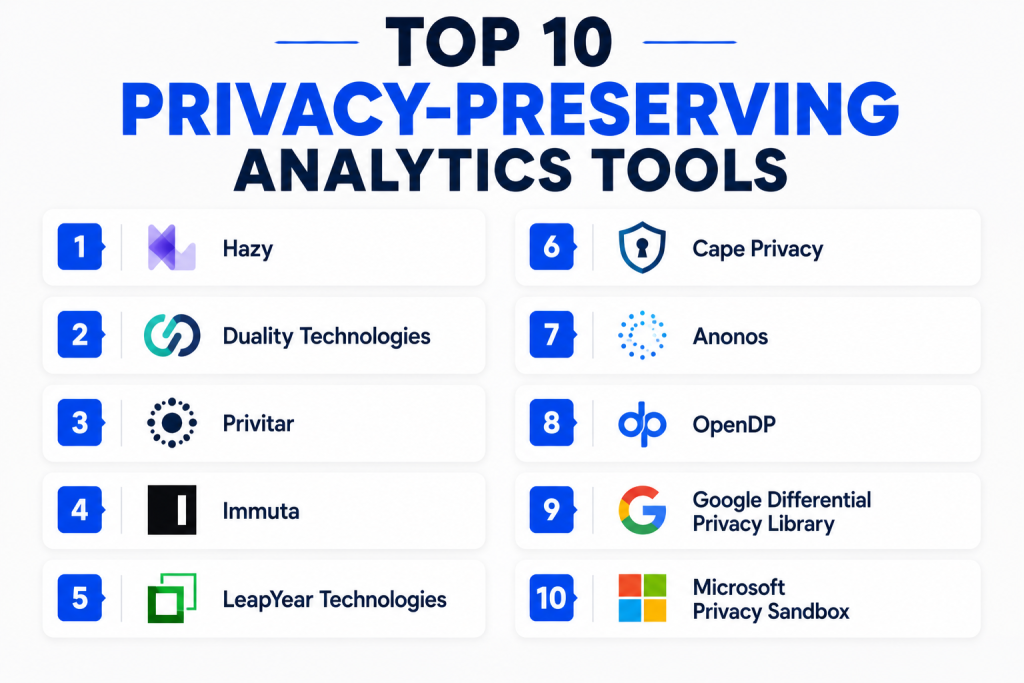
Top 10 Privacy-preserving Analytics Tools
#1 — Hazy
Short description: Hazy provides synthetic data generation and anonymization for secure analytics and compliance.
Key Features
- Synthetic data creation
- GDPR and CCPA compliance
- Differential privacy enforcement
- AI/ML-ready datasets
- Integration with BI and analytics platforms
- Automated data masking
- Scenario simulation
Pros
- Strong synthetic data capabilities
- Easy integration with analytics pipelines
Cons
- Focused primarily on structured data
- Limited open-source support
Platforms / Deployment
- Web
- Cloud
Security & Compliance
- SOC 2, GDPR, CCPA
Integrations & Ecosystem
Supports Tableau, Power BI, Python, and R for analytics workflows.
- API for data pipelines
- Connectors for cloud databases
- Compatible with AI frameworks
Support & Community
- Documentation available
- Enterprise support tiers
#2 — Duality Technologies
Short description: Offers secure analytics using homomorphic encryption and privacy-preserving computation.
Key Features
- Homomorphic encryption for computations
- Secure multi-party computation
- Compliance-ready solutions
- Integration with data warehouses
- AI and analytics support
Pros
- High-level security for sensitive data
- Enterprise-grade privacy
Cons
- Computational overhead can be high
- Setup complexity for beginners
Platforms / Deployment
- Web
- Cloud / On-premises
Security & Compliance
- GDPR, HIPAA
Integrations & Ecosystem
- Compatible with Python, SQL databases, cloud storage
- API for analytics workflows
Support & Community
- Documentation available
- Customer support varies
#3 — Privitar
Short description: Data privacy platform for enterprise analytics with masking and anonymization tools.
Key Features
- Data masking and pseudonymization
- Differential privacy support
- Compliance automation
- Integration with analytics and BI platforms
- Real-time data protection
Pros
- Strong compliance and privacy governance
- Scalable for large datasets
Cons
- Higher cost for smaller teams
- Learning curve for complex features
Platforms / Deployment
- Web
- Cloud / Hybrid
Security & Compliance
- SOC 2, GDPR, HIPAA
Integrations & Ecosystem
- Tableau, Power BI, Python, Spark
- API for data workflows
Support & Community
- Documentation and guides
- Enterprise support tiers
#4 — Immuta
Short description: Cloud-native platform enabling privacy-safe analytics with dynamic data access controls.
Key Features
- Policy-driven data access
- Differential privacy enforcement
- Integration with cloud data warehouses
- Real-time privacy-aware analytics
- Audit logs and compliance reporting
Pros
- Easy-to-manage privacy policies
- Good for cloud data environments
Cons
- Premium pricing
- Focused on enterprises
Platforms / Deployment
- Web
- Cloud
Security & Compliance
- SOC 2, GDPR, HIPAA
Integrations & Ecosystem
- Snowflake, Databricks, AWS, Azure
- API for analytics integration
Support & Community
- Documentation available
- Enterprise support
#5 — LeapYear Technologies
Short description: Offers secure computation and analytics for sensitive datasets using homomorphic encryption.
Key Features
- Privacy-preserving analytics
- Multi-party secure computation
- Integration with AI/ML pipelines
- Regulatory compliance
- Data masking and anonymization
Pros
- High-level data security
- Supports collaborative analytics
Cons
- Complexity for small teams
- Computationally intensive
Platforms / Deployment
- Web
- Cloud / On-premises
Security & Compliance
- GDPR, HIPAA
Integrations & Ecosystem
- Python, R, cloud storage
- APIs for custom workflows
Support & Community
- Documentation provided
- Customer support varies
#6 — Cape Privacy
Short description: Combines encryption and machine learning for privacy-preserving analytics.
Key Features
- Privacy-preserving ML
- Encrypted data workflows
- Integration with BI and AI platforms
- Real-time privacy compliance
- Secure data collaboration
Pros
- AI-ready privacy
- Flexible integrations
Cons
- Limited offline analytics
- Enterprise-focused pricing
Platforms / Deployment
- Web
- Cloud
Security & Compliance
- GDPR, SOC 2
Integrations & Ecosystem
- Python, R, BI tools
- API support
Support & Community
- Documentation and onboarding guides
- Support tiers available
#7 — Anonos
Short description: Provides pseudonymization and privacy-safe analytics for enterprise data.
Key Features
- Pseudonymization of datasets
- GDPR and HIPAA compliance
- Secure analytics pipelines
- Data access control policies
- Integration with BI and AI tools
Pros
- Strong regulatory focus
- Scalable for large datasets
Cons
- Learning curve for complex pipelines
- Enterprise-oriented
Platforms / Deployment
- Web
- Cloud / Hybrid
Security & Compliance
- GDPR, HIPAA
Integrations & Ecosystem
- SQL, Python, BI platforms
- API for workflows
Support & Community
- Documentation available
- Enterprise support
#8 — OpenDP
Short description: Open-source library for differential privacy in analytics and AI.
Key Features
- Differential privacy algorithms
- Integration with Python and R
- Supports secure analytics pipelines
- Open-source and community-driven
- Flexible for ML use cases
Pros
- Free and open-source
- Highly customizable
Cons
- Requires technical expertise
- Limited out-of-the-box dashboards
Platforms / Deployment
- Web / Linux / macOS / Windows
- Self-hosted / Cloud
Security & Compliance
- Not publicly stated
Integrations & Ecosystem
- Python, R, Jupyter notebooks
- API integration available
Support & Community
- Community forums
- Documentation available
#9 — Google Differential Privacy Library
Short description: Open-source library for applying differential privacy techniques to datasets.
Key Features
- Differential privacy for analytics
- Supports large datasets
- Python and Go libraries
- Integration with ML pipelines
- Open-source and customizable
Pros
- Free and community-supported
- Scalable for analytics
Cons
- No built-in dashboards
- Requires developer expertise
Platforms / Deployment
- Web / Linux / macOS / Windows
- Self-hosted
Security & Compliance
- Not publicly stated
Integrations & Ecosystem
- Python, ML frameworks
- API and libraries for integration
Support & Community
- Community support
- Documentation available
#10 — Microsoft Privacy Sandbox
Short description: Provides privacy-safe analytics and advertising measurement on Microsoft platforms.
Key Features
- Privacy-preserving analytics
- Differential privacy techniques
- Integration with Microsoft BI and cloud
- Data access policies
- Secure data sharing
Pros
- Strong integration with Microsoft ecosystem
- Enterprise-grade privacy
Cons
- Limited to Microsoft environments
- Enterprise-focused pricing
Platforms / Deployment
- Web
- Cloud
Security & Compliance
- GDPR, SOC 2
Integrations & Ecosystem
- Power BI, Azure, Python
- API support for analytics pipelines
Support & Community
- Documentation and guides
- Enterprise support tiers
Comparison Table (Top 10)
| Tool Name | Best For | Platform(s) Supported | Deployment | Standout Feature | Public Rating |
|---|---|---|---|---|---|
| Hazy | Synthetic data & anonymization | Web | Cloud | AI-driven synthetic datasets | N/A |
| Duality Technologies | Secure computation | Web | Cloud / On-premises | Homomorphic encryption | N/A |
| Privitar | Enterprise data privacy | Web | Cloud / Hybrid | Data masking & governance | N/A |
| Immuta | Cloud analytics | Web | Cloud | Policy-driven access | N/A |
| LeapYear Technologies | Secure analytics | Web | Cloud / On-premises | Multi-party computation | N/A |
| Cape Privacy | Privacy + ML | Web | Cloud | Encrypted ML workflows | N/A |
| Anonos | Enterprise pseudonymization | Web | Cloud / Hybrid | Regulatory compliance | N/A |
| OpenDP | Open-source differential privacy | Web / Linux / macOS / Windows | Self-hosted / Cloud | Flexible open-source library | N/A |
| Google Differential Privacy Library | Developer-focused DP | Web / Linux / macOS / Windows | Self-hosted | Open-source DP algorithms | N/A |
| Microsoft Privacy Sandbox | Enterprise Microsoft users | Web | Cloud | Privacy-safe analytics | N/A |
Evaluation & Scoring of Privacy-preserving Analytics Tools
| Tool Name | Core (25%) | Ease (15%) | Integrations (15%) | Security (10%) | Performance (10%) | Support (10%) | Value (15%) | Weighted Total (0–10) |
|---|---|---|---|---|---|---|---|---|
| Hazy | 9 | 8 | 8 | 9 | 8 | 8 | 7 | 8.3 |
| Duality Technologies | 9 | 7 | 7 | 9 | 8 | 7 | 7 | 8.0 |
| Privitar | 8 | 7 | 8 | 9 | 8 | 8 | 7 | 8.0 |
| Immuta | 8 | 8 | 8 | 9 | 8 | 8 | 7 | 8.1 |
| LeapYear Technologies | 8 | 7 | 7 | 9 | 8 | 7 | 7 | 7.9 |
| Cape Privacy | 8 | 8 | 8 | 9 | 8 | 8 | 7 | 8.0 |
| Anonos | 8 | 7 | 7 | 9 | 8 | 7 | 7 | 7.9 |
| OpenDP | 7 | 6 | 6 | 8 | 7 | 6 | 8 | 7.0 |
| Google Differential Privacy Library | 7 | 6 | 6 | 8 | 7 | 6 | 8 | 7.0 |
| Microsoft Privacy Sandbox | 8 | 7 | 8 | 9 | 8 | 8 | 7 | 8.0 |
Interpretation: Weighted scores are comparative across tools. Higher totals indicate stronger balance of privacy, integration, usability, and value. Scores guide selection depending on organizational needs.
Which Privacy-preserving Analytics Tool Is Right for You?
Solo / Freelancer
OpenDP or Google Differential Privacy Library for free, flexible privacy solutions; requires developer expertise.
SMB
Hazy or Cape Privacy provide easier setup and ready-to-use privacy features for small teams.
Mid-Market
Immuta or Privitar provide enterprise-grade privacy with dashboards, governance, and compliance.
Enterprise
Duality Technologies, Microsoft Privacy Sandbox, and Anonos deliver advanced privacy-preserving analytics, multi-party computation, and regulatory compliance.
Budget vs Premium
SMBs benefit from open-source or mid-tier cloud solutions. Enterprises may require premium tools with AI and ML integration.
Feature Depth vs Ease of Use
Developer-focused libraries provide depth but require expertise; platforms like Hazy offer usability with strong features.
Integrations & Scalability
Ensure compatibility with BI, cloud, and ML platforms. Cloud solutions offer scalability; hybrid deployments offer flexibility.
Security & Compliance Needs
Enterprises should prioritize SOC 2, GDPR, HIPAA-compliant solutions like Privitar, Immuta, and Microsoft Privacy Sandbox.
Frequently Asked Questions (FAQs)
1. What are privacy-preserving analytics tools?
Tools that enable data analysis while protecting PII through anonymization, differential privacy, or secure computation.
2. Which industries benefit most?
Healthcare, finance, e-commerce, and any organization handling sensitive or regulated data.
3. Can open-source tools be used in enterprise?
Yes, but they may require technical expertise and custom integration for large-scale deployment.
4. How do these tools protect data?
Through techniques like data masking, differential privacy, pseudonymization, and homomorphic encryption.
5. Are these tools compatible with AI/ML workflows?
Yes, many tools support AI/ML model training on privacy-safe datasets.
6. Can these tools handle multi-party data collaboration?
Tools like Duality Technologies and LeapYear enable secure computation across organizations.
7. Do they comply with GDPR/CCPA?
Top tools include compliance features; always verify certification and privacy policy adherence.
8. How complex is setup?
It varies; open-source requires development skills, while enterprise platforms offer guided setup and dashboards.
9. Can SMBs afford these tools?
Some mid-tier cloud platforms like Hazy and Cape Privacy provide scalable pricing suitable for SMBs.
10. How often should models be updated?
Regularly, especially when integrating new datasets or changing analytics objectives.
Conclusion
Selecting the right privacy-preserving analytics tool depends on your organization’s size, data sensitivity, and analytics needs. SMBs may prioritize usability and cost, while enterprises often need advanced privacy, compliance, and integration capabilities. Begin by shortlisting 2–3 tools that meet your security and analytics requirements. Pilot the solutions, validate results, and scale insights across datasets to maintain compliance while extracting actionable business insights.
