Introduction
Post-Quantum Cryptography Migration Tools help organizations find, assess, replace, and manage cryptographic systems that may become weak against future quantum computing threats. In simple words, these tools help security teams understand where cryptography is used, which systems may be at risk, and how to move toward quantum-safe protection without breaking business operations.
This matters because organizations depend on cryptography across certificates, VPNs, TLS, code signing, applications, cloud workloads, payment systems, identity platforms, databases, APIs, and connected devices. A rushed migration can create outages, compatibility issues, weak controls, and compliance gaps. A planned migration helps teams build a cryptographic inventory, prioritize risky assets, test safer algorithms, and modernize key management.
Common use cases include cryptographic asset discovery, certificate inventory, TLS scanning, PKI modernization, hybrid cryptography testing, application dependency mapping, compliance planning, and risk reporting for leadership.
Buyers should evaluate crypto discovery depth, certificate lifecycle support, API access, hybrid cryptography support, cloud integration, reporting, policy automation, HSM support, scalability, and vendor maturity.
Best for: CISOs, security architects, PKI teams, DevSecOps teams, compliance leaders, cloud security teams, financial services, government agencies, healthcare, telecom, SaaS companies, and enterprises with large cryptographic environments.
Not ideal for: Very small teams with limited digital infrastructure, organizations that only need basic certificate tracking, or teams that are not ready to perform cryptographic inventory and risk prioritization.
Key Trends in Post-Quantum Cryptography Migration Tools
- Cryptographic inventory is becoming the first real migration step. Most organizations cannot migrate what they cannot see, so discovery and inventory tools are becoming essential.
- Hybrid cryptography is gaining attention. Many teams want classical and post-quantum approaches to run together during the transition stage to reduce compatibility risk.
- Certificate lifecycle management is becoming more strategic. Certificate management is no longer only an operations task. It is becoming part of long-term cryptographic readiness.
- HSM and key management vendors are expanding quantum-safe capabilities. Enterprises want stronger protection without abandoning trusted hardware-backed key management.
- Cloud and SaaS environments are increasing complexity. Cryptography is spread across cloud workloads, APIs, containers, service meshes, mobile apps, and third-party services.
- DevSecOps integration is becoming more important. Security teams need migration workflows that connect with CI/CD, infrastructure-as-code, application scanning, and automated policy checks.
- Regulated industries are moving earlier. Banking, insurance, healthcare, telecom, public sector, and defense-related organizations are paying closer attention to long-term cryptographic risk.
- Crypto-agility is becoming a buying requirement. Buyers want systems that can change algorithms, key sizes, policies, and certificates without rebuilding the entire architecture.
- Reporting for executives and auditors is improving. Security leaders need dashboards that explain exposure, migration progress, risk level, and business impact in simple language.
- Open-source testing ecosystems are important for developers. Developer-first teams often use open-source libraries and providers to experiment before enterprise-wide migration.
How We Selected These Tools
The tools below were selected using a practical SaaS and security product evaluation approach.
- We focused on tools that are relevant to post-quantum cryptography migration, cryptographic inventory, PKI modernization, key management, HSM strategy, or quantum-safe implementation.
- We included a balanced mix of enterprise platforms, developer-first tools, certificate lifecycle tools, HSM/key management tools, and crypto discovery solutions.
- We considered market visibility and mindshare in enterprise cryptography, PKI, certificate management, and quantum-safe security.
- We looked for tools that help organizations move from assessment to implementation, not only provide theoretical guidance.
- We considered whether tools support discovery, reporting, lifecycle automation, APIs, hybrid cryptography, or integration with existing security workflows.
- We prioritized products that can support large organizations with complex infrastructure, distributed systems, and compliance requirements.
- We included open-source options where relevant for testing, experimentation, and developer adoption.
- We avoided guessing public ratings, certifications, pricing, or compliance claims when they are not clearly stated.
- We considered customer fit across solo developers, SMBs, mid-market companies, and large enterprises.
- We evaluated how practical each tool is for building crypto-agility and preparing for long-term cryptographic change.
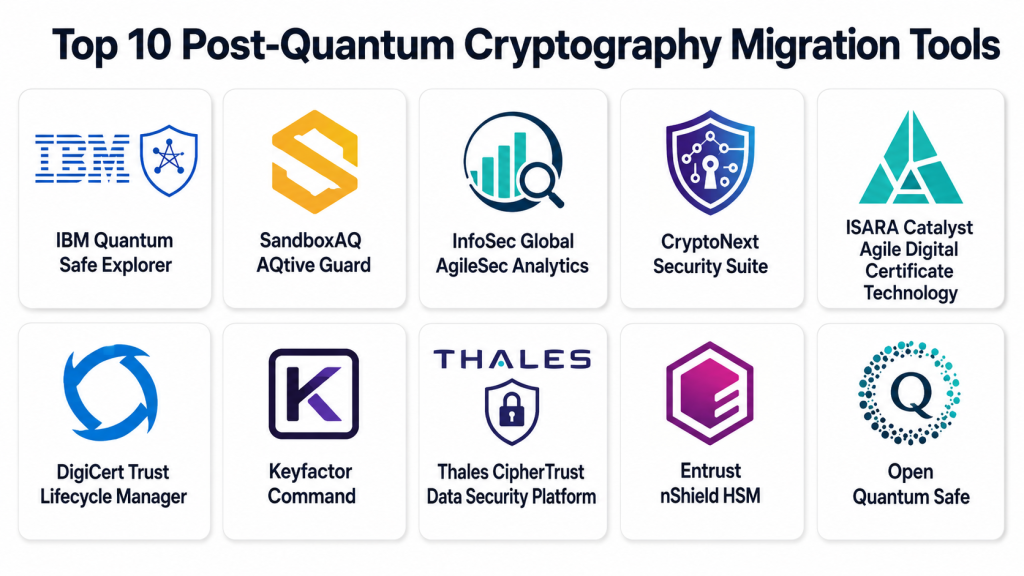
Top 10 Post-Quantum Cryptography Migration Tools
#1 — IBM Quantum Safe Explorer
Short description: IBM Quantum Safe Explorer helps organizations discover cryptographic assets, understand quantum risk, and plan migration toward quantum-safe cryptography. It is useful for large enterprises, regulated industries, and security teams that need structured visibility into cryptographic exposure.
Key Features
- Helps discover cryptographic usage across applications and infrastructure.
- Supports risk assessment for quantum-vulnerable cryptography.
- Assists with migration planning and prioritization.
- Useful for building a cryptographic bill of materials.
- Helps security leaders understand exposure across business systems.
- Supports enterprise quantum-safe readiness programs.
- Fits well into broader security and modernization initiatives.
Pros
- Strong enterprise focus for cryptographic risk discovery.
- Useful for organizations that need structured migration planning.
- Good fit for regulated industries with complex IT environments.
Cons
- May be more advanced than what small businesses need.
- Implementation can require security architecture and application knowledge.
- Pricing and deployment details may require vendor discussion.
Platforms / Deployment
Cloud / Enterprise deployment options vary
Self-hosted or hybrid details: Not publicly stated
Security & Compliance
Security and compliance controls may vary by deployment and enterprise agreement. SSO/SAML, MFA, encryption, audit logs, RBAC, SOC 2, ISO 27001, GDPR, HIPAA: Not publicly stated for every use case.
Integrations & Ecosystem
IBM Quantum Safe Explorer is most useful when connected with enterprise application, infrastructure, and security workflows. It can support broader modernization planning where cryptographic risk must be mapped across many systems.
- Enterprise security workflows
- Application assessment processes
- Risk management platforms
- Compliance reporting workflows
- Cloud and infrastructure analysis
- Quantum-safe migration planning
Support & Community
IBM has strong enterprise support, consulting, and technical documentation ecosystems. Community strength is strongest among enterprise security, cryptography, and quantum-safe readiness professionals.
#2 — SandboxAQ AQtive Guard
Short description: SandboxAQ AQtive Guard helps organizations discover cryptographic assets, identify vulnerabilities, and plan crypto-agile migration. It is useful for enterprises that need visibility across applications, networks, certificates, and cryptographic dependencies.
Key Features
- Cryptographic inventory and discovery capabilities.
- Helps identify weak or quantum-vulnerable cryptography.
- Supports crypto-agility planning.
- Useful for enterprise-wide risk mapping.
- Helps prioritize migration based on business impact.
- Supports reporting for security and compliance teams.
- Designed for large-scale cryptographic risk management.
Pros
- Strong focus on crypto-agility and enterprise migration.
- Useful for complex organizations with many cryptographic dependencies.
- Helps move beyond basic certificate tracking.
Cons
- May require expert implementation and interpretation.
- Not ideal for teams that only need simple certificate management.
- Product depth may be more than small teams require.
Platforms / Deployment
Cloud / Enterprise deployment options vary
Self-hosted or hybrid details: Not publicly stated
Security & Compliance
Enterprise security controls may vary by product configuration and contract. SSO/SAML, MFA, encryption, audit logs, RBAC, SOC 2, ISO 27001, GDPR, HIPAA: Not publicly stated unless confirmed directly.
Integrations & Ecosystem
AQtive Guard is designed for enterprise cryptographic visibility and migration planning. It fits into security operations, compliance, risk management, and infrastructure modernization workflows.
- Enterprise asset discovery workflows
- Security risk dashboards
- Compliance and audit reporting
- Certificate and crypto inventory processes
- Cloud and application security workflows
- Crypto-agility planning
Support & Community
Support appears enterprise-oriented. Documentation, onboarding, and service levels may vary based on contract, deployment model, and migration scope.
#3 — InfoSec Global AgileSec Analytics
Short description: InfoSec Global AgileSec Analytics focuses on cryptographic discovery, inventory, and risk analysis. It is useful for organizations that want to understand where cryptography exists across applications, infrastructure, files, certificates, and systems.
Key Features
- Cryptographic discovery and inventory.
- Helps identify weak cryptographic algorithms.
- Supports crypto-agility assessment.
- Useful for post-quantum migration planning.
- Helps map cryptographic usage across enterprise assets.
- Supports reporting for risk and compliance teams.
- Helps prioritize remediation work.
Pros
- Strong focus on cryptographic visibility.
- Useful for organizations starting their quantum-readiness journey.
- Helps reduce blind spots in cryptographic dependencies.
Cons
- May require technical knowledge to interpret findings.
- Migration execution still needs planning and engineering work.
- Deployment and pricing details may require vendor engagement.
Platforms / Deployment
Cloud / Enterprise deployment options vary
Self-hosted or hybrid details: Not publicly stated
Security & Compliance
Security controls such as encryption, access control, and audit support may vary by deployment. SSO/SAML, MFA, RBAC, SOC 2, ISO 27001, GDPR, HIPAA: Not publicly stated for all use cases.
Integrations & Ecosystem
AgileSec Analytics is useful where teams need to discover and classify cryptography before remediation. It can support risk teams, application owners, infrastructure teams, and compliance programs.
- Cryptographic inventory workflows
- Risk reporting processes
- Application assessment programs
- Infrastructure scanning
- Compliance readiness workflows
- Post-quantum migration planning
Support & Community
Support is likely enterprise-focused. Community strength is more professional and security-program driven than open-source community-based.
#4 — CryptoNext Security Suite
Short description: CryptoNext Security Suite provides post-quantum cryptography solutions for organizations preparing to protect sensitive data, communications, and applications. It is useful for enterprises, governments, and regulated industries that need quantum-safe implementation support.
Key Features
- Post-quantum cryptography implementation support.
- Helps organizations move toward quantum-safe protection.
- Supports secure communication and data protection use cases.
- Useful for hybrid cryptographic transition planning.
- Designed for enterprise and regulated environments.
- Helps improve crypto-agility.
- Supports migration from vulnerable classical cryptography.
Pros
- Strong focus on post-quantum cryptography.
- Useful for regulated and high-security environments.
- Relevant for organizations that need implementation support, not only discovery.
Cons
- May be complex for non-specialist teams.
- Specific deployment details may vary by use case.
- Buyers should validate interoperability with existing systems.
Platforms / Deployment
Cloud / Self-hosted / Hybrid options may vary
Exact platform support: Varies / N/A
Security & Compliance
Security posture depends on deployment and product configuration. SSO/SAML, MFA, encryption, audit logs, RBAC, SOC 2, ISO 27001, GDPR, HIPAA: Not publicly stated unless confirmed directly.
Integrations & Ecosystem
CryptoNext Security Suite fits best into organizations that need practical post-quantum implementation across communications, applications, and sensitive data flows.
- Secure communication systems
- Enterprise application environments
- Hybrid cryptography workflows
- Key management processes
- Data protection architecture
- Regulated industry security programs
Support & Community
Support appears professional and enterprise-focused. Documentation and onboarding should be reviewed during product evaluation because post-quantum deployments can be highly technical.
#5 — ISARA Catalyst Agile Digital Certificate Technology
Short description: ISARA Catalyst helps organizations explore crypto-agile and quantum-safe certificate strategies. It is useful for PKI teams, certificate authorities, enterprises, and product teams that need to test or prepare certificate-based post-quantum migration.
Key Features
- Supports crypto-agile certificate approaches.
- Helps prepare certificate systems for post-quantum transition.
- Useful for PKI modernization planning.
- Supports hybrid and quantum-safe certificate concepts.
- Helps organizations test interoperability.
- Relevant for identity, device, and secure communication use cases.
- Useful for certificate-heavy environments.
Pros
- Strong focus on certificates and crypto-agility.
- Useful for PKI teams planning long-term migration.
- Helps reduce risk in certificate transition workflows.
Cons
- More specialized than general discovery platforms.
- Best suited for teams with PKI knowledge.
- Availability and product details should be verified during evaluation.
Platforms / Deployment
Varies / N/A
Cloud / Self-hosted / Hybrid details: Not publicly stated
Security & Compliance
Security and compliance controls vary by deployment and use case. SSO/SAML, MFA, encryption, audit logs, RBAC, SOC 2, ISO 27001, GDPR, HIPAA: Not publicly stated
Integrations & Ecosystem
ISARA Catalyst is most relevant for organizations working with certificates, PKI, secure device identity, and cryptographic agility.
- PKI systems
- Certificate authority workflows
- Device identity systems
- Secure communication platforms
- Hybrid certificate testing
- Crypto-agile architecture planning
Support & Community
Support is likely specialized and technical. Community visibility is strongest among cryptography, PKI, and post-quantum security professionals.
#6 — DigiCert Trust Lifecycle Manager
Short description: DigiCert Trust Lifecycle Manager helps organizations discover, manage, and automate certificate lifecycles across complex environments. It is useful for PKI teams and enterprises that want better certificate visibility as part of broader post-quantum readiness.
Key Features
- Certificate discovery and lifecycle management.
- Helps reduce outages caused by unmanaged certificates.
- Supports centralized certificate visibility.
- Useful for PKI modernization and automation.
- Helps manage trust across enterprise systems.
- Supports policy-based certificate workflows.
- Can support cryptographic readiness planning.
Pros
- Strong fit for certificate-heavy organizations.
- Useful for improving PKI operations before post-quantum migration.
- Helps build visibility and control over digital trust assets.
Cons
- Not only a post-quantum migration tool.
- Quantum-safe readiness depends on broader PKI and vendor strategy.
- May not solve application-level cryptographic discovery alone.
Platforms / Deployment
Cloud / Enterprise deployment
Self-hosted or hybrid details: Not publicly stated
Security & Compliance
Enterprise security controls may vary by plan. SSO/SAML, MFA, encryption, audit logs, RBAC, SOC 2, ISO 27001, GDPR, HIPAA: Not publicly stated unless confirmed directly.
Integrations & Ecosystem
DigiCert Trust Lifecycle Manager fits into enterprise certificate and digital trust workflows where teams need visibility, automation, and governance.
- Certificate authorities
- PKI workflows
- Cloud environments
- DevOps and automation pipelines
- IT service management workflows
- Security and compliance reporting
Support & Community
DigiCert has a strong digital trust and certificate management ecosystem. Support quality may vary by plan, contract, and enterprise service level.
#7 — Keyfactor Command
Short description: Keyfactor Command is a certificate lifecycle management and crypto-agility platform that helps enterprises discover, manage, and automate certificates and keys. It is useful for organizations preparing for stronger cryptographic governance and post-quantum readiness.
Key Features
- Certificate discovery and lifecycle automation.
- Helps manage machine identities.
- Supports PKI governance and policy control.
- Useful for crypto-agility planning.
- Helps reduce certificate outage risk.
- Supports enterprise integrations and APIs.
- Useful for large-scale certificate visibility.
Pros
- Strong fit for enterprise certificate and machine identity management.
- Useful for building crypto-agile foundations.
- Good option for teams that need automation and governance.
Cons
- Not a standalone post-quantum algorithm implementation platform.
- Application-level crypto discovery may require additional tools.
- May be more than small teams need.
Platforms / Deployment
Cloud / Self-hosted / Hybrid options may vary
Exact platform support: Varies / N/A
Security & Compliance
Security controls may vary by edition and deployment. SSO/SAML, MFA, audit logs, RBAC, encryption, SOC 2, ISO 27001, GDPR, HIPAA: Not publicly stated unless confirmed directly.
Integrations & Ecosystem
Keyfactor Command fits certificate lifecycle, PKI, machine identity, and automation workflows. It is relevant for teams that need better control before large cryptographic transitions.
- PKI systems
- Certificate authorities
- DevOps pipelines
- Cloud platforms
- IT operations workflows
- Machine identity management
Support & Community
Support is enterprise-oriented, with documentation and professional services commonly important for larger deployments. Community strength is strongest among PKI, identity, and enterprise security teams.
#8 — Thales CipherTrust Data Security Platform
Short description: Thales CipherTrust Data Security Platform helps organizations manage encryption, keys, and data security controls. It is useful for enterprises that want stronger key management and data protection foundations as part of a post-quantum migration roadmap.
Key Features
- Centralized key management.
- Supports data encryption and access control workflows.
- Helps manage cryptographic policies across enterprise environments.
- Useful for cloud and hybrid data protection.
- Supports security governance for sensitive data.
- Helps organizations improve crypto control and visibility.
- Relevant for long-term crypto-agility planning.
Pros
- Strong enterprise key management and data protection focus.
- Useful for regulated industries and hybrid environments.
- Helps strengthen encryption governance.
Cons
- Not purely a post-quantum migration tool.
- Cryptographic inventory across applications may require additional tooling.
- Enterprise deployment may need careful planning.
Platforms / Deployment
Cloud / Self-hosted / Hybrid
Exact platform support varies by product configuration.
Security & Compliance
Encryption, key management, and access control are central to the platform. Specific compliance claims, SSO/SAML, MFA, audit logs, RBAC, SOC 2, ISO 27001, GDPR, HIPAA should be confirmed for the exact deployment and product edition.
Integrations & Ecosystem
Thales CipherTrust fits into enterprise data security, encryption, cloud security, and key management workflows.
- Cloud platforms
- Databases
- Enterprise applications
- HSM and key management workflows
- Data security platforms
- Compliance reporting processes
Support & Community
Thales has a strong enterprise security and data protection ecosystem. Support is typically enterprise-focused and may vary by contract and deployment model.
#9 — Entrust nShield HSM
Short description: Entrust nShield HSM provides hardware security module capabilities for protecting cryptographic keys and supporting high-assurance security operations. It is relevant for organizations planning post-quantum transition in PKI, signing, identity, and key protection workflows.
Key Features
- Hardware-backed key protection.
- Supports high-assurance cryptographic operations.
- Useful for PKI, code signing, identity, and payment-related workflows.
- Helps protect sensitive keys from software-only exposure.
- Relevant for long-term cryptographic modernization.
- Supports enterprise security architecture.
- Useful for regulated and high-trust environments.
Pros
- Strong fit for key protection and high-assurance cryptography.
- Useful for PKI and signing workflows.
- Relevant for enterprises that need hardware-backed trust.
Cons
- Not a full migration discovery platform.
- Hardware-based deployment may require specialist skills.
- Post-quantum support and roadmap should be validated for exact use cases.
Platforms / Deployment
Hardware / Cloud HSM options may vary
Hybrid deployment possible depending on architecture.
Security & Compliance
HSMs are designed for strong key protection and secure cryptographic operations. Specific certifications, SSO/SAML, MFA, audit logs, RBAC, SOC 2, ISO 27001, GDPR, HIPAA: Varies / Not publicly stated for all use cases.
Integrations & Ecosystem
Entrust nShield HSM fits into environments that require strong key protection and trusted cryptographic operations.
- PKI platforms
- Certificate authorities
- Code signing systems
- Payment systems
- Identity and access systems
- Enterprise cryptographic infrastructure
Support & Community
Support is enterprise and security-specialist oriented. Documentation and professional services are important for successful deployment in complex environments.
#10 — Open Quantum Safe
Short description: Open Quantum Safe is an open-source project that provides tools and libraries for testing and experimenting with post-quantum cryptography. It is useful for developers, researchers, architects, and security teams that want hands-on post-quantum testing before enterprise deployment.
Key Features
- Open-source post-quantum cryptography libraries.
- Useful for testing post-quantum algorithms.
- Supports developer experimentation and research.
- Helps teams understand interoperability challenges.
- Useful for proof-of-concept work.
- Supports integration testing in technical environments.
- Helps engineering teams learn post-quantum implementation patterns.
Pros
- Strong developer and research value.
- Useful for proof-of-concept testing.
- Good starting point for technical teams exploring post-quantum cryptography.
Cons
- Not a complete enterprise migration platform.
- Requires cryptography and engineering knowledge.
- Support depends on community and internal expertise.
Platforms / Deployment
Linux / macOS / Windows support may vary by component
Self-hosted / Developer environment
Security & Compliance
Open-source project security depends on implementation, maintenance, and deployment practices. SSO/SAML, MFA, audit logs, RBAC, SOC 2, ISO 27001, GDPR, HIPAA: Not applicable / Not publicly stated
Integrations & Ecosystem
Open Quantum Safe is best for technical experimentation, library testing, and proof-of-concept work. It helps developers understand how post-quantum algorithms may behave inside real systems.
- Developer environments
- Test labs
- Cryptography research
- Proof-of-concept projects
- TLS experimentation
- Application compatibility testing
Support & Community
Community strength is important for this project. It is more suitable for technical users who can work with documentation, open-source libraries, and engineering-led experimentation.
Comparison Table
| Tool Name | Best For | Platform(s) Supported | Deployment | Standout Feature | Public Rating |
|---|---|---|---|---|---|
| IBM Quantum Safe Explorer | Enterprise cryptographic risk discovery | Cloud / Enterprise systems | Cloud / Varies | Cryptographic inventory and quantum-risk planning | N/A |
| SandboxAQ AQtive Guard | Crypto-agility and enterprise migration planning | Cloud / Enterprise systems | Cloud / Varies | Enterprise cryptographic visibility | N/A |
| InfoSec Global AgileSec Analytics | Cryptographic inventory and risk analysis | Cloud / Enterprise systems | Cloud / Varies | Crypto discovery and exposure mapping | N/A |
| CryptoNext Security Suite | Post-quantum implementation support | Varies / N/A | Cloud / Self-hosted / Hybrid varies | Quantum-safe cryptography implementation | N/A |
| ISARA Catalyst | PKI and certificate crypto-agility | Varies / N/A | Varies / N/A | Quantum-safe certificate strategy | N/A |
| DigiCert Trust Lifecycle Manager | Certificate lifecycle and digital trust | Web / Enterprise systems | Cloud | Certificate visibility and automation | N/A |
| Keyfactor Command | Machine identity and certificate automation | Web / Enterprise systems | Cloud / Self-hosted / Hybrid varies | Enterprise certificate lifecycle management | N/A |
| Thales CipherTrust Data Security Platform | Key management and data protection | Enterprise systems | Cloud / Self-hosted / Hybrid | Centralized encryption and key management | N/A |
| Entrust nShield HSM | Hardware-backed key protection | Hardware / Enterprise systems | Hardware / Cloud / Hybrid varies | High-assurance key protection | N/A |
| Open Quantum Safe | Developer testing and research | Linux / macOS / Windows varies | Self-hosted / Developer environment | Open-source post-quantum testing | N/A |
Evaluation & Scoring of Post-Quantum Cryptography Migration Tools
| Tool Name | Core (25%) | Ease (15%) | Integrations (15%) | Security (10%) | Performance (10%) | Support (10%) | Value (15%) | Weighted Total (0–10) |
|---|---|---|---|---|---|---|---|---|
| IBM Quantum Safe Explorer | 9 | 7 | 8 | 8 | 8 | 9 | 7 | 8.10 |
| SandboxAQ AQtive Guard | 9 | 7 | 8 | 8 | 8 | 8 | 7 | 8.00 |
| InfoSec Global AgileSec Analytics | 8 | 7 | 7 | 7 | 8 | 7 | 7 | 7.45 |
| CryptoNext Security Suite | 8 | 6 | 7 | 8 | 8 | 7 | 7 | 7.45 |
| ISARA Catalyst | 7 | 6 | 7 | 7 | 7 | 7 | 7 | 6.95 |
| DigiCert Trust Lifecycle Manager | 8 | 8 | 8 | 8 | 8 | 8 | 8 | 8.00 |
| Keyfactor Command | 8 | 8 | 9 | 8 | 8 | 8 | 8 | 8.15 |
| Thales CipherTrust Data Security Platform | 8 | 7 | 8 | 9 | 8 | 8 | 7 | 7.80 |
| Entrust nShield HSM | 7 | 6 | 8 | 9 | 8 | 8 | 7 | 7.45 |
| Open Quantum Safe | 7 | 5 | 7 | 6 | 7 | 6 | 9 | 6.70 |
These scores are comparative and should be used as a shortlist guide, not as a universal ranking. A higher score means the tool is broadly strong across the chosen criteria, but your best option depends on your environment. For example, Keyfactor Command may be stronger for certificate lifecycle automation, while IBM Quantum Safe Explorer or SandboxAQ AQtive Guard may be better for enterprise cryptographic discovery. Open Quantum Safe has strong developer value but is not a complete enterprise migration platform.
Which Post-Quantum Cryptography Migration Tool Is Right for You?
Solo / Freelancer
Solo developers, consultants, and independent security researchers usually do not need a full enterprise migration platform. Open Quantum Safe is a practical starting point for experimentation, testing, and learning how post-quantum cryptography works in technical environments.
If the work involves advising clients, the next step should be learning cryptographic inventory concepts, certificate lifecycle risks, and migration planning. A solo consultant can use open-source testing tools for labs while recommending enterprise-grade platforms for production environments.
SMB
Small and medium-sized businesses should usually start with certificate visibility, TLS inventory, and basic cryptographic asset discovery. DigiCert Trust Lifecycle Manager or Keyfactor Command can be useful if the business has many certificates, domains, applications, or machine identities.
If the SMB operates in a regulated industry, it should also consider cryptographic risk assessment tools. However, most SMBs should avoid overbuilding too early. The first goal should be visibility, ownership, renewal control, and a simple roadmap.
Mid-Market
Mid-market organizations often have enough complexity to justify more structured planning. They may have cloud workloads, APIs, customer-facing applications, internal PKI, third-party integrations, and multiple certificate authorities.
A practical approach could combine Keyfactor Command or DigiCert Trust Lifecycle Manager for certificate lifecycle management with IBM Quantum Safe Explorer, SandboxAQ AQtive Guard, or InfoSec Global AgileSec Analytics for broader cryptographic discovery. This gives both operational control and risk visibility.
Enterprise
Enterprise organizations should treat post-quantum migration as a security architecture program, not a small tool replacement. They need cryptographic discovery, certificate lifecycle automation, HSM strategy, key management, application remediation, vendor risk review, compliance reporting, and executive visibility.
IBM Quantum Safe Explorer, SandboxAQ AQtive Guard, InfoSec Global AgileSec Analytics, Keyfactor Command, DigiCert Trust Lifecycle Manager, Thales CipherTrust, and Entrust nShield HSM can all play different roles. The best enterprise approach is usually a layered stack rather than one single tool.
Budget vs Premium
Budget-conscious teams can start with Open Quantum Safe for technical learning and basic internal testing. They can also begin with manual certificate inventory, policy review, and targeted scans before investing in large platforms.
Premium buyers should evaluate enterprise suites that provide discovery, reporting, automation, support, and integration. Premium value is strongest when the organization has large cryptographic exposure, compliance pressure, distributed infrastructure, or high-risk data.
Feature Depth vs Ease of Use
If ease of use matters most, certificate lifecycle tools like DigiCert Trust Lifecycle Manager and Keyfactor Command may be easier to operationalize because they solve known certificate management problems.
If feature depth matters more, IBM Quantum Safe Explorer, SandboxAQ AQtive Guard, InfoSec Global AgileSec Analytics, and CryptoNext Security Suite may be more relevant. These tools support deeper cryptographic risk analysis or migration planning.
Integrations & Scalability
Large organizations should prioritize APIs, automation, cloud integration, reporting, and compatibility with existing PKI and security tools. Keyfactor Command, DigiCert Trust Lifecycle Manager, Thales CipherTrust, Entrust nShield HSM, IBM Quantum Safe Explorer, and SandboxAQ AQtive Guard are stronger candidates for scalable environments.
Technical teams should also check compatibility with CI/CD, service mesh, containers, cloud workloads, HSMs, certificate authorities, identity systems, and monitoring tools.
Security & Compliance Needs
Regulated organizations should ask vendors about access controls, audit logging, encryption, data retention, deployment models, compliance documentation, key protection, and regional processing requirements.
For high-assurance environments, HSM-backed key protection and strong key management matter. Entrust nShield HSM and Thales CipherTrust may be important parts of the architecture, while discovery and certificate lifecycle tools help manage the migration program.
Frequently Asked Questions
1. What are Post-Quantum Cryptography Migration Tools?
Post-Quantum Cryptography Migration Tools help organizations find and replace cryptographic systems that may become vulnerable to quantum computing. They support discovery, inventory, risk assessment, planning, testing, and migration workflows.
2. Why do companies need post-quantum migration planning?
Companies need planning because cryptography is spread across applications, certificates, networks, APIs, databases, devices, and cloud systems. Migrating without visibility can cause outages, broken integrations, and security gaps.
3. What is cryptographic inventory?
Cryptographic inventory is a list of where and how cryptography is used across an organization. It may include certificates, algorithms, keys, protocols, libraries, applications, devices, and third-party systems.
4. What is crypto-agility?
Crypto-agility means the ability to change cryptographic algorithms, keys, certificates, and policies without major system redesign. It helps organizations adapt faster when security standards change.
5. Are certificate lifecycle tools enough for post-quantum migration?
Certificate lifecycle tools are important, but they are not always enough. Many organizations also need application cryptography discovery, HSM planning, key management review, vendor assessment, and compatibility testing.
6. What pricing models are common for these tools?
Common pricing models include enterprise contracts, asset-based pricing, certificate volume pricing, API usage pricing, user-based pricing, and custom pricing. Many vendors do not publicly disclose detailed pricing.
7. How long does implementation usually take?
Implementation depends on the size and complexity of the environment. Basic testing can start quickly, but enterprise cryptographic discovery and migration planning may require coordination across security, application, infrastructure, cloud, and compliance teams.
8. What are common mistakes during post-quantum migration?
Common mistakes include starting without an inventory, focusing only on certificates, ignoring third-party systems, skipping application dependencies, failing to test compatibility, and treating migration as a one-time project.
9. Can open-source tools replace enterprise migration platforms?
Open-source tools are useful for testing, learning, and proof-of-concept work. However, large organizations usually need enterprise platforms for discovery, reporting, governance, support, and operational control.
10. What should enterprises ask vendors before buying?
Enterprises should ask about discovery coverage, supported algorithms, hybrid cryptography, API access, deployment models, audit logs, RBAC, data handling, HSM support, cloud integration, and migration reporting.
Conclusion
Post-Quantum Cryptography Migration Tools are becoming important for organizations that want to protect long-term data, reduce cryptographic risk, and prepare for future security requirements. The best tool depends on your starting point. If you need cryptographic discovery, IBM Quantum Safe Explorer, SandboxAQ AQtive Guard, or InfoSec Global AgileSec Analytics may be strong options. If you need certificate lifecycle control, Keyfactor Command or DigiCert Trust Lifecycle Manager may be better. If your focus is key protection and encryption governance, Thales CipherTrust or Entrust nShield HSM may fit better. If you are a developer or researcher, Open Quantum Safe is a practical testing option.
There is no single universal winner because post-quantum migration is not one task. It includes discovery, inventory, certificates, key management, application remediation, vendor review, testing, compliance, and long-term crypto-agility. The best next step is to shortlist two or three tools, run a focused pilot, validate integrations, review security controls, and build a phased roadmap before scaling the migration program.
