Introduction
Policy as Code Tools are platforms that allow organizations to define, enforce, and automate governance, security, and compliance rules as code. By codifying policies, teams can ensure consistency, prevent misconfigurations, and enforce best practices across cloud, on-premises, and hybrid environments.
In 2026, organizations increasingly adopt automated governance frameworks to manage complex IT infrastructures. Policy as Code ensures policies are applied consistently, reduces manual errors, and integrates seamlessly with CI/CD pipelines to enforce security and compliance before deployment.
Real-world use cases include:
- Automating security and compliance checks across cloud and on-prem environments.
- Enforcing configuration standards in Kubernetes, Terraform, and other IaC platforms.
- Implementing automated chargeback and usage policies for cloud resources.
- Ensuring audit-ready reporting for internal and regulatory compliance.
- Detecting and remediating policy violations in real time.
Evaluation Criteria for Buyers:
- Policy definition flexibility and templating
- Multi-cloud and hybrid environment support
- CI/CD and IaC integration
- Real-time enforcement and automated remediation
- Reporting and audit features
- Scalability for multi-team environments
- Ease of use for developers and engineers
- Security and compliance certifications
Best for: DevOps, cloud engineering, security, and compliance teams seeking automated, code-driven governance across infrastructure.
Not ideal for: Small teams with simple IT environments or minimal automation needs.
Key Trends in Policy as Code Tools
- AI/ML-assisted detection of risky changes and policy violations.
- Native integration with CI/CD pipelines and Infrastructure as Code tools.
- Multi-cloud and hybrid environment enforcement.
- Automated remediation and guardrails for policy violations.
- Policy versioning, testing, and lifecycle management.
- Enhanced audit and compliance reporting.
- Open-source community-driven policy templates.
- Declarative and modular policy definition frameworks.
- Integration with CSPM and other cloud security solutions.
How We Selected These Tools (Methodology)
- Evaluated enterprise and community adoption.
- Assessed policy creation, enforcement, and automation capabilities.
- Verified integration with IaC and CI/CD platforms.
- Considered scalability and performance across environments.
- Checked security posture and compliance support.
- Evaluated usability and onboarding experience.
- Reviewed ecosystem integrations and extensibility.
- Analyzed reporting and audit functionality.
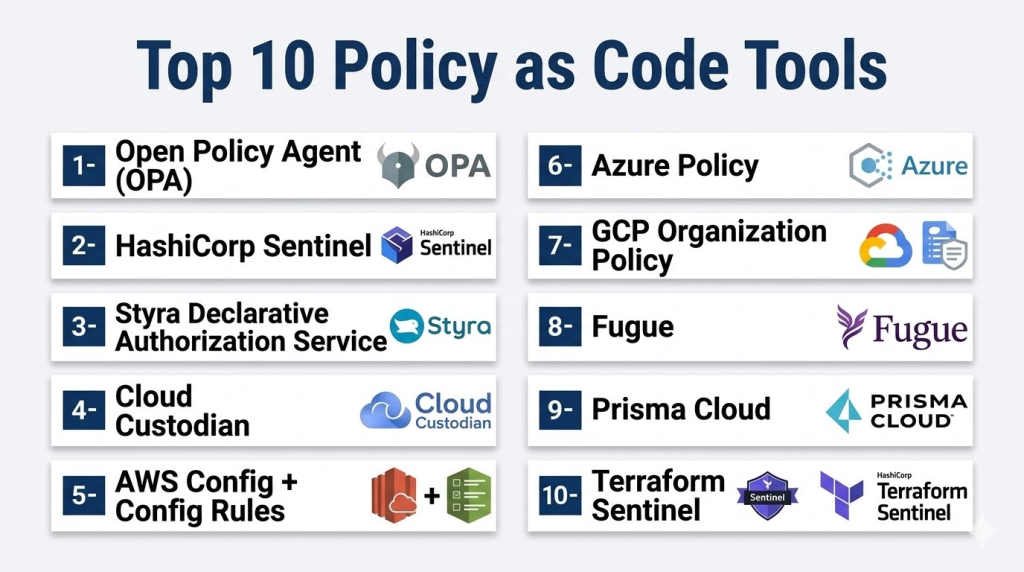
Top 10 Policy as Code Tools
1- Open Policy Agent (OPA)
Short description: OPA is an open-source, general-purpose policy engine for enforcing declarative policies across cloud, Kubernetes, and microservices.
Key Features
- Declarative policy language (Rego)
- Real-time enforcement
- Kubernetes integration
- API-driven decision-making
- Modular policy templates
Pros
- Flexible and open-source
- Wide integration ecosystem
Cons
- Requires Rego expertise
- No native GUI
Platforms / Deployment
- Web / Linux / macOS
- Cloud / Self-hosted
Security & Compliance
- Not publicly stated
Integrations & Ecosystem
Supports Kubernetes, Terraform, Envoy, and CI/CD pipelines.
- API-based integration
- Custom enforcement workflows
- Modular reusable policies
Support & Community
- GitHub community, forums, documentation
2- HashiCorp Sentinel
Short description: Sentinel integrates with HashiCorp tools like Terraform and Vault to provide pre-deployment policy enforcement and compliance automation.
Key Features
- Policy enforcement for Terraform and Vault
- Modular reusable policies
- Pre-deployment checks
- Workflow integration
- Audit-ready logging
Pros
- Native integration with HashiCorp ecosystem
- Enterprise-grade security
Cons
- Dependent on HashiCorp tools
- Steeper learning curve
Platforms / Deployment
- Web
- Cloud / Hybrid
Security & Compliance
- SOC 2, ISO 27001, RBAC, audit logs
Integrations & Ecosystem
- Terraform, Vault, Nomad
- CI/CD integration
- API access for custom policies
Support & Community
- Enterprise support, documentation, training
3- Styra Declarative Authorization Service
Short description: Styra DAS provides a managed OPA-based platform with policy lifecycle management, enforcement automation, and compliance reporting.
Key Features
- Policy lifecycle management
- Cloud-native compliance templates
- Automated enforcement
- Pre-deployment checks
- Role-based access enforcement
Pros
- Enterprise-ready policy management
- Built on OPA for flexibility
Cons
- Premium pricing
- OPA learning curve required
Platforms / Deployment
- Web
- Cloud
Security & Compliance
- SOC 2, ISO 27001
Integrations & Ecosystem
- Terraform, Kubernetes, CI/CD pipelines
- API access for custom enforcement
- Policy templates and versioning
Support & Community
- Vendor support, documentation, onboarding
4- Cloud Custodian
Short description: Cloud Custodian is an open-source tool that enforces cloud governance policies using YAML-based rules for AWS, Azure, and GCP.
Key Features
- YAML policy definitions
- Multi-cloud support
- Automated remediation
- Resource filtering and actions
- Reporting dashboards
Pros
- Open-source flexibility
- Multi-cloud enforcement
Cons
- No native UI
- Requires scripting expertise
Platforms / Deployment
- Web / Linux / macOS
- Cloud / Self-hosted
Security & Compliance
- Not publicly stated
Integrations & Ecosystem
- AWS, Azure, GCP
- CI/CD pipelines and APIs
- Custom automation workflows
Support & Community
- Community-driven support, GitHub, forums
5- AWS Config + Config Rules
Short description: AWS Config automates compliance monitoring and policy enforcement for AWS resources using predefined or custom rules.
Key Features
- Continuous configuration monitoring
- Prebuilt AWS Config rules
- Custom rule support
- Automated remediation
- Compliance reporting
Pros
- Fully managed AWS solution
- Tight integration with AWS services
Cons
- AWS-only
- Limited multi-cloud capabilities
Platforms / Deployment
- Web
- Cloud (AWS)
Security & Compliance
- SOC 2, ISO 27001, encryption
Integrations & Ecosystem
- AWS services, Lambda, CloudTrail, CloudWatch
- API-based custom enforcement
Support & Community
- AWS support tiers, documentation, forums
6- Azure Policy
Short description: Azure Policy enforces organizational rules across Azure resources with real-time compliance evaluation and remediation.
Key Features
- Predefined and custom policies
- Compliance dashboards
- Automatic remediation tasks
- Subscription-level enforcement
- Integration with Azure DevOps
Pros
- Seamless Azure integration
- Scalable across multiple subscriptions
Cons
- Azure-only
- Limited multi-cloud enforcement
Platforms / Deployment
- Web
- Cloud (Azure)
Security & Compliance
- SOC 2, ISO 27001, Azure AD SSO
Integrations & Ecosystem
- Azure DevOps, Terraform, CI/CD
- API for custom policies
Support & Community
- Microsoft support, documentation, community templates
7- GCP Organization Policy
Short description: GCP Org Policy enables declarative enforcement of constraints across Google Cloud projects and organizations.
Key Features
- Resource constraints and policies
- Real-time enforcement
- Audit logging
- Integration with IAM
- Predefined and custom constraints
Pros
- Deep GCP integration
- Simple policy enforcement
Cons
- GCP-only
- Limited multi-cloud coverage
Platforms / Deployment
- Web
- Cloud (GCP)
Security & Compliance
- SOC 2, ISO 27001, encryption
Integrations & Ecosystem
- GCP IAM, Cloud services
- API access for automation
Support & Community
- Google Cloud support, documentation, forums
8- Fugue
Short description: Fugue automates policy enforcement and continuous compliance across multi-cloud infrastructures.
Key Features
- Automated policy enforcement
- Continuous compliance monitoring
- Pre-deployment checks
- Drift detection and remediation
- Audit-ready reporting
Pros
- Strong multi-cloud support
- Continuous compliance
Cons
- Premium pricing
- Learning curve for complex policies
Platforms / Deployment
- Web
- Cloud
Security & Compliance
- SOC 2, ISO 27001
Integrations & Ecosystem
- Terraform, AWS, Azure, GCP
- CI/CD pipeline integration
- API access
Support & Community
- Vendor support, documentation, onboarding
9- Prisma Cloud
Short description: Prisma Cloud provides cloud security posture management with policy as code enforcement for governance and compliance.
Key Features
- Multi-cloud policy enforcement
- Real-time monitoring and alerts
- Automated remediation
- Compliance dashboards
- CI/CD integration
Pros
- Enterprise-ready multi-cloud security
- Strong compliance features
Cons
- Premium pricing
- Setup complexity
Platforms / Deployment
- Web
- Cloud
Security & Compliance
- SOC 2, ISO 27001, GDPR
Integrations & Ecosystem
- AWS, Azure, GCP
- CI/CD pipelines, APIs
Support & Community
- Vendor support, documentation, forums
10- Terraform Sentinel
Short description: Terraform Sentinel enforces pre-deployment policies for Terraform-managed infrastructure, ensuring compliance and security before provisioning.
Key Features
- Pre-deployment policy checks
- CI/CD integration
- Modular, reusable policies
- Audit logging
- Role-based enforcement
Pros
- Tight Terraform integration
- Enterprise-grade enforcement
Cons
- Requires Terraform adoption
- Learning curve
Platforms / Deployment
- Web
- Cloud / Hybrid
Security & Compliance
- SOC 2, ISO 27001, audit logs
Integrations & Ecosystem
- Terraform Enterprise/Cloud
- CI/CD pipelines, APIs
Support & Community
- HashiCorp support, documentation, community
Comparison Table (Top 10)
| Tool Name | Best For | Platform(s) Supported | Deployment | Standout Feature | Public Rating |
|---|---|---|---|---|---|
| Open Policy Agent | Multi-cloud IaC | Web / Linux / macOS | Cloud / Self-hosted | Flexible open-source engine | N/A |
| HashiCorp Sentinel | Terraform & Vault | Web | Cloud / Hybrid | Pre-deployment enforcement | N/A |
| Styra DAS | Enterprise policy mgmt | Web | Cloud | Policy lifecycle management | N/A |
| Cloud Custodian | Multi-cloud | Web / Linux / macOS | Cloud / Self-hosted | Automated remediation | N/A |
| AWS Config | AWS governance | Web | Cloud | Real-time compliance & remediation | N/A |
| Azure Policy | Azure governance | Web | Cloud | Real-time policy enforcement | N/A |
| GCP Org Policy | GCP governance | Web | Cloud | Declarative constraint enforcement | N/A |
| Fugue | Multi-cloud compliance | Web | Cloud | Continuous compliance monitoring | N/A |
| Prisma Cloud | Multi-cloud security | Web | Cloud | Policy enforcement & compliance | N/A |
| Terraform Sentinel | Terraform governance | Web | Cloud / Hybrid | Infrastructure policy as code | N/A |
Evaluation & Scoring of Policy as Code Tools
| Tool Name | Core (25%) | Ease (15%) | Integrations (15%) | Security (10%) | Performance (10%) | Support (10%) | Value (15%) | Weighted Total |
|---|---|---|---|---|---|---|---|---|
| Open Policy Agent | 8 | 6 | 8 | 7 | 8 | 7 | 9 | 7.7 |
| HashiCorp Sentinel | 9 | 7 | 8 | 9 | 8 | 8 | 7 | 8.2 |
| Styra DAS | 9 | 7 | 8 | 9 | 8 | 8 | 7 | 8.2 |
| Cloud Custodian | 8 | 6 | 7 | 7 | 7 | 7 | 8 | 7.3 |
| AWS Config | 7 | 8 | 7 | 8 | 8 | 7 | 7 | 7.5 |
| Azure Policy | 7 | 8 | 7 | 8 | 7 | 7 | 7 | 7.4 |
| GCP Org Policy | 7 | 8 | 7 | 8 | 7 | 7 | 7 | 7.4 |
| Fugue | 8 | 7 | 8 | 8 | 8 | 7 | 7 | 7.7 |
| Prisma Cloud | 9 | 7 | 8 | 9 | 8 | 8 | 7 | 8.2 |
| Terraform Sentinel | 9 | 7 | 8 | 9 | 8 | 8 | 7 | 8.2 |
Which Policy as Code Tool Is Right for You?
Solo / Freelancer
- Open Policy Agent or Cloud Custodian for flexible, open-source enforcement.
SMB
- Styra DAS or Fugue for simpler multi-cloud enforcement and CI/CD integration.
Mid-Market
- HashiCorp Sentinel or Terraform Sentinel for Terraform-heavy environments.
Enterprise
- Prisma Cloud, AWS Config, Azure Policy for full-scale multi-cloud governance.
Budget vs Premium
- Open-source: OPA, Cloud Custodian
- Premium: Styra, HashiCorp Sentinel, Prisma
Feature Depth vs Ease of Use
- Terraform Sentinel & HashiCorp Sentinel: deeper features, steeper learning curve
- Styra & Fugue: easier adoption, enterprise support
Integrations & Scalability
- Terraform, Styra, Prisma integrate with CI/CD pipelines, multi-cloud, and DevOps workflows
Security & Compliance Needs
- SOC 2, ISO 27001, encryption, audit logs recommended for enterprises
Frequently Asked Questions (FAQs)
1- What is Policy as Code?
A method to codify governance, security, and compliance rules for IT infrastructure.
2- How does it prevent misconfigurations?
By enforcing rules during provisioning or continuously, preventing violations before they affect production.
3- Are these tools multi-cloud compatible?
Many support AWS, Azure, GCP; some focus on cloud-native, others on hybrid.
4- Can Policy as Code integrate with CI/CD?
Yes, integration allows automated policy checks in DevOps pipelines.
5- Is coding expertise required?
Depends on the tool; OPA and Cloud Custodian require scripting, while Styra or enterprise tools simplify policy creation.
6- Do these tools provide audit reports?
Yes, enterprise-grade tools provide compliance reports for audits.
7- Are open-source options viable?
Yes, OPA and Cloud Custodian offer flexibility and community support.
8- Can policies be version-controlled?
Yes, most enterprise tools support policy versioning, testing, and code review workflows.
9- What deployment options exist?
Cloud-native SaaS or self-hosted/hybrid depending on the tool.
10- How to select the right tool?
Consider IaC adoption, cloud strategy, compliance needs, budget, and team expertise.
Conclusion
Policy as Code Tools automate governance, compliance, and security across cloud and hybrid IT infrastructures. Enterprises benefit from HashiCorp Sentinel, Styra DAS, and Prisma Cloud, while SMBs or teams preferring open-source may choose OPA or Cloud Custodian. Practical tools, run a pilot, validate enforcement and integrations, then scale adoption to ensure consistent governance.
