Introduction
Personalization Engines are platforms that use data, AI, and behavioral insights to deliver tailored experiences to users across websites, apps, emails, and digital channels. These tools analyze user behavior, preferences, and context to dynamically adjust content, recommendations, and interactions in real time.
In today’s experience-driven economy, users expect highly relevant and personalized interactions. Generic experiences often lead to lower engagement and conversions. Personalization engines help businesses improve customer journeys, increase retention, and drive revenue by delivering the right content to the right user at the right time.
Common use cases include:
- Personalized product recommendations
- Dynamic website content and landing pages
- Email and marketing personalization
- Customer journey optimization
- Cross-channel user experience personalization
What buyers should evaluate:
- AI and machine learning capabilities
- Real-time personalization
- Data integration and customer profiles
- Omnichannel support
- Segmentation and targeting features
- Analytics and reporting
- Scalability and performance
- Privacy and compliance controls
Best for: E-commerce businesses, SaaS companies, marketers, and enterprises focused on customer experience optimization.
Not ideal for: Small websites with minimal traffic or businesses not leveraging user data.
Key Trends in Personalization Engines for the Future
- AI-driven hyper-personalization
- Real-time behavioral targeting
- Integration with Customer Data Platforms (CDPs)
- Predictive personalization using machine learning
- Omnichannel personalization across web, mobile, and email
- Privacy-first personalization strategies
- No-code personalization tools for marketers
- Integration with experimentation platforms
- Dynamic content generation using AI
- Personalization in edge computing environments
How We Selected These Tools (Methodology)
- Evaluated adoption across marketing and product teams
- Assessed personalization depth and AI capabilities
- Compared ease of integration with existing systems
- Reviewed scalability and performance
- Considered omnichannel capabilities
- Analyzed analytics and reporting features
- Checked security and compliance readiness
- Included tools for SMB to enterprise use cases
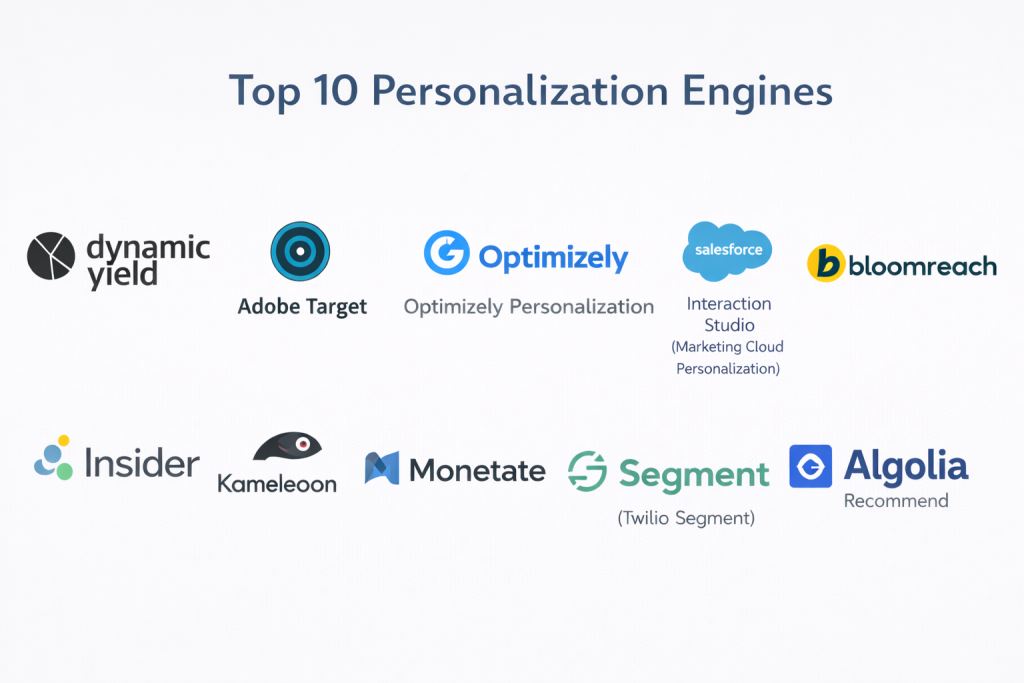
Top 10 Personalization Engines
#1 — Dynamic Yield
Short description: Enterprise personalization platform offering AI-driven recommendations and omnichannel experiences.
Key Features
- AI recommendations
- Real-time personalization
- A/B testing integration
- Customer segmentation
- Omnichannel delivery
- Predictive targeting
- Analytics dashboards
Pros
- Strong AI capabilities
- Enterprise-ready
Cons
- Expensive
- Complex setup
Platforms / Deployment
Cloud
Security & Compliance
Enterprise controls (details not publicly stated)
Integrations & Ecosystem
Strong integrations with marketing and commerce tools.
- APIs
- CRM systems
- E-commerce platforms
Support & Community
Enterprise-level support.
#2 — Adobe Target
Short description: Personalization and experimentation platform within Adobe Experience Cloud.
Key Features
- AI personalization
- A/B testing
- Audience targeting
- Automation
- Recommendations engine
- Analytics integration
- Omnichannel support
Pros
- Powerful personalization
- Deep Adobe integration
Cons
- Expensive
- Requires expertise
Platforms / Deployment
Cloud
Security & Compliance
Enterprise controls (details not publicly stated)
Integrations & Ecosystem
Adobe ecosystem integrations.
- Marketing tools
- APIs
- Analytics platforms
Support & Community
Enterprise support.
#3 — Optimizely Personalization
Short description: Personalization solution integrated with experimentation and digital experience tools.
Key Features
- Real-time personalization
- A/B testing
- Customer segmentation
- Content targeting
- Analytics
- Omnichannel delivery
- AI recommendations
Pros
- Strong experimentation integration
- Flexible targeting
Cons
- Pricing
- Learning curve
Platforms / Deployment
Cloud
Security & Compliance
Enterprise controls (not publicly stated)
Integrations & Ecosystem
Wide integrations.
- APIs
- Marketing tools
Support & Community
Enterprise support.
#4 — Salesforce Interaction Studio (Marketing Cloud Personalization)
Short description: Personalization engine built within Salesforce Marketing Cloud ecosystem.
Key Features
- Real-time personalization
- Customer journey mapping
- AI recommendations
- Segmentation
- Cross-channel personalization
- Analytics
- Data integration
Pros
- Strong CRM integration
- Omnichannel capabilities
Cons
- Salesforce dependency
- Complex setup
Platforms / Deployment
Cloud
Security & Compliance
Enterprise controls (not publicly stated)
Integrations & Ecosystem
Salesforce ecosystem integrations.
- CRM
- Marketing tools
- APIs
Support & Community
Enterprise support.
#5 — Bloomreach
Short description: AI-driven personalization platform focused on e-commerce experiences.
Key Features
- Product recommendations
- Search personalization
- Customer segmentation
- Analytics
- Omnichannel delivery
- AI insights
- Campaign management
Pros
- Strong e-commerce focus
- AI capabilities
Cons
- Limited outside e-commerce
- Pricing
Platforms / Deployment
Cloud
Security & Compliance
Basic enterprise controls (not publicly stated)
Integrations & Ecosystem
E-commerce integrations.
- APIs
- Commerce platforms
Support & Community
Good support.
#6 — Insider
Short description: Growth management platform offering personalization across multiple channels.
Key Features
- AI-driven personalization
- Cross-channel campaigns
- Customer segmentation
- Predictive analytics
- Automation
- A/B testing
- Real-time targeting
Pros
- Omnichannel capabilities
- Easy to use
Cons
- Limited deep customization
- Pricing tiers
Platforms / Deployment
Cloud
Security & Compliance
Basic controls (not publicly stated)
Integrations & Ecosystem
Moderate integrations.
- APIs
- Marketing tools
Support & Community
Good support.
#7 — Kameleoon
Short description: AI-driven personalization and experimentation platform.
Key Features
- Personalization
- A/B testing
- AI targeting
- Predictive analytics
- Real-time insights
- Segmentation
- Analytics
Pros
- Strong AI targeting
- Enterprise-ready
Cons
- Learning curve
- Pricing
Platforms / Deployment
Cloud
Security & Compliance
Enterprise controls (not publicly stated)
Integrations & Ecosystem
Enterprise integrations.
- APIs
- Data tools
Support & Community
Enterprise support.
#8 — Monetate
Short description: Personalization platform focused on customer experience optimization.
Key Features
- Real-time personalization
- A/B testing
- Customer segmentation
- Product recommendations
- Analytics
- Campaign management
- Omnichannel delivery
Pros
- Strong CX optimization
- Easy to use
Cons
- Limited developer features
- Pricing
Platforms / Deployment
Cloud
Security & Compliance
Basic controls (not publicly stated)
Integrations & Ecosystem
Moderate integrations.
- APIs
- Marketing tools
Support & Community
Good support.
#9 — Segment (Twilio Segment)
Short description: Customer data platform enabling personalization through unified data.
Key Features
- Customer data collection
- Data unification
- Real-time streaming
- Audience segmentation
- Integration hub
- API-first design
- Analytics
Pros
- Strong data foundation
- Flexible integrations
Cons
- Not a full personalization engine
- Requires setup
Platforms / Deployment
Cloud
Security & Compliance
Basic enterprise controls (not publicly stated)
Integrations & Ecosystem
Extensive integrations.
- APIs
- Data tools
- Marketing platforms
Support & Community
Strong adoption.
#10 — Algolia Recommend
Short description: Personalization engine focused on recommendations and search experiences.
Key Features
- Product recommendations
- Personalization APIs
- AI models
- Search integration
- Real-time updates
- Analytics
- Developer tools
Pros
- Fast performance
- Easy integration
Cons
- Limited full-suite features
- Developer-focused
Platforms / Deployment
Cloud
Security & Compliance
API security (not publicly stated)
Integrations & Ecosystem
Developer ecosystem.
- APIs
- SDKs
Support & Community
Strong developer community.
Comparison Table (Top 10)
| Tool Name | Best For | Platform(s) Supported | Deployment | Standout Feature | Public Rating |
|---|---|---|---|---|---|
| Dynamic Yield | Enterprise | Web | Cloud | AI personalization | N/A |
| Adobe Target | Enterprise | Web | Cloud | Deep personalization | N/A |
| Optimizely Personalization | Mid-market | Web | Cloud | Experimentation integration | N/A |
| Salesforce Interaction Studio | CRM users | Web | Cloud | Salesforce integration | N/A |
| Bloomreach | E-commerce | Web | Cloud | Product recommendations | N/A |
| Insider | Growth teams | Web | Cloud | Omnichannel campaigns | N/A |
| Kameleoon | Enterprises | Web | Cloud | AI targeting | N/A |
| Monetate | Marketing teams | Web | Cloud | CX optimization | N/A |
| Segment | Data-driven teams | Web | Cloud | Data unification | N/A |
| Algolia Recommend | Developers | Web | Cloud | Recommendation APIs | N/A |
Evaluation & Scoring of Personalization Engines
| Tool Name | Core (25%) | Ease (15%) | Integrations (15%) | Security (10%) | Performance (10%) | Support (10%) | Value (15%) | Weighted Total |
|---|---|---|---|---|---|---|---|---|
| Dynamic Yield | 9 | 7 | 9 | 8 | 9 | 8 | 6 | 8.3 |
| Adobe Target | 10 | 6 | 9 | 9 | 9 | 9 | 6 | 8.8 |
| Optimizely Personalization | 9 | 7 | 9 | 8 | 9 | 8 | 7 | 8.4 |
| Salesforce Interaction Studio | 9 | 6 | 10 | 9 | 9 | 8 | 6 | 8.5 |
| Bloomreach | 8 | 7 | 8 | 7 | 8 | 7 | 7 | 7.8 |
| Insider | 8 | 8 | 7 | 7 | 8 | 7 | 8 | 7.9 |
| Kameleoon | 9 | 7 | 8 | 8 | 8 | 8 | 7 | 8.1 |
| Monetate | 8 | 8 | 7 | 7 | 8 | 7 | 7 | 7.8 |
| Segment | 8 | 7 | 10 | 8 | 9 | 8 | 7 | 8.3 |
| Algolia Recommend | 7 | 8 | 8 | 7 | 9 | 7 | 8 | 7.9 |
Interpretation:
Scores reflect relative strengths across personalization depth, integrations, and usability. Enterprise tools excel in AI capabilities and scalability, while simpler tools offer ease of use and faster implementation.
Which Personalization Engine Is Right for You?
Solo / Freelancer
- Best: Algolia Recommend, Insider
- Simple and easy to deploy
SMB
- Best: Insider, Monetate
- Balanced features and usability
Mid-Market
- Best: Optimizely, Bloomreach
- Strong personalization and analytics
Enterprise
- Best: Adobe Target, Dynamic Yield, Salesforce
- Advanced AI and omnichannel
Budget vs Premium
- Budget: Insider
- Premium: Adobe, Dynamic Yield
Feature Depth vs Ease of Use
- Feature-heavy: Adobe, Salesforce
- Easy-to-use: Insider, Monetate
Integrations & Scalability
- Strong: Segment, Salesforce, Adobe
- Moderate: Monetate
Security & Compliance Needs
- Enterprise-grade: Adobe, Salesforce
- Basic: Insider
Frequently Asked Questions (FAQs)
What is a personalization engine?
It is a tool that delivers customized user experiences based on data and behavior.
Why is personalization important?
It improves engagement, conversions, and customer satisfaction.
Do personalization engines use AI?
Yes, most modern tools use AI for recommendations and targeting.
Can personalization engines integrate with CRM?
Yes, most tools support CRM and marketing integrations.
Are personalization tools expensive?
Pricing varies widely depending on features and scale.
Can I use personalization for e-commerce?
Yes, it is widely used for product recommendations and search.
Do I need developers?
Some tools are no-code, while others require technical setup.
Is personalization privacy-compliant?
Many tools support compliance features, but implementation matters.
What industries use personalization engines?
E-commerce, SaaS, media, finance, and marketing.
What is the future of personalization?
AI-driven, real-time, and omnichannel experiences.
Conclusion
Personalization engines have become a cornerstone of modern digital experiences, enabling businesses to deliver highly relevant and engaging interactions across multiple channels. From enterprise platforms like Adobe Target and Dynamic Yield to more accessible solutions like Insider and Monetate, organizations have a wide range of options depending on their needs and scale. While advanced platforms provide deep AI-driven insights and omnichannel capabilities, simpler tools offer ease of use and faster deployment for growing teams. The key is to clearly define your personalization strategy, shortlist a few tools, test their capabilities, and ensure they integrate seamlessly with your data and marketing ecosystem before making a final decision.
