Introduction
Network Detection & Response (NDR) tools are advanced cybersecurity solutions designed to monitor network traffic, detect suspicious behavior, and respond to threats in real time. Unlike traditional network security tools that rely on signature-based detection, NDR uses behavioral analytics, machine learning, and threat intelligence to identify unknown and sophisticated attacks.
As organizations adopt cloud infrastructure, hybrid networks, and remote work models, visibility into network activity has become more critical than ever. NDR solutions help security teams detect lateral movement, insider threats, and advanced persistent threats (APTs) that may bypass traditional defenses.
Real-world use cases:
- Detecting lateral movement inside networks
- Identifying insider threats
- Monitoring cloud and hybrid network traffic
- Investigating suspicious network behavior
- Responding to advanced cyberattacks
What buyers should evaluate:
- Network visibility and traffic analysis
- Behavioral detection capabilities
- Threat intelligence integration
- Automated response features
- Integration with SIEM and EDR tools
- Scalability across networks
- Ease of deployment and management
- Performance impact
- Cloud and hybrid support
- Pricing and flexibility
Best for: Enterprises, SOC teams, cybersecurity professionals, and organizations with complex network environments
Not ideal for: Small networks with minimal traffic and low security requirements
Key Trends in Network Detection & Response (NDR)
- Adoption of AI and machine learning for anomaly detection
- Integration with XDR and SIEM platforms
- Increased focus on encrypted traffic analysis
- Cloud-native NDR solutions
- Real-time threat detection and automated response
- Behavioral analytics replacing signature-based detection
- Expansion into hybrid and multi-cloud environments
- Integration with Zero Trust architectures
- Threat hunting capabilities built into NDR
- Unified network and endpoint visibility
How We Selected These Tools (Methodology)
- Strong market adoption and reputation
- Advanced network monitoring and detection capabilities
- Integration with modern security ecosystems
- Performance and scalability
- Ease of deployment and usability
- Threat intelligence and analytics capabilities
- Vendor maturity and innovation
- Support and community strength
- Fit across SMB and enterprise environments
- Flexibility in deployment models
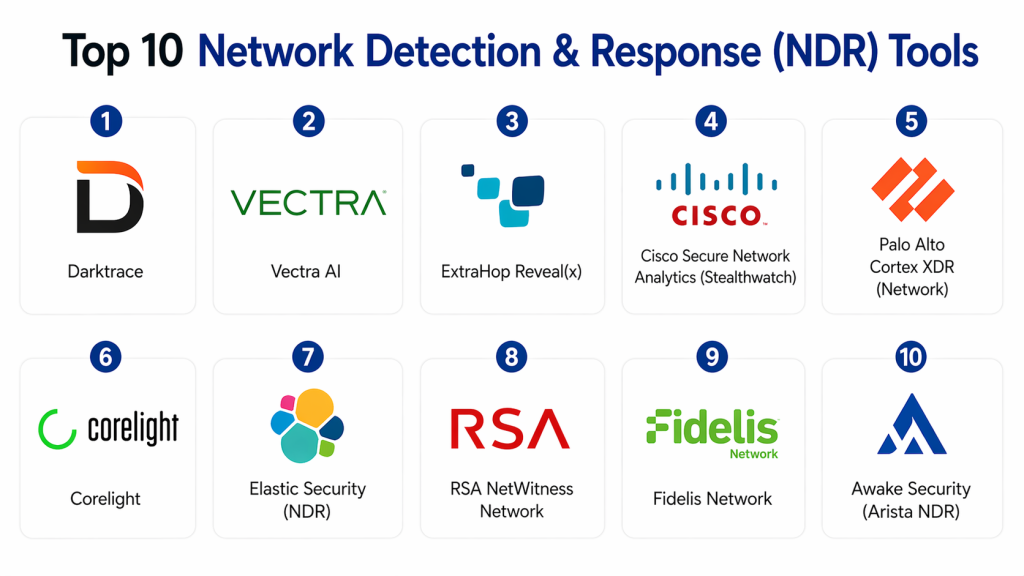
Top 10 Network Detection & Response (NDR) Tools
#1 — Darktrace
Short description :
Darktrace is a leading NDR platform known for its AI-driven threat detection capabilities. It continuously monitors network activity to identify anomalies. It is widely used in enterprises. It supports real-time response. It is scalable. It provides strong visibility across networks.
Key Features
- AI-based detection
- Real-time monitoring
- Threat intelligence
- Automated response
- Network visibility
Pros
- Strong AI detection
- Real-time response
- Scalable
Cons
- Expensive
- Complex setup
Platforms / Deployment
- Cloud / On-prem
Security & Compliance
- Encryption, RBAC
- Compliance: Not publicly stated
Integrations & Ecosystem
- SIEM tools
- APIs
Support & Community
- Enterprise support
#2 — Vectra AI
Short description :
Vectra AI provides NDR with advanced threat detection using AI and behavioral analytics. It focuses on identifying attacker behavior. It is widely used in enterprises. It supports hybrid environments. It is scalable. It provides strong insights.
Key Features
- Behavioral analytics
- AI detection
- Threat intelligence
- Monitoring
- Response
Pros
- Strong detection
- Scalable
- AI-driven
Cons
- Expensive
- Requires expertise
Platforms / Deployment
- Cloud / Hybrid
Security & Compliance
- RBAC, encryption
- Compliance: Not publicly stated
#3 — ExtraHop Reveal(x)
Short description :
ExtraHop Reveal(x) offers NDR capabilities with deep network visibility. It analyzes network traffic in real time. It provides strong threat detection. It integrates with enterprise systems. It is scalable. It is suitable for large environments.
Key Features
- Network analysis
- Threat detection
- Real-time monitoring
- Analytics
- Integration
Pros
- Deep visibility
- Strong analytics
- Scalable
Cons
- Complex
- Costly
Platforms / Deployment
- Cloud / On-prem
Security & Compliance
- Encryption
- Compliance: Not publicly stated
#4 — Cisco Secure Network Analytics (Stealthwatch)
Short description :
Cisco Secure Network Analytics provides NDR capabilities for monitoring network behavior. It detects anomalies and threats. It integrates with Cisco ecosystem. It is scalable. It supports enterprises. It offers strong analytics.
Key Features
- Network monitoring
- Behavioral detection
- Threat analytics
- Integration
- Reporting
Pros
- Strong integration
- Scalable
- Enterprise-ready
Cons
- Cisco dependency
- Complex setup
Platforms / Deployment
- Cloud / Hybrid
Security & Compliance
- RBAC
- Compliance: Not publicly stated
#5 — Palo Alto Cortex XDR (Network)
Short description :
Cortex XDR extends NDR with broader detection across networks and endpoints. It uses analytics and automation. It integrates with Palo Alto ecosystem. It is scalable. It supports enterprises. It provides strong visibility.
Key Features
- Extended detection
- Analytics
- Automation
- Threat intelligence
- Integration
Pros
- Advanced features
- Scalable
- Strong analytics
Cons
- Complex
- Expensive
Platforms / Deployment
- Cloud
Security & Compliance
- RBAC, encryption
- Compliance: Not publicly stated
#6 — Corelight
Short description :
Corelight provides NDR capabilities based on network traffic analysis. It offers deep visibility into network activity. It supports threat detection and investigation. It integrates with security tools. It is scalable. It is suitable for enterprises.
Key Features
- Network analysis
- Threat detection
- Monitoring
- Integration
- Analytics
Pros
- Strong visibility
- Flexible
- Scalable
Cons
- Requires expertise
- Complex setup
Platforms / Deployment
- Cloud / On-prem
Security & Compliance
- RBAC
- Compliance: Not publicly stated
#7 — Elastic Security (NDR)
Short description :
Elastic Security provides NDR capabilities with flexible analytics and monitoring. It integrates with Elastic stack. It supports threat detection. It is scalable. It is suitable for developers. It offers customization.
Key Features
- Threat detection
- Monitoring
- Analytics
- Integration
- Open platform
Pros
- Flexible
- Open ecosystem
- Scalable
Cons
- Requires expertise
- Setup complexity
Platforms / Deployment
- Cloud / Self-hosted
Security & Compliance
- RBAC
- Compliance: Not publicly stated
#8 — RSA NetWitness Network
Short description :
RSA NetWitness provides NDR with strong threat detection and investigation tools. It offers real-time monitoring. It supports enterprises. It integrates with SIEM tools. It is scalable. It provides strong visibility.
Key Features
- Threat detection
- Monitoring
- Analytics
- Investigation
- Integration
Pros
- Strong analytics
- Enterprise-ready
- Scalable
Cons
- Complex
- Costly
Platforms / Deployment
- Cloud / Hybrid
Security & Compliance
- RBAC, encryption
- Compliance: Not publicly stated
#9 — Fidelis Network
Short description :
Fidelis Network provides NDR capabilities with strong detection and response features. It offers monitoring and analytics. It supports enterprises. It is scalable. It provides visibility. It helps detect threats.
Key Features
- Threat detection
- Monitoring
- Analytics
- Response
- Visibility
Pros
- Strong detection
- Scalable
- Reliable
Cons
- Complex
- Limited ecosystem
Platforms / Deployment
- Cloud / Hybrid
Security & Compliance
- Encryption
- Compliance: Not publicly stated
#10 — Awake Security (Arista NDR)
Short description :
Awake Security provides NDR with AI-driven detection and visibility. It monitors network activity and identifies threats. It integrates with Arista ecosystem. It is scalable. It supports enterprises. It offers strong analytics.
Key Features
- AI detection
- Monitoring
- Analytics
- Integration
- Visibility
Pros
- Strong AI detection
- Scalable
- Reliable
Cons
- Expensive
- Requires expertise
Platforms / Deployment
- Cloud
Security & Compliance
- RBAC, encryption
- Compliance: Not publicly stated
Comparison Table
| Tool | Best For | Platform | Deployment | Feature | Rating |
|---|---|---|---|---|---|
| Darktrace | Enterprise | Multi | Hybrid | AI detection | N/A |
| Vectra | Enterprise | Multi | Hybrid | Behavioral | N/A |
| ExtraHop | Enterprise | Multi | Hybrid | Visibility | N/A |
| Cisco | Enterprise | Multi | Hybrid | Integration | N/A |
| Palo Alto | Enterprise | Cloud | Cloud | XDR | N/A |
| Corelight | Enterprise | Multi | Hybrid | Analysis | N/A |
| Elastic | Devs | Multi | Hybrid | Open | N/A |
| RSA | Enterprise | Multi | Hybrid | Analytics | N/A |
| Fidelis | Enterprise | Multi | Hybrid | Detection | N/A |
| Awake | Enterprise | Cloud | Cloud | AI | N/A |
Evaluation & Scoring of NDR Tools
| Tool | Core | Ease | Integration | Security | Performance | Support | Value | Total |
|---|---|---|---|---|---|---|---|---|
| Darktrace | 10 | 7 | 8 | 10 | 9 | 9 | 7 | 8.8 |
| Vectra | 9 | 7 | 8 | 9 | 9 | 8 | 7 | 8.4 |
| ExtraHop | 9 | 7 | 8 | 9 | 9 | 8 | 7 | 8.4 |
| Cisco | 9 | 7 | 9 | 9 | 8 | 8 | 7 | 8.3 |
| Palo Alto | 10 | 7 | 9 | 10 | 9 | 9 | 7 | 8.9 |
| Corelight | 9 | 6 | 8 | 9 | 8 | 8 | 8 | 8.2 |
| Elastic | 8 | 7 | 9 | 8 | 8 | 7 | 9 | 8.2 |
| RSA | 9 | 6 | 8 | 9 | 8 | 8 | 7 | 8.1 |
| Fidelis | 8 | 6 | 7 | 9 | 8 | 7 | 8 | 7.9 |
| Awake | 9 | 7 | 8 | 9 | 9 | 8 | 7 | 8.3 |
Which NDR Tool Is Right for You?
Solo / Freelancer
- Not required
SMB
- Elastic
Mid-Market
- Vectra, Corelight
Enterprise
- Darktrace, Palo Alto, Cisco
Budget vs Premium
- Budget → Elastic
- Premium → Darktrace
Feature Depth vs Ease
- Easy → Elastic
- Advanced → Darktrace
Integrations & Scalability
- Best → Cisco
Security Needs
- High security → Darktrace
Frequently Asked Questions (FAQs)
1. What is Network Detection & Response (NDR)?
Network Detection & Response (NDR) is a security solution that monitors network traffic to detect and respond to cyber threats. It focuses on identifying abnormal behavior instead of relying only on known threat signatures. NDR tools provide deep visibility into network activity. They help security teams detect hidden and advanced attacks.
2. Why is NDR important for organizations?
NDR is important because many modern threats bypass traditional security tools. It helps detect lateral movement, insider threats, and unknown attacks within the network. By analyzing network traffic in real time, it improves threat visibility. This allows faster response and reduces potential damage.
3. How does NDR work?
NDR works by collecting and analyzing network traffic data continuously. It uses behavioral analytics and machine learning to identify unusual patterns. When suspicious activity is detected, it generates alerts or triggers automated responses. This helps contain threats before they spread across the network.
4. Who should use NDR solutions?
NDR solutions are best suited for enterprises and organizations with complex network environments. Security teams and SOC analysts rely on NDR for advanced threat detection. It is especially useful for companies with hybrid or cloud infrastructures. Any organization handling sensitive data can benefit from NDR.
5. Is NDR scalable for large networks?
Yes, modern NDR platforms are highly scalable and can handle large volumes of network traffic. Cloud-based solutions allow centralized monitoring across distributed environments. This makes them ideal for large enterprises. Scalability ensures consistent visibility and protection.
6. What is the difference between NDR and EDR?
NDR focuses on monitoring network traffic, while EDR focuses on endpoint devices. NDR detects threats moving across the network, and EDR detects threats on individual systems. Both solutions complement each other. Together, they provide complete threat visibility.
7. Does NDR support automated response?
Yes, many NDR tools include automated response capabilities. These can isolate affected systems or block malicious traffic. Automation helps reduce response time and limits damage. It also reduces the workload on security teams.
8. Is NDR enough for complete security?
NDR is a powerful tool but not sufficient alone for full security. It should be used alongside EDR, SIEM, and other security solutions. A layered security approach provides better protection. NDR plays a key role in network-level defense.
9. Is NDR difficult to implement?
Implementation complexity depends on the organization and tool used. Some modern NDR solutions are easier to deploy, especially cloud-based ones. However, proper configuration and tuning are important. Skilled teams help ensure effective deployment.
10. What are alternatives to NDR?
NDR works alongside solutions like EDR, SIEM, and XDR. These tools focus on different layers of security. They are not replacements but complementary technologies. Together, they strengthen overall cybersecurity defense.
Conclusion
Network Detection & Response (NDR) tools are essential for modern cybersecurity, providing deep visibility into network activity and enabling organizations to detect and respond to advanced threats in real time. As cyber threats evolve, NDR solutions have become a key component of a layered security strategy.
The right NDR solution depends on your organization’s needs and scale. Enterprise tools like Darktrace and Palo Alto Cortex XDR offer advanced capabilities, while solutions like Elastic provide flexibility and affordability. Organizations should evaluate their requirements, test solutions, and implement NDR as part of a comprehensive security architecture.
