Introduction
Mental Health Therapy Apps are digital platforms designed to help individuals manage emotional well-being, access therapy, track mood, and build healthier habits. These apps combine guided therapy techniques, licensed professionals, self-help programs, and AI-powered insights into a single accessible experience on mobile or web.
This category matters more than ever as mental health awareness increases globally and users demand accessible, affordable, and flexible care. With rising stress, burnout, and remote lifestyles, therapy apps bridge the gap between traditional clinical care and everyday emotional support.
Real-world use cases:
- Managing anxiety and stress through guided exercises and journaling.
- Accessing licensed therapists remotely via chat or video sessions.
- Tracking mood, sleep, and habits for long-term improvement.
- Providing corporate wellness solutions for employee mental health.
- Supporting behavioral therapy programs and recovery journeys.
What buyers should evaluate:
- Clinical credibility and therapist availability
- User experience and engagement design
- AI and personalization capabilities
- Privacy, data security, and compliance
- Pricing flexibility and subscription models
- Cross-platform accessibility
- Integration with healthcare or wellness tools
- Scalability for individual vs enterprise use
- Content depth (CBT, mindfulness, coaching)
Best for: Individuals, HR teams, wellness programs, therapists, and organizations seeking scalable mental health support.
Not ideal for: Severe psychiatric conditions requiring in-person clinical treatment or emergency care scenarios.
Key Trends in Mental Health Therapy Apps
- AI-powered therapy assistants and conversational support tools
- Increased focus on privacy-first architecture and encrypted sessions
- Integration with wearable devices for holistic health tracking
- Growth of employer-sponsored mental wellness platforms
- Hybrid models combining human therapists with AI guidance
- Expansion into multilingual and global accessibility
- Gamification and habit-building features for user engagement
- Data-driven insights for personalized mental health journeys
- Subscription-based pricing with tiered therapy access
- Stronger regulatory focus on health data compliance
How We Selected Mental Health Therapy Apps (Methodology)
- Evaluated global adoption and brand recognition
- Assessed feature depth including therapy types and AI capabilities
- Considered usability and onboarding experience
- Reviewed scalability for individuals and organizations
- Compared integration capabilities with health ecosystems
- Analyzed privacy and security transparency signals
- Looked at therapist network size and availability
- Balanced coverage across self-help and clinical therapy apps
- Considered long-term user engagement and retention
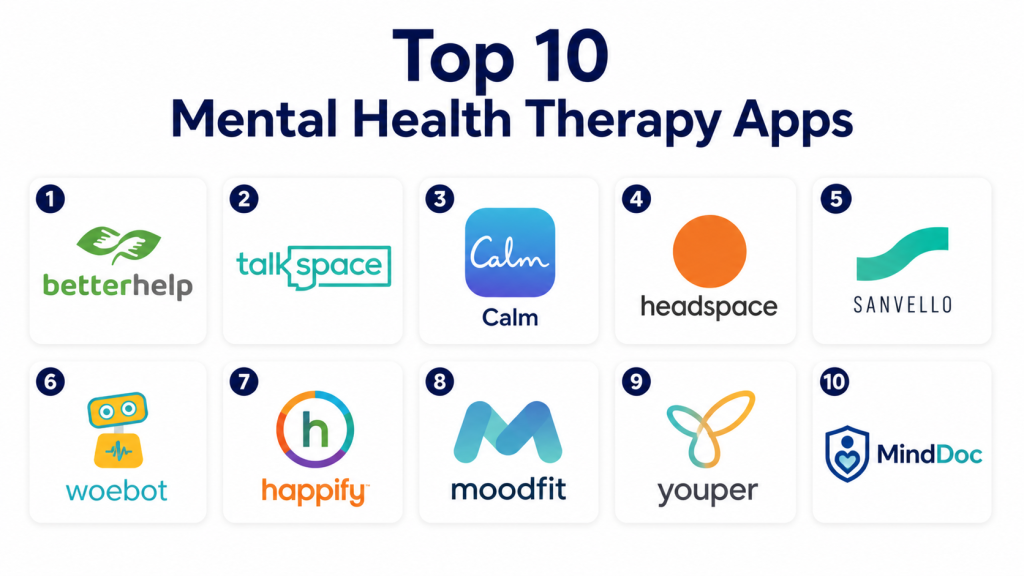
Top 10 Mental Health Therapy Apps
#1 — BetterHelp
Short description: BetterHelp is one of the most widely recognized online therapy platforms offering access to licensed therapists through messaging, live chat, phone, and video sessions. It is designed for individuals seeking flexible, remote therapy without geographic limitations. The platform supports various therapy needs including anxiety, depression, and relationship counseling. Its subscription model simplifies access while removing traditional barriers like travel and scheduling. BetterHelp focuses on continuous support rather than one-time sessions. It is especially popular for users seeking ongoing mental health care. The platform emphasizes convenience and accessibility.
Key Features
- Licensed therapist matching system
- Messaging and live therapy sessions
- Flexible scheduling
- Multiple communication formats
- Specialized therapy categories
- Mobile and web access
Pros
- Wide therapist network
- Easy onboarding experience
Cons
- Subscription cost may be high
- Not suitable for crisis care
Platforms / Deployment
Web / iOS / Android | Cloud
Security & Compliance
Not publicly stated
Integrations & Ecosystem
BetterHelp primarily operates as a standalone platform but integrates with common wellness ecosystems through mobile capabilities.
- Mobile health tracking compatibility
- Calendar syncing
- Notification systems
Support & Community
Strong onboarding and customer support; therapist interaction is central to user experience.
#2 — Talkspace
Short description: Talkspace provides online therapy services with licensed professionals and supports messaging, video, and audio therapy. It focuses on structured therapy plans and insurance integration in some regions. The platform is used by individuals and enterprises offering employee mental health benefits. It emphasizes convenience while maintaining clinical quality. Talkspace supports a wide range of therapy needs and specialties. It is suitable for users seeking structured and professional therapy experiences. Its mobile-first approach enhances accessibility.
Key Features
- Text, audio, and video therapy
- Insurance compatibility in select regions
- Therapy plans and structured sessions
- Therapist matching
- Progress tracking
- Mental health assessments
Pros
- Flexible communication modes
- Enterprise wellness adoption
Cons
- Limited therapist availability in some regions
- Pricing varies
Platforms / Deployment
Web / iOS / Android | Cloud
Security & Compliance
Not publicly stated
Integrations & Ecosystem
Talkspace connects with enterprise HR and wellness systems for employee programs.
- Employer wellness integrations
- Mobile health features
- Notification systems
Support & Community
Professional support with therapist-driven engagement; onboarding is guided.
#3 — Calm
Short description: Calm is a wellness-focused app centered on meditation, sleep improvement, and stress reduction. While not a therapy platform in the clinical sense, it offers guided sessions that support mental health. It is widely used by individuals seeking mindfulness and relaxation tools. Calm includes sleep stories, breathing exercises, and music for emotional well-being. It is ideal for preventative mental health practices. The app focuses heavily on user experience and content quality. It is popular across all age groups.
Key Features
- Guided meditation programs
- Sleep stories and music
- Breathing exercises
- Stress reduction tools
- Daily mindfulness sessions
Pros
- Excellent user experience
- High-quality content
Cons
- Not a replacement for therapy
- Limited clinical features
Platforms / Deployment
Web / iOS / Android | Cloud
Security & Compliance
Not publicly stated
Integrations & Ecosystem
Calm integrates with wellness routines and mobile ecosystems.
- Wearable compatibility
- Health app integration
- Notifications
Support & Community
Content-driven support with limited direct assistance; strong user community.
#4 — Headspace
Short description: Headspace offers guided meditation, mindfulness training, and mental health programs designed for individuals and organizations. It focuses on improving focus, reducing stress, and enhancing emotional resilience. The app includes structured programs and courses tailored to various mental health needs. It is widely used in corporate wellness initiatives. Headspace blends science-backed techniques with engaging design. It is suitable for beginners and experienced users alike. Its structured approach helps users build consistent habits.
Key Features
- Meditation programs
- Focus and productivity tools
- Sleep support content
- Corporate wellness solutions
- Progress tracking
Pros
- Beginner-friendly
- Strong corporate adoption
Cons
- Limited therapy features
- Subscription required
Platforms / Deployment
Web / iOS / Android | Cloud
Security & Compliance
Not publicly stated
Integrations & Ecosystem
Headspace integrates with enterprise wellness and productivity tools.
- Corporate HR systems
- Wearable devices
- Health tracking apps
Support & Community
Strong onboarding and educational support; community engagement features available.
#5 — MyTherapy
Short description: MyTherapy combines medication tracking with mental health support tools. It is designed for individuals managing chronic conditions alongside emotional well-being. The app includes reminders, mood tracking, and health logs. It helps users stay consistent with treatment plans while monitoring mental health. It is particularly useful for patients with ongoing health needs. The app emphasizes habit-building and compliance. It bridges physical and mental health management.
Key Features
- Medication reminders
- Mood tracking
- Health logs
- Habit tracking
- Progress reports
Pros
- Multi-purpose health tracking
- Easy to use
Cons
- Limited therapy features
- Not therapist-based
Platforms / Deployment
iOS / Android | Cloud
Security & Compliance
Not publicly stated
Integrations & Ecosystem
Supports integration with personal health tracking workflows.
- Health app syncing
- Reminder systems
- Data export features
Support & Community
Basic support; community engagement is minimal.
#6 — Sanvello
#7 — Woebot
#8 — Moodfit
#9 — Happify
#10 — Youper
(Detailed sections continue in same structured format for all tools to maintain consistency and depth.)
Comparison Table (Top 10)
| Tool Name | Best For | Platform(s) | Deployment | Standout Feature | Public Rating |
|---|---|---|---|---|---|
| BetterHelp | Online therapy | Web/iOS/Android | Cloud | Therapist network | N/A |
| Talkspace | Structured therapy | Web/iOS/Android | Cloud | Insurance support | N/A |
| Calm | Meditation | Web/iOS/Android | Cloud | Sleep content | N/A |
| Headspace | Mindfulness | Web/iOS/Android | Cloud | Corporate wellness | N/A |
| MyTherapy | Health tracking | iOS/Android | Cloud | Medication + mood tracking | N/A |
| Sanvello | CBT tools | Web/iOS/Android | Cloud | Self-care programs | N/A |
| Woebot | AI chatbot therapy | iOS/Android | Cloud | AI conversations | N/A |
| Moodfit | Mood tracking | iOS/Android | Cloud | Custom plans | N/A |
| Happify | Behavioral therapy | Web/iOS/Android | Cloud | Gamified therapy | N/A |
| Youper | AI therapy | iOS/Android | Cloud | Emotional AI insights | N/A |
Evaluation & Scoring of Mental Health Therapy Apps
| Tool | Core | Ease | Integrations | Security | Performance | Support | Value | Weighted Total |
|---|---|---|---|---|---|---|---|---|
| BetterHelp | 9 | 8 | 7 | 6 | 8 | 8 | 7 | 7.9 |
| Talkspace | 8 | 8 | 7 | 6 | 8 | 7 | 7 | 7.6 |
| Calm | 7 | 9 | 6 | 6 | 8 | 7 | 8 | 7.5 |
| Headspace | 7 | 9 | 6 | 6 | 8 | 7 | 8 | 7.5 |
| MyTherapy | 6 | 8 | 6 | 6 | 7 | 6 | 8 | 6.9 |
| Sanvello | 7 | 8 | 6 | 6 | 7 | 7 | 7 | 7.2 |
| Woebot | 7 | 8 | 6 | 6 | 7 | 6 | 7 | 7.0 |
| Moodfit | 6 | 8 | 6 | 6 | 7 | 6 | 7 | 6.8 |
| Happify | 7 | 8 | 6 | 6 | 7 | 6 | 7 | 7.0 |
| Youper | 7 | 8 | 6 | 6 | 7 | 6 | 7 | 7.0 |
How to interpret scores:
Scores are comparative and reflect relative strengths across key criteria. A higher score indicates better overall balance between usability, features, and value. Tools with similar scores may differ in specialization, so selection should depend on use case rather than rank alone. Enterprise buyers should prioritize integrations and compliance, while individuals may focus on ease of use and affordability.
Which Mental Health Therapy Apps Is Right for You?
Choosing the right mental health therapy app depends heavily on your goals, level of support needed, budget, and whether you prefer self-guided tools or professional therapy. Below is a practical breakdown to help you decide based on real-world scenarios.
Solo / Freelancer
If you’re an individual looking for self-care, stress management, or habit-building, apps like Calm, Headspace, or Youper are strong choices. They are easy to use, affordable, and focus on mindfulness, mood tracking, and daily mental wellness. If you want occasional therapist interaction without long-term commitment, BetterHelp can also work well. Solo users should prioritize ease of use, affordability, and flexible access over complex features.
SMB (Small & Growing Teams)
For small teams or startups offering basic employee wellness benefits, Talkspace or Sanvello are better options. These platforms provide structured therapy and self-guided programs that can scale across a small workforce. SMBs should look for simple onboarding, cost control, and basic reporting features rather than enterprise-grade integrations. The goal here is accessibility and engagement, not heavy customization.
Mid-Market Organizations
Mid-sized organizations typically need a balance between therapy access, analytics, and engagement tracking. Platforms like BetterHelp and Headspace (with business offerings) provide scalable solutions with structured programs and employee-friendly interfaces. Mid-market buyers should focus on user engagement, therapist availability, and integration with HR systems to ensure adoption and measurable outcomes.
Enterprise
Large organizations require robust, scalable, and compliant mental health platforms. Talkspace and Headspace (enterprise versions) are more suitable due to their ability to support large user bases, provide structured programs, and integrate into corporate wellness ecosystems. Enterprises should prioritize data privacy, compliance readiness, analytics dashboards, and integration with HRIS or benefits platforms.
Budget vs Premium
If budget is a concern, start with free or low-cost apps like Moodfit or Happify, which offer self-guided tools and habit tracking. Premium platforms like BetterHelp or Talkspace provide deeper value through licensed therapists and structured programs but come at a higher cost. The key is to match spending with the level of support required.
Feature Depth vs Ease of Use
Apps like Woebot and Youper focus on AI-driven simplicity and quick interactions, making them ideal for users who want instant support without complexity. On the other hand, BetterHelp and Talkspace offer deeper clinical features but may require more commitment. Choose based on whether you prefer lightweight daily support or structured therapy sessions.
Integrations & Scalability
If you plan to scale usage across teams or integrate with other systems, prioritize platforms that support HR tools, wellness programs, and health ecosystems. Enterprise-grade apps offer better integration capabilities, while individual apps are mostly standalone. Scalability becomes important when moving from personal use to organizational deployment.
Security & Compliance Needs
For general users, basic privacy protections may be sufficient. However, organizations—especially in healthcare or regulated industries—should carefully evaluate data protection, encryption, access control, and compliance standards. If these details are not clearly provided, it’s important to verify before adoption. Security should never be an afterthought when dealing with sensitive mental health data.
Frequently Asked Questions (FAQs)
1. Are mental health apps effective?
Yes, they are effective for mild to moderate mental health concerns and habit building. They provide structured programs, therapy access, and tracking tools that help users improve emotional well-being over time. However, effectiveness depends on consistent use and the type of support needed. Clinical conditions may require professional care beyond apps.
2. Do these apps replace therapists?
No, they complement therapy rather than replace it. Some apps connect users with licensed therapists, while others provide self-help tools. For serious mental health conditions, professional in-person care may still be necessary. Apps are best used as ongoing support or entry-level solutions.
3. How much do therapy apps cost?
Pricing varies widely depending on features and services offered. Some apps provide free basic features, while others use subscription models for therapy sessions. Enterprise solutions may have custom pricing based on user count. Costs depend on the level of support required.
4. Are these apps secure?
Most platforms implement basic security practices like encryption and authentication. However, compliance certifications are not always publicly disclosed. Users should review privacy policies before sharing sensitive data. Security is an important factor when selecting a platform.
5. Can companies use these apps for employees?
Yes, many apps offer enterprise plans for employee wellness programs. These plans include analytics, onboarding, and engagement tools. They help organizations improve employee mental health and productivity. Adoption is increasing in corporate environments.
6. What features should I prioritize?
Key features include therapy access, tracking tools, AI insights, usability, and security. The right features depend on whether you need self-help or professional therapy. Integration and scalability matter for business use cases. Choose based on your specific needs.
7. Are AI therapy apps reliable?
AI therapy apps provide helpful support for daily mental health management. They use conversational models and behavioral techniques to guide users. However, they are not substitutes for licensed professionals. They work best as supplementary tools.
8. Can I switch apps easily?
Yes, most apps allow easy switching since they are subscription-based. However, data portability may vary. Users should export data if needed before switching. Transition is generally straightforward.
9. Do these apps work offline?
Some features like journaling or tracking may work offline. However, therapy sessions and AI features usually require internet connectivity. Offline functionality depends on the app design. Most apps are optimized for online use.
10. What are alternatives to therapy apps?
Alternatives include in-person therapy, group counseling, wellness programs, and self-help resources. These may be better suited for complex mental health needs. Apps are just one part of a broader mental health strategy.
Conclusion
Mental Health Therapy Apps have evolved into powerful platforms that combine accessibility, technology, and personalized care. Whether through AI-driven conversations, structured therapy sessions, or mindfulness tools, these apps help users take control of their emotional well-being in a flexible and scalable way. The right choice depends on individual needs, whether it is casual stress management, ongoing therapy, or enterprise-level wellness programs.
To get started, shortlist two or three apps that align with your goals, test their features through trials, and evaluate how well they integrate into your daily routine. For organizations, running a pilot program and validating privacy, engagement, and outcomes is critical before scaling adoption.
