Introduction
Knowledge Graph Construction Tools are platforms that help organizations build, manage, and query structured knowledge graphs by connecting entities, relationships, and data from multiple sources. These tools transform raw, unstructured, and semi-structured data into context-rich, interconnected knowledge systems that power search, recommendations, analytics, and AI applications.
In the modern data and AI ecosystem, knowledge graphs are becoming foundational for semantic search, recommendation engines, fraud detection, enterprise knowledge management, and AI copilots. They enable machines to understand relationships between data points rather than treating them as isolated records. These platforms also integrate with Identity Management, Cybersecurity frameworks, Zero Trust architectures, and Access Control systems to ensure secure and governed data usage.
Real-world use cases include:
- Building enterprise knowledge bases and search systems
- Powering recommendation engines and personalization
- Fraud detection and risk analysis
- Data integration across multiple systems
- AI-driven semantic search and question answering
What buyers should evaluate:
- Data ingestion and integration capabilities
- Graph modeling and schema flexibility
- Query performance and scalability
- Visualization and analytics features
- Integration with AI/ML pipelines
- Security and compliance controls
- Ease of use and developer experience
- Deployment flexibility (cloud/on-premise)
Best for: Data engineers, AI teams, enterprises, research organizations, and companies dealing with complex data relationships.
Not ideal for: Simple relational data use cases that do not require graph-based modeling.
Key Trends in Knowledge Graph Construction Tools
- Integration with generative AI and LLMs for semantic reasoning
- Graph-based retrieval for AI copilots and RAG systems
- Real-time graph updates and streaming data integration
- Improved visualization and graph analytics capabilities
- Cloud-native graph databases gaining popularity
- Graph-based security and fraud detection systems
- Standardization of graph query languages
- Hybrid architectures combining graphs with data lakes
- Low-code tools for building knowledge graphs
- Increased focus on governance and data lineage
How We Knowledge Graph Construction Tools (Methodology)
We evaluated tools based on:
- Graph modeling flexibility and features
- Data ingestion and integration capabilities
- Performance and scalability
- Query language support and usability
- Security and compliance readiness
- Visualization and analytics features
- Ecosystem and community support
- Enterprise adoption and maturity
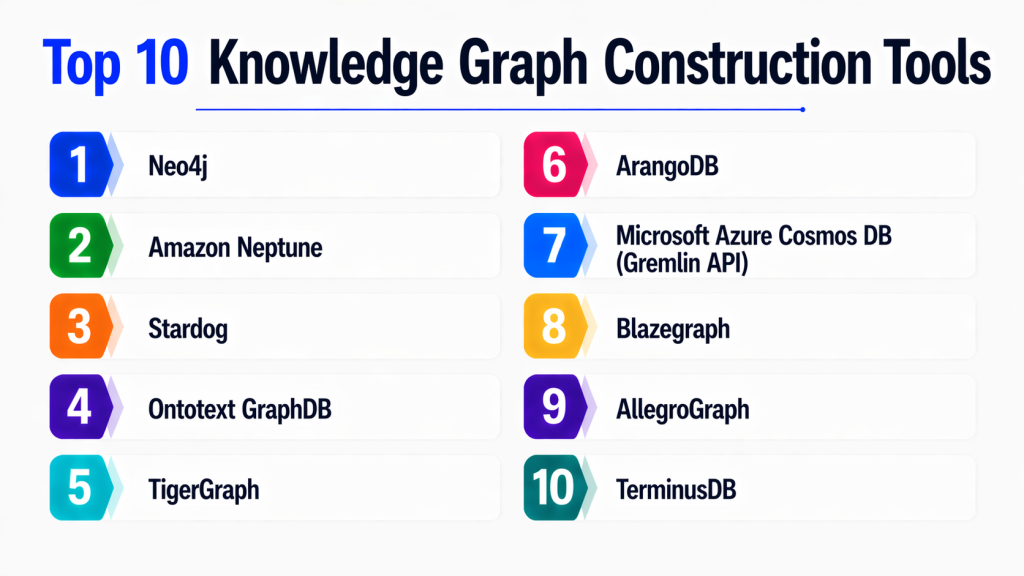
Top 10 Knowledge Graph Construction Tools
#1 — Neo4j
Short description :
Neo4j is one of the most popular graph database platforms used for building knowledge graphs. It offers powerful graph modeling and querying capabilities. Widely used in enterprise applications. Supports real-time analytics and visualization. Ideal for large-scale graph systems.
Key Features
- Graph database engine
- Cypher query language
- Visualization tools
- Real-time analytics
- Scalability
Pros
- Mature ecosystem
- Strong performance
Cons
- Licensing costs
- Learning curve
Platforms / Deployment
Cloud / On-premise / Hybrid
Security & Compliance
RBAC, encryption
Compliance: Varies
Integrations & Ecosystem
- Data pipelines
- APIs
- Analytics tools
Support & Community
Large global community.
#2 — Amazon Neptune
Short description :
Amazon Neptune is a managed graph database service designed for building knowledge graphs at scale. It supports multiple graph models. Ideal for cloud-native applications. Integrates with AWS ecosystem.
Key Features
- Managed graph database
- RDF and property graph support
- High availability
- Scalable architecture
Pros
- Fully managed
- Scalable
Cons
- AWS dependency
- Pricing complexity
Platforms / Deployment
Cloud
Security & Compliance
IAM, encryption
Compliance: Varies
Integrations & Ecosystem
- AWS services
- Data lakes
Support & Community
Enterprise support.
#3 — Stardog
Short description :
Stardog is a knowledge graph platform focused on enterprise data integration. It combines graph databases with reasoning capabilities. Ideal for semantic applications. Supports complex queries.
Key Features
- Knowledge graph platform
- Data virtualization
- Reasoning engine
- SPARQL support
Pros
- Strong semantic capabilities
- Enterprise-ready
Cons
- Complex setup
- Premium pricing
Platforms / Deployment
Cloud / On-premise
Security & Compliance
Enterprise controls
Compliance: Varies
Integrations & Ecosystem
- Data sources
- APIs
Support & Community
Enterprise support.
#4 — Ontotext GraphDB
Short description :
GraphDB by Ontotext is a semantic graph database for building knowledge graphs. It supports RDF and reasoning. Suitable for enterprise and research use.
Key Features
- RDF support
- Semantic reasoning
- SPARQL queries
- Data integration
Pros
- Strong semantic support
- Scalable
Cons
- Learning curve
- Complex setup
Platforms / Deployment
Cloud / On-premise
Security & Compliance
Varies
Integrations & Ecosystem
- Data tools
- APIs
Support & Community
Active community.
#5 — TigerGraph
Short description :
TigerGraph is a high-performance graph database platform. It is designed for real-time analytics and large-scale graphs. Ideal for enterprise applications.
Key Features
- High-performance engine
- Real-time analytics
- Graph processing
Pros
- Fast performance
- Scalable
Cons
- Complex
- Costly
Platforms / Deployment
Cloud / On-premise
Security & Compliance
Enterprise-grade controls
Compliance: Varies
Integrations & Ecosystem
- Data platforms
- APIs
Support & Community
Enterprise support.
#6 — ArangoDB
Short description :
ArangoDB is a multi-model database supporting graph data. It combines graph, document, and key-value models. Ideal for flexible data systems.
Key Features
- Multi-model support
- Graph queries
- Scalability
Pros
- Flexible
- Open-source
Cons
- Smaller ecosystem
- Learning curve
Platforms / Deployment
Cloud / On-premise
Security & Compliance
Varies
Integrations & Ecosystem
- APIs
- Dev tools
Support & Community
Active community.
#7 — Microsoft Azure Cosmos DB (Gremlin API)
Short description :
Azure Cosmos DB supports graph databases via Gremlin API. It enables building knowledge graphs within Microsoft ecosystem. Ideal for cloud applications.
Key Features
- Multi-model database
- Gremlin API
- Global distribution
Pros
- Scalable
- Cloud-native
Cons
- Azure dependency
- Pricing complexity
Platforms / Deployment
Cloud
Security & Compliance
Azure AD, encryption
Compliance: Varies
Integrations & Ecosystem
- Azure services
Support & Community
Enterprise support.
#8 — Blazegraph
Short description :
Blazegraph is an RDF graph database used for semantic applications. Known for scalability and performance. Suitable for research and enterprise use.
Key Features
- RDF support
- SPARQL queries
- Scalable
Pros
- Efficient
- Open-source
Cons
- Limited updates
- Smaller community
Platforms / Deployment
Local / Cloud
Security & Compliance
Not publicly stated
Integrations & Ecosystem
- APIs
Support & Community
Limited support.
#9 — AllegroGraph
Short description :
AllegroGraph is a graph database platform focused on semantic data. It supports reasoning and analytics. Ideal for enterprise knowledge graphs.
Key Features
- Semantic graph database
- Reasoning
- Analytics
Pros
- Strong semantic support
- Reliable
Cons
- Costly
- Learning curve
Platforms / Deployment
Cloud / On-premise
Security & Compliance
Enterprise controls
Compliance: Varies
Integrations & Ecosystem
- Data tools
Support & Community
Enterprise support.
#10 — TerminusDB
Short description :
TerminusDB is a graph database designed for knowledge graph applications. It supports versioning and collaboration. Ideal for data teams.
Key Features
- Graph database
- Version control
- Collaboration
Pros
- Flexible
- Open-source
Cons
- Smaller ecosystem
- Limited enterprise features
Platforms / Deployment
Cloud / Local
Security & Compliance
Not publicly stated
Integrations & Ecosystem
- APIs
Support & Community
Growing community.
Comparison Table (Top 10)
| Tool Name | Best For | Platform(s) | Deployment | Standout Feature | Public Rating |
|---|---|---|---|---|---|
| Neo4j | Enterprise | Multi | Hybrid | Graph DB | N/A |
| Neptune | Cloud | Cloud | Cloud | Managed service | N/A |
| Stardog | Enterprise | Multi | Hybrid | Reasoning | N/A |
| GraphDB | Semantic | Multi | Hybrid | RDF | N/A |
| TigerGraph | Analytics | Multi | Hybrid | Performance | N/A |
| ArangoDB | Flexible | Multi | Hybrid | Multi-model | N/A |
| Cosmos DB | Cloud | Cloud | Cloud | Gremlin API | N/A |
| Blazegraph | Research | Multi | Hybrid | RDF | N/A |
| AllegroGraph | Enterprise | Multi | Hybrid | Analytics | N/A |
| TerminusDB | Teams | Multi | Hybrid | Versioning | N/A |
Evaluation & Scoring of Knowledge Graph Tools
| Tool | Core | Ease | Integration | Security | Performance | Support | Value | Total |
|---|---|---|---|---|---|---|---|---|
| Neo4j | 10 | 8 | 10 | 9 | 9 | 10 | 8 | 9.2 |
| Neptune | 9 | 8 | 9 | 9 | 9 | 9 | 7 | 8.7 |
| Stardog | 9 | 7 | 9 | 9 | 8 | 9 | 7 | 8.4 |
| GraphDB | 9 | 7 | 8 | 8 | 8 | 8 | 7 | 8.0 |
| TigerGraph | 9 | 6 | 8 | 9 | 10 | 8 | 7 | 8.3 |
| ArangoDB | 8 | 8 | 8 | 7 | 8 | 8 | 9 | 8.2 |
| Cosmos DB | 9 | 7 | 9 | 9 | 9 | 9 | 7 | 8.5 |
| Blazegraph | 7 | 7 | 7 | 6 | 8 | 6 | 8 | 7.0 |
| AllegroGraph | 8 | 7 | 8 | 9 | 8 | 8 | 7 | 7.9 |
| TerminusDB | 8 | 8 | 7 | 7 | 8 | 7 | 9 | 8.0 |
Which Knowledge Graph Tool Is Right for You?
Solo / Freelancer
Use TerminusDB, ArangoDB
SMB
Use ArangoDB, GraphDB
Mid-Market
Use Neo4j, TigerGraph
Enterprise
Use Neo4j, Stardog, Neptune
Budget vs Premium
Budget: ArangoDB
Premium: Neo4j
Feature Depth vs Ease
Depth: Neo4j
Ease: ArangoDB
Security & Compliance
Best: Neptune, Cosmos DB
Frequently Asked Questions (FAQs)
1. What is a knowledge graph?
A knowledge graph is a structured way of representing data where entities are connected through relationships. Unlike traditional databases, it focuses on context and meaning rather than just storage. This helps systems understand how different pieces of information relate to each other. Knowledge graphs are widely used in search engines, AI systems, and recommendation platforms. They improve data discovery and decision-making.
2. Why should I use knowledge graph tools?
Knowledge graph tools help manage complex and interconnected data more efficiently than relational systems. They enable better analytics, faster queries, and improved data relationships. These tools are especially useful when dealing with large datasets from multiple sources. They also support AI-driven applications like semantic search and chatbots. Overall, they enhance data usability and insights.
3. Are knowledge graphs scalable?
Yes, modern knowledge graph platforms are designed to scale for enterprise-level data. Cloud-based solutions offer distributed architectures for handling large datasets. Performance depends on factors like data modeling and query optimization. Many tools support real-time processing and analytics. With proper design, knowledge graphs can handle massive workloads efficiently.
4. Are knowledge graph tools secure?
Security depends on the platform and deployment model used. Enterprise-grade tools offer features like encryption, role-based access control, and audit logging. Cloud platforms provide additional security layers through managed services. Organizations must follow best practices to secure data and access. Compliance support varies across tools and should be evaluated carefully.
5. Which knowledge graph tool is best for beginners?
Tools like ArangoDB and TerminusDB are often easier for beginners due to their flexibility and simpler setup. They provide intuitive interfaces and support multiple data models. Beginners can start with smaller projects to understand graph concepts. More advanced tools may require deeper technical expertise. Choosing the right tool depends on learning goals and use cases.
6. Can knowledge graphs integrate with AI systems?
Yes, knowledge graphs are widely used in AI applications to provide context-aware insights. They are essential for semantic search, recommendation engines, and retrieval-augmented generation systems. Integration with machine learning pipelines enhances model accuracy. Many modern tools offer built-in AI integration features. This makes them highly valuable for intelligent applications.
7. Are knowledge graph tools expensive?
Costs vary depending on whether the tool is open-source or enterprise-grade. Open-source options are free but may require infrastructure and maintenance. Enterprise solutions offer advanced features but come with licensing costs. Cloud-based tools follow usage-based pricing models. Organizations should evaluate total cost based on scale and requirements.
8. What industries use knowledge graphs?
Knowledge graphs are used across industries such as finance, healthcare, e-commerce, telecommunications, and research. They help in fraud detection, personalized recommendations, and data integration. Many large enterprises rely on them for analytics and AI applications. Their adoption is growing rapidly as data complexity increases. They are becoming a key part of modern data strategies.
9. What are the limitations of knowledge graphs?
Knowledge graphs can be complex to design and implement, especially for beginners. They require careful data modeling and expertise in graph structures. Performance tuning may be needed for large datasets. Some tools have a steep learning curve. Despite these challenges, the benefits often outweigh the limitations for complex data use cases.
10. How do I choose the right knowledge graph tool?
Choosing the right tool depends on your use case, data complexity, and scalability needs. Evaluate features like performance, integrations, and ease of use. Consider whether you need a cloud-based or on-premise solution. Testing tools with real-world data is highly recommended. Select a tool that aligns with your long-term technical and business goals.
Conclusion
Knowledge graph construction tools are transforming how organizations manage and utilize complex data relationships. By enabling structured, interconnected data systems, these tools empower businesses to unlock deeper insights, improve decision-making, and build advanced AI applications such as semantic search, recommendation engines, and intelligent assistants. As data continues to grow in volume and complexity, knowledge graphs are becoming a foundational component of modern data architectures.
Selecting the right knowledge graph tool depends on your specific requirements, including scalability, integration capabilities, ease of use, and security needs. While enterprise platforms like Neo4j and Stardog offer powerful features for large-scale deployments, flexible options like ArangoDB and TerminusDB are well-suited for smaller teams and experimental use cases. The best approach is to evaluate multiple tools, test them with real datasets, and choose the one that aligns with your technical and business goals.
