Introduction
IT Operations Analytics (ITOA) Platforms are specialized solutions designed to collect, analyze, and visualize data from IT infrastructure, applications, and services to improve operational performance, reduce downtime, and optimize resource usage. By applying analytics and sometimes AI/ML algorithms, ITOA platforms provide actionable insights to help IT teams proactively detect issues, predict failures, and optimize infrastructure utilization.
With modern IT environments becoming increasingly complex—spanning cloud, on-premises, containers, and hybrid deployments—organizations need real-time visibility into system performance, dependencies, and anomalies. ITOA platforms enable IT teams to improve incident response, capacity planning, and overall operational efficiency.
Real-world use cases include:
- Monitoring performance and availability of servers, networks, and applications
- Predictive analytics to prevent outages and failures
- Correlating events and logs for root cause analysis
- Optimizing resource usage and infrastructure costs
- Integrating IT metrics with business KPIs for operational insights
Evaluation criteria buyers should consider:
- Data collection capabilities across servers, networks, applications, and cloud environments
- Real-time monitoring and analytics
- Predictive insights and anomaly detection
- Integration with ITSM, DevOps, and observability tools
- Scalability and support for hybrid or multi-cloud environments
- Dashboards and visualization capabilities
- Automation for incident detection and remediation
- Security and compliance monitoring
- Vendor support and ease of use
Best for: Enterprises, IT operations teams, DevOps teams, and organizations with complex IT infrastructures requiring predictive insights.
Not ideal for: Small organizations with minimal IT infrastructure or limited operational complexity.
Key Trends in IT Operations Analytics Platforms
- AI/ML-powered anomaly detection and predictive analytics
- Cloud-native observability and hybrid IT support
- Integration with ITSM, AIOps, and DevOps pipelines
- Real-time monitoring and alerting with automated remediation
- Infrastructure cost optimization and capacity planning insights
- Policy-based automation for recurring incidents
- Centralized dashboards for cross-team visibility
- Role-based access and compliance reporting
- Subscription-based pricing with usage-based tiers
- API-first architecture for extensibility and integrations
How We Selected These Tools
- Market adoption and recognition among enterprise IT operations teams
- Coverage of infrastructure, applications, and cloud monitoring
- Predictive analytics and anomaly detection capabilities
- Integration with ITSM, DevOps, and observability tools
- Scalability for large IT environments
- Automation features for alerts, incident response, and remediation
- Security and compliance monitoring
- Vendor support, documentation, and community presence
- Real-time dashboards and analytics visualization
- Cost-to-value ratio for mid-market and enterprise deployments
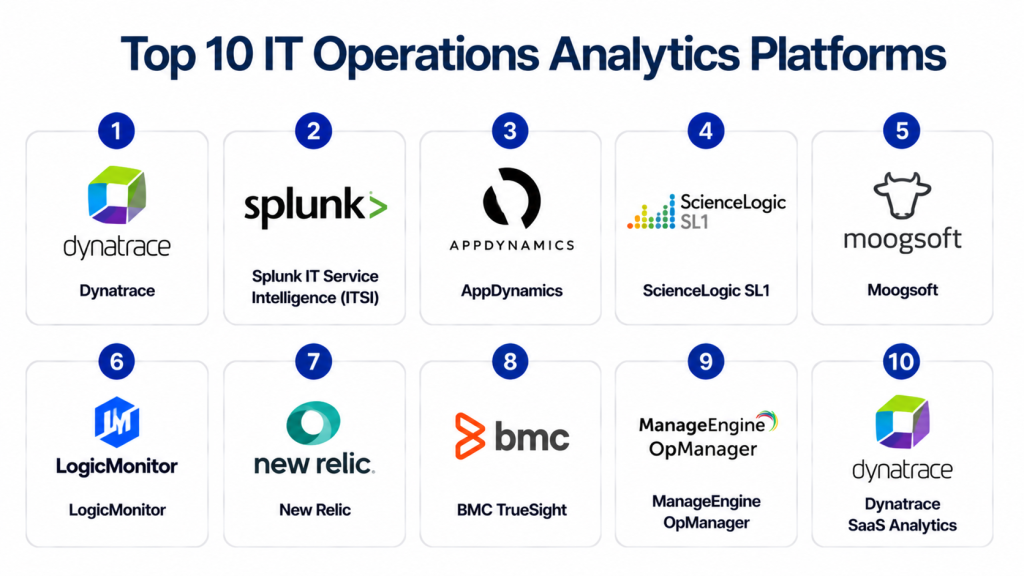
Top 10 IT Operations Analytics Platforms
1- Dynatrace
Short description: AI-driven ITOA platform providing full-stack observability, automated root cause analysis, and predictive analytics.
Key Features
- Automatic discovery of infrastructure and applications
- AI-powered anomaly detection and root cause analysis
- Real-time dashboards and analytics
- Cloud-native and hybrid IT support
- Integration with DevOps and ITSM tools
Pros
- Comprehensive full-stack visibility
- Predictive insights reduce downtime
Cons
- Enterprise pricing may be high for SMBs
- Complex configuration for advanced features
Platforms / Deployment
- Web, Cloud, Hybrid
Security & Compliance
- SOC 2, ISO 27001, audit logs
Integrations & Ecosystem
- AWS, Azure, Kubernetes, ServiceNow, Jira
- API and webhook support
Support & Community
- Enterprise support tiers, professional documentation, active community
2- Splunk IT Service Intelligence (ITSI)
Short description: ITOA platform combining real-time monitoring, analytics, and predictive insights across IT infrastructure and applications.
Key Features
- Event correlation and KPI monitoring
- Predictive analytics and anomaly detection
- Dashboards for performance and operational insights
- ITSM and AIOps integration
- Cloud, on-prem, and hybrid support
Pros
- Strong analytics and visualization capabilities
- Flexible deployment options
Cons
- Higher cost and licensing complexity
- Requires trained staff to fully leverage
Platforms / Deployment
- Web, Cloud, Hybrid
Security & Compliance
- SOC 2, ISO 27001
Integrations & Ecosystem
- ServiceNow, Jira, AWS, Azure, Kubernetes
- API access for custom integrations
Support & Community
- Vendor support tiers, active community, extensive documentation
3- AppDynamics
Short description: Full-stack observability platform providing performance monitoring, analytics, and operational insights across complex IT environments.
Key Features
- Application performance monitoring (APM)
- Real-time analytics and dashboards
- Automated root cause analysis
- Integration with DevOps and ITSM tools
- Multi-cloud and hybrid environment support
Pros
- Strong application-level insights
- Predictive analytics for performance optimization
Cons
- Cost may be high for smaller teams
- Advanced analytics setup requires expertise
Platforms / Deployment
- Web, Cloud, Hybrid
Security & Compliance
- SOC 2, ISO 27001
Integrations & Ecosystem
- AWS, Azure, Kubernetes, ServiceNow, Jira
- API integration for automation
Support & Community
- Vendor support, professional services, documentation
4- ScienceLogic SL1
Short description: IT operations analytics platform delivering hybrid IT visibility, predictive analytics, and automated incident management.
Key Features
- Unified monitoring for on-premises, cloud, and hybrid IT
- Predictive insights and anomaly detection
- Automated incident management
- Centralized dashboards and reporting
- Integration with ITSM and DevOps tools
Pros
- Broad infrastructure coverage
- Automation reduces manual incident resolution
Cons
- Enterprise-focused; may be overkill for SMBs
- Deployment complexity for hybrid environments
Platforms / Deployment
- Web, Cloud, Hybrid
Security & Compliance
- SOC 2, Not publicly stated
Integrations & Ecosystem
- AWS, Azure, ServiceNow, Jira, Slack
- API access for custom workflows
Support & Community
- Vendor support tiers, professional documentation
5- Moogsoft
Short description: AIOps-driven platform providing IT operations analytics, anomaly detection, and automated incident response.
Key Features
- AI-driven event correlation and anomaly detection
- Predictive insights for proactive remediation
- Integration with ITSM and monitoring tools
- Dashboards and reporting
- Automation for recurring incidents
Pros
- Reduces alert fatigue
- Enhances operational efficiency
Cons
- Enterprise pricing
- Learning curve for AI-based configuration
Platforms / Deployment
- Web, Cloud
Security & Compliance
- SOC 2, Not publicly stated
Integrations & Ecosystem
- ServiceNow, Jira, AWS, Azure
- API and webhook integrations
Support & Community
- Vendor support, documentation, community forums
6- LogicMonitor
Short description: Cloud-based IT operations analytics platform offering infrastructure monitoring, predictive analytics, and alerting.
Key Features
- Full-stack infrastructure and application monitoring
- Real-time dashboards and alerts
- Predictive analytics for capacity planning
- Hybrid IT and multi-cloud support
- Integration with ITSM and DevOps tools
Pros
- Quick deployment and easy to scale
- Strong alerting and visualization
Cons
- May require training for advanced analytics
- Enterprise-level features cost extra
Platforms / Deployment
- Web, Cloud
Security & Compliance
- SOC 2, ISO 27001
Integrations & Ecosystem
- AWS, Azure, Kubernetes, ServiceNow, Jira
- API support for custom workflows
Support & Community
- Vendor support tiers, documentation
7- New Relic
Short description: Observability and IT operations analytics platform providing full-stack monitoring, alerts, and predictive insights.
Key Features
- Application and infrastructure monitoring
- Real-time analytics dashboards
- Predictive anomaly detection
- DevOps and ITSM integrations
- Multi-cloud and hybrid support
Pros
- Easy-to-use interface
- Cloud-native and scalable
Cons
- Some advanced features require higher tiers
- Cost increases with scale
Platforms / Deployment
- Web, Cloud
Security & Compliance
- SOC 2, Not publicly stated
Integrations & Ecosystem
- AWS, Azure, Kubernetes, ServiceNow, Jira
- API and webhook integration
Support & Community
- Vendor support tiers, documentation, community
8- BMC TrueSight
Short description: IT operations analytics platform with predictive insights, AIOps, and hybrid IT monitoring.
Key Features
- Predictive analytics and anomaly detection
- Real-time dashboards and visualization
- Automated incident management
- Multi-cloud and hybrid support
- ITSM and DevOps integrations
Pros
- Enterprise-scale predictive analytics
- Strong automation for incident handling
Cons
- Complex deployment
- High cost for smaller organizations
Platforms / Deployment
- Web, Cloud, Hybrid
Security & Compliance
- SOC 2, ISO 27001
Integrations & Ecosystem
- AWS, Azure, ServiceNow, Jira, Slack
- API access for custom workflows
Support & Community
- Vendor support tiers, professional documentation
9- ManageEngine OpManager
Short description: IT infrastructure and operations analytics platform for monitoring, alerting, and reporting across hybrid IT environments.
Key Features
- Network, server, and application monitoring
- Real-time dashboards and analytics
- Automated alerts and incident correlation
- Hybrid IT and multi-cloud support
- Integration with ITSM and DevOps tools
Pros
- Cost-effective for mid-market
- Easy to deploy and manage
Cons
- Less advanced AI-based predictive analytics
- Limited scalability for very large enterprises
Platforms / Deployment
- Web, Cloud, Hybrid
Security & Compliance
- SOC 2, Not publicly stated
Integrations & Ecosystem
- AWS, Azure, ServiceNow, Jira
- API and webhook integrations
Support & Community
- Vendor support, documentation
10- Dynatrace SaaS Analytics
Short description: Cloud-based IT operations analytics platform with AI-driven monitoring, predictive insights, and automated problem resolution.
Key Features
- AI-driven root cause analysis
- Application, infrastructure, and network monitoring
- Predictive anomaly detection
- Multi-cloud and hybrid IT support
- Dashboards, alerts, and reporting
Pros
- Comprehensive AI-driven insights
- Reduces downtime and improves performance
Cons
- Enterprise pricing
- Learning curve for advanced analytics
Platforms / Deployment
- Web, Cloud
Security & Compliance
- SOC 2, ISO 27001
Integrations & Ecosystem
- AWS, Azure, Kubernetes, ServiceNow, Jira
- API access for custom workflows
Support & Community
- Vendor support, professional documentation
Comparison Table (Top 10)
| Tool Name | Best For | Platform(s) Supported | Deployment | Standout Feature | Public Rating |
|---|---|---|---|---|---|
| Dynatrace | Enterprise | Web | Cloud/Hybrid | AI-driven root cause analysis | N/A |
| Splunk ITSI | Enterprise | Web | Cloud/Hybrid | Event correlation & KPIs | N/A |
| AppDynamics | Enterprise | Web | Cloud/Hybrid | Application performance monitoring | N/A |
| ScienceLogic SL1 | Hybrid IT | Web | Cloud/Hybrid | Predictive insights & automation | N/A |
| Moogsoft | Enterprise | Web | Cloud | AI-driven event correlation | N/A |
| LogicMonitor | Mid-Market | Web | Cloud | Full-stack monitoring & alerts | N/A |
| New Relic | Cloud-native | Web | Cloud | Observability & predictive insights | N/A |
| BMC TrueSight | Enterprise | Web | Cloud/Hybrid | AIOps predictive analytics | N/A |
| ManageEngine OpManager | Mid-Market | Web | Cloud/Hybrid | Network & infrastructure monitoring | N/A |
| Dynatrace SaaS Analytics | Enterprise | Web | Cloud | AI-driven SaaS monitoring | N/A |
Evaluation & Scoring of IT Operations Analytics Platforms
| Tool Name | Core (25%) | Ease (15%) | Integrations (15%) | Security (10%) | Performance (10%) | Support (10%) | Value (15%) | Weighted Total |
|---|---|---|---|---|---|---|---|---|
| Dynatrace | 9 | 8 | 8 | 9 | 8 | 8 | 7 | 8.3 |
| Splunk ITSI | 9 | 7 | 8 | 9 | 8 | 7 | 7 | 8.0 |
| AppDynamics | 9 | 7 | 8 | 9 | 8 | 7 | 7 | 8.0 |
| ScienceLogic SL1 | 8 | 8 | 7 | 8 | 8 | 7 | 7 | 7.7 |
| Moogsoft | 8 | 7 | 7 | 8 | 8 | 7 | 7 | 7.7 |
| LogicMonitor | 8 | 8 | 7 | 8 | 8 | 7 | 7 | 7.7 |
| New Relic | 8 | 8 | 7 | 8 | 8 | 7 | 7 | 7.7 |
| BMC TrueSight | 9 | 7 | 8 | 9 | 8 | 7 | 7 | 8.0 |
| ManageEngine OpManager | 7 | 8 | 6 | 7 | 7 | 7 | 7 | 7.1 |
| Dynatrace SaaS Analytics | 9 | 8 | 8 | 9 | 8 | 8 | 7 | 8.3 |
Which IT Operations Analytics Platform Is Right for You?
Solo / Freelancer
LogicMonitor or New Relic for smaller IT environments
SMB
LogicMonitor, ScienceLogic SL1, or ManageEngine OpManager for hybrid IT monitoring and alerts
Mid-Market
Dynatrace SaaS Analytics, Moogsoft, or New Relic for predictive analytics and incident management
Enterprise
Dynatrace, AppDynamics, Splunk ITSI, or BMC TrueSight for enterprise-scale monitoring, AI-driven insights, and hybrid cloud support
Budget vs Premium
SMBs may leverage LogicMonitor or ManageEngine OpManager; enterprises gain ROI from Dynatrace, AppDynamics, or Splunk ITSI
Feature Depth vs Ease of Use
Enterprise platforms provide deeper analytics and AI insights; mid-market platforms are easier to deploy and adopt
Integrations & Scalability
Enterprise-scale environments require CI/CD, ITSM, HR, and multi-cloud integrations
Security & Compliance Needs
Organizations needing SOC 2, ISO 27001, or GDPR monitoring should prioritize Dynatrace, AppDynamics, or BMC TrueSight
Frequently Asked Questions (FAQs)
1- What is the pricing model for IT operations analytics platforms?
Pricing ranges from subscription tiers for mid-market to enterprise-level subscriptions based on nodes, metrics, or users
2- Can these platforms predict outages?
Yes, AI/ML-driven predictive analytics can forecast incidents and prevent downtime
3- Do they support hybrid IT environments?
Most platforms provide visibility across on-prem, cloud, and hybrid infrastructures
4- How do they integrate with ITSM or DevOps workflows?
Integration with ServiceNow, Jira, Slack, and CI/CD pipelines allows automated incident management
5- Are open-source tools sufficient?
Open-source options exist but typically lack predictive analytics and enterprise-scale automation
6- Can they monitor cloud-native applications?
Yes, platforms support containers, Kubernetes, and multi-cloud environments
7- Do they provide dashboards and visualization?
Yes, dashboards and visualization are core features for monitoring and reporting
8- How do they help with compliance?
Audit logs, reporting, and policy enforcement help meet SOC 2, ISO, and GDPR standards
9- Are these platforms suitable for mid-market organizations?
Yes, platforms like LogicMonitor and ScienceLogic SL1 provide scalable monitoring and analytics
10- Can they automate incident remediation?
Yes, many platforms support automated alerting, root cause analysis, and remediation workflows
Conclusion
IT Operations Analytics Platforms are essential for monitoring, predicting, and optimizing IT infrastructure and applications. Small teams may use LogicMonitor or New Relic for quick deployment and monitoring, while mid-market and enterprise organizations benefit from Dynatrace, AppDynamics, and Splunk ITSI for AI-driven insights, predictive analytics, and hybrid IT support. pilot them across IT environments, and validate monitoring, analytics, and integration before wider adoption
