Introduction
Influencer Marketing Platforms are tools that help brands discover, manage, collaborate with, and measure influencers across platforms like Instagram, YouTube, TikTok, and more. These platforms streamline the entire lifecycle—from influencer discovery and outreach to campaign tracking and ROI measurement.
In today’s creator-driven economy, influencer marketing has become a core growth strategy. Businesses are moving from manual outreach to data-driven platforms that offer analytics, automation, and scalability. These tools enable brands to build authentic partnerships, improve targeting, and optimize campaign performance with real-time insights.
Common use cases include:
- Influencer discovery and vetting
- Campaign management and collaboration
- Performance tracking and ROI measurement
- Affiliate and creator partnerships
- Brand awareness and product launches
What buyers should evaluate:
- Influencer discovery and filtering capabilities
- Campaign management features
- Analytics and ROI tracking
- Fraud detection and authenticity checks
- Integration with e-commerce and CRM tools
- Automation and outreach capabilities
- Platform coverage (Instagram, TikTok, YouTube, etc.)
- Scalability and pricing
Best for: Marketing teams, e-commerce brands, agencies, and enterprises leveraging creator-driven growth.
Not ideal for: Businesses without a defined influencer strategy or minimal social media presence.
Key Trends in Influencer Marketing Platforms for the Future
- AI-driven influencer discovery and matching
- Automated outreach and campaign workflows
- Integration with affiliate and e-commerce platforms
- Real-time ROI tracking and attribution
- Growth of micro and nano influencers
- Fraud detection and authenticity scoring
- Creator marketplaces and self-serve platforms
- Integration with social listening tools
- AI-generated campaign insights
- Expansion into creator economy ecosystems
How We Selected These Tools (Methodology)
- Evaluated adoption across brands and agencies
- Assessed influencer discovery capabilities
- Compared campaign management features
- Reviewed analytics and ROI tracking
- Considered scalability and global reach
- Analyzed integration ecosystems
- Checked ease of use and onboarding
- Included tools for SMB to enterprise
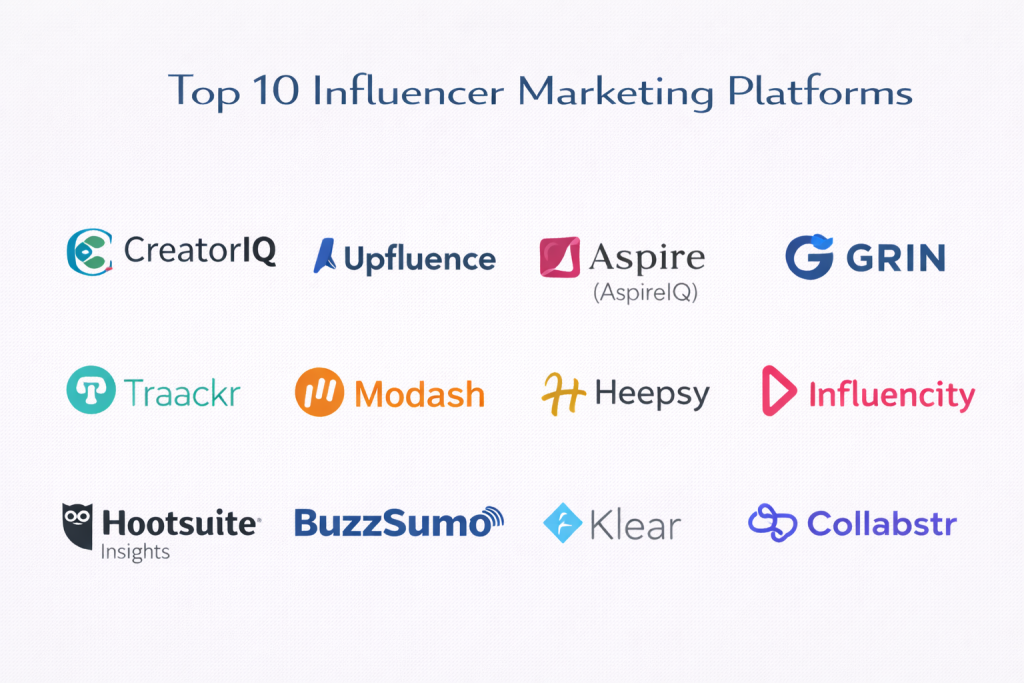
Top 10 Influencer Marketing Platforms
#1 — CreatorIQ
Short description: Enterprise influencer marketing platform with advanced analytics and large creator database.
Key Features
- Influencer discovery engine
- Campaign management
- Real-time analytics
- KPI tracking
- Fraud detection
- CRM integration
- Global influencer database
Pros
- Enterprise-grade insights
- Highly scalable
Cons
- Expensive
- Complex setup
Platforms / Deployment
Cloud
Security & Compliance
Enterprise controls (details not publicly stated)
Integrations & Ecosystem
Strong enterprise integrations.
- APIs
- CRM tools
- Marketing platforms
Support & Community
Enterprise-level support.
#2 — Upfluence
Short description: All-in-one influencer and affiliate marketing platform focused on e-commerce brands.
Key Features
- Influencer discovery
- Campaign management
- Affiliate tracking
- Payment automation
- Analytics
- CRM integration
- AI insights
Pros
- Strong e-commerce focus
- ROI tracking
Cons
- Pricing
- Learning curve
Platforms / Deployment
Cloud
Security & Compliance
Basic enterprise controls (not publicly stated)
Integrations & Ecosystem
E-commerce integrations.
- APIs
- Shopify
- CRM tools
Support & Community
Good support.
#3 — Aspire (AspireIQ)
Short description: Platform focused on influencer relationships and campaign workflows.
Key Features
- Influencer discovery
- Campaign workflows
- Relationship management
- Content collaboration
- Analytics
- Automation
- CRM tools
Pros
- Strong collaboration features
- Easy campaign management
Cons
- Limited deep analytics
- Pricing
Platforms / Deployment
Cloud
Security & Compliance
Basic controls (not publicly stated)
Integrations & Ecosystem
Moderate integrations.
- APIs
- Marketing tools
Support & Community
Good support.
#4 — GRIN
Short description: Influencer platform designed for direct-to-consumer brands with e-commerce integration.
Key Features
- Influencer discovery
- Campaign management
- Affiliate tracking
- E-commerce integration
- Analytics
- Reporting
- Relationship management
Pros
- Strong DTC focus
- Scalable
Cons
- Pricing
- Setup complexity
Platforms / Deployment
Cloud
Security & Compliance
Basic controls (not publicly stated)
Integrations & Ecosystem
E-commerce ecosystem.
- APIs
- Shopify
Support & Community
Strong adoption.
#5 — Traackr
Short description: Data-driven influencer marketing platform focused on performance analytics.
Key Features
- Influencer discovery
- Performance analytics
- Campaign tracking
- ROI measurement
- Benchmarking
- Reporting
- Data insights
Pros
- Strong analytics
- Enterprise-ready
Cons
- Expensive
- Learning curve
Platforms / Deployment
Cloud
Security & Compliance
Enterprise controls (not publicly stated)
Integrations & Ecosystem
Enterprise integrations.
- APIs
- Data tools
Support & Community
Enterprise support.
#6 — Modash
Short description: Influencer discovery platform with a large global creator database.
Key Features
- Influencer search
- Audience insights
- Campaign tracking
- Fraud detection
- Analytics
- API access
- Reporting
Pros
- Large influencer database
- Easy to use
Cons
- Limited campaign tools
- Developer-focused
Platforms / Deployment
Cloud
Security & Compliance
Basic controls (not publicly stated)
Integrations & Ecosystem
Developer integrations.
- APIs
- Data tools
Support & Community
Growing adoption.
#7 — Heepsy
Short description: Affordable influencer discovery tool with filtering and analytics features.
Key Features
- Influencer search
- Audience analytics
- Fraud detection
- Campaign tracking
- Reporting
- Multi-platform support
- Filters
Pros
- Easy to use
- Budget-friendly
Cons
- Limited campaign features
- Basic analytics
Platforms / Deployment
Cloud
Security & Compliance
Basic controls (not publicly stated)
Integrations & Ecosystem
Moderate integrations.
- APIs
- Marketing tools
Support & Community
Good support.
#8 — Influencity
Short description: Full-suite influencer marketing platform with analytics and campaign management.
Key Features
- Influencer discovery
- Campaign management
- Audience insights
- Analytics
- Automation
- Reporting
- API access
Pros
- Balanced features
- Scalable
Cons
- UI complexity
- Pricing
Platforms / Deployment
Cloud
Security & Compliance
Basic controls (not publicly stated)
Integrations & Ecosystem
Moderate integrations.
- APIs
- CRM tools
Support & Community
Growing adoption.
#9 — Klear
Short description: Influencer marketing platform focused on analytics and relationship management.
Key Features
- Influencer discovery
- Campaign management
- Analytics
- Relationship tracking
- Reporting
- Automation
- CRM tools
Pros
- Strong analytics
- Easy to use
Cons
- Pricing
- Limited customization
Platforms / Deployment
Cloud
Security & Compliance
Basic controls (not publicly stated)
Integrations & Ecosystem
Moderate integrations.
- APIs
- Marketing tools
Support & Community
Good support.
#10 — Collabstr
Short description: Marketplace platform for quickly finding and hiring influencers.
Key Features
- Influencer marketplace
- Campaign management
- Direct hiring
- Pricing transparency
- Analytics
- Content collaboration
- Multi-platform support
Pros
- Easy onboarding
- Transparent pricing
Cons
- Limited enterprise features
- Marketplace-focused
Platforms / Deployment
Cloud
Security & Compliance
Basic controls (not publicly stated)
Integrations & Ecosystem
Moderate integrations.
- APIs
- Social platforms
Support & Community
Growing community.
Comparison Table (Top 10)
| Tool Name | Best For | Platform(s) Supported | Deployment | Standout Feature | Public Rating |
|---|---|---|---|---|---|
| CreatorIQ | Enterprise | Web | Cloud | Advanced analytics | N/A |
| Upfluence | E-commerce | Web | Cloud | Affiliate tracking | N/A |
| Aspire | Agencies | Web | Cloud | Creator workflows | N/A |
| GRIN | DTC brands | Web | Cloud | E-commerce integration | N/A |
| Traackr | Enterprise | Web | Cloud | ROI analytics | N/A |
| Modash | Discovery | Web | Cloud | Large database | N/A |
| Heepsy | SMB | Web | Cloud | Influencer filters | N/A |
| Influencity | SMB/Mid | Web | Cloud | Full-suite platform | N/A |
| Klear | Marketing teams | Web | Cloud | Analytics | N/A |
| Collabstr | SMB | Web | Cloud | Marketplace model | N/A |
Evaluation & Scoring of Influencer Marketing Platforms
| Tool Name | Core (25%) | Ease (15%) | Integrations (15%) | Security (10%) | Performance (10%) | Support (10%) | Value (15%) | Weighted Total |
|---|---|---|---|---|---|---|---|---|
| CreatorIQ | 10 | 6 | 9 | 9 | 9 | 9 | 6 | 8.8 |
| Upfluence | 9 | 7 | 9 | 8 | 8 | 8 | 7 | 8.3 |
| Aspire | 8 | 8 | 8 | 7 | 8 | 8 | 7 | 8.0 |
| GRIN | 9 | 7 | 9 | 8 | 8 | 8 | 7 | 8.2 |
| Traackr | 9 | 6 | 9 | 9 | 9 | 9 | 6 | 8.4 |
| Modash | 8 | 8 | 7 | 7 | 8 | 7 | 8 | 7.9 |
| Heepsy | 7 | 9 | 6 | 6 | 7 | 7 | 9 | 7.5 |
| Influencity | 8 | 7 | 7 | 7 | 8 | 7 | 8 | 7.8 |
| Klear | 8 | 8 | 7 | 7 | 8 | 7 | 7 | 7.8 |
| Collabstr | 7 | 9 | 6 | 6 | 7 | 7 | 8 | 7.4 |
Interpretation:
Scores reflect comparative strengths across discovery, analytics, and campaign management. Enterprise platforms excel in scalability and insights, while SMB tools focus on ease of use and affordability.
Which Influencer Marketing Platform Is Right for You?
Solo / Freelancer
- Best: Collabstr, Heepsy
- Easy influencer discovery
SMB
- Best: Influencity, Modash
- Balanced features
Mid-Market
- Best: Aspire, Upfluence
- Strong campaign tools
Enterprise
- Best: CreatorIQ, Traackr
- Advanced analytics and scale
Budget vs Premium
- Budget: Heepsy, Collabstr
- Premium: CreatorIQ, Traackr
Feature Depth vs Ease of Use
- Feature-heavy: CreatorIQ, Traackr
- Easy-to-use: Heepsy, Collabstr
Integrations & Scalability
- Strong: Upfluence, GRIN
- Moderate: Influencity
Security & Compliance Needs
- Enterprise-grade: CreatorIQ, Traackr
- Basic: Collabstr
Frequently Asked Questions (FAQs)
What are influencer marketing platforms?
They help brands discover, manage, and track influencer campaigns.
Why use influencer marketing tools?
They improve efficiency and ROI tracking.
How do these platforms find influencers?
They use filters, analytics, and AI-based discovery.
Are influencer platforms expensive?
Pricing varies from affordable to enterprise-level.
Can I track campaign performance?
Yes, most tools provide analytics dashboards.
Do they support multiple social platforms?
Yes, including Instagram, TikTok, and YouTube.
Are influencer platforms suitable for small businesses?
Yes, many tools offer SMB-friendly plans.
Can I automate outreach?
Yes, many platforms support automation workflows.
What is influencer fraud detection?
It identifies fake followers and engagement.
What is the future of influencer marketing platforms?
AI-driven insights and creator economy integration.
Conclusion
Influencer marketing platforms have become essential for brands looking to scale creator partnerships and achieve measurable results. From enterprise solutions like CreatorIQ and Traackr to accessible platforms like Heepsy and Collabstr, there are tools available for every business size and strategy. While advanced platforms provide deep analytics and campaign control, simpler tools offer faster onboarding and ease of use. The best approach is to define your influencer marketing goals, shortlist a few platforms, test their discovery and analytics capabilities, and ensure they integrate seamlessly with your marketing ecosystem before making a final decision.
