Introduction
Hotel Revenue Management Systems are specialized software platforms designed to help hotels optimize pricing, inventory, and distribution strategies to maximize revenue. In simple terms, they analyze demand patterns, competitor pricing, and market trends to recommend the best room rates at the right time.
In today’s competitive hospitality landscape, dynamic pricing is no longer optional. With increasing online competition, fluctuating travel demand, and digital booking platforms, hotels need intelligent systems that adapt in real time. Modern systems now incorporate AI, automation, and predictive analytics to stay ahead.
Common use cases include:
- Adjusting room prices based on demand fluctuations
- Forecasting occupancy and revenue trends
- Managing distribution across OTAs and direct channels
- Competitor rate monitoring and benchmarking
- Optimizing group bookings and corporate contracts
What buyers should evaluate:
- Pricing automation and AI capabilities
- Forecasting accuracy and reporting
- Integration with PMS and channel managers
- Ease of use and training requirements
- Security and access control features
- Scalability for multi-property operations
- Support and onboarding quality
- Customization and rule flexibility
Best for: Hotel chains, independent hotels, revenue managers, and hospitality groups aiming to maximize occupancy and profitability through data-driven pricing.
Not ideal for: Very small guesthouses or manual operations with low booking volume, where spreadsheets or basic PMS tools may be sufficient.
Key Trends in Hotel Revenue Management Systems
- AI-driven pricing models replacing manual rate adjustments
- Real-time demand forecasting using large data sets
- Integration with channel managers and PMS platforms for unified operations
- Automation of rate strategies based on occupancy and seasonality
- Cloud-based deployment models for accessibility and scalability
- Focus on total revenue optimization including upselling and ancillary revenue
- Advanced competitor benchmarking tools
- Mobile dashboards for on-the-go decision-making
- Stronger security layers including role-based access control and audit logs
- Shift toward unified hospitality platforms combining RMS, CRM, and analytics
How We Evaluate Hotel Revenue Management Systems (Methodology)
- Market adoption and industry recognition
- Feature depth including automation and forecasting
- Reliability and performance consistency
- Security capabilities such as access control and data protection
- Integration ecosystem with PMS, CRS, and OTAs
- Ease of use for non-technical hotel staff
- Flexibility for different hotel sizes and business models
- Support quality and onboarding experience
- Scalability for multi-property operations
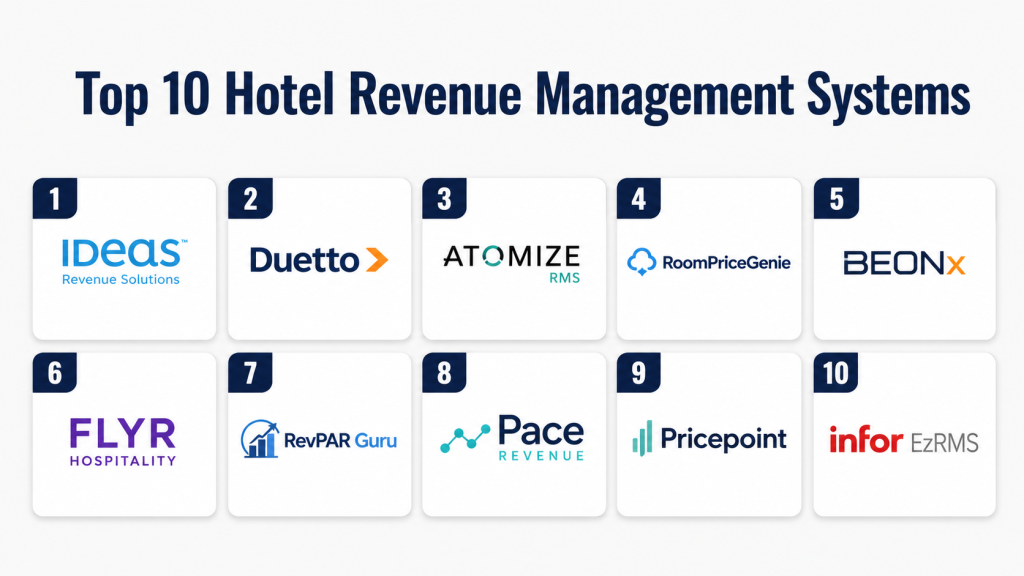
Top 10 Hotel Revenue Management Systems
#1 — IDeaS Revenue Solutions
Short description:
IDeaS is one of the most established revenue management platforms used by global hotel chains. It focuses on advanced analytics and AI-driven pricing strategies to maximize profitability. The platform supports large-scale operations with deep forecasting capabilities. It is ideal for enterprise hotels that require precise revenue optimization. Its automation reduces manual intervention significantly. It integrates well with major hospitality systems. Overall, it is built for data-driven decision making.
Key Features
- AI-powered demand forecasting
- Dynamic pricing automation
- Advanced reporting dashboards
- Group pricing optimization
- Multi-property management
- Competitor rate analysis
Pros
- Highly accurate forecasting
- Strong enterprise scalability
Cons
- Complex setup for beginners
- Premium pricing
Platforms / Deployment
Cloud
Security & Compliance
SSO, RBAC, encryption, audit logs
Other certifications: Not publicly stated
Integrations & Ecosystem
Integrates with major PMS and channel managers. Supports APIs for custom workflows. Strong ecosystem in enterprise hospitality systems.
- PMS integrations
- CRS connectivity
- Channel manager support
- API access
Support & Community
Strong enterprise support with onboarding programs and dedicated account managers.
#2 — Duetto
Short description:
Duetto is a modern cloud-based revenue management system focused on real-time pricing and flexibility. It uses open pricing models to allow hotels to optimize rates dynamically. It is widely used by boutique and mid-sized hotels. The platform emphasizes usability and quick deployment. It supports multiple revenue streams beyond rooms. It is known for its intuitive interface. Duetto is ideal for agile pricing strategies.
Key Features
- Open pricing model
- Real-time analytics
- Demand forecasting
- Revenue strategy automation
- Multi-channel pricing
- User-friendly dashboards
Pros
- Flexible pricing strategies
- Easy to use interface
Cons
- Limited deep analytics compared to enterprise tools
- May require integrations for full functionality
Platforms / Deployment
Cloud
Security & Compliance
Encryption, RBAC
Other certifications: Not publicly stated
Integrations & Ecosystem
Connects with PMS, booking engines, and channel managers. Offers APIs for extensibility.
- PMS integration
- Booking engine connectivity
- Channel distribution
- API support
Support & Community
Good onboarding support with responsive customer service.
#3 — Atomize RMS
Short description:
Atomize is a fast-growing revenue management platform known for its real-time pricing engine. It uses machine learning to adjust rates based on live demand signals. It is suitable for small to mid-sized hotels. The platform emphasizes automation and simplicity. It reduces manual pricing efforts significantly. It provides clear insights for revenue teams. Atomize is designed for quick ROI.
Key Features
- Real-time rate optimization
- Machine learning forecasting
- Automated pricing rules
- Demand signal analysis
- Revenue insights dashboard
Pros
- Strong automation
- Easy implementation
Cons
- Limited enterprise features
- Smaller ecosystem
Platforms / Deployment
Cloud
Security & Compliance
Not publicly stated
Integrations & Ecosystem
Integrates with PMS and distribution platforms. Focuses on simplicity rather than deep integrations.
- PMS connectivity
- Channel manager integration
- API access
Support & Community
Good customer support with onboarding assistance.
#4 — RevPAR Guru
Short description:
RevPAR Guru is designed for independent hotels looking for automated revenue management. It simplifies pricing strategies with easy-to-use tools. The platform focuses on maximizing occupancy and revenue simultaneously. It is cost-effective for smaller properties. It provides actionable insights without complexity. RevPAR Guru is ideal for non-technical users. It offers a balance between automation and control.
Key Features
- Automated pricing engine
- Revenue forecasting
- Competitor analysis
- Reporting tools
- Channel management support
Pros
- Affordable solution
- Easy to operate
Cons
- Limited advanced analytics
- Not ideal for large enterprises
Platforms / Deployment
Cloud
Security & Compliance
Not publicly stated
Integrations & Ecosystem
Supports integrations with PMS and booking systems. Limited compared to enterprise tools.
- PMS integration
- Booking platforms
- Channel connectivity
Support & Community
Reliable support with helpful onboarding.
#5 — BEONx
Short description:
BEONx focuses on total revenue optimization beyond room pricing. It helps hotels maximize profitability across multiple revenue streams. The platform uses AI-driven insights for better decision making. It is suitable for mid to large hotels. It provides advanced dashboards and analytics. It supports strategic planning. BEONx is designed for holistic revenue growth.
Key Features
- Total revenue optimization
- AI-driven analytics
- Demand forecasting
- Strategic pricing tools
- Performance dashboards
Pros
- Focus on total revenue
- Strong analytics
Cons
- Learning curve
- Higher cost
Platforms / Deployment
Cloud
Security & Compliance
Not publicly stated
Integrations & Ecosystem
Integrates with PMS and financial systems. Supports data-driven workflows.
- PMS integration
- Financial tools
- API connectivity
Support & Community
Enterprise-level support available.
#6 — RoomPriceGenie
Short description:
RoomPriceGenie is a simple and affordable RMS designed for small hotels and guesthouses. It automates pricing without requiring deep technical expertise. The platform is easy to set up and use. It focuses on delivering quick results. It provides clear pricing recommendations. RoomPriceGenie is ideal for small teams. It reduces manual effort significantly.
Key Features
- Automated pricing
- Easy setup
- Demand forecasting
- Pricing recommendations
- Simple dashboard
Pros
- Beginner-friendly
- Affordable
Cons
- Limited advanced features
- Basic analytics
Platforms / Deployment
Cloud
Security & Compliance
Not publicly stated
Integrations & Ecosystem
Supports integrations with PMS and booking platforms.
- PMS integration
- Booking engines
- Channel managers
Support & Community
Strong customer support for small businesses.
#7 — Pace Revenue
Short description:
Pace Revenue offers predictive analytics and demand-based pricing tools. It helps hotels understand future demand trends accurately. The platform is designed for mid-sized hotels. It provides clear insights and automation. It improves decision-making speed. It focuses on data transparency. Pace Revenue is ideal for growth-focused hotels.
Key Features
- Predictive analytics
- Demand forecasting
- Automated pricing
- Data visualization
- Market insights
Pros
- Strong forecasting
- Transparent data insights
Cons
- Limited brand recognition
- Smaller ecosystem
Platforms / Deployment
Cloud
Security & Compliance
Not publicly stated
Integrations & Ecosystem
Integrates with PMS and analytics platforms.
- PMS connectivity
- Data integration
- API support
Support & Community
Good support with responsive teams.
#8 — Pricepoint
Short description:
Pricepoint is designed for independent hotels seeking automated pricing. It uses AI to adjust rates dynamically. The platform is easy to use and implement. It focuses on maximizing occupancy. It provides actionable insights. It is suitable for small to mid-sized properties. Pricepoint is known for simplicity.
Key Features
- AI pricing engine
- Automated rate updates
- Demand analysis
- Revenue insights
- Easy dashboard
Pros
- Simple interface
- Quick setup
Cons
- Limited enterprise features
- Basic reporting
Platforms / Deployment
Cloud
Security & Compliance
Not publicly stated
Integrations & Ecosystem
Supports integrations with core hotel systems.
- PMS integration
- Channel managers
- API support
Support & Community
Reliable support for smaller hotels.
#9 — Cloudbeds Pricing Intelligence Engine
Short description:
Cloudbeds offers an integrated RMS within its hospitality platform. It combines PMS, booking, and pricing tools. The platform is suitable for hotels already using Cloudbeds. It provides centralized management. It simplifies operations. It supports scalability. It is ideal for unified systems.
Key Features
- Integrated RMS
- Centralized dashboard
- Dynamic pricing
- Multi-property support
- Reporting tools
Pros
- All-in-one platform
- Easy integration
Cons
- Limited standalone flexibility
- Best within Cloudbeds ecosystem
Platforms / Deployment
Cloud
Security & Compliance
Encryption, RBAC
Other certifications: Not publicly stated
Integrations & Ecosystem
Part of a broader ecosystem with PMS and booking tools.
- PMS integration
- Booking engine
- Channel distribution
Support & Community
Strong support with global reach.
#10 — Infor EzRMS
Short description:
Infor EzRMS is an enterprise-grade revenue management system designed for large hotel chains. It provides advanced analytics and forecasting. The platform supports complex pricing strategies. It integrates deeply with enterprise systems. It is suitable for large operations. It offers scalability and reliability. EzRMS is built for enterprise performance.
Key Features
- Advanced forecasting
- Enterprise scalability
- Pricing optimization
- Data analytics
- Multi-property management
Pros
- Powerful analytics
- Enterprise-ready
Cons
- Complex implementation
- Higher cost
Platforms / Deployment
Cloud / Hybrid
Security & Compliance
SSO, RBAC, encryption
Other certifications: Not publicly stated
Integrations & Ecosystem
Strong integration with enterprise hospitality systems.
- PMS integration
- ERP connectivity
- API support
Support & Community
Enterprise-level support with strong documentation.
Comparison Table (Top 10)
| Tool Name | Best For | Platforms | Deployment | Standout Feature | Public Rating |
|---|---|---|---|---|---|
| IDeaS | Enterprise hotels | Web | Cloud | AI forecasting | N/A |
| Duetto | Flexible pricing | Web | Cloud | Open pricing | N/A |
| Atomize | SMB hotels | Web | Cloud | Real-time pricing | N/A |
| RevPAR Guru | Small hotels | Web | Cloud | Affordable automation | N/A |
| BEONx | Revenue optimization | Web | Cloud | Total revenue focus | N/A |
| RoomPriceGenie | Small hotels | Web | Cloud | Simplicity | N/A |
| Pace Revenue | Mid-market | Web | Cloud | Predictive analytics | N/A |
| Pricepoint | Independent hotels | Web | Cloud | AI pricing | N/A |
| Cloudbeds | Integrated systems | Web | Cloud | Unified platform | N/A |
| Infor EzRMS | Enterprise | Web | Cloud/Hybrid | Advanced analytics | N/A |
Evaluation & Scoring of Hotel Revenue Management Systems
| Tool | Core | Ease | Integrations | Security | Performance | Support | Value | Total |
|---|---|---|---|---|---|---|---|---|
| IDeaS | 9 | 7 | 9 | 8 | 9 | 9 | 7 | 8.4 |
| Duetto | 8 | 9 | 8 | 7 | 8 | 8 | 8 | 8.1 |
| Atomize | 8 | 9 | 7 | 6 | 8 | 7 | 8 | 7.8 |
| RevPAR Guru | 7 | 9 | 6 | 6 | 7 | 7 | 9 | 7.6 |
| BEONx | 9 | 7 | 8 | 7 | 8 | 8 | 7 | 8.0 |
| RoomPriceGenie | 7 | 10 | 6 | 6 | 7 | 8 | 9 | 7.7 |
| Pace Revenue | 8 | 8 | 7 | 6 | 8 | 7 | 8 | 7.7 |
| Pricepoint | 7 | 9 | 6 | 6 | 7 | 7 | 8 | 7.4 |
| Cloudbeds | 8 | 9 | 9 | 7 | 8 | 9 | 8 | 8.3 |
| Infor EzRMS | 9 | 6 | 9 | 8 | 9 | 9 | 7 | 8.3 |
How to interpret:
These scores are comparative and based on weighted criteria. A higher score indicates stronger overall capability but does not guarantee the best fit. Ease of use and value can outweigh advanced features for smaller hotels. Enterprise tools often score higher in performance but lower in simplicity. Always match scores with your operational needs. Consider running a pilot before final selection.
Which Hotel Revenue Management Systems Is Right for You?
Solo / Freelancer
Choose RoomPriceGenie or RevPAR Guru for simplicity and low cost.
SMB
Atomize, Pricepoint, or Duetto offer a balance of automation and usability.
Mid-Market
Pace Revenue or BEONx provide better analytics and scalability.
Enterprise
IDeaS and Infor EzRMS deliver advanced forecasting and integration capabilities.
Budget vs Premium
Budget tools focus on automation with fewer features. Premium tools offer deeper analytics and integrations.
Feature Depth vs Ease of Use
Complex tools provide better forecasting but require training. Simpler tools are faster to adopt.
Integrations & Scalability
Choose platforms with strong PMS and channel manager integrations for growth.
Security & Compliance Needs
Enterprise hotels should prioritize systems with SSO, RBAC, and audit logs.
Frequently Asked Questions (FAQs)
1. What is a hotel revenue management system?
A hotel revenue management system is software that helps hotels optimize pricing and occupancy. It analyzes demand, competitor pricing, and booking trends. The system suggests or automates pricing strategies. This improves revenue and profitability. It is widely used by hotels of all sizes. It replaces manual pricing methods.
2. How much do these systems cost?
Pricing varies based on hotel size and features. Some tools offer subscription-based pricing. Others may charge based on room count or revenue. Entry-level tools are more affordable. Enterprise systems are more expensive. Exact pricing is usually not publicly stated.
3. How long does implementation take?
Implementation time depends on system complexity. Simple tools can be set up in a few days. Advanced systems may take weeks. Integration with PMS and training also affects timelines. Most vendors provide onboarding support. Planning is important for smooth deployment.
4. Are these systems secure?
Most modern systems include encryption and access controls. Features like RBAC and audit logs are common. Some offer SSO and MFA. Compliance certifications vary by vendor. Always verify security details before purchase. Security is critical for enterprise use.
5. Can these tools integrate with PMS?
Yes, integration with PMS is essential. Most RMS platforms support major PMS systems. This allows automatic data sharing. It ensures accurate pricing decisions. Integration reduces manual work. APIs are often available for customization.
6. Do small hotels need RMS?
Small hotels can benefit from RMS if they have variable demand. It helps maximize occupancy and revenue. However, very small operations may not need advanced tools. Simple solutions may be enough. Cost-benefit analysis is important. Choose based on scale.
7. What are common mistakes when choosing RMS?
Choosing overly complex tools is a common mistake. Ignoring integration requirements can cause issues. Not considering ease of use affects adoption. Underestimating training needs is risky. Focusing only on price can lead to poor results. Proper evaluation is key.
8. Can RMS handle multiple properties?
Yes, many systems support multi-property management. Enterprise tools are designed for this. They provide centralized dashboards. This helps manage pricing across locations. Scalability is important for hotel chains. Ensure the system supports growth.
9. What alternatives exist to RMS?
Alternatives include manual pricing or basic PMS tools. Some hotels use spreadsheets. However, these lack automation. RMS provides better accuracy and efficiency. Alternatives may work for small setups. Larger hotels need dedicated systems.
10. Is AI important in RMS?
AI plays a key role in modern RMS. It improves forecasting accuracy. It enables dynamic pricing. AI reduces manual effort. It adapts to market changes quickly. Most advanced systems now include AI features. It is becoming essential.
Conclusion
Hotel Revenue Management Systems have evolved from basic pricing tools into advanced, AI-driven platforms that enable hotels to maximize profitability with precision. Whether it is forecasting demand, adjusting rates in real time, or managing multiple revenue streams, these systems provide a clear competitive advantage in a dynamic hospitality market.
The right solution depends heavily on your hotel size, operational complexity, and growth ambitions. Smaller properties benefit from simplicity and automation, while larger enterprises require deep analytics, integrations, and scalability. Security, integrations, and ease of use should always be part of your evaluation checklist alongside pricing and feature depth.
To move forward, shortlist two or three tools that match your requirements, request demos, and run a pilot implementation. Validate how well they integrate with your existing systems and how easily your team can adopt them. A well-chosen RMS can significantly improve both occupancy and long-term revenue performance.
