Introduction
Hedge Fund Order Management Systems OMS help investment teams manage the full trade order lifecycle from idea generation to order creation, compliance checks, execution routing, allocation, confirmation, and post-trade workflows. In simple terms, an OMS acts as the operational control center for hedge fund trading activity, helping portfolio managers, traders, compliance teams, and operations teams work from a shared system instead of disconnected spreadsheets, emails, and broker portals.
For hedge funds, OMS platforms matter because trade complexity, multi-asset strategies, regulatory oversight, and operational risk continue to increase. A strong OMS helps firms reduce manual errors, improve execution visibility, support compliance controls, and manage trading workflows across portfolios and counterparties.
Real-world use cases include:
- Managing equity, fixed income, derivatives, and multi-asset orders
- Pre-trade and post-trade compliance checks
- Trade allocation across funds and accounts
- Broker and execution venue connectivity
- Portfolio rebalancing and risk-aware trade workflows
Buyers should evaluate:
- Asset class coverage
- Pre-trade compliance controls
- Execution management integration
- Broker and counterparty connectivity
- Portfolio and position visibility
- API and integration flexibility
- Reporting and audit trails
- Security and user permissions
- Deployment model and scalability
- Support quality and implementation complexity
Best for: Hedge funds, asset managers, investment advisers, trading desks, portfolio managers, compliance teams, and operations teams that need structured order control, execution visibility, compliance workflows, and portfolio-level trade management.
Not ideal for: Small investment teams with very simple trading workflows, firms using only one broker portal, or organizations that only need lightweight portfolio tracking rather than full trade lifecycle management.
Key Trends in Hedge Fund Order Management Systems OMS
- Converged OMS and EMS workflows are becoming more important as hedge funds want order creation, execution, routing, and monitoring in one connected environment.
- Multi-asset trading support is now a key requirement because many hedge funds trade equities, options, futures, fixed income, swaps, FX, and private instruments.
- Compliance automation is expanding, especially for pre-trade checks, restricted lists, position limits, allocation rules, and audit trails.
- Cloud and hosted deployment models are gaining adoption because firms want faster implementation, easier upgrades, and reduced infrastructure burden.
- API-first architecture is becoming essential for connecting OMS platforms with risk systems, portfolio accounting, data warehouses, reporting tools, and analytics platforms.
- Real-time portfolio visibility is increasingly expected, including positions, cash, exposures, orders, fills, and compliance status.
- Integrated data workflows are improving decision-making by combining market data, reference data, pricing, holdings, and transaction history.
- Security and access governance are becoming stronger buying factors, especially for firms with multiple teams, regions, strategies, and external administrators.
- Operational resilience is now central to OMS selection because trade failures, duplicate orders, and broken allocations can create serious financial and compliance risk.
- Configurable workflows are preferred over rigid systems because hedge funds often have unique trading, approval, and allocation processes.
How We Evaluated Hedge Fund Order Management Systems OMS
The following Top 10 platforms were selected using practical buyer-focused criteria:
- Market adoption and recognition among hedge funds, asset managers, investment firms, and institutional trading teams.
- Core OMS capability, including order creation, routing, compliance, allocation, and trade lifecycle management.
- Multi-asset support, especially for firms trading more than one instrument type or strategy.
- Execution and broker connectivity, including EMS integration, FIX connectivity, and counterparty workflows.
- Portfolio and position visibility, including intraday updates, cash views, holdings, and exposure monitoring.
- Compliance and audit controls, especially pre-trade rules, restricted lists, approvals, and reporting support.
- Integration ecosystem, including APIs, accounting platforms, risk tools, market data, custodians, administrators, and reporting systems.
- Scalability and reliability, including support for high-volume trading, multiple funds, multiple desks, and global workflows.
- Security posture signals, including user permissions, access controls, audit logs, and enterprise administration.
- Customer fit, including suitability for hedge funds, asset managers, large institutions, and growing investment firms.
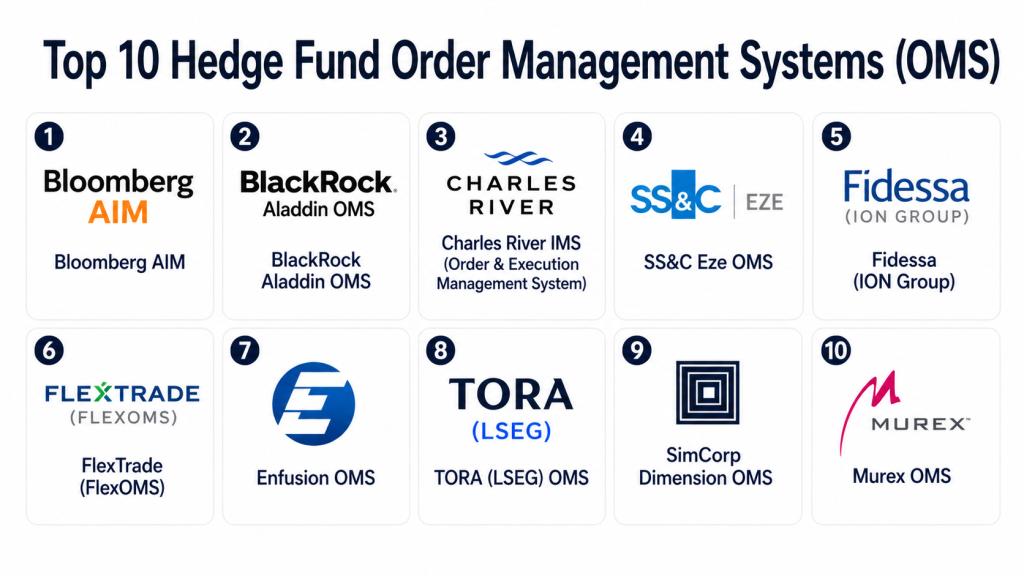
Top 10 Hedge Fund Order Management Systems OMS
#1 — Charles River IMS
Short description: Charles River IMS is an enterprise investment management platform used by asset managers, hedge funds, wealth managers, and institutional investment teams.
It supports portfolio management, order management, compliance, trading, and post-trade workflows in a connected environment.
The platform is best suited for firms that need institutional-grade control across portfolios, asset classes, and investment operations.
Hedge funds can use it to manage orders, compliance checks, allocations, portfolio views, and trade lifecycle processes.
Its strength is the breadth of front-to-middle office coverage rather than being a lightweight standalone trading tool.
Charles River IMS is often considered by larger firms with complex investment workflows and compliance needs.
Implementation can be significant, but it can support sophisticated operating models when configured properly.
It is a strong option for hedge funds that need scale, governance, and deep investment workflow coverage.
Key Features
- Order management and trade lifecycle workflows
- Portfolio management and position visibility
- Pre-trade and post-trade compliance support
- Multi-asset investment workflow coverage
- Trade allocation and confirmation workflows
- Enterprise reporting and audit trails
- Integrations with market data, accounting, and risk systems
Pros
- Strong institutional workflow coverage for complex investment teams.
- Suitable for hedge funds that need compliance, portfolio, and trading workflows in one environment.
- Scales well for larger and multi-strategy organizations.
Cons
- Implementation can be complex and resource-intensive.
- May be more platform than smaller hedge funds need.
- Cost and configuration effort can be high compared with lighter OMS tools.
Platforms / Deployment
Cloud / Hosted / Enterprise deployment options vary
Security & Compliance
Enterprise access controls, permissions, and audit workflows are commonly expected in this type of platform.
Specific certifications and compliance claims: Not publicly stated.
Integrations & Ecosystem
Charles River IMS is designed for enterprise investment operations and connects with data, trading, accounting, risk, and reporting ecosystems. It is best evaluated as part of a broader investment management architecture.
- Market data integrations
- Broker and trading connectivity
- Portfolio accounting integrations
- Risk and analytics systems
- Compliance workflows
- Enterprise reporting tools
Support & Community
Support is generally enterprise-focused, with implementation, onboarding, training, and account support depending on contract scope. Community visibility is more institutional than open community-based.
#2 — Bloomberg AIM
Short description: Bloomberg AIM is an investment and order management platform designed for asset managers, hedge funds, insurance companies, and institutional investment teams.
It combines portfolio management, order management, compliance, trading workflows, and operational tools.
The platform is especially strong for firms already using Bloomberg data, analytics, messaging, and terminal workflows.
Hedge funds can use Bloomberg AIM for order creation, compliance checks, trade routing, portfolio monitoring, and operations coordination.
Its ecosystem advantage is significant because Bloomberg is already deeply embedded in many trading and investment workflows.
The platform can support multi-asset investment processes and front-office collaboration.
It is best for firms that value data, analytics, connectivity, and institutional-grade workflows in one environment.
Bloomberg AIM is a strong choice for hedge funds that want OMS capabilities closely connected to Bloomberg’s broader ecosystem.
Key Features
- Order management and portfolio workflows
- Pre-trade and post-trade compliance tools
- Multi-asset investment workflow support
- Bloomberg data and analytics ecosystem alignment
- Trade routing and execution connectivity
- Position, cash, and exposure visibility
- Reporting and operational workflow support
Pros
- Strong fit for firms already using Bloomberg workflows.
- Deep institutional ecosystem for data, analytics, and trading connectivity.
- Good coverage for hedge funds with complex multi-asset needs.
Cons
- May be expensive for smaller firms.
- Best value is often realized when the firm already uses Bloomberg extensively.
- Customization and implementation require careful planning.
Platforms / Deployment
Bloomberg ecosystem / Cloud or hosted enterprise model varies
Security & Compliance
Enterprise-grade controls are expected, but specific certifications should be confirmed directly.
Specific certifications: Not publicly stated.
Integrations & Ecosystem
Bloomberg AIM benefits from Bloomberg’s broader data, analytics, communication, and trading ecosystem. It is particularly valuable when the OMS is part of a Bloomberg-centered operating model.
- Bloomberg data workflows
- Trading and broker connectivity
- Compliance workflows
- Portfolio analytics
- Market data and reference data
- Reporting and operational tools
Support & Community
Support is enterprise-oriented and typically includes onboarding, account management, training resources, and Bloomberg ecosystem support. Details vary by customer agreement.
#3 — SS&C Eze OMS
Short description: SS&C Eze OMS is a widely recognized order management system used by hedge funds, asset managers, and institutional investment firms.
It supports investment workflows across order creation, compliance, execution, allocations, and portfolio monitoring.
The platform is especially relevant for hedge funds because Eze has long been associated with buy-side trading technology.
It offers OMS and related workflow capabilities that can support multi-asset trading and investment operations.
Hedge funds can use it to connect portfolio managers, traders, compliance teams, and operations staff in one workflow.
Its strength is its institutional focus and support for buy-side trading operations.
It is often considered by firms that need a mature OMS with strong industry recognition.
SS&C Eze OMS is a strong fit for hedge funds seeking proven order and trading workflow infrastructure.
Key Features
- Buy-side order management workflows
- Compliance and trade rule support
- Allocation and trade processing tools
- Portfolio and position visibility
- Multi-asset trading workflow support
- Broker and execution connectivity
- Reporting and operational workflows
Pros
- Strong market recognition in buy-side trading technology.
- Well suited for hedge fund and institutional investment workflows.
- Supports complex order and allocation processes.
Cons
- May require meaningful implementation planning.
- Cost may be high for smaller investment teams.
- Advanced configuration can require specialist knowledge.
Platforms / Deployment
Cloud / Hosted / Enterprise deployment options vary
Security & Compliance
Access controls, workflow controls, and audit capabilities are expected in institutional OMS use cases.
Specific certifications: Not publicly stated.
Integrations & Ecosystem
SS&C Eze OMS fits into a broader buy-side ecosystem that may include execution, accounting, compliance, reporting, and operational systems. It is commonly evaluated by firms looking for mature institutional trading infrastructure.
- Broker connectivity
- Execution workflows
- Compliance tools
- Portfolio systems
- Accounting and operations integrations
- Reporting workflows
Support & Community
Support is enterprise and vendor-led, typically involving implementation, training, configuration, and account support. Community is more institutional than public open community-based.
#4 — Enfusion
Short description: Enfusion is a cloud-native investment management platform that combines portfolio management, order and execution management, accounting, analytics, and operational workflows.
It is widely considered by hedge funds and investment managers that want a unified front-to-back office platform.
The platform is useful for firms that want OMS, PMS, EMS, and accounting workflows connected in one system.
Hedge funds can use Enfusion to manage orders, monitor positions, route trades, handle allocations, and connect operations teams.
Its cloud-native model can reduce infrastructure burden and simplify access for distributed investment teams.
Enfusion is particularly attractive for growing hedge funds that want institutional functionality without building many separate systems.
It can support multiple asset classes and operational workflows depending on configuration.
It is a strong choice for hedge funds seeking an integrated investment operations platform.
Key Features
- Order and execution management workflows
- Portfolio management and accounting capabilities
- Cloud-native investment platform model
- Position, cash, and exposure visibility
- Multi-asset workflow support
- Reporting and analytics
- Operational workflow integration
Pros
- Unified front-to-back platform can reduce system fragmentation.
- Cloud-native model supports modern deployment needs.
- Good fit for hedge funds looking for integrated investment operations.
Cons
- Firms needing only OMS may find the broader platform more than required.
- Implementation scope can grow if many modules are adopted.
- Custom workflow requirements should be validated carefully.
Platforms / Deployment
Cloud / Web-based / Managed platform
Security & Compliance
Enterprise security controls are expected, but certifications and compliance details should be confirmed with the vendor.
Specific certifications: Not publicly stated.
Integrations & Ecosystem
Enfusion is designed as an integrated investment management ecosystem. It connects front-office, middle-office, and back-office workflows and can reduce reliance on multiple disconnected tools.
- Broker and execution connectivity
- Portfolio accounting workflows
- Risk and analytics tools
- Reporting systems
- Data and operations integrations
- Investment workflow modules
Support & Community
Support is vendor-led and commonly includes onboarding, implementation, account support, and platform assistance. Public community activity is limited compared with developer-first platforms.
#5 — SimCorp Dimension
Short description: SimCorp Dimension is an enterprise investment management platform used by asset managers, pension funds, insurers, and large institutional investment teams.
It supports investment operations across portfolio management, order management, compliance, accounting, risk, and reporting workflows.
For hedge funds, it is most relevant when the firm has complex portfolios, multiple asset classes, and institutional operating requirements.
The platform is best suited for larger organizations needing broad investment lifecycle coverage rather than a simple trading tool.
Its strength is enterprise depth, data consistency, and operational control across investment functions.
Hedge funds with global operations or complex reporting needs may consider it for front-to-back investment infrastructure.
Implementation is typically significant and should be planned as a strategic transformation project.
SimCorp Dimension is best for mature firms requiring scale, governance, and deep operational integration.
Key Features
- Enterprise investment management workflows
- Order management and portfolio operations
- Compliance and risk workflow support
- Accounting and reporting capabilities
- Multi-asset and global investment support
- Data consistency across investment lifecycle
- Operational control and audit support
Pros
- Strong enterprise platform for complex investment organizations.
- Broad front-to-back investment lifecycle coverage.
- Good fit for firms needing scale and governance.
Cons
- May be too complex for small hedge funds.
- Implementation can be lengthy and resource-heavy.
- Not ideal for teams wanting a lightweight OMS only.
Platforms / Deployment
Enterprise deployment / Cloud or hosted options vary
Security & Compliance
Enterprise security and operational controls are expected, but specific certifications should be verified directly.
Specific certifications: Not publicly stated.
Integrations & Ecosystem
SimCorp Dimension is commonly used as part of a broad institutional investment operating model. It connects order management, portfolio data, risk, accounting, and reporting workflows.
- Portfolio accounting
- Risk systems
- Compliance workflows
- Data management
- Reporting tools
- Enterprise investment operations
Support & Community
Support is enterprise-focused and usually includes consulting, implementation, training, and customer success resources. Details vary by contract and deployment scope.
#6 — Linedata Longview
Short description: Linedata Longview is an order management and trading platform designed for asset managers, hedge funds, and institutional investment firms.
It supports portfolio management, order creation, compliance, trade execution workflows, and operational processes.
The platform is relevant for hedge funds that need a buy-side OMS with multi-asset capabilities and investment workflow control.
It can help portfolio managers and traders collaborate around orders, allocations, and compliance rules.
Linedata has a broader investment technology portfolio, which can make Longview useful for firms seeking connected operational workflows.
It is best suited for firms that require institutional OMS capability but want flexibility across trading and compliance processes.
Buyers should evaluate integrations, implementation requirements, and asset class support based on their strategy needs.
Linedata Longview is a strong option for hedge funds that need structured OMS functionality with institutional support.
Key Features
- Order management and trade workflow support
- Portfolio and position visibility
- Pre-trade compliance controls
- Trade allocation tools
- Multi-asset workflow capabilities
- Execution and broker connectivity
- Reporting and operational support
Pros
- Strong fit for buy-side investment workflows.
- Supports portfolio, trading, and compliance coordination.
- Useful for hedge funds needing institutional-grade OMS structure.
Cons
- Implementation and customization may require planning.
- Smaller firms may find it more complex than needed.
- Specific capabilities depend on configuration and modules.
Platforms / Deployment
Cloud / Hosted / Enterprise options vary
Security & Compliance
Security controls and permissions are expected in institutional deployments.
Specific certifications: Not publicly stated.
Integrations & Ecosystem
Linedata Longview fits within a broader investment management technology ecosystem. It can connect trading workflows with compliance, operations, reporting, and portfolio systems.
- Broker connectivity
- Compliance systems
- Portfolio workflows
- Reporting tools
- Market data and reference data
- Operations integrations
Support & Community
Support is vendor-led and enterprise-oriented. Onboarding, implementation assistance, and support levels may vary by contract and deployment model.
#7 — FlexTrade FlexOMS
Short description: FlexTrade FlexOMS is an order management system designed for buy-side trading teams that need configurable order workflows and strong execution connectivity.
It is part of FlexTrade’s broader trading technology ecosystem, which includes execution management and multi-asset trading capabilities.
The platform is suitable for hedge funds that want OMS functionality closely connected with execution workflows.
FlexOMS can support order staging, routing, allocation, monitoring, and integration with trading systems.
It is useful for firms that value execution flexibility and configurable trading workflows.
Hedge funds with active trading desks may find it attractive because of FlexTrade’s trading technology focus.
The platform is especially relevant when OMS and EMS alignment is a priority.
FlexOMS is a strong option for hedge funds needing trading workflow depth and execution-oriented architecture.
Key Features
- Order management workflow support
- Execution management ecosystem alignment
- Multi-asset trading workflows
- Configurable order routing
- Trade allocation and monitoring
- Broker and venue connectivity
- Trading desk workflow automation
Pros
- Strong fit for execution-oriented hedge funds.
- Good alignment between OMS and EMS workflows.
- Configurable trading workflow capabilities.
Cons
- May require specialized implementation support.
- Best suited for firms with active trading requirements.
- Smaller teams may not need the full platform depth.
Platforms / Deployment
Cloud / Hosted / Enterprise deployment options vary
Security & Compliance
Enterprise access controls and operational security features are expected, but exact certifications are not publicly stated.
Specific certifications: Not publicly stated.
Integrations & Ecosystem
FlexOMS benefits from FlexTrade’s broader trading ecosystem. It is designed to connect order management with execution, routing, and trading workflows.
- EMS integrations
- Broker connectivity
- Execution venues
- Market data tools
- Trade routing workflows
- Multi-asset trading systems
Support & Community
Support is vendor-led and typically enterprise-focused. Implementation, configuration, and support depend on customer requirements and contract scope.
#8 — TS Imagine TradeSmart OEMS
Short description: TS Imagine TradeSmart OEMS combines order and execution management capabilities for investment firms, hedge funds, and trading desks.
It is designed for users who want a connected workflow across order creation, routing, execution, and monitoring.
The platform is relevant for hedge funds that need trade lifecycle control and execution visibility in one environment.
It can support multi-asset trading workflows and help teams manage orders across desks and strategies.
TradeSmart OEMS is especially useful for firms seeking a combined OMS and EMS experience rather than separate systems.
Its value depends on how well it fits the firm’s asset classes, brokers, and execution workflows.
Buyers should evaluate configuration depth, reporting, integration options, and support model.
It is a strong option for hedge funds seeking integrated order and execution management.
Key Features
- Combined OMS and EMS workflows
- Order routing and execution support
- Multi-asset trading capabilities
- Real-time trade monitoring
- Portfolio and order visibility
- Broker and venue connectivity
- Reporting and workflow tools
Pros
- Useful for firms wanting OMS and EMS in one workflow.
- Strong fit for active trading desks.
- Supports execution visibility and order lifecycle control.
Cons
- May be more complex than standalone OMS tools.
- Configuration requirements should be reviewed carefully.
- Smaller teams may not need full OEMS capabilities.
Platforms / Deployment
Cloud / Hosted / Enterprise options vary
Security & Compliance
Security and access controls are expected in institutional use cases.
Specific certifications: Not publicly stated.
Integrations & Ecosystem
TradeSmart OEMS is designed to connect order workflows with execution, routing, and trade monitoring. It works best when evaluated against a hedge fund’s broker network and asset class needs.
- Broker connectivity
- Execution venues
- Risk and analytics tools
- Portfolio workflows
- Reporting systems
- Trade monitoring tools
Support & Community
Support is vendor-led and institutional-focused. Training, onboarding, and configuration assistance vary by customer engagement.
#9 — Broadridge Investment Management Solutions
Short description: Broadridge Investment Management Solutions provides technology for investment operations, order management, portfolio management, compliance, and post-trade workflows.
It is relevant for hedge funds and asset managers that need scalable infrastructure across the investment lifecycle.
The platform is strongest for firms that value operational connectivity, regulatory support, and post-trade process alignment.
Hedge funds can use Broadridge solutions to support order workflows, accounting, reporting, and operational controls.
Its broader financial technology footprint can be valuable for firms needing enterprise connectivity.
The platform is better suited to institutional teams than very small trading groups.
Buyers should carefully evaluate which Broadridge modules match their OMS and hedge fund workflow needs.
Broadridge is a strong candidate for firms seeking operational scale and institutional process coverage.
Key Features
- Investment management workflow support
- Order and portfolio management capabilities
- Compliance and operational controls
- Post-trade and accounting workflow alignment
- Reporting and data management support
- Scalable enterprise infrastructure
- Integration with broader financial operations
Pros
- Strong institutional operations focus.
- Useful for firms needing more than trade order entry.
- Broad financial technology ecosystem.
Cons
- Product scope can be broad and requires careful module selection.
- May not be ideal for firms wanting a lightweight trading-focused OMS.
- Implementation complexity can vary significantly.
Platforms / Deployment
Cloud / Hosted / Enterprise deployment options vary
Security & Compliance
Enterprise security controls are expected, but specific certifications should be verified directly.
Specific certifications: Not publicly stated.
Integrations & Ecosystem
Broadridge solutions are often used as part of broader investment operations and financial infrastructure. The ecosystem is relevant for firms needing connectivity across trading, accounting, reporting, and operations.
- Investment operations systems
- Portfolio accounting
- Reporting workflows
- Compliance tools
- Data management
- Enterprise integrations
Support & Community
Support is enterprise-oriented and depends on selected solutions, contract scope, implementation model, and customer requirements.
#10 — Murex MX.3
Short description: Murex MX.3 is a sophisticated capital markets technology platform used by banks, asset managers, hedge funds, and financial institutions with complex trading and risk workflows.
It is most relevant for hedge funds that trade complex derivatives, fixed income, structured products, FX, or cross-asset strategies.
The platform covers trading, risk, processing, and enterprise capital markets workflows.
For hedge funds, MX.3 may be considered when order management is tied closely to pricing, risk, valuation, and post-trade processing.
It is not a lightweight OMS for simple equity trading teams.
Its strength is cross-asset depth and complex product support.
Implementation can be significant and requires strong internal expertise or partner support.
Murex MX.3 is best for sophisticated firms that need broad trading and risk infrastructure.
Key Features
- Cross-asset trading workflow support
- Risk and valuation capabilities
- Complex product coverage
- Trade processing and lifecycle management
- Enterprise capital markets infrastructure
- Reporting and control workflows
- Integration with front, middle, and back office systems
Pros
- Strong fit for complex cross-asset and derivatives-heavy workflows.
- Broad trading, risk, and processing coverage.
- Suitable for sophisticated institutional operating models.
Cons
- Too complex for many small or mid-sized hedge funds.
- Implementation can be long and resource-intensive.
- Not focused solely on lightweight OMS needs.
Platforms / Deployment
Enterprise deployment / Hosted or managed options vary
Security & Compliance
Enterprise-grade access controls and operational controls are expected.
Specific certifications: Not publicly stated.
Integrations & Ecosystem
Murex MX.3 is typically part of a complex capital markets technology architecture. It connects trading, risk, valuation, processing, and reporting functions.
- Risk systems
- Pricing workflows
- Trade processing
- Market data
- Reporting systems
- Enterprise financial infrastructure
Support & Community
Support is enterprise-focused and typically involves implementation teams, professional services, training, and long-term customer engagement.
Comparison Table
| Tool Name | Best For | Platform Supported | Deployment | Standout Feature | Public Rating |
|---|---|---|---|---|---|
| Charles River IMS | Large hedge funds and asset managers | Web / Enterprise platform | Cloud / Hosted / Enterprise | Broad investment lifecycle coverage | N/A |
| Bloomberg AIM | Bloomberg-centric investment teams | Bloomberg ecosystem | Hosted / Enterprise | Deep Bloomberg data and workflow integration | N/A |
| SS&C Eze OMS | Buy-side hedge fund trading workflows | Enterprise platform | Cloud / Hosted | Mature institutional OMS capability | N/A |
| Enfusion | Hedge funds wanting front-to-back workflows | Web / Cloud platform | Cloud | Integrated OMS, PMS, EMS, and accounting | N/A |
| SimCorp Dimension | Large institutional investment firms | Enterprise platform | Cloud / Hosted / Enterprise | Enterprise investment operations depth | N/A |
| Linedata Longview | Buy-side OMS and compliance workflows | Enterprise platform | Cloud / Hosted | Trading and compliance workflow support | N/A |
| FlexTrade FlexOMS | Execution-focused hedge fund desks | Enterprise trading platform | Cloud / Hosted | OMS and EMS ecosystem alignment | N/A |
| TS Imagine TradeSmart OEMS | Active trading teams needing OEMS | Enterprise platform | Cloud / Hosted | Combined order and execution management | N/A |
| Broadridge Investment Management Solutions | Operationally complex investment firms | Enterprise platform | Cloud / Hosted / Enterprise | Investment operations and post-trade alignment | N/A |
| Murex MX.3 | Cross-asset and derivatives-heavy firms | Enterprise platform | Hosted / Enterprise | Trading, risk, and processing depth | N/A |
Evaluation & Scoring of Hedge Fund Order Management Systems OMS
| Tool Name | Core 25% | Ease 15% | Integrations 15% | Security 10% | Performance 10% | Support 10% | Value 15% | Weighted Total 0–10 |
|---|---|---|---|---|---|---|---|---|
| Charles River IMS | 10 | 7 | 9 | 9 | 9 | 9 | 7 | 8.60 |
| Bloomberg AIM | 9 | 8 | 10 | 9 | 9 | 9 | 7 | 8.65 |
| SS&C Eze OMS | 9 | 8 | 9 | 8 | 9 | 8 | 8 | 8.45 |
| Enfusion | 9 | 8 | 8 | 8 | 8 | 8 | 8 | 8.25 |
| SimCorp Dimension | 10 | 6 | 9 | 9 | 9 | 9 | 6 | 8.25 |
| Linedata Longview | 8 | 7 | 8 | 8 | 8 | 8 | 8 | 7.85 |
| FlexTrade FlexOMS | 8 | 7 | 9 | 8 | 9 | 8 | 7 | 8.00 |
| TS Imagine TradeSmart OEMS | 8 | 7 | 8 | 8 | 8 | 8 | 7 | 7.75 |
| Broadridge Investment Management Solutions | 8 | 6 | 8 | 9 | 8 | 8 | 7 | 7.65 |
| Murex MX.3 | 9 | 5 | 8 | 9 | 9 | 8 | 6 | 7.75 |
The scoring is comparative and designed to help buyers create a shortlist. A higher score does not mean the platform is the universal best choice for every hedge fund. Large enterprise systems may score high on depth but lower on ease of use and value for smaller teams. Buyers should validate asset class fit, implementation effort, broker connectivity, compliance needs, and total cost before making a final decision.
Which Hedge Fund Order Management System OMS Is Right for You?
Solo / Freelancer
Solo traders and very small investment teams usually do not need a heavy institutional OMS. If the trading workflow is simple, a broker platform, portfolio tracker, or lightweight execution tool may be enough. A full OMS becomes useful only when order volume, allocation complexity, compliance checks, or multiple accounts create operational risk.
For small but serious hedge fund launches, Enfusion or a lighter buy-side platform may be more practical than a very large enterprise system. The key is to avoid overbuying before the operating model is mature.
SMB
Small and mid-sized hedge funds should prioritize implementation speed, cost control, broker connectivity, and core OMS reliability. Enfusion, SS&C Eze OMS, Linedata Longview, and FlexTrade FlexOMS may be worth evaluating depending on asset class and trading style.
SMBs should focus on practical workflow needs: order entry, allocations, compliance rules, portfolio visibility, and reporting. A platform that reduces manual work without overwhelming the team is often the best choice.
Mid-Market
Mid-market hedge funds need stronger controls, broader asset support, deeper integrations, and more reliable operational workflows. Charles River IMS, Bloomberg AIM, SS&C Eze OMS, Enfusion, and TS Imagine TradeSmart OEMS can all fit this segment depending on the firm’s priorities.
At this stage, integration becomes very important. The OMS should connect cleanly with risk, accounting, administrator, broker, data, and reporting systems.
Enterprise
Enterprise hedge funds and global investment firms should focus on scale, governance, multi-region support, advanced compliance, and front-to-back process control. Charles River IMS, Bloomberg AIM, SimCorp Dimension, Broadridge, and Murex MX.3 may fit sophisticated enterprise requirements.
Enterprise buyers should run detailed proof-of-concept testing. They should validate data models, workflow configuration, permissions, audit logs, disaster recovery, and support commitments.
Budget vs Premium
Budget-conscious firms should avoid choosing a platform only because it is less expensive. A low-cost OMS that creates operational gaps can become more expensive over time. Smaller firms should focus on right-sized solutions with strong core workflows.
Premium platforms are often justified when the firm has complex strategies, multiple funds, high order volume, regulatory requirements, and many integrations. The value comes from control, scalability, and reduced operational risk.
Feature Depth vs Ease of Use
Enterprise platforms like SimCorp Dimension, Murex MX.3, and Charles River IMS offer deep functionality but may require more implementation effort. Cloud-native or more focused platforms may be easier to adopt for growing hedge funds.
The best choice depends on team maturity. A smaller team may benefit from a simpler integrated workflow, while a larger team may need advanced customization and governance.
Integrations & Scalability
Hedge funds should evaluate integrations before signing a contract. Important integrations include brokers, custodians, fund administrators, market data providers, risk systems, accounting tools, reporting platforms, and data warehouses.
Scalability matters because OMS replacement is disruptive. Buyers should choose a system that can support future asset classes, new funds, additional users, and more complex workflows.
Security & Compliance Needs
Security and compliance should be central to OMS selection. Buyers should review permissions, MFA, audit trails, approval workflows, encryption, access controls, and separation of duties.
For regulated or institutional firms, it is important to request security documentation directly from vendors. If certifications are not publicly stated, buyers should not assume them.
Frequently Asked Questions FAQs
1. What is a Hedge Fund Order Management System OMS?
A Hedge Fund OMS is software that helps investment teams manage trade orders from creation to completion.
It supports order entry, routing, allocation, compliance checks, portfolio visibility, and post-trade workflows.
The system helps reduce manual errors and keeps trading teams aligned.
It is especially useful for hedge funds trading across multiple accounts, brokers, and asset classes.
A good OMS acts as the operational backbone of the trading process.
2. Why do hedge funds need an OMS?
Hedge funds need an OMS because trading workflows can become complex very quickly.
Multiple portfolios, brokers, strategies, and compliance rules are difficult to manage manually.
An OMS improves control, visibility, and consistency across the order lifecycle.
It also helps operations teams reconcile trades and monitor allocations.
Without an OMS, firms may face higher operational and compliance risk.
3. How is an OMS different from an EMS?
An OMS focuses on order creation, compliance, allocation, portfolio visibility, and trade lifecycle management.
An EMS focuses more on execution, routing, market access, and trading desk activity.
Many modern platforms combine OMS and EMS capabilities into an OEMS.
Hedge funds with active trading desks often need both workflows connected.
The right setup depends on trading volume, asset class, and execution complexity.
4. What features should buyers look for in a hedge fund OMS?
Buyers should look for order management, compliance checks, allocations, broker connectivity, reporting, and audit trails.
Portfolio and position visibility are also critical for decision-making.
The OMS should support the firm’s asset classes and workflows.
Strong integrations with accounting, risk, and data systems are important.
Security, scalability, and support quality should be reviewed carefully.
5. How much does a hedge fund OMS cost?
Pricing varies by vendor, modules, users, asset classes, deployment model, and implementation scope.
Enterprise OMS platforms often use custom pricing rather than public fixed pricing.
Costs may include licensing, implementation, integrations, data feeds, support, and training.
Buyers should calculate total cost of ownership, not only subscription fees.
If pricing is not clearly public, it should be treated as Varies / N/A.
6. How long does OMS implementation take?
Implementation time depends on platform complexity, integrations, data migration, workflow configuration, and testing.
A simpler cloud deployment may be faster, while enterprise implementations can take longer.
Hedge funds should plan for user training, compliance rule setup, broker testing, and reconciliation checks.
Rushing implementation can create operational issues later.
A phased rollout is often safer than switching everything at once.
7. What are common OMS implementation mistakes?
Common mistakes include poor workflow mapping, weak data cleanup, and underestimating integration complexity.
Some firms also fail to involve traders, compliance, operations, and technology teams early enough.
Another mistake is copying old manual workflows into a new system without improving them.
Buyers should test orders, allocations, compliance rules, and reporting before going live.
Clear ownership and change management are essential.
8. Is cloud OMS better than self-hosted OMS?
Cloud OMS platforms can reduce infrastructure burden and make upgrades easier.
They are often attractive to growing hedge funds and distributed teams.
Self-hosted or enterprise-controlled models may appeal to firms with strict infrastructure or customization needs.
The best option depends on security requirements, IT resources, integration needs, and vendor capabilities.
Buyers should evaluate resilience, access controls, backup, and support commitments.
9. What security features should an OMS include?
A hedge fund OMS should include role-based access, audit logs, MFA, permission controls, and secure authentication.
Encryption, approval workflows, and separation of duties are also important.
Firms should review how API credentials, user access, and trade approvals are handled.
Security should also include operational controls like order limits and exception alerts.
If certifications are not public, request vendor documentation directly.
10. Can an OMS support multiple asset classes?
Many institutional OMS platforms support multiple asset classes, but coverage varies by vendor and configuration.
Common asset classes include equities, fixed income, FX, futures, options, swaps, and other derivatives.
Buyers should not assume coverage without validating specific instruments and workflows.
Asset class support affects pricing, data, compliance, and post-trade processing.
A hedge fund should test real examples from its own trading strategy.
Conclusion
Hedge Fund Order Management Systems OMS are essential for investment firms that need reliable control over trade orders, compliance checks, allocations, broker connectivity, and post-trade workflows. Platforms like Charles River IMS, Bloomberg AIM, SS&C Eze OMS, Enfusion, SimCorp Dimension, Linedata Longview, FlexTrade FlexOMS, TS Imagine TradeSmart OEMS, Broadridge Investment Management Solutions, and Murex MX.3 each serve different hedge fund needs. Some are best for enterprise investment operations, while others are better for cloud-native hedge funds, execution-heavy desks, or complex cross-asset strategies.
The best OMS depends on fund size, asset classes, trading volume, regulatory requirements, integration needs, and internal technology maturity. Buyers should shortlist two or three platforms, map real workflows, validate broker and accounting integrations, review security controls, run test orders, and involve portfolio, trading, compliance, operations, and technology teams before final selection. A strong OMS should not only process trades; it should reduce operational risk, improve decision-making, and support scalable hedge fund growth.
