Introduction
GPU Cluster Scheduling Tools are specialized systems designed to allocate, manage, and optimize GPU resources across distributed computing clusters. These tools ensure that machine learning workloads, AI training jobs, scientific simulations, and high-performance computing (HPC) tasks are efficiently scheduled across available GPU nodes without conflicts or resource waste.
As AI adoption accelerates, GPU demand has surged dramatically. Organizations now run large-scale deep learning training, inference pipelines, and simulation workloads that require intelligent scheduling systems. Without proper scheduling, GPU clusters suffer from underutilization, job delays, and increased operational costs.
Modern GPU schedulers help solve this by enabling workload prioritization, fair resource sharing, auto-scaling, queue management, and multi-tenant GPU allocation across cloud and on-premise environments.
Real World Use Cases
- Large-scale AI model training pipelines
- Multi-tenant GPU sharing in research environments
- Scientific computing and simulations
- Deep learning inference clusters
- Autonomous vehicle training workloads
- Financial risk modeling and simulations
- Rendering and media processing workloads
- Kubernetes-based AI platform orchestration
Evaluation Criteria for Buyers
- GPU utilization efficiency
- Scheduling flexibility and fairness
- Multi-cluster and multi-tenant support
- Integration with Kubernetes or HPC systems
- Scalability across GPU fleets
- Job prioritization and queue management
- Fault tolerance and reliability
- Cloud and on-prem deployment support
- Monitoring and observability features
- Ease of configuration and operations
Best for: AI research teams, MLOps engineers, HPC administrators, cloud platform teams, and enterprises running GPU-heavy workloads.
Not ideal for: Small applications with minimal compute needs or workloads that do not require distributed GPU orchestration.
Key Trends in GPU Cluster Scheduling Tools
- AI-first scheduling policies are becoming standard
- Kubernetes-native GPU schedulers are rapidly growing
- Dynamic GPU sharing and slicing is increasing efficiency
- Multi-cloud GPU orchestration is gaining traction
- Integration with MLOps pipelines is expanding
- Workload-aware scheduling using AI optimization
- Serverless GPU scheduling models are emerging
- Heterogeneous compute support (CPU + GPU + TPU) is rising
- Real-time observability for GPU workloads is improving
- Open-source schedulers are gaining enterprise adoption
How We Selected These Tools (Methodology)
- Industry adoption in HPC and AI ecosystems
- GPU scheduling efficiency and fairness models
- Integration with Kubernetes and cloud platforms
- Scalability for large GPU clusters
- Fault tolerance and workload resilience
- Ecosystem maturity and community support
- Support for AI/ML workloads
- Operational simplicity and automation capabilities
- Multi-tenant scheduling capabilities
- Observability and monitoring features
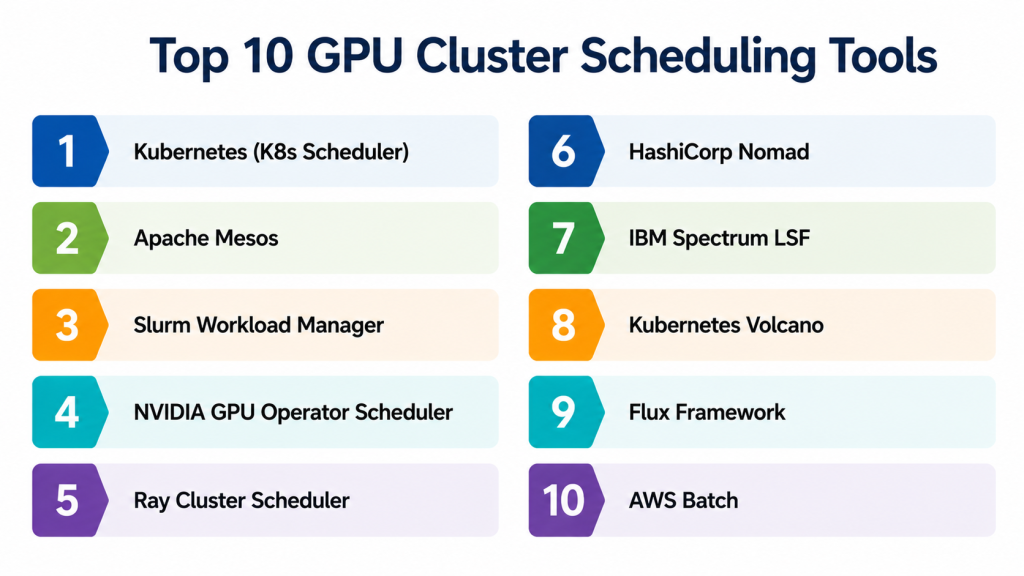
Top 10 GPU Cluster Scheduling Tools
1- Kubernetes (K8s Scheduler)
Short Description:
Kubernetes is the most widely used container orchestration system that includes built-in scheduling capabilities for GPU workloads through extensions and device plugins.
Key Features
- Pod-based workload scheduling
- GPU resource allocation via device plugins
- Horizontal scaling support
- Namespace-based multi-tenancy
- Integration with AI frameworks
- Custom scheduling policies
- Cluster autoscaling
Pros
- Massive ecosystem
- Highly flexible
- Strong community support
Cons
- Complex setup for GPU workloads
- Requires tuning for performance
Platforms / Deployment
Cloud, On-premise, Hybrid
Security & Compliance
RBAC, namespace isolation, policy controls
Integrations & Ecosystem
- NVIDIA GPU Operator
- Kubeflow
- Prometheus
- Helm ecosystem
Support & Community
Very large global open-source community
2- Apache Mesos
Short Description:
Apache Mesos is a distributed systems kernel designed for efficient resource isolation and sharing across distributed applications, including GPU workloads.
Key Features
- Multi-framework scheduling
- Resource isolation
- GPU support extensions
- Fault-tolerant architecture
- Dynamic resource allocation
- Cluster-wide scheduling
- Scalability support
Pros
- Strong scalability
- Flexible architecture
- Multi-framework support
Cons
- Reduced modern adoption
- Complex configuration
Platforms / Deployment
On-premise, Cloud, Hybrid
Security & Compliance
Authentication, authorization, isolation controls
Integrations & Ecosystem
- Marathon
- Spark
- Hadoop
- Custom frameworks
Support & Community
Moderate open-source community
3- Slurm Workload Manager
Short Description:
Slurm is one of the most widely used HPC workload managers for GPU cluster scheduling in research and enterprise environments.
Key Features
- Job scheduling and queuing
- GPU-aware scheduling
- Resource allocation policies
- Job prioritization
- Cluster monitoring
- Multi-node execution
- Fair-share scheduling
Pros
- Excellent HPC performance
- Highly reliable
- Strong GPU support
Cons
- Steep learning curve
- HPC-focused complexity
Platforms / Deployment
On-premise, Hybrid
Security & Compliance
User authentication, access control, logging
Integrations & Ecosystem
- MPI workloads
- AI training frameworks
- HPC storage systems
- Cluster monitoring tools
Support & Community
Strong academic and enterprise adoption
4- NVIDIA GPU Operator Scheduler
Short Description:
NVIDIA GPU Operator enhances Kubernetes with GPU management, scheduling, and optimization capabilities for AI workloads.
Key Features
- Automated GPU provisioning
- Kubernetes integration
- Driver management
- GPU monitoring
- Multi-GPU scheduling
- MIG support
- AI workload optimization
Pros
- Deep NVIDIA integration
- Optimized GPU performance
- Easy Kubernetes integration
Cons
- NVIDIA ecosystem dependency
- Requires Kubernetes knowledge
Platforms / Deployment
Cloud, Kubernetes, On-premise
Security & Compliance
RBAC, secure container execution
Integrations & Ecosystem
- Kubernetes
- CUDA
- AI frameworks
- Monitoring tools
Support & Community
Strong enterprise NVIDIA support
5- Ray Cluster Scheduler
Short Description:
Ray is a distributed computing framework that includes built-in scheduling for machine learning and AI workloads across CPU and GPU clusters.
Key Features
- Distributed task scheduling
- GPU resource management
- Dynamic workload scaling
- ML workload optimization
- Actor-based architecture
- Fault tolerance
- Python-native API
Pros
- Very developer-friendly
- Great for AI workloads
- Flexible scaling
Cons
- Less suited for traditional HPC
- Requires framework adoption
Platforms / Deployment
Cloud, On-premise
Security & Compliance
Not publicly stated
Integrations & Ecosystem
- PyTorch
- TensorFlow
- Kubernetes
- ML pipelines
Support & Community
Strong and growing AI community
6- HashiCorp Nomad
Short Description:
Nomad is a flexible workload orchestrator that supports GPU scheduling across containers and virtualized environments.
Key Features
- Multi-region scheduling
- GPU resource allocation
- Container orchestration
- Batch and service workloads
- Lightweight architecture
- Dynamic scaling
- Job prioritization
Pros
- Simple architecture
- Easy deployment
- Flexible workload support
Cons
- Smaller ecosystem than Kubernetes
- Limited GPU-specific features
Platforms / Deployment
Cloud, On-premise
Security & Compliance
ACLs, encryption, identity controls
Integrations & Ecosystem
- Consul
- Vault
- Docker
- Kubernetes
Support & Community
Strong HashiCorp enterprise support
7- IBM Spectrum LSF
Short Description:
IBM Spectrum LSF is a powerful HPC workload scheduler designed for large-scale GPU and compute cluster environments.
Key Features
- Advanced job scheduling
- GPU workload management
- Multi-cluster support
- Resource optimization
- Priority-based queues
- Analytics dashboards
- Fault tolerance
Pros
- Enterprise-grade HPC solution
- Strong reliability
- High scalability
Cons
- Expensive enterprise solution
- Complex setup
Platforms / Deployment
On-premise, Hybrid
Security & Compliance
RBAC, auditing, access control
Integrations & Ecosystem
- HPC systems
- AI frameworks
- Storage solutions
- Cloud connectors
Support & Community
Enterprise IBM support
8- Kubernetes Volcano
Short Description:
Volcano is a Kubernetes-native batch scheduling system optimized for AI, big data, and GPU-intensive workloads.
Key Features
- Batch scheduling optimization
- GPU-aware scheduling
- Queue management
- Multi-tenant workloads
- DAG scheduling support
- Elastic scheduling
- Kubernetes integration
Pros
- Kubernetes-native
- Strong AI workload focus
- Flexible scheduling
Cons
- Requires Kubernetes expertise
- Still evolving ecosystem
Platforms / Deployment
Kubernetes
Security & Compliance
Kubernetes-native security model
Integrations & Ecosystem
- Kubeflow
- Spark
- TensorFlow
- Kubernetes ecosystem
Support & Community
Open-source community support
9- Flux Framework
Short Description:
Flux is a next-generation resource management and scheduling framework designed for HPC and GPU-intensive workloads.
Key Features
- Hierarchical scheduling
- Dynamic resource management
- GPU workload optimization
- HPC workload support
- Distributed scheduling
- Workflow orchestration
- Resource abstraction
Pros
- Modern HPC design
- Flexible architecture
- Strong research adoption
Cons
- Smaller ecosystem
- Requires expertise
Platforms / Deployment
On-premise, Hybrid
Security & Compliance
Not publicly stated
Integrations & Ecosystem
- HPC systems
- AI workloads
- Scientific computing tools
Support & Community
Research-driven community
10- AWS Batch
Short Description:
AWS Batch is a fully managed service that schedules batch computing workloads, including GPU-based AI and ML tasks.
Key Features
- Managed job scheduling
- GPU instance support
- Dynamic scaling
- Queue management
- Job dependencies
- Container support
- Cloud integration
Pros
- Fully managed service
- Easy scaling
- Strong AWS ecosystem
Cons
- AWS lock-in
- Limited customization
Platforms / Deployment
Cloud
Security & Compliance
IAM, encryption, logging
Integrations & Ecosystem
- AWS EC2
- ECS
- S3
- SageMaker
Support & Community
Strong AWS enterprise support
Comparison Table
| Tool Name | Best For | Platforms Supported | Deployment | Standout Feature | Public Rating |
|---|---|---|---|---|---|
| Kubernetes | General GPU workloads | Multi OS | Hybrid | Ecosystem flexibility | N/A |
| Slurm | HPC clusters | Linux | On-premise | HPC scheduling | N/A |
| Ray | AI workloads | Python | Cloud/On-premise | Distributed AI scheduling | N/A |
| NVIDIA GPU Operator | Kubernetes GPU workloads | Kubernetes | Hybrid | GPU optimization | N/A |
| AWS Batch | Cloud batch GPU | AWS Cloud | Cloud | Managed scheduling | N/A |
| Volcano | AI batch jobs | Kubernetes | Cloud/On-premise | Batch optimization | N/A |
| Nomad | Lightweight scheduling | Multi OS | Hybrid | Simplicity | N/A |
| IBM LSF | Enterprise HPC | Linux | On-premise | Enterprise scheduling | N/A |
| Mesos | Distributed systems | Multi OS | Hybrid | Resource isolation | N/A |
| Flux | HPC research | Linux | Hybrid | Modern HPC design | N/A |
Evaluation & Scoring Table
| Tool Name | Core | Ease | Integrations | Security | Performance | Support | Value | Weighted Total |
|---|---|---|---|---|---|---|---|---|
| Kubernetes | 9.6 | 8.5 | 9.7 | 9.2 | 9.4 | 9.3 | 9.0 | 9.27 |
| Slurm | 9.5 | 7.8 | 8.8 | 9.3 | 9.6 | 9.0 | 8.7 | 9.02 |
| Ray | 9.3 | 9.1 | 9.0 | 8.9 | 9.2 | 8.8 | 9.1 | 9.05 |
| NVIDIA GPU Operator | 9.4 | 8.7 | 9.3 | 9.2 | 9.6 | 9.2 | 8.9 | 9.19 |
| AWS Batch | 9.2 | 9.0 | 9.5 | 9.3 | 9.4 | 9.1 | 9.0 | 9.18 |
| Volcano | 9.1 | 8.6 | 9.2 | 9.0 | 9.3 | 8.9 | 9.1 | 9.05 |
| Nomad | 8.8 | 9.2 | 8.9 | 9.0 | 8.9 | 8.8 | 9.2 | 8.97 |
| IBM LSF | 9.4 | 7.6 | 8.7 | 9.4 | 9.5 | 9.1 | 8.5 | 8.98 |
| Mesos | 8.9 | 7.8 | 8.6 | 8.9 | 9.0 | 8.5 | 8.8 | 8.80 |
| Flux | 8.8 | 7.7 | 8.5 | 9.0 | 8.9 | 8.6 | 8.7 | 8.76 |
Which GPU Cluster Scheduling Tool Is Right for You?
Solo / Freelancer
Ray and Nomad provide flexible, easy-to-adopt scheduling for small AI experiments.
SMB
Kubernetes with GPU Operator or AWS Batch provides scalable and manageable GPU scheduling.
Mid-Market
Volcano, Ray, and Slurm offer strong balance of control and performance.
Enterprise
IBM LSF, Slurm, Kubernetes, and AWS Batch are ideal for large GPU fleets.
Budget vs Premium
Open-source tools like Ray, Kubernetes, and Volcano are cost-efficient; IBM LSF and AWS Batch are premium managed options.
Feature Depth vs Ease of Use
Slurm and LSF provide deep control; AWS Batch and Ray offer simpler workflows.
Integrations & Scalability
Kubernetes and AWS lead in ecosystem integration and large-scale scalability.
Security & Compliance Needs
Enterprise schedulers with RBAC, audit logging, and cloud governance are preferred for regulated environments.
Frequently Asked Questions
1- What is GPU cluster scheduling?
It is the process of distributing GPU workloads efficiently across multiple nodes in a cluster.
2- Why is GPU scheduling important?
It maximizes GPU utilization and reduces job wait times and compute waste.
3- Is Kubernetes a GPU scheduler?
Yes, with extensions it can schedule GPU workloads effectively.
4- What is Slurm used for?
Slurm is widely used for HPC and scientific GPU computing workloads.
5- Can cloud services handle GPU scheduling?
Yes, AWS Batch and Azure provide managed scheduling systems.
6- What is the difference between Ray and Kubernetes?
Ray is AI-native, while Kubernetes is a general-purpose orchestrator.
7- Do these tools support multi-GPU jobs?
Yes, most enterprise schedulers support multi-GPU allocation.
8- Are open-source GPU schedulers reliable?
Yes, tools like Kubernetes, Slurm, and Ray are widely used in production.
9- What industries use GPU scheduling tools?
AI research, automotive, healthcare, finance, and scientific computing.
10- What is the biggest challenge in GPU scheduling?
Efficient utilization of expensive GPU resources across distributed workloads.
Conclusion
GPU Cluster Scheduling Tools are essential for efficiently managing high-performance AI and HPC workloads across distributed GPU environments. As AI models grow larger and more complex, intelligent scheduling ensures optimal resource utilization, reduced costs, and faster execution. Kubernetes, Slurm, and Ray lead in flexibility and adoption, while AWS Batch and IBM LSF provide strong enterprise-managed capabilities. The right tool depends on workload type, infrastructure strategy, and scalability needs. Organizations should evaluate multiple schedulers, test real workloads, and optimize based on performance, cost, and operational complexity.
#GPUComputing, #AIInfrastructure, #HPC, #MachineLearning, #CloudComputing
