Introduction
Global Trade Management (GTM) systems are specialized software platforms designed to help businesses manage their international trade operations efficiently. In plain English, GTM systems centralize compliance, customs processing, logistics management, documentation, and analytics into a single platform. For companies operating globally, these platforms are essential to reduce operational risk, optimize costs, and ensure compliance with ever-changing trade regulations.
In 2026, GTM systems are more critical than ever. The complexity of global supply chains, volatile trade agreements, evolving tariffs, and stricter compliance mandates make manual processes inefficient and error-prone. Modern GTM platforms now leverage AI, automation, and real-time data to provide actionable insights, optimize duties, and accelerate customs clearance.
Real-world use cases include:
- Automating import/export compliance to prevent fines and penalties.
- Managing multi-country shipments with optimized routing and customs clearance.
- Integrating suppliers, carriers, and logistics partners for end-to-end visibility.
- Monitoring trade agreements, tariffs, and duty optimization opportunities.
- Generating regulatory reports and audit trails for government authorities.
Evaluation Criteria for Buyers:
- Core functionality covering compliance, customs management, and logistics.
- User experience and ease of navigation.
- Integration capabilities with ERP, WMS, TMS, and other platforms.
- Security standards including encryption, SSO, MFA, and audit logs.
- Performance, reliability, and uptime for mission-critical operations.
- Support, documentation, and training availability.
- Pricing and value for the organization.
- Deployment flexibility: cloud, on-premises, or hybrid.
- Scalability to handle enterprise-level trade volume.
- AI/automation capabilities to optimize trade workflows.
Best for:
Global supply chain managers, trade compliance officers, logistics teams, and enterprises handling multi-country trade operations. Particularly suitable for mid-market and large enterprises seeking AI-driven compliance and visibility.
Not ideal for:
Small businesses with limited or domestic-only trade activities. Companies without dedicated compliance teams, or those relying on basic ERP or shipping modules, may find GTM systems unnecessarily complex.
Key Trends in Global Trade Management (GTM) Systems
- AI-driven compliance validation to reduce manual intervention and errors.
- Automation of customs filings and trade document generation.
- Cloud-based GTM adoption for flexibility, scalability, and remote operations.
- Real-time trade analytics to monitor tariffs, duties, and supply chain risks.
- Integrated risk management for embargoes, sanctions, and regulatory changes.
- Multi-platform interoperability with ERP, WMS, TMS, and logistics solutions.
- Modular and subscription-based pricing models reducing upfront investments.
- Blockchain adoption for secure documentation and immutable audit trails.
- Heightened focus on cybersecurity and global regulatory compliance.
- Mobile-first interfaces enabling trade teams to operate from anywhere.
How We Selected These Tools (Methodology)
- Evaluated market adoption, customer mindshare, and global footprint.
- Assessed feature completeness including compliance, customs, and logistics capabilities.
- Considered reliability, uptime, and performance signals for large-scale operations.
- Analyzed security posture, including encryption, SSO, MFA, and audit logging.
- Reviewed integrations and ecosystem compatibility with ERP, WMS, TMS, and carrier networks.
- Evaluated customer fit across SMB, mid-market, and enterprise segments.
- Checked AI and automation capabilities for trade optimization.
- Examined scalability across multiple countries and trade volumes.
- Assessed implementation complexity, onboarding, and training support.
- Compared pricing and value relative to features and organizational size.
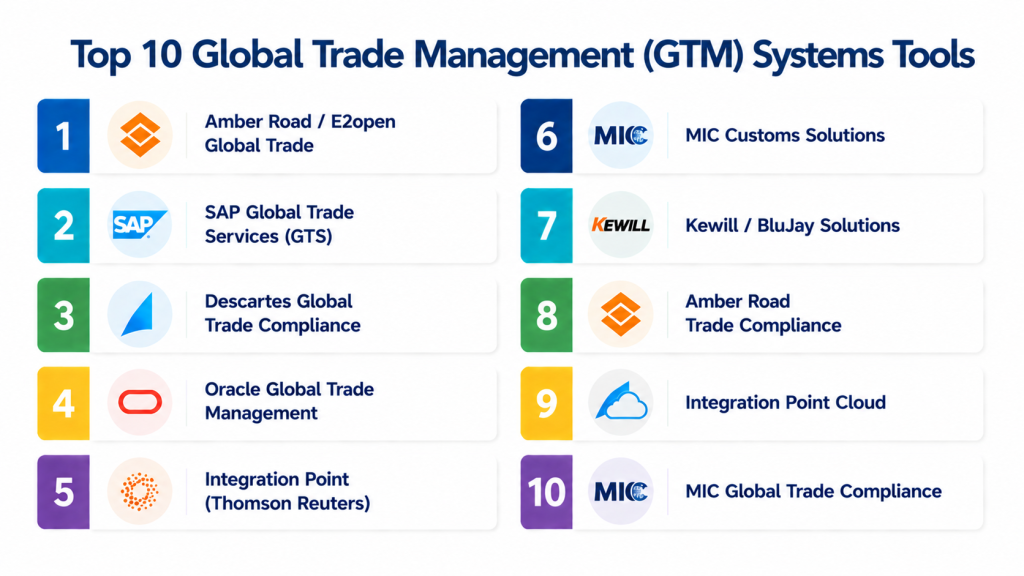
Top 10 Global Trade Management (GTM) Systems Tools
1- Amber Road / E2open Global Trade
Short description: Amber Road provides enterprise-grade GTM capabilities for import/export operations, compliance, and logistics management, designed for large multinational organizations.
Key Features
- End-to-end trade compliance automation
- Duty optimization and tariff management
- Shipment visibility and logistics tracking
- Supplier collaboration portal
- Real-time regulatory updates
- AI-based risk and sanctions screening
Pros
- Minimizes compliance risk effectively
- Centralizes complex global trade operations
Cons
- Costly for small or mid-market organizations
- Steep learning curve for advanced modules
Platforms / Deployment
- Web
- Cloud / Hybrid
Security & Compliance
- SSO/SAML, MFA, encryption
- SOC 2, ISO 27001, GDPR
Integrations & Ecosystem
Integrates with ERP, WMS, and logistics partners for seamless data exchange.
- SAP, Oracle ERP, Microsoft Dynamics
- Carrier APIs
- Customs portals
Support & Community
Dedicated enterprise support with training modules and knowledge base.
2- SAP Global Trade Services (GTS)
Short description: SAP GTS streamlines trade compliance and customs operations, fully integrated with SAP ERP for multinational corporations.
Key Features
- Automated customs filing and compliance checks
- Trade preference management
- Export control and sanction screening
- AI-driven document automation
- Risk management dashboards
Pros
- Strong SAP ERP integration
- Scalable for global operations
Cons
- Limited flexibility outside SAP environments
- Complex implementation for small teams
Platforms / Deployment
- Web
- Cloud / On-prem / Hybrid
Security & Compliance
- SSO/SAML, encryption
- ISO 27001, GDPR
Integrations & Ecosystem
ERP modules, EDI providers, and customs portals for end-to-end connectivity.
Support & Community
Extensive SAP documentation, forums, and enterprise support.
3- Descartes Global Trade Compliance
Short description: Designed for multinational shippers, Descartes automates customs compliance, import/export processing, and trade risk management.
Key Features
- Customs filing automation
- Restricted party and sanctions screening
- Duty and tax optimization
- Trade document generation
- Shipment visibility and reporting
Pros
- Quick deployment for compliance workflows
- Reduces manual errors effectively
Cons
- May require additional modules for full visibility
- Enterprise pricing can be high for smaller users
Platforms / Deployment
- Web
- Cloud
Security & Compliance
- MFA, encryption
- SOC 2, GDPR
Integrations & Ecosystem
Integrates with ERP systems, carrier portals, and customs authorities.
- APIs for automation and reporting
Support & Community
Online knowledge base, email support, professional services available.
4- Oracle Global Trade Management
Short description: Oracle GTM centralizes trade compliance, transportation, and documentation management for multinational enterprises.
Key Features
- Global trade compliance and risk management
- Customs document automation
- Import/export management
- Duty and tariff optimization
- AI-based trade analytics
Pros
- Advanced reporting and analytics
- Seamless Oracle ERP integration
Cons
- Complex setup outside Oracle ecosystem
- May be excessive for smaller organizations
Platforms / Deployment
- Web
- Cloud / Hybrid
Security & Compliance
- Encryption, SSO, audit logs
- SOC 2, ISO 27001
Integrations & Ecosystem
ERP, TMS, WMS, carrier APIs, and customs authorities.
Support & Community
Oracle support services, online forums, dedicated account managers.
5- Integration Point (Thomson Reuters)
Short description: Provides compliance automation, customs filing, and trade visibility for large global enterprises.
Key Features
- Automated trade compliance workflows
- Restricted party screening
- Customs filing and document management
- Real-time analytics and reporting
- Trade agreement monitoring
Pros
- Strong compliance focus
- Good analytics capabilities
Cons
- Interface may be less intuitive
- Requires compliance expertise
Platforms / Deployment
- Web
- Cloud / Hybrid
Security & Compliance
- SSO, encryption
- Not publicly stated
Integrations & Ecosystem
ERP, logistics platforms, customs portals
- APIs for automation
Support & Community
Online documentation, professional services, email support.
6- MIC Customs Solutions
Short description: Simplifies customs and trade compliance processes for importers and exporters worldwide.
Key Features
- Import/export compliance automation
- Duty and tariff management
- Customs filing workflows
- Restricted party screening
- Reporting dashboards
Pros
- Flexible deployment
- Supports multi-country operations
Cons
- Customization may be required
- Smaller user community
Platforms / Deployment
- Web
- Cloud / Hybrid
Security & Compliance
- Encryption, audit logs
- SOC 2, GDPR
Integrations & Ecosystem
ERP systems, shipping carriers, customs authorities
- API-based integration
Support & Community
Email and phone support, professional training.
7- Kewill / BluJay Solutions
Short description: Combines trade compliance, logistics, and visibility in a unified platform.
Key Features
- Customs filing and trade compliance
- Shipment visibility and tracking
- Duty optimization
- Trade documentation automation
- Analytics dashboards
Pros
- Unified trade and logistics management
- Scalable for mid-market and enterprise
Cons
- Integration requires professional services
- Enterprise pricing
Platforms / Deployment
- Web
- Cloud / Hybrid
Security & Compliance
- SSO, encryption
- Not publicly stated
Integrations & Ecosystem
ERP, TMS, WMS, customs authorities
- API extensibility
Support & Community
Onboarding support, knowledge base, professional services.
8- Amber Road Trade Compliance
Short description: Focused on regulatory compliance and customs automation.
Key Features
- Compliance automation and filing
- Duty and tariff management
- Restricted party screening
- Trade document generation
- Monitoring and reporting
Pros
- Simplifies compliance
- Reduces documentation errors
Cons
- Advanced training required
- Enterprise-focused pricing
Platforms / Deployment
- Web
- Cloud
Security & Compliance
- MFA, encryption
- SOC 2, ISO 27001
Integrations & Ecosystem
ERP, logistics partners, customs portals
- API-based automation
Support & Community
Knowledge base, training, enterprise support.
9- Integration Point Cloud
Short description: Cloud-native GTM system providing compliance, customs, and trade visibility.
Key Features
- Trade compliance automation
- Customs filing
- Risk and sanction screening
- Duty optimization
- Analytics dashboards
Pros
- Fast cloud deployment
- Reduces operational complexity
Cons
- ERP integration may need customization
- Limited offline capabilities
Platforms / Deployment
- Web
- Cloud
Security & Compliance
- SSO, encryption
- Not publicly stated
Integrations & Ecosystem
ERP, WMS, carrier APIs, customs portals
- Cloud-based extensibility
Support & Community
Online documentation, email support, professional services.
10- MIC Global Trade Compliance
Short description: Enterprise GTM platform emphasizing compliance, customs, and import/export visibility.
Key Features
- Automated customs filing
- Duty optimization
- Restricted party screening
- Reporting and analytics
- Trade documentation management
Pros
- Strong compliance and risk reduction
- Flexible deployment options
Cons
- May require professional services
- Enterprise-oriented pricing
Platforms / Deployment
- Web
- Cloud / Hybrid
Security & Compliance
- MFA, encryption, audit logs
- SOC 2, GDPR
Integrations & Ecosystem
ERP, carrier systems, customs authorities
- API automation
Support & Community
Dedicated support, onboarding, and professional services.
Comparison Table (Top 10)
| Tool Name | Best For | Platform(s) Supported | Deployment | Standout Feature | Public Rating |
|---|---|---|---|---|---|
| Amber Road / E2open | Enterprise import/export | Web | Cloud / Hybrid | End-to-end trade automation | N/A |
| SAP GTS | SAP ERP users | Web | Cloud / On-prem / Hybrid | Deep SAP integration | N/A |
| Descartes | Compliance-heavy shippers | Web | Cloud | Customs automation | N/A |
| Oracle GTM | Multinational enterprises | Web | Cloud / Hybrid | AI trade analytics | N/A |
| Integration Point | Large corporates | Web | Cloud / Hybrid | Compliance automation | N/A |
| MIC Customs Solutions | Global shippers | Web | Cloud / Hybrid | Multi-country compliance | N/A |
| Kewill / BluJay | Mid-market to enterprise | Web | Cloud / Hybrid | Unified trade & logistics | N/A |
| Amber Road Trade Compliance | Regulatory adherence | Web | Cloud | Compliance automation | N/A |
| Integration Point Cloud | Modern cloud-native | Web | Cloud | Cloud-native GTM | N/A |
| MIC Global Trade Compliance | Enterprise GTM | Web | Cloud / Hybrid | Compliance & visibility | N/A |
Evaluation & Scoring of Global Trade Management (GTM) Systems
| Tool Name | Core (25%) | Ease (15%) | Integrations (15%) | Security (10%) | Performance (10%) | Support (10%) | Value (15%) | Weighted Total |
|---|---|---|---|---|---|---|---|---|
| Amber Road / E2open | 9 | 8 | 8 | 9 | 9 | 8 | 7 | 8.5 |
| SAP GTS | 9 | 7 | 9 | 9 | 9 | 8 | 6 | 8.2 |
| Descartes | 8 | 8 | 7 | 8 | 8 | 7 | 7 | 7.8 |
| Oracle GTM | 9 | 7 | 8 | 8 | 9 | 8 | 6 | 8.0 |
| Integration Point | 8 | 7 | 7 | 8 | 8 | 7 | 6 | 7.5 |
| MIC Customs Solutions | 8 | 8 | 7 | 8 | 8 | 7 | 7 | 7.7 |
| Kewill / BluJay | 8 | 8 | 8 | 7 | 8 | 7 | 7 | 7.7 |
| Amber Road Trade Compliance | 8 | 7 | 7 | 8 | 8 | 7 | 6 | 7.3 |
| Integration Point Cloud | 8 | 8 | 7 | 7 | 8 | 7 | 7 | 7.5 |
| MIC Global Trade Compliance | 8 | 7 | 7 | 8 | 8 | 7 | 6 | 7.3 |
Interpretation: Weighted totals reflect overall suitability. Higher scores indicate platforms better suited for enterprise-scale GTM operations. Criteria include functionality, usability, integration, security, performance, support, and value.
Which Global Trade Management (GTM) Systems Tool Is Right for You?
Solo / Freelancer
Most GTM tools are enterprise-focused; solo operators may rely on lightweight compliance modules or ERP add-ons.
SMB
Tools like Descartes, Kewill / BluJay, or Integration Point Cloud offer scalable GTM features without overcomplicating small teams’ workflows.
Mid-Market
Amber Road / E2open and MIC solutions provide automation, multi-country compliance, and ERP/WMS/TMS integration.
Enterprise
SAP GTS, Oracle GTM, and Amber Road are ideal for high-volume, multi-country operations needing advanced AI-driven compliance and analytics.
Budget vs Premium
- Budget-conscious: Integration Point Cloud or Descartes for cost-effective compliance automation.
- Premium: SAP GTS or Amber Road for full enterprise capabilities.
Feature Depth vs Ease of Use
- Feature Depth: Oracle GTM, SAP GTS offer comprehensive functionality.
- Ease of Use: Descartes, Kewill / BluJay provide more intuitive interfaces.
Integrations & Scalability
Enterprise tools excel in connecting with ERP, TMS, WMS, and carriers, scaling to global trade operations. Cloud-native solutions simplify deployment for growing businesses.
Security & Compliance Needs
Enterprises with strict oversight should choose Amber Road, SAP GTS, or Oracle GTM, offering SOC 2, ISO 27001, encryption, and audit trails.
Frequently Asked Questions (FAQs)
1- What pricing models do GTM systems use?
Most GTM platforms are subscription-based, often tiered by users, transactions, or modules. Enterprise implementations may include professional service fees.
2- How long does implementation take?
Implementation varies; small-scale setups may take weeks, global deployments 3–6 months depending on complexity.
3- Can GTM integrate with ERP systems?
Yes, leading GTM systems integrate with SAP, Oracle, Microsoft Dynamics, and other ERP systems via APIs or pre-built connectors.
4- Are these tools suitable for small businesses?
GTM systems generally target mid-market and enterprise users. Small businesses may prefer ERP add-ons or modular compliance tools.
5- How do GTM systems handle regulatory changes?
Top platforms provide real-time regulatory updates, automated compliance checks, and alerts for sanction or trade law changes.
6- Is cloud deployment secure for trade data?
Cloud GTM platforms implement encryption, SSO, MFA, audit logging, and comply with SOC 2, ISO 27001, and GDPR standards.
7- Can GTM systems automate customs filing?
Yes, automated customs filing and document generation are standard features, minimizing manual work and errors.
8- What AI capabilities are available?
AI supports duty optimization, risk detection, trade decision analytics, and anomaly detection across global operations.
9- How scalable are these solutions?
Enterprise GTM systems scale globally, handling multi-country trade volumes, ERP/WMS/TMS integrations, and complex supply chains.
10- What common mistakes should be avoided?
Underestimating implementation time, ignoring integration needs, insufficient training, and neglecting compliance updates are frequent pitfalls.
Conclusion
Selecting the right Global Trade Management (GTM) system depends heavily on your company size, trade complexity, compliance requirements, and existing technology stack. Enterprise organizations benefit from Amber Road, SAP GTS, or Oracle GTM for their full-featured, AI-enabled trade workflows, while mid-market teams may find Descartes or Kewill / BluJay more practical. Cloud-native platforms like Integration Point Cloud offer faster deployment and flexibility for growing operations. Buyers should shortlist run pilot tests, validate integrations and compliance features, and then scale to full deployment to ensure maximum efficiency, cost savings, and regulatory adherence.
