Introduction
Genomics analysis pipelines are software frameworks used to process, analyze, and interpret large-scale genomic data. These pipelines are essential for tasks such as DNA sequencing analysis, variant detection, gene expression studies, and biomarker discovery. They are widely used in research labs, healthcare institutions, and biotech companies to extract meaningful insights from complex genomic datasets.
Modern genomics pipelines integrate multiple tools and workflows, enabling automation and scalability in data processing. They support high-throughput sequencing data and provide reproducible results. With the growth of precision medicine and genomics research, choosing the right pipeline is critical for ensuring accuracy, efficiency, and scalability.
Key Trends in Genomics Analysis Pipelines
- Increased use of cloud-based genomics workflows
- Integration with AI and machine learning tools
- Automation of sequencing data processing
- Focus on reproducibility and standardization
- Support for multi-omics data analysis
- Real-time data processing and analytics
- Enhanced visualization and reporting tools
- Growing adoption in clinical genomics
How We Selected These Tools
- Data processing and analysis capabilities
- Ease of use and workflow design
- Scalability for large datasets
- Integration with sequencing platforms
- Reproducibility and reliability
- Automation and workflow management
- Reporting and visualization features
- Overall flexibility and value
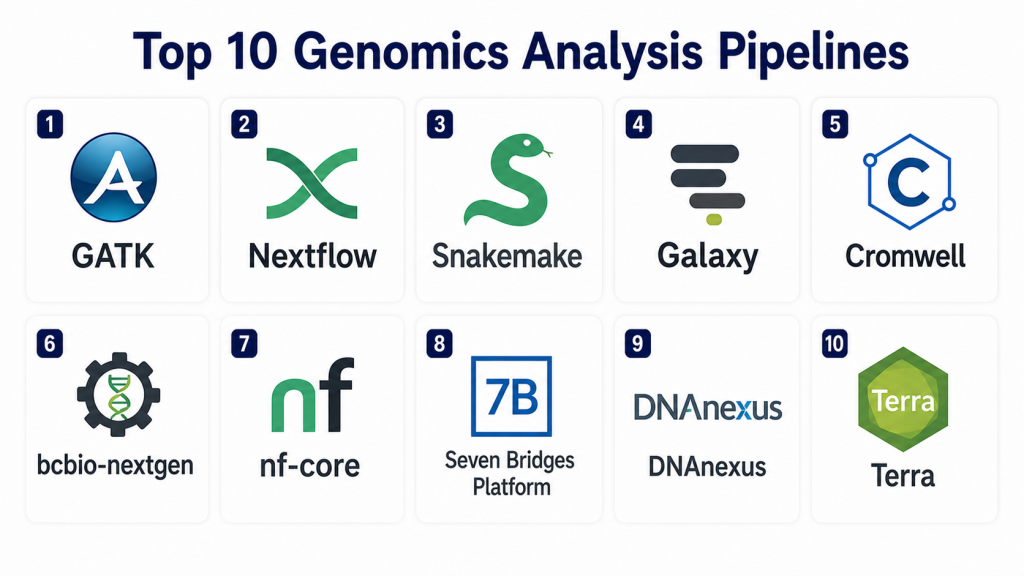
Top 10 Genomics Analysis Pipelines
#1 — GATK
GATK is a widely used genomics pipeline developed for variant discovery and genotyping. It offers robust tools for processing sequencing data. The platform supports large-scale genomic analysis. It is highly reliable and scalable. It is widely adopted in research and clinical environments. It is suitable for advanced genomics workflows.
Key Features
- Variant discovery
- Data processing tools
- High scalability
- Workflow automation
Pros
- Industry standard
- Reliable
- Scalable
Cons
- Complex setup
- Requires expertise
Platforms / Deployment
Cloud and On-premise
#2 — Nextflow
Nextflow is a workflow management system designed for scalable and reproducible scientific pipelines. It enables easy integration with multiple tools. The platform supports cloud and containerized environments. It improves workflow automation. It is widely used in genomics research. It is suitable for flexible pipeline design.
Key Features
- Workflow automation
- Cloud support
- Container integration
- Reproducibility
Pros
- Flexible
- Scalable
- Strong community
Cons
- Learning curve
- Requires scripting
#3 — Snakemake
Snakemake is a workflow management tool that simplifies the creation of reproducible pipelines. It supports automation and scalability. The platform integrates with various bioinformatics tools. It is easy to use for structured workflows. It is widely used in research labs. It is suitable for pipeline automation.
Key Features
- Workflow automation
- Reproducibility
- Integration support
- Scalability
Pros
- Easy to use
- Flexible
- Open-source
Cons
- Limited GUI
- Requires coding
#4 — Galaxy
Galaxy is a user-friendly platform for genomics data analysis. It provides a graphical interface for building pipelines. The system supports reproducibility and collaboration. It is widely used in academic research. It simplifies complex workflows. It is suitable for beginners and researchers.
Key Features
- GUI-based workflows
- Data analysis tools
- Collaboration features
- Reproducibility
Pros
- Easy to use
- No coding required
- Accessible
Cons
- Limited customization
- Performance constraints
#5 — Cromwell
Cromwell is a workflow execution engine designed for running genomics pipelines. It supports workflow description languages and cloud deployment. The platform ensures reproducibility and scalability. It integrates with genomic tools. It is suitable for large-scale workflows.
Key Features
- Workflow execution
- Cloud integration
- Scalability
- Reproducibility
Pros
- Reliable
- Scalable
- Flexible
Cons
- Complex setup
- Requires expertise
#6 — bcbio-nextgen
bcbio-nextgen is an automated pipeline for sequencing data analysis. It supports variant calling and RNA sequencing workflows. The platform is designed for reproducibility. It integrates multiple tools. It is widely used in research labs. It is suitable for standardized workflows.
Key Features
- Automated workflows
- Variant analysis
- RNA sequencing
- Integration tools
Pros
- Comprehensive
- Reliable
- Reproducible
Cons
- Setup complexity
- Resource intensive
#7 — nf-core
nf-core is a community-driven collection of curated Nextflow pipelines. It ensures standardized workflows for genomics analysis. The platform supports reproducibility and scalability. It integrates with cloud environments. It is widely used in research. It is suitable for collaborative projects.
Key Features
- Standardized pipelines
- Community support
- Cloud integration
- Reproducibility
Pros
- Consistent workflows
- Scalable
- Open-source
Cons
- Depends on Nextflow
- Learning curve
#8 — Seven Bridges Platform
Seven Bridges Platform provides a cloud-based environment for genomics analysis. It supports workflow automation and data management. The platform integrates with sequencing tools. It offers scalability and collaboration features. It is suitable for enterprise and research use.
Key Features
- Cloud platform
- Workflow automation
- Data management
- Collaboration tools
Pros
- Scalable
- User-friendly
- Strong integration
Cons
- Costly
- Requires internet
#9 — DNAnexus
DNAnexus is a cloud-based genomics analysis platform offering data processing and workflow automation. It supports large datasets and integration with research tools. The platform ensures data security and compliance. It is widely used in biotech. It is suitable for enterprise environments.
Key Features
- Data processing
- Workflow automation
- Cloud deployment
- Security features
Pros
- Secure
- Scalable
- Reliable
Cons
- Expensive
- Learning curve
#10 — Terra
Terra is a cloud-based genomics platform designed for large-scale data analysis. It integrates tools for workflow management and collaboration. The platform supports reproducible research. It is widely used in genomics projects. It is suitable for large datasets and collaborative research.
Key Features
- Cloud workflows
- Data analysis
- Collaboration
- Reproducibility
Pros
- Scalable
- Flexible
- Collaborative
Cons
- Complex setup
- Requires expertise
Comparison Table
| Tool | Best For | Deployment | Automation | Scalability | Standout Feature |
|---|---|---|---|---|---|
| GATK | Variant analysis | Hybrid | High | High | Industry standard |
| Nextflow | Workflow design | Hybrid | High | High | Flexibility |
| Snakemake | Automation | Hybrid | High | Medium | Simplicity |
| Galaxy | Beginners | Cloud | Medium | Medium | GUI interface |
| Cromwell | Execution engine | Hybrid | High | High | Reliability |
| bcbio | Standard workflows | Hybrid | High | Medium | Automation |
| nf-core | Standard pipelines | Hybrid | High | High | Community-driven |
| Seven Bridges | Enterprise | Cloud | High | High | Collaboration |
| DNAnexus | Secure analysis | Cloud | High | High | Security |
| Terra | Large projects | Cloud | High | High | Collaboration |
Evaluation & Scoring Table
| Tool | Core | Ease | Integrations | Security | Performance | Support | Value | Total |
|---|---|---|---|---|---|---|---|---|
| GATK | 9 | 6 | 9 | 9 | 9 | 8 | 7 | 8.1 |
| Nextflow | 9 | 7 | 9 | 8 | 9 | 8 | 8 | 8.3 |
| Snakemake | 8 | 8 | 8 | 8 | 8 | 7 | 8 | 8.0 |
| Galaxy | 7 | 9 | 7 | 8 | 7 | 7 | 9 | 7.7 |
| Cromwell | 9 | 6 | 9 | 9 | 9 | 8 | 7 | 8.1 |
| bcbio | 8 | 7 | 8 | 8 | 8 | 7 | 8 | 7.9 |
| nf-core | 9 | 7 | 9 | 8 | 9 | 8 | 8 | 8.3 |
| Seven Bridges | 9 | 8 | 9 | 9 | 9 | 8 | 7 | 8.4 |
| DNAnexus | 9 | 7 | 9 | 9 | 9 | 8 | 7 | 8.3 |
| Terra | 9 | 7 | 9 | 9 | 9 | 8 | 7 | 8.3 |
Which Genomics Analysis Pipeline Is Right for You?
Choosing the right genomics analysis pipeline depends on your technical expertise, data scale, research goals, and available infrastructure. Each tool is designed for different workflows, so aligning the platform with your needs is essential.
For beginners and small research teams
If you are new to genomics or working in a small lab, ease of use and accessibility should be your priority. Galaxy is an excellent choice because it provides a graphical interface that simplifies complex workflows. It allows users to build pipelines without coding knowledge. This reduces the learning curve and speeds up adoption. It is ideal for teaching, small projects, and early-stage research. It also supports collaboration in a simple environment.
For academic labs and reproducible research
Academic institutions often require reproducibility and structured workflows. Snakemake and Nextflow are strong options for these use cases. They allow researchers to define workflows clearly and ensure consistent results across experiments. These tools integrate well with bioinformatics software. They also support version control and automation. This makes them suitable for research environments where accuracy and repeatability are critical.
For growing labs and flexible workflows
As labs grow, they need scalable and flexible solutions that can handle increasing data complexity. Nextflow and nf-core provide standardized pipelines and strong community support. They allow integration with multiple tools and cloud environments. These platforms help manage larger datasets efficiently. They are ideal for teams transitioning from basic workflows to more advanced systems. They also support collaboration and scalability.
For enterprise and large-scale genomics projects
Large organizations and research centers require high-performance pipelines that can process massive datasets. GATK, DNAnexus, Seven Bridges Platform, and Terra are designed for these environments. They offer scalability, cloud infrastructure, and advanced data processing capabilities. These platforms support collaboration across global teams. They are suitable for clinical genomics and large research projects. They ensure reliability and performance at scale.
For workflow execution and advanced users
Advanced users who need control over execution and customization should consider Cromwell and bcbio-nextgen. These tools provide detailed workflow management and integration capabilities. They allow users to design complex pipelines tailored to specific needs. They require technical expertise but offer high flexibility. These platforms are ideal for bioinformatics experts. They support advanced research workflows and optimization.
FAQs
1. What is a genomics analysis pipeline?
A genomics analysis pipeline is a set of tools and workflows used to process and analyze genomic data. It helps researchers perform tasks like sequencing analysis and variant detection. These pipelines automate complex processes. They improve accuracy and efficiency. They are widely used in research and healthcare.
2. What features are important in genomics pipelines?
Key features include automation, scalability, reproducibility, and integration with sequencing tools. Workflow management and data visualization are also important. These features help manage large datasets efficiently. They ensure consistent results. Choosing the right features depends on research needs.
3. Are cloud-based pipelines better?
Cloud-based pipelines offer scalability and flexibility. They allow researchers to process large datasets without local infrastructure. They also support collaboration. However, they require internet access and may have costs. The choice depends on your setup. Both options have advantages.
4. Can genomics pipelines handle large datasets?
Yes, most modern pipelines are designed for large-scale data processing. They use high-performance computing and cloud resources. This ensures efficient analysis. Scalability is a key feature. It is essential for genomics research.
5. Are these pipelines suitable for beginners?
Some tools like Galaxy are beginner-friendly. They provide graphical interfaces and simplified workflows. Advanced tools may require coding knowledge. Beginners should start with easy platforms. Gradually they can move to advanced systems.
6. How secure are genomics pipelines?
Security depends on the platform. Cloud-based systems offer strong security features. On-premise systems rely on internal controls. Data protection is important in genomics. Choosing a secure platform is essential. It protects sensitive data.
7. Do pipelines integrate with other tools?
Yes, most pipelines integrate with bioinformatics tools and databases. Integration improves workflow efficiency. It allows seamless data sharing. This is important for research. It enhances productivity.
8. What industries use genomics pipelines?
Genomics pipelines are used in healthcare, biotech, and research institutions. They help analyze genetic data. Different industries use them for different purposes. However, the core functionality remains the same. They improve research outcomes.
9. Are these pipelines scalable?
Yes, most pipelines are designed to scale with data growth. They support increasing workloads. Cloud-based systems offer flexible scaling. This ensures long-term usability. Scalability is important for research.
10. Which genomics pipeline is best?
There is no single best pipeline. GATK is strong for variant analysis. Nextflow and Snakemake are great for workflows. Galaxy is ideal for beginners. The best choice depends on your needs. Evaluating options is important.
Conclusion
Genomics analysis pipelines are essential for processing and interpreting complex genetic data. They provide automation, scalability, and reproducibility, enabling researchers to handle large datasets efficiently. With advancements in technology, these pipelines are becoming more powerful and accessible, supporting innovation in healthcare and research.
Choosing the right pipeline depends on your expertise, data requirements, and research goals. While beginner-friendly tools simplify workflows, advanced platforms offer scalability and performance for large projects. By selecting the right solution, organizations can improve efficiency and drive meaningful insights from genomic data.
