Introduction
Financial Planning & Analysis (FP&A) Software helps organizations plan budgets, forecast financial performance, and analyze business data for strategic decision-making. These platforms replace spreadsheets with centralized, automated systems that improve accuracy, speed, and collaboration across finance teams.
In today’s data-driven environment, FP&A tools are critical for managing uncertainty, optimizing costs, and driving growth. Modern platforms incorporate AI-driven forecasting, real-time dashboards, and scenario modeling to support faster and smarter financial decisions.
Common use cases include:
- Budgeting and financial forecasting
- Scenario planning and modeling
- Financial reporting and analysis
- Revenue and expense tracking
- Strategic planning and decision support
Key evaluation criteria:
- Forecasting and modeling capabilities
- Data integration and consolidation
- Reporting and dashboards
- Ease of use and collaboration
- Automation and AI features
- Security and access control
- Scalability and performance
- Integration with ERP and finance systems
Best for: Finance teams, CFOs, enterprises, and mid-sized companies managing complex financial planning processes.
Not ideal for: Small businesses with simple financial needs or those relying on basic accounting tools.
Key Trends in Financial Planning & Analysis (FP&A) Software
- AI-driven forecasting and predictive analytics
- Real-time financial dashboards and reporting
- Cloud-based FP&A platforms replacing spreadsheets
- Scenario planning and what-if analysis
- Integration with ERP, CRM, and data systems
- Automation of budgeting and consolidation
- Collaborative planning across departments
- API-first architectures for integration
- Enhanced security with role-based access control
- Subscription-based pricing models
How We Evaluated Financial Planning & Analysis (FP&A) Software
- Market adoption across finance teams and enterprises
- Feature depth for planning, forecasting, and analysis
- Performance, scalability, and reliability
- Security features and compliance readiness
- Integration ecosystem with finance and data tools
- Ease of use and onboarding experience
- Vendor support and documentation quality
- Suitability across SMB, mid-market, and enterprise
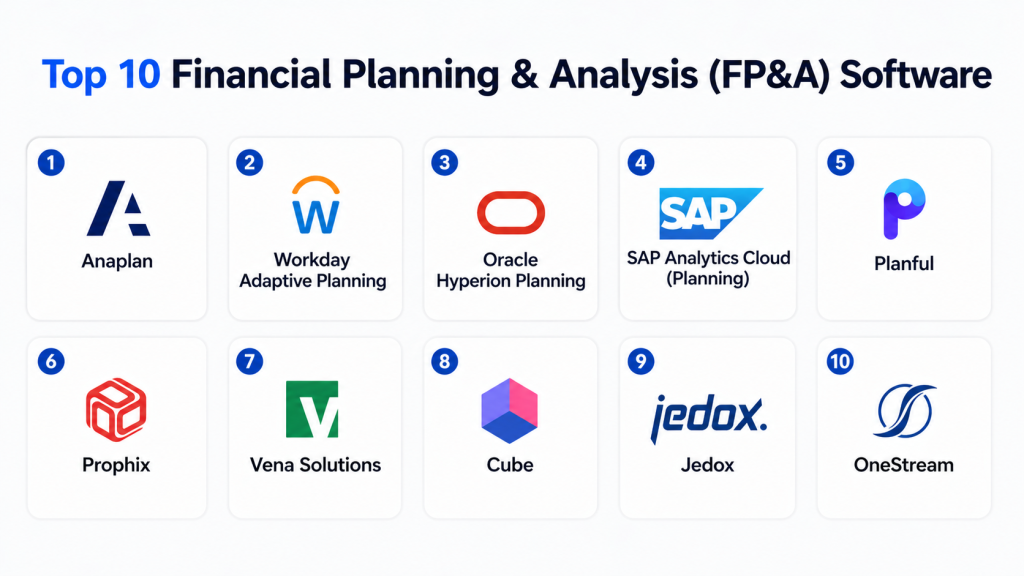
Top 10 Financial Planning & Analysis (FP&A) Software
#1 — Pigment
Pigment is an enterprise Integrated Business Planning (IBP) and EPM platform built for FP&A and cross-functional planning. It connects finance, HR, sales, and operations in a single real-time environment. The platform combines flexible multidimensional modeling with embedded AI for faster, smarter forecasting. It is designed for large and fast-scaling enterprises. Pigment supports collaborative planning with strong governance controls and helps organizations move from reactive reporting to proactive strategy.
Key Features:
• Real-time scenario planning
• Multidimensional modeling
• Embedded AI and ML forecasting
• Cross-functional planning across finance, HR, sales, and operations
• Native collaboration and workflow governance
• ERP, CRM, HRIS, and data warehouse integrations
Pros:
• Highly scalable for enterprise-wide planning.
• AI capabilities built directly into workflows.
Cons:
• Onboarding is required to maximize modeling and AI features.
• Less spreadsheet-centric than Excel-native tools.
Platforms / Deployment:
• Cloud
Security & Compliance:
• SOC 1 Type II, SOC 2 Type II, GDPR, and CCPA compliant
• AES-256 and TLS 1.3 encryption
• Role-based access controls (RBAC)
• Full audit trails
Integrations & Ecosystem:
• ERP systems
• CRM platforms
• HRIS tools
• Data warehouses
Support & Community:
• Dedicated customer success teams
• Pigment Academy
• Structured onboarding programs
• Active global user community
#2 — Adaptive Insights (Workday Adaptive Planning)
Short description :
Adaptive Insights is a cloud-based FP&A solution for budgeting and forecasting. It offers real-time financial planning and reporting. The platform is easy to use and scalable. It integrates with Workday systems. It is ideal for mid-market and enterprise companies. It supports collaborative planning.
Key Features
- Budgeting
- Forecasting
- Reporting
- Integration
- Collaboration
Pros
- User-friendly
- Strong reporting
Cons
- Limited customization
- Pricing varies
Platforms / Deployment
Cloud
Security & Compliance
Encryption
Integrations & Ecosystem
- Workday
- ERP systems
Support & Community
Reliable support
#3 — Oracle Hyperion Planning
Short description :
Oracle Hyperion is an enterprise FP&A solution offering advanced planning and forecasting capabilities. It supports financial consolidation and reporting. The platform integrates with Oracle systems. It is ideal for large enterprises. Hyperion provides strong analytics. It is widely used in finance teams.
Key Features
- Financial planning
- Forecasting
- Consolidation
- Reporting
- Analytics
Pros
- Strong enterprise features
- Advanced analytics
Cons
- Complex
- Requires expertise
Platforms / Deployment
On-prem / Cloud
Security & Compliance
RBAC, encryption
Integrations & Ecosystem
- Oracle ERP
- Finance systems
Support & Community
Enterprise support
#4 — SAP Analytics Cloud (Planning)
Short description :
SAP Analytics Cloud combines analytics and planning in one platform. It provides forecasting, reporting, and visualization tools. The platform integrates with SAP systems. It is ideal for enterprises. SAP Analytics Cloud offers real-time insights. It supports data-driven decision-making.
Key Features
- Planning and forecasting
- Data visualization
- Analytics
- Integration
- Reporting
Pros
- Strong analytics
- Integrated platform
Cons
- Complex setup
- Requires SAP ecosystem
Platforms / Deployment
Cloud
Security & Compliance
SSO, RBAC
Integrations & Ecosystem
- SAP ERP
- Data tools
Support & Community
Enterprise support
#5 — Planful
Short description :
Planful is an FP&A platform designed for financial planning and analysis. It offers budgeting, forecasting, and reporting features. The platform is easy to use and scalable. It is ideal for mid-market companies. Planful supports automation and collaboration. It helps improve financial performance.
Key Features
- Budgeting
- Forecasting
- Reporting
- Automation
- Collaboration
Pros
- Easy to use
- Scalable
Cons
- Limited advanced features
- Pricing varies
Platforms / Deployment
Cloud
Security & Compliance
Encryption
Integrations & Ecosystem
- ERP systems
- Finance tools
Support & Community
Good support
#6 — Prophix
Short description :
Prophix is an FP&A solution focused on budgeting and financial planning. It provides automation and reporting tools. The platform is designed for mid-sized businesses. It is easy to use and deploy. Prophix helps improve financial visibility. It integrates with accounting systems.
Key Features
- Budgeting
- Forecasting
- Reporting
- Automation
- Integration
Pros
- User-friendly
- Affordable
Cons
- Limited enterprise features
- Basic analytics
Platforms / Deployment
Cloud
Security & Compliance
Encryption
Integrations & Ecosystem
- Accounting tools
- ERP systems
Support & Community
Reliable support
#7 — Vena Solutions
Short description :
Vena Solutions is an FP&A platform that integrates with Excel. It provides budgeting, forecasting, and reporting features. The platform is ideal for finance teams familiar with spreadsheets. It supports automation and collaboration. Vena helps improve planning processes. It integrates with ERP systems.
Key Features
- Excel integration
- Budgeting
- Forecasting
- Reporting
- Collaboration
Pros
- Familiar interface
- Strong integration
Cons
- Depends on Excel
- Limited advanced features
Platforms / Deployment
Cloud
Security & Compliance
Encryption
Integrations & Ecosystem
- ERP systems
- Finance tools
Support & Community
Good support
#8 — Cube
Short description :
Cube is a modern FP&A platform designed for finance teams. It provides real-time data and analytics. The platform integrates with spreadsheets and data sources. It is easy to use and deploy. Cube is ideal for SMBs. It helps improve planning efficiency.
Key Features
- Real-time data
- Forecasting
- Reporting
- Integration
- Automation
Pros
- Easy to use
- Modern interface
Cons
- Limited enterprise features
- Smaller ecosystem
Platforms / Deployment
Cloud
Security & Compliance
Encryption
Integrations & Ecosystem
- Data tools
- Accounting systems
Support & Community
Good support
#9 — Mosaic Tech
Short description :
Mosaic Tech is an FP&A platform focused on analytics and forecasting. It provides real-time insights into financial data. The platform is designed for startups and SMBs. It is easy to use. Mosaic helps improve decision-making. It integrates with finance tools.
Key Features
- Analytics
- Forecasting
- Reporting
- Integration
- Automation
Pros
- User-friendly
- Strong analytics
Cons
- Limited enterprise features
- Growing ecosystem
Platforms / Deployment
Cloud
Security & Compliance
Encryption
Integrations & Ecosystem
- Accounting tools
- Data platforms
Support & Community
Reliable support
#10 — Jedox
Short description :
Jedox is an FP&A platform offering planning, analytics, and reporting features. It provides automation and integration capabilities. The platform supports complex financial planning. It is suitable for mid-market and enterprise companies. Jedox offers flexibility and scalability. It helps streamline financial processes.
Key Features
- Planning
- Analytics
- Reporting
- Automation
- Integration
Pros
- Flexible
- Scalable
Cons
- Learning curve
- Requires setup
Platforms / Deployment
Cloud / On-prem
Security & Compliance
RBAC, encryption
Integrations & Ecosystem
- ERP systems
- Data tools
Support & Community
Strong support
Comparison Table (Top 10)
| Tool Name | Best For | Platform(s) | Deployment | Standout Feature | Rating |
|---|---|---|---|---|---|
| Anaplan | Enterprise | Web | Cloud | Connected planning | N/A |
| Adaptive Insights | Mid/Enterprise | Web | Cloud | Ease of use | N/A |
| Oracle Hyperion | Enterprise | Web | Hybrid | Consolidation | N/A |
| SAP Analytics Cloud | Enterprise | Web | Cloud | Analytics | N/A |
| Planful | Mid-market | Web | Cloud | Simplicity | N/A |
| Prophix | SMB/Mid | Web | Cloud | Affordability | N/A |
| Vena | Mid-market | Web | Cloud | Excel integration | N/A |
| Cube | SMB | Web | Cloud | Real-time data | N/A |
| Mosaic | SMB | Web | Cloud | Analytics | N/A |
| Jedox | Mid/Enterprise | Web | Hybrid | Flexibility | N/A |
Evaluation & Scoring of Financial Planning & Analysis (FP&A) Software
| Tool | Core | Ease | Integrations | Security | Performance | Support | Value | Total |
|---|---|---|---|---|---|---|---|---|
| Anaplan | 9 | 6 | 9 | 9 | 9 | 9 | 6 | 8.4 |
| Adaptive | 8 | 8 | 8 | 8 | 8 | 8 | 7 | 7.9 |
| Oracle | 9 | 6 | 9 | 9 | 9 | 9 | 6 | 8.4 |
| SAP | 9 | 6 | 9 | 9 | 9 | 9 | 6 | 8.4 |
| Planful | 7 | 8 | 7 | 7 | 7 | 7 | 8 | 7.4 |
| Prophix | 7 | 8 | 7 | 7 | 7 | 7 | 8 | 7.4 |
| Vena | 7 | 8 | 8 | 7 | 7 | 7 | 8 | 7.6 |
| Cube | 6 | 9 | 7 | 7 | 7 | 7 | 9 | 7.5 |
| Mosaic | 6 | 9 | 7 | 7 | 7 | 7 | 9 | 7.5 |
| Jedox | 8 | 7 | 8 | 8 | 8 | 8 | 8 | 7.9 |
How to interpret scores:
These scores provide a relative comparison across key criteria such as features, usability, and value. Enterprise tools score higher in scalability and performance, while SMB tools excel in ease of use and affordability. These are comparative insights, not absolute benchmarks.
Which Financial Planning & Analysis (FP&A) Software Is Right for You?
Solo / Freelancer
Cube or Mosaic is sufficient.
SMB
Prophix, Cube, and Mosaic are ideal.
Mid-Market
Planful and Vena provide balanced features.
Enterprise
Anaplan, SAP, and Oracle are best.
Budget vs Premium
Budget: Cube, Mosaic
Premium: Anaplan, SAP
Feature Depth vs Ease of Use
Deep: Anaplan, Oracle
Easy: Cube, Prophix
Integrations & Scalability
Strong: SAP, Oracle
Scalable: Anaplan, Jedox
Security & Compliance Needs
High: SAP, Oracle
Moderate: Cube, Mosaic
Frequently Asked Questions (FAQs)
1. What is FP&A software?
FP&A software helps businesses plan budgets, forecast financial performance, and analyze data. It automates financial planning processes. It improves accuracy and efficiency. It provides insights for decision-making. Finance teams rely on it.
2. How much does FP&A software cost?
Pricing varies depending on features and scale. Cloud tools use subscription pricing. SMB tools are affordable. Enterprise solutions are expensive. Additional costs may include integrations.
3. Is FP&A software necessary?
It is essential for businesses with complex financial planning needs. It improves accuracy and efficiency. It supports strategic decision-making. Small businesses may not need it. Growing companies benefit most.
4. How long does implementation take?
Cloud platforms can be deployed quickly. Enterprise systems take longer. Integration complexity affects timelines. Planning helps reduce delays. Testing ensures smooth deployment.
5. What integrations are important?
Important integrations include ERP, CRM, and data platforms. APIs enable flexibility. Integration improves efficiency. It reduces manual work. Compatibility is important.
6. Can FP&A software improve forecasting?
Yes, it provides predictive analytics and scenario modeling. It improves accuracy. It helps plan for different scenarios. It supports decision-making. Businesses benefit from better insights.
7. What security features should it have?
It should include RBAC, encryption, and authentication. Data protection is critical. Compliance is important. Secure systems ensure reliability. Businesses should evaluate security carefully.
8. Can you switch FP&A tools later?
Switching is possible but complex. It involves data migration and integration changes. Costs may be high. Planning reduces risks. Choose scalable tools initially.
9. What are alternatives?
Alternatives include spreadsheets or basic accounting tools. These lack automation. FP&A tools provide better insights. They improve efficiency. They are more scalable.
10. Which is best for enterprises?
Anaplan, SAP Analytics Cloud, and Oracle Hyperion are strong choices. They offer scalability and advanced features. They support complex planning. They integrate with enterprise systems. They are widely used.
Conclusion
Financial Planning & Analysis (FP&A) Software has become essential for organizations aiming to improve financial visibility and strategic decision-making. From enterprise-grade platforms like Anaplan and Oracle Hyperion to SMB-friendly solutions like Cube and Mosaic, there are tools available for every business size and complexity. These platforms help automate budgeting, improve forecasting accuracy, and provide actionable insights for growth.
Choosing the right FP&A software depends on your organization’s needs, complexity, and integration requirements. Instead of focusing only on features, evaluate ease of use, scalability, and compatibility with your existing systems. A practical approach is to shortlist a few tools, test them in real scenarios, and validate integrations before making a final decision. This ensures better financial planning and long-term success.
