Introduction
Event Streaming Platforms enable organizations to process, analyze, and react to data in real time as it is generated. Instead of waiting for batch processing, these platforms continuously stream events—such as user actions, transactions, logs, and IoT signals—across systems. This real-time capability is essential for modern applications that demand instant insights and responsiveness.
They are widely used for fraud detection, real-time analytics, monitoring systems, recommendation engines, and event-driven microservices architectures. Buyers should evaluate scalability, latency, fault tolerance, ecosystem maturity, integration capabilities, security, and ease of deployment.
Best for: data engineers, backend developers, platform teams, and organizations building real-time data pipelines.
Not ideal for: teams with only periodic reporting needs or simple batch processing workflows.
Key Trends in Event Streaming Platforms
- Shift from batch processing to real-time streaming architectures
- Cloud-native and fully managed streaming services
- Integration with AI and machine learning pipelines
- Event-driven microservices becoming standard
- Serverless streaming with auto-scaling capabilities
- Low-latency, high-throughput performance optimization
- Integration with data lakes and analytics platforms
- Stronger governance, security, and compliance controls
How We Evaluate Event Streaming Platforms (Methodology)
- Market adoption and industry usage
- Performance, scalability, and latency
- Reliability and fault tolerance
- Ease of deployment and management
- Integration with modern data ecosystems
- Security and compliance capabilities
- Developer experience and APIs
- Community and vendor support
- Deployment flexibility (cloud, hybrid, on-prem)
- Value compared to cost
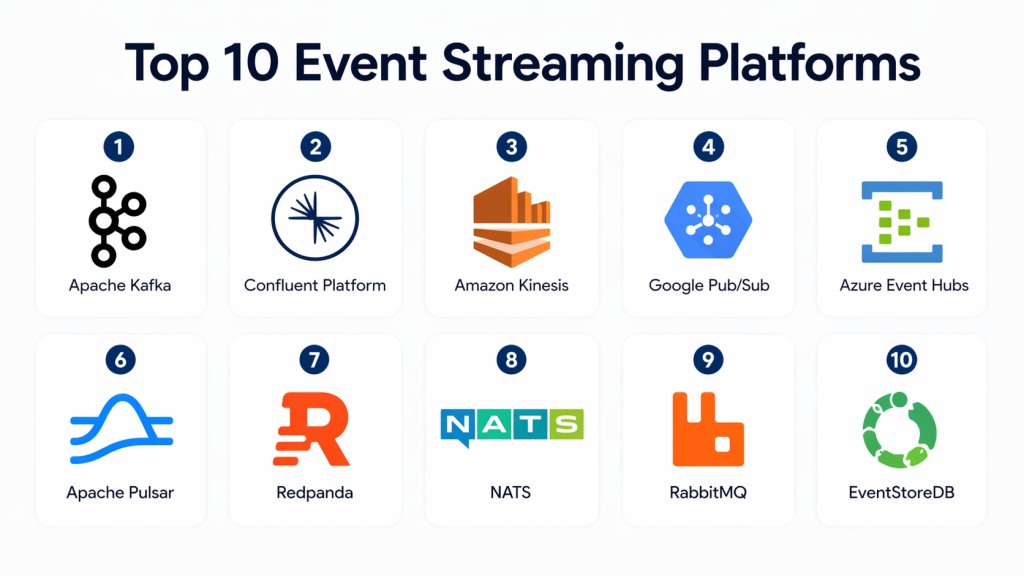
Top 10 Event Streaming Platforms
#1 — Apache Kafka
Short description : Apache Kafka is the industry-standard open-source event streaming platform used for building real-time data pipelines. It handles massive data streams with high throughput and reliability. Kafka is widely adopted across industries for mission-critical applications. It supports distributed architectures and scalability. It forms the backbone of many modern data ecosystems.
Key Features
- Distributed streaming architecture
- High throughput and low latency
- Fault tolerance with replication
- Stream processing support
- Real-time data pipelines
- Scalable clusters
- Durable storage
Pros
- Highly scalable
- Strong ecosystem
- Proven reliability
Cons
- Complex setup
- Requires operational expertise
- Maintenance overhead
Platforms / Deployment
- Linux / Cloud
- Self-hosted / Cloud / Hybrid
Security & Compliance
Supports encryption, RBAC, and authentication.
Integrations & Ecosystem
Integrates with data lakes, ETL tools, and analytics systems.
- API connectivity
- Connector ecosystem
- Stream processing tools
Support & Community
Very large open-source community and strong support.
#2 — Confluent Platform
Short description : Confluent is a fully managed and enterprise-ready platform built on Kafka. It simplifies Kafka deployment and adds enterprise-grade features. It provides tools for stream processing, monitoring, and governance. It supports multi-cloud environments. It is widely used by enterprises.
Key Features
- Managed Kafka service
- Stream processing
- Schema registry
- Data connectors
- Monitoring and analytics
- Multi-cloud support
- Event streaming pipelines
Pros
- Easier than Kafka
- Enterprise features
- Strong support
Cons
- Expensive
- Vendor lock-in
- Learning curve
Platforms / Deployment
- Web / Cloud
- Cloud / Hybrid
Security & Compliance
Supports encryption, RBAC, audit logs.
Integrations & Ecosystem
Works with Kafka ecosystem and cloud platforms.
- API connectivity
- Data integration tools
- Streaming pipelines
Support & Community
Enterprise support and ecosystem.
#3 — Amazon Kinesis
Short description : Amazon Kinesis is a cloud-native streaming platform designed for real-time data ingestion and processing. It integrates deeply with AWS services. It is highly scalable and fully managed. It supports analytics and event-driven applications. It is widely used in cloud-native architectures.
Key Features
- Real-time data streaming
- Scalable architecture
- Data ingestion and processing
- Integration with AWS services
- Low latency processing
- Stream analytics
- Data retention
Pros
- Fully managed
- Scalable
- Strong AWS integration
Cons
- AWS dependency
- Complex pricing
- Cost considerations
Platforms / Deployment
- Web / Cloud
- Cloud
Security & Compliance
Supports encryption and IAM-based access control.
Integrations & Ecosystem
Integrates with AWS analytics and storage services.
- API connectivity
- Data pipelines
- Cloud integration
Support & Community
Strong cloud support and documentation.
#4 — Google Pub/Sub
Short description : Google Pub/Sub is a fully managed messaging and streaming service. It supports real-time event-driven architectures. It provides global scalability and reliability. It integrates with Google Cloud services. It is easy to deploy and manage.
Key Features
- Global messaging system
- Real-time streaming
- Auto-scaling
- High availability
- Low latency
- Event-driven architecture
- Cloud integration
Pros
- Fully managed
- Scalable
- Easy to use
Cons
- Google Cloud dependency
- Limited customization
- Cost considerations
Platforms / Deployment
- Web / Cloud
- Cloud
Security & Compliance
Supports IAM, encryption, audit logs.
Integrations & Ecosystem
Integrates with Google Cloud analytics tools.
- API connectivity
- Data pipelines
- Cloud services
Support & Community
Strong cloud ecosystem support.
#5 — Azure Event Hubs
Short description : Azure Event Hubs is a streaming platform designed for ingesting and processing large volumes of data. It is ideal for big data and event-driven systems. It integrates with Azure services. It supports real-time analytics. It is scalable and reliable.
Key Features
- Event ingestion
- Real-time streaming
- Scalable architecture
- Integration with Azure services
- Low latency
- Data processing
- Event-driven apps
Pros
- Strong Azure integration
- Scalable
- Managed service
Cons
- Azure dependency
- Learning curve
- Cost considerations
Platforms / Deployment
- Web / Cloud
- Cloud
Security & Compliance
Supports RBAC, encryption, compliance features.
Integrations & Ecosystem
Integrates with Azure analytics tools.
- API connectivity
- Data pipelines
- Cloud integration
Support & Community
Strong enterprise support.
#6 — Apache Pulsar
Short description : Apache Pulsar is an open-source streaming platform designed for multi-tenant and scalable architectures. It supports both messaging and streaming workloads. It offers geo-replication and high availability. It is flexible and modern. It is gaining popularity as an alternative to Kafka.
Key Features
- Multi-tenant architecture
- High scalability
- Low latency
- Stream processing
- Geo-replication
- Messaging support
- Event streaming
Pros
- Flexible architecture
- Scalable
- Open-source
Cons
- Smaller ecosystem
- Complex setup
- Requires expertise
Platforms / Deployment
- Linux / Cloud
- Self-hosted / Cloud
Security & Compliance
Supports authentication, encryption, RBAC.
Integrations & Ecosystem
Integrates with data platforms and pipelines.
- API support
- Streaming tools
- Data integration
Support & Community
Growing community support.
#7 — Redpanda
Short description : Redpanda is a Kafka-compatible streaming platform designed for high performance and simplicity. It removes the need for external dependencies. It offers low latency and easy deployment. It is modern and developer-friendly. It is suitable for real-time applications.
Key Features
- Kafka compatibility
- High performance
- Low latency
- Simplified architecture
- Real-time streaming
- Scalable clusters
- Data pipelines
Pros
- Easy to deploy
- High performance
- Kafka-compatible
Cons
- Newer platform
- Smaller ecosystem
- Limited enterprise adoption
Platforms / Deployment
- Linux / Cloud
- Self-hosted / Cloud
Security & Compliance
Supports encryption and access control.
Integrations & Ecosystem
Compatible with Kafka ecosystem tools.
- API connectivity
- Data pipelines
- Streaming integrations
Support & Community
Growing community.
#8 — NATS
Short description : NATS is a lightweight messaging and streaming system built for cloud-native applications. It focuses on simplicity and speed. It is ideal for microservices architectures. It offers high performance and low latency. It is easy to deploy and use.
Key Features
- Lightweight messaging
- High performance
- Low latency
- Cloud-native design
- Pub/Sub model
- Event streaming
- Microservices support
Pros
- Simple
- Fast
- Lightweight
Cons
- Limited advanced features
- Smaller ecosystem
- Not enterprise-heavy
Platforms / Deployment
- Linux / Cloud
- Self-hosted / Cloud
Security & Compliance
Supports encryption and authentication.
Integrations & Ecosystem
Integrates with microservices and cloud apps.
- API connectivity
- Cloud-native tools
- Messaging systems
Support & Community
Active open-source community.
#9 — RabbitMQ
Short description : RabbitMQ is a widely used messaging broker supporting event-driven architectures. It is easy to use and reliable. It supports multiple messaging protocols. It is suitable for lightweight streaming use cases. It is commonly used in application integration.
Key Features
- Message queuing
- Event streaming
- Pub/Sub model
- Routing capabilities
- Reliability
- Integration support
- Flexible messaging
Pros
- Easy to use
- Reliable
- Mature ecosystem
Cons
- Not ideal for high-scale streaming
- Lower throughput
- Requires tuning
Platforms / Deployment
- Linux / Windows
- Self-hosted / Cloud
Security & Compliance
Supports RBAC, encryption, authentication.
Integrations & Ecosystem
Integrates with applications and services.
- API connectivity
- Messaging pipelines
- Data integration
Support & Community
Large community support.
#10 — EventStoreDB
Short description : EventStoreDB is a specialized database for event sourcing and streaming applications. It stores events as the primary data source. It supports real-time processing and replay capabilities. It is suitable for event-driven systems. It provides high performance and scalability.
Key Features
- Event sourcing
- Real-time streaming
- Data persistence
- Event replay
- High performance
- Scalable architecture
- Integration support
Pros
- Strong event sourcing
- High performance
- Scalable
Cons
- Niche use case
- Learning curve
- Smaller ecosystem
Platforms / Deployment
- Linux / Windows
- Cloud / Self-hosted
Security & Compliance
Supports authentication, encryption, access control.
Integrations & Ecosystem
Integrates with applications and event systems.
- API connectivity
- Data pipelines
- Event-driven systems
Support & Community
Growing support community.
Comparison Table (Top 10)
| Tool Name | Best For | Platforms | Deployment | Standout Feature | Public Rating |
|---|---|---|---|---|---|
| Apache Kafka | Enterprise streaming | Linux | Self-hosted/Cloud | High throughput | N/A |
| Confluent | Managed Kafka | Web | Cloud | Enterprise features | N/A |
| Amazon Kinesis | AWS users | Web | Cloud | Fully managed | N/A |
| Google Pub/Sub | GCP users | Web | Cloud | Global messaging | N/A |
| Azure Event Hubs | Azure users | Web | Cloud | Event ingestion | N/A |
| Apache Pulsar | Multi-tenant streaming | Linux | Self-hosted/Cloud | Multi-tenancy | N/A |
| Redpanda | Kafka alternative | Linux | Self-hosted/Cloud | High performance | N/A |
| NATS | Lightweight messaging | Linux | Self-hosted/Cloud | Simplicity | N/A |
| RabbitMQ | Messaging | Linux/Windows | Self-hosted/Cloud | Reliability | N/A |
| EventStoreDB | Event sourcing | Linux/Windows | Self-hosted/Cloud | Event storage | N/A |
Evaluation & Scoring of Event Streaming Platforms
| Tool Name | Core (25%) | Ease (15%) | Integrations (15%) | Security (10%) | Performance (10%) | Support (10%) | Value (15%) | Weighted Total |
|---|---|---|---|---|---|---|---|---|
| Kafka | 9.5 | 7.0 | 9.2 | 8.8 | 9.5 | 9.2 | 8.5 | 8.94 |
| Confluent | 9.3 | 8.2 | 9.0 | 9.0 | 9.2 | 9.0 | 7.8 | 8.90 |
| Kinesis | 8.8 | 8.5 | 8.7 | 9.0 | 8.8 | 8.8 | 7.5 | 8.61 |
| Pub/Sub | 8.7 | 8.6 | 8.6 | 8.9 | 8.7 | 8.7 | 7.6 | 8.58 |
| Event Hubs | 8.8 | 8.4 | 8.7 | 8.9 | 8.8 | 8.7 | 7.6 | 8.60 |
| Pulsar | 8.9 | 7.5 | 8.5 | 8.6 | 8.9 | 8.5 | 8.2 | 8.52 |
| Redpanda | 8.6 | 8.2 | 8.4 | 8.3 | 9.0 | 8.0 | 8.3 | 8.47 |
| NATS | 8.0 | 9.0 | 7.8 | 7.8 | 8.8 | 8.0 | 9.0 | 8.39 |
| RabbitMQ | 8.2 | 8.8 | 8.0 | 8.2 | 7.8 | 8.5 | 8.8 | 8.33 |
| EventStoreDB | 8.4 | 7.5 | 7.8 | 8.2 | 8.6 | 7.8 | 8.0 | 8.10 |
Scores are comparative and reflect relative strengths. Enterprise tools score higher in scalability and performance, while lightweight tools score higher in ease of use and value.
Which Event Streaming Platform Is Right for You?
Solo / Freelancer
Choose NATS or RabbitMQ for simplicity and lightweight setup.
SMB
Redpanda or Kafka provide scalability without excessive complexity.
Mid-Market
Kafka, Pulsar, or Confluent offer strong performance and flexibility.
Enterprise
Confluent, Kinesis, Azure Event Hubs, or Pub/Sub are best suited.
Budget vs Premium
Open-source tools reduce cost; managed services provide convenience.
Feature Depth vs Ease of Use
Kafka offers depth; managed tools offer ease.
Integrations & Scalability
Choose based on your cloud ecosystem and growth plans.
Security & Compliance Needs
Enterprise tools provide advanced compliance and governance features.
Frequently Asked Questions (FAQs)
1. What is an event streaming platform?
An event streaming platform processes continuous streams of data in real time. It enables systems to communicate instantly using events. These platforms are essential for modern applications. They replace batch processing with real-time pipelines. They improve responsiveness and insights.
2. Why are event streaming platforms important?
They enable real-time decision-making and faster data processing. Organizations can react instantly to changes. This improves user experience and operational efficiency. They are widely used in modern architectures. Real-time data is becoming critical for businesses.
3. Is Apache Kafka the best option?
Kafka is the most widely used platform, but not always the best for every use case. Managed services or simpler tools may be better for some teams. The choice depends on requirements. Evaluate based on complexity and scale. No single tool fits all.
4. Are event streaming platforms cloud-based?
Many modern platforms are cloud-native or offer managed services. Cloud deployment provides scalability and ease of use. Hybrid and self-hosted options are also available. Choose based on infrastructure needs. Flexibility is important.
5. Can these platforms handle large-scale data?
Yes, most event streaming platforms are designed for high scalability. They can process millions of events per second. Scalability depends on architecture and configuration. Enterprise tools handle massive workloads. Performance is a key strength.
6. What industries use event streaming?
Industries like finance, retail, healthcare, and technology use these platforms. They support real-time analytics and monitoring. They are also used in IoT and e-commerce. Adoption is growing rapidly. Many sectors rely on streaming data.
7. Are event streaming platforms secure?
Yes, they include security features such as encryption and access control. Enterprise platforms offer advanced security options. Proper configuration is important. Security depends on both the tool and deployment. Governance is critical.
8. Do they support real-time analytics?
Yes, real-time analytics is a core function. They allow immediate processing of data streams. This enables instant insights and alerts. Many platforms integrate with analytics tools. Real-time capability is a major advantage.
9. What is the cost of these platforms?
Costs vary widely. Open-source tools are free but require infrastructure. Managed services have subscription-based pricing. Costs depend on scale and usage. Evaluate total cost carefully. Budget planning is important.
10. How to choose the best platform?
Identify your requirements, data volume, and architecture. Evaluate tools based on scalability, integration, and cost. Test with real workloads. Consider long-term growth. Choose a platform that aligns with your strategy.
Conclusion
Event Streaming Platforms are essential for building real-time, event-driven architectures in modern organizations. They enable continuous data flow, instant processing, and faster decision-making. From open-source leaders like Apache Kafka and Pulsar to managed cloud services like Kinesis and Event Hubs, there are options for every use case and scale.
The right choice depends on your technical requirements, budget, and ecosystem alignment. Instead of selecting a single “best” tool, shortlist a few options and test them in real-world scenarios. Focus on scalability, integration, and operational ease to ensure long-term success in your streaming data strategy.
