Introduction
Disaster Recovery (DR) Tools are specialized platforms that help organizations restore IT systems, applications, and data after disruptions such as cyberattacks, hardware failures, or natural disasters. Unlike basic backups, DR tools focus on complete system recovery, minimizing downtime, and ensuring business continuity.
As businesses rely heavily on digital infrastructure, even a short outage can lead to financial loss, reputational damage, and compliance risks. Modern DR solutions now include automation, cloud failover, and orchestration capabilities to ensure rapid recovery with minimal manual intervention.
Real-world use cases include:
- Recovering systems after ransomware or cyberattacks
- Failover during data center outages
- Ensuring uptime for critical applications
- Meeting compliance and disaster recovery mandates
- Supporting hybrid and multi-cloud infrastructure resilience
Key evaluation criteria:
- Recovery Time Objective (RTO) and Recovery Point Objective (RPO)
- Automation and orchestration capabilities
- Cloud and hybrid failover support
- Scalability and performance
- Security and ransomware resilience
- Ease of testing and validation
- Integration with backup and IT systems
- Cost and licensing flexibility
Best for: Enterprises, IT teams, DevOps engineers, and compliance-driven industries needing high availability and rapid recovery.
Not ideal for: Small teams with non-critical workloads or environments where downtime has minimal business impact.
Key Trends in Disaster Recovery (DR) Tools
- Automated failover and failback workflows
- Cloud-based disaster recovery replacing traditional DR sites
- AI-driven recovery validation and anomaly detection
- Increased adoption of DRaaS (Disaster Recovery as a Service)
- Integration with Zero Trust security models
- Continuous data replication for near real-time recovery
- Multi-cloud disaster recovery strategies
- Built-in ransomware detection and response
- API-driven orchestration for DevOps environments
- Simplified DR testing without impacting production
How We Selected These Tools (Methodology)
- Strong industry adoption and credibility
- Comprehensive disaster recovery capabilities
- Proven reliability and performance
- Security features and ransomware protection
- Integration with cloud, virtualization, and enterprise systems
- Scalability across SMB to enterprise environments
- Ease of deployment and usability
- Vendor innovation and DR automation capabilities
- Support quality and community adoption
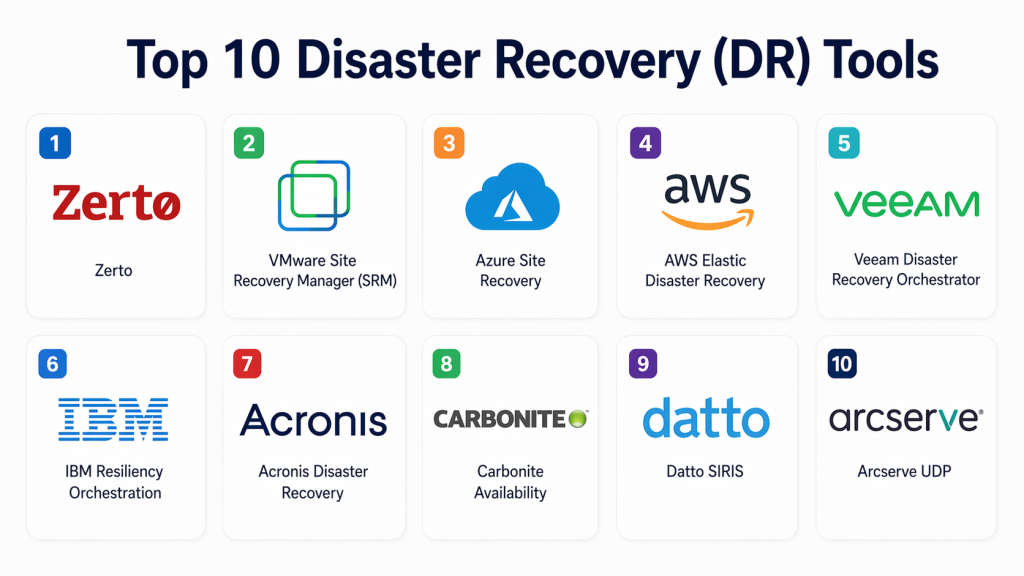
Top 10 Disaster Recovery (DR) Tools
#1 — Zerto
Short description:
Zerto is a leading disaster recovery platform focused on continuous data protection and near-zero downtime recovery. It is widely used for virtualized and cloud environments.
Key Features
- Continuous data replication
- Near-zero RPO and low RTO
- Automated failover and failback
- Multi-cloud support
- DR orchestration
Pros
- Very fast recovery times
- Strong virtualization support
Cons
- Premium pricing
- Requires careful setup
Platforms / Deployment
Windows / Linux
Cloud / Hybrid
Security & Compliance
Encryption, RBAC
Compliance: Not publicly stated
Integrations & Ecosystem
Integrates with enterprise virtualization and cloud platforms.
- VMware, Hyper-V
- AWS, Azure
- Enterprise storage
Support & Community
Strong enterprise support and growing community adoption.
#2 — VMware Site Recovery Manager (SRM)
Short description:
VMware SRM is a disaster recovery orchestration tool designed for VMware environments, offering automated recovery workflows.
Key Features
- Automated DR orchestration
- Policy-based recovery plans
- Non-disruptive testing
- Integration with VMware ecosystem
- Failover automation
Pros
- Seamless VMware integration
- Reliable automation
Cons
- Limited outside VMware
- Licensing complexity
Platforms / Deployment
VMware environments
Hybrid
Security & Compliance
RBAC, encryption
Compliance: Not publicly stated
Integrations & Ecosystem
Deep integration within VMware ecosystem.
- vSphere
- VMware Cloud
- Storage systems
Support & Community
Strong documentation and enterprise support.
#3 — Azure Site Recovery
Short description:
Azure Site Recovery provides cloud-based disaster recovery for on-prem and cloud workloads, offering scalable failover capabilities.
Key Features
- Automated failover to cloud
- Continuous replication
- Multi-site recovery
- Integration with cloud services
- DR testing
Pros
- Scalable cloud solution
- Cost-efficient DR
Cons
- Dependent on Azure ecosystem
- Requires cloud expertise
Platforms / Deployment
Cloud / Hybrid
Security & Compliance
Encryption, identity integration
Compliance: Varies
Integrations & Ecosystem
Strong cloud ecosystem integration.
- Azure services
- Virtual machines
- Databases
Support & Community
Extensive support and documentation.
#4 — AWS Elastic Disaster Recovery
Short description:
AWS Elastic Disaster Recovery enables fast recovery of workloads to AWS, providing cost-effective DR for cloud and on-prem systems.
Key Features
- Continuous replication
- Automated recovery
- Scalable infrastructure
- Minimal downtime
- Cloud-native architecture
Pros
- Flexible scaling
- Cost-efficient
Cons
- AWS dependency
- Setup complexity
Platforms / Deployment
Cloud / Hybrid
Security & Compliance
Encryption, IAM integration
Compliance: Varies
Integrations & Ecosystem
Deep integration with AWS ecosystem.
- EC2
- S3
- Cloud services
Support & Community
Strong cloud support ecosystem.
#5 — Veeam Disaster Recovery Orchestrator
Short description:
Veeam DR Orchestrator extends backup capabilities with automated disaster recovery planning and execution.
Key Features
- DR orchestration
- Automated recovery plans
- Compliance reporting
- Backup integration
- Testing automation
Pros
- Seamless with Veeam
- Strong reporting
Cons
- Requires Veeam ecosystem
- Enterprise-focused
Platforms / Deployment
Windows / Linux
Hybrid
Security & Compliance
Encryption, RBAC
Compliance: Varies
Integrations & Ecosystem
Works with Veeam and enterprise systems.
- VMware
- Cloud platforms
- Storage
Support & Community
Strong enterprise support.
#6 — IBM Resiliency Orchestration
Short description:
IBM offers a comprehensive DR orchestration platform designed for large enterprises with complex recovery needs.
Key Features
- Automated DR workflows
- Risk assessment
- Multi-cloud recovery
- Compliance support
- Analytics
Pros
- Enterprise-grade solution
- Strong automation
Cons
- Complex deployment
- High cost
Platforms / Deployment
Cloud / Hybrid
Security & Compliance
Encryption, RBAC
Compliance: Varies
Integrations & Ecosystem
Enterprise integrations across IT systems.
- IBM ecosystem
- Cloud platforms
- Databases
Support & Community
Enterprise-level support.
#7 — Acronis Disaster Recovery
Short description:
Acronis provides integrated backup and disaster recovery, making it suitable for SMBs and MSPs.
Key Features
- Cloud DR
- Backup integration
- Automated failover
- Ransomware protection
- Recovery testing
Pros
- Easy to use
- All-in-one platform
Cons
- Limited enterprise depth
- Feature overlap
Platforms / Deployment
Cloud / Hybrid
Security & Compliance
Encryption, anti-malware
Compliance: Not publicly stated
Integrations & Ecosystem
Supports IT and cloud environments.
- Virtual machines
- Cloud storage
- Endpoint systems
Support & Community
Strong MSP-focused support.
#8 — Carbonite Availability
Short description:
Carbonite offers continuous data replication and DR solutions focused on minimizing downtime.
Key Features
- Continuous replication
- Automated failover
- Real-time monitoring
- Recovery testing
- Data protection
Pros
- Reliable replication
- Good for SMBs
Cons
- Limited scalability
- Fewer advanced features
Platforms / Deployment
Windows / Linux
Hybrid
Security & Compliance
Encryption
Compliance: Not publicly stated
Integrations & Ecosystem
Works with enterprise and SMB systems.
- Servers
- Applications
- Cloud storage
Support & Community
Accessible support and documentation.
#9 — Datto SIRIS
Short description:
Datto SIRIS is a business continuity and disaster recovery solution tailored for MSPs and SMBs.
Key Features
- Image-based backup
- Instant virtualization
- Cloud replication
- Automated recovery
- Centralized management
Pros
- Easy deployment
- Strong MSP support
Cons
- Appliance-based
- Limited customization
Platforms / Deployment
Cloud / Hybrid
Security & Compliance
Encryption
Compliance: Not publicly stated
Integrations & Ecosystem
Supports SMB IT environments.
- Virtualization platforms
- Cloud services
- Endpoint systems
Support & Community
Strong MSP-focused ecosystem.
#10 — Arcserve UDP
Short description:
Arcserve Unified Data Protection (UDP) combines backup, replication, and disaster recovery in one platform.
Key Features
- Unified backup and DR
- Replication
- High availability
- Recovery testing
- Centralized management
Pros
- All-in-one platform
- Flexible deployment
Cons
- Interface complexity
- Smaller ecosystem
Platforms / Deployment
Windows / Linux
Cloud / Hybrid
Security & Compliance
Encryption
Compliance: Not publicly stated
Integrations & Ecosystem
Supports enterprise and SMB environments.
- Virtualization
- Cloud platforms
- Storage systems
Support & Community
Moderate community with enterprise support options.
Comparison Table (Top 10)
| Tool Name | Best For | Platform(s) Supported | Deployment | Standout Feature | Public Rating |
|---|---|---|---|---|---|
| Zerto | Enterprise | Windows/Linux | Hybrid | Continuous replication | N/A |
| VMware SRM | VMware users | VMware | Hybrid | DR automation | N/A |
| Azure Site Recovery | Cloud users | Cloud | Hybrid | Scalable failover | N/A |
| AWS Elastic DR | Cloud workloads | Cloud | Hybrid | Elastic recovery | N/A |
| Veeam DR Orchestrator | Veeam users | Multi-OS | Hybrid | DR planning | N/A |
| IBM Resiliency | Enterprise | Multi-OS | Hybrid | Automation | N/A |
| Acronis DR | SMB/MSP | Multi-OS | Hybrid | Integrated security | N/A |
| Carbonite | SMB | Multi-OS | Hybrid | Continuous replication | N/A |
| Datto SIRIS | MSP | Multi-OS | Hybrid | Instant virtualization | N/A |
| Arcserve UDP | SMB/Enterprise | Multi-OS | Hybrid | Unified platform | N/A |
Evaluation & Scoring of Disaster Recovery (DR) Tools
| Tool Name | Core | Ease | Integrations | Security | Performance | Support | Value | Weighted Total |
|---|---|---|---|---|---|---|---|---|
| Zerto | 9 | 8 | 9 | 9 | 9 | 9 | 7 | 8.7 |
| VMware SRM | 8 | 7 | 8 | 8 | 9 | 8 | 7 | 7.9 |
| Azure Site Recovery | 8 | 8 | 9 | 8 | 8 | 8 | 8 | 8.1 |
| AWS Elastic DR | 8 | 7 | 9 | 8 | 8 | 8 | 8 | 8.0 |
| Veeam DR Orchestrator | 9 | 7 | 8 | 9 | 9 | 9 | 7 | 8.4 |
| IBM Resiliency | 9 | 6 | 8 | 9 | 9 | 8 | 6 | 8.1 |
| Acronis DR | 7 | 8 | 7 | 8 | 7 | 8 | 8 | 7.6 |
| Carbonite | 7 | 8 | 7 | 7 | 7 | 7 | 8 | 7.4 |
| Datto SIRIS | 8 | 9 | 7 | 7 | 8 | 8 | 8 | 8.0 |
| Arcserve UDP | 8 | 7 | 7 | 8 | 8 | 7 | 7 | 7.6 |
How to interpret scores:
These scores represent a comparative evaluation based on multiple criteria. Higher scores indicate stronger overall performance, but the best choice depends on your specific needs. Enterprises should focus on reliability and automation, while SMBs may prioritize cost and ease of use. Always align the scoring with your recovery objectives and infrastructure.
Which Disaster Recovery (DR) Tool Is Right for You?
Solo / Freelancer
Basic DR tools or backup solutions with recovery features are sufficient. Focus on affordability and simplicity.
SMB
Acronis, Carbonite, or Datto SIRIS provide a balance of cost, ease, and recovery capabilities.
Mid-Market
Arcserve and Azure Site Recovery offer scalability and cloud flexibility for growing businesses.
Enterprise
Zerto, Veeam DR Orchestrator, and IBM Resiliency provide advanced automation, compliance, and performance.
Budget vs Premium
- Budget: Carbonite, Acronis
- Premium: Zerto, IBM
Feature Depth vs Ease of Use
- Feature-rich: IBM, Veeam
- Easy to use: Datto, Acronis
Integrations & Scalability
- Strong integrations: Azure, AWS, Veeam
- Scalable cloud DR: AWS Elastic DR
Security & Compliance Needs
- High security: Zerto, IBM
- Basic needs: Carbonite, Arcserve
Frequently Asked Questions (FAQs)
What is disaster recovery in IT?
Disaster recovery refers to the process of restoring systems, data, and applications after a disruption. It ensures that businesses can continue operations with minimal downtime and data loss.
How is disaster recovery different from backup?
Backup focuses on storing copies of data, while disaster recovery includes restoring entire systems and operations. DR is broader and includes automation and failover capabilities.
What are RTO and RPO?
RTO (Recovery Time Objective) defines how quickly systems must be restored, while RPO (Recovery Point Objective) defines how much data loss is acceptable. Both are critical for DR planning.
Why is disaster recovery important?
Disaster recovery is essential for minimizing downtime, protecting data, and maintaining business continuity. It also helps meet compliance requirements in regulated industries.
What is DRaaS?
Disaster Recovery as a Service (DRaaS) is a cloud-based model where providers manage recovery infrastructure. It reduces the need for on-premise DR setups.
Can disaster recovery protect against ransomware?
Yes, DR tools can restore systems from clean backups after ransomware attacks. Advanced tools also include detection and isolation features.
How often should DR plans be tested?
DR plans should be tested regularly to ensure they work during real incidents. Many tools now support non-disruptive testing.
What are common DR challenges?
Common challenges include high costs, complex setups, lack of testing, and integration issues. Choosing the right tool can reduce these challenges.
Is cloud DR better than traditional DR?
Cloud DR offers scalability and flexibility, while traditional DR provides control. Hybrid models are commonly used for balance.
How do you choose the right DR tool?
Evaluate based on recovery speed, automation, scalability, integrations, and security. Align the tool with your business needs and infrastructure.
Conclusion
Disaster Recovery Tools are critical for ensuring business continuity in an increasingly digital world. From handling cyberattacks to recovering from infrastructure failures, these tools provide the foundation for resilient IT operations. Enterprise solutions like Zerto and IBM offer deep automation and performance, while tools like Acronis and Datto deliver simplicity and affordability for smaller teams.
Selecting the right DR solution depends on your recovery objectives, infrastructure complexity, and budget. Organizations should carefully assess their RTO and RPO requirements before making a decision.
A practical next step is to shortlist a few tools, conduct controlled testing, and validate how effectively they handle real recovery scenarios. This ensures your disaster recovery strategy is reliable, scalable, and ready when it matters most.
