Introduction
Digital Forensics & Incident Response (DFIR) suites are comprehensive platforms that allow organizations to detect, investigate, and remediate cybersecurity incidents while preserving critical evidence for compliance and legal purposes. They combine endpoint monitoring, network analysis, malware investigation, and reporting tools into a unified system for security teams.
In modern threat landscapes, DFIR suites are essential for timely response to ransomware attacks, insider threats, data breaches, and advanced persistent threats. These tools help organizations reduce downtime, limit damage, and comply with regulatory requirements by providing structured workflows for incident handling.
Real-world use cases include:
- Investigating data breaches and identifying affected systems
- Performing malware and rootkit analysis on endpoints
- Conducting forensic examinations of servers, endpoints, and cloud resources
- Incident response planning, tracking, and remediation
- Compliance and reporting for regulations like GDPR, HIPAA, or SOC 2
Evaluation criteria for buyers:
- Ability to handle large-scale endpoint and network data
- Real-time alerting and threat detection capabilities
- Forensic evidence preservation and chain-of-custody support
- Integration with SIEM, EDR, and threat intelligence platforms
- Ease of deployment and automation workflows
- Cloud, on-prem, or hybrid support
- Scalability across distributed enterprise environments
- Vendor support, training, and community resources
- Pricing model and licensing flexibility
Best for: Security operations centers (SOCs), enterprises, managed security service providers (MSSPs), and organizations that handle sensitive data and require rapid incident response
Not ideal for: Small teams or startups without dedicated cybersecurity personnel, or organizations that rely solely on lightweight endpoint security without complex forensic needs
Key Trends in DFIR Suites
- Integration of AI and machine learning for automated anomaly detection and threat hunting
- Cloud-native or hybrid deployments enabling distributed incident response
- Advanced malware sandboxing and behavioral analysis for rapid investigations
- Centralized dashboards combining endpoint, network, and cloud for holistic visibility
- Automated playbooks and response workflows for faster containment
- Compliance-focused reporting for GDPR, HIPAA, PCI DSS, and other regulations
- Cross-platform endpoint support including Windows, macOS, Linux, and cloud workloads
- Integration with SIEM, EDR, threat intelligence, and vulnerability management tools
- Adoption of threat intelligence feeds for proactive detection
- API-first design for extensibility and integration with existing security stacks
How We Selected These Tools
- Market adoption and mindshare among SOCs, enterprises, and MSSPs
- Feature completeness including investigation, reporting, and automation
- Reliability, performance, and scalability across large deployments
- Security posture and adherence to forensics best practices
- Integration capabilities with SIEM, EDR, cloud, and network systems
- Vendor support, training resources, and user community engagement
- AI-driven capabilities for threat detection and automation
- Endpoint, network, and cloud visibility across hybrid environments
- Compliance reporting features for regulations
- Cost-effectiveness and flexible licensing options
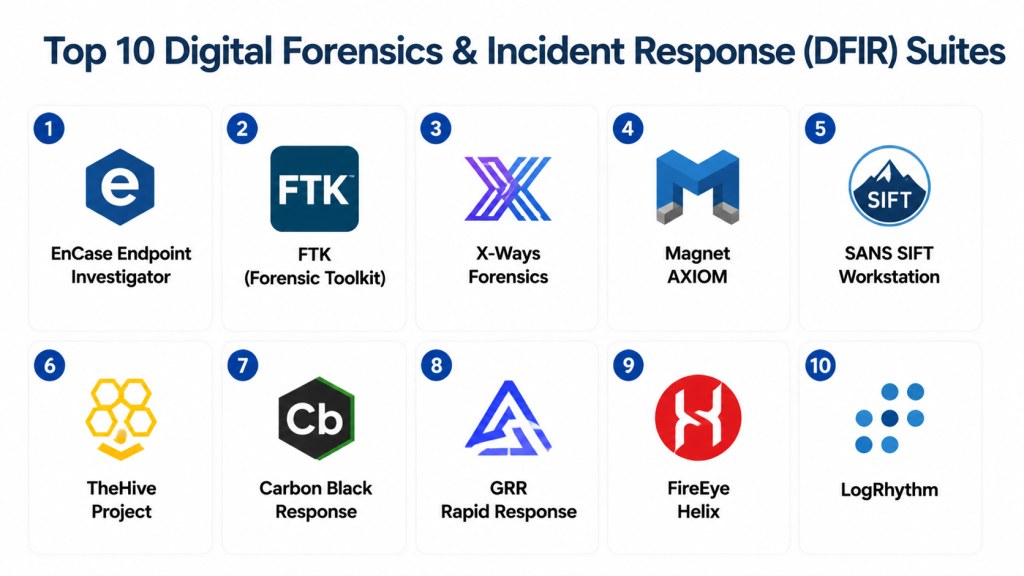
Top 10 Digital Forensics & Incident Response (DFIR) Suites
1- EnCase Endpoint Investigator
Short description: Comprehensive endpoint forensics tool for evidence collection, malware analysis, and incident investigation
Key Features
- Full disk and memory imaging
- File and artifact analysis
- Remote endpoint collection
- Malware and timeline analysis
- Compliance reporting
- Automation workflows for repetitive tasks
- Chain-of-custody management
Pros
- Industry-standard for forensic investigations
- Robust evidence preservation
- Detailed reporting capabilities
Cons
- Steeper learning curve for new users
- Licensing can be expensive for smaller teams
- Primarily Windows-focused
Platforms / Deployment
- Windows, hybrid
Security & Compliance
- Evidence integrity verification
- GDPR, SOC 2 support
Integrations & Ecosystem
Integrates with SIEM, EDR, and threat intelligence platforms
- Splunk
- McAfee EDR
- Custom scripts and APIs
Support & Community
Comprehensive documentation, vendor training, active user forums
2- FTK (Forensic Toolkit)
Short description: DFIR suite offering powerful forensic imaging, analysis, and incident response capabilities
Key Features
- File system and memory analysis
- Indexing and search capabilities
- Email and artifact analysis
- Automated report generation
- Evidence preservation and export
- Timeline and metadata analysis
- Cloud data acquisition support
Pros
- Fast indexing and search engine
- Supports complex forensic investigations
- Strong reporting functionality
Cons
- Resource-intensive during large investigations
- Setup and deployment require technical expertise
- Limited macOS support
Platforms / Deployment
- Windows, hybrid
Security & Compliance
- Chain-of-custody management
- GDPR, HIPAA, SOC 2
Integrations & Ecosystem
Connects with SIEM, endpoint security, and cloud tools
- Splunk
- Threat intelligence feeds
- Custom API integrations
Support & Community
Vendor support, user community, training programs
3- X-Ways Forensics
Short description: Lightweight and efficient DFIR tool focusing on disk imaging, file recovery, and investigation automation
Key Features
- Disk cloning and imaging
- File carving and recovery
- Automated forensic analysis
- Timeline and case management
- Integrated hashing and verification
- Lightweight and portable
Pros
- Low resource requirements
- Portable and efficient
- Fast processing of forensic data
Cons
- Minimal GUI compared to competitors
- Limited cloud integration
- Learning curve for complex workflows
Platforms / Deployment
- Windows, self-hosted
Security & Compliance
- Hash verification, chain-of-custody
- Not publicly stated
Integrations & Ecosystem
Supports plugins and scripting for SIEM or EDR integration
- Splunk
- Custom scripts
Support & Community
Documentation and active forum, vendor support
4- Magnet AXIOM
Short description: DFIR suite for endpoint, mobile, and cloud data collection with comprehensive analysis and reporting
Key Features
- Endpoint, cloud, and mobile acquisition
- File and artifact analysis
- Timeline and case management
- Malware analysis and triage
- Automated report generation
- Collaboration features for SOC teams
- Cross-platform support
Pros
- Multi-platform capabilities
- Strong automation and reporting
- Mobile forensics support
Cons
- Premium pricing for small teams
- Resource-intensive during processing
- Complex initial setup
Platforms / Deployment
- Windows, macOS, cloud, hybrid
Security & Compliance
- Chain-of-custody, encrypted storage
- GDPR, HIPAA support
Integrations & Ecosystem
Integrates with SIEM, EDR, cloud storage
- Splunk, Azure Security
- Threat intelligence feeds
- Custom API support
Support & Community
Vendor support, detailed documentation, community forums
5- SANS SIFT Workstation
Short description: Open-source DFIR platform for incident responders offering forensic and malware analysis tools
Key Features
- Forensic and malware analysis tools
- Timeline reconstruction
- Memory and disk imaging
- Open-source scripts and utilities
- Automation and workflow support
- Evidence preservation
Pros
- Free and open-source
- Full-featured for endpoint and network analysis
- Strong community resources
Cons
- Limited GUI; command-line heavy
- Requires technical expertise
- Setup may be complex
Platforms / Deployment
- Linux, self-hosted
Security & Compliance
- Evidence preservation
- Not publicly stated
Integrations & Ecosystem
Works with SIEM, EDR, and other open-source DFIR tools
- Splunk
- Open-source analyzers
- Custom scripting
Support & Community
Active open-source community, mailing lists, documentation
6- TheHive Project
Short description: Open-source incident response platform with case management and collaborative features
Key Features
- Case management and workflow automation
- Alert ingestion from SIEM and EDR
- Forensic evidence tracking
- Collaboration for SOC teams
- Automated response playbooks
- API-driven integrations
Pros
- Open-source and customizable
- Collaborative SOC capabilities
- Scalable workflow automation
Cons
- Requires self-hosting
- Advanced setup and maintenance needed
- GUI may require customization
Platforms / Deployment
- Linux, cloud, self-hosted
Security & Compliance
- Audit logging, role-based access
- Not publicly stated
Integrations & Ecosystem
SIEM, alerting, and automation tools
- ELK Stack
- SIEM feeds
- API integrations
Support & Community
Open-source community, documentation, vendor consultancy optional
7- Carbon Black Response
Short description: Endpoint detection and response platform with forensic and IR capabilities for rapid investigation
Key Features
- Endpoint monitoring and analysis
- Real-time threat detection
- Malware investigation
- Automated response actions
- Integration with SOC workflows
- Timeline and artifact analysis
Pros
- Real-time endpoint visibility
- Integration with SOC automation
- Strong detection capabilities
Cons
- Premium pricing for smaller organizations
- Cloud dependency for full features
- Learning curve for advanced forensic tasks
Platforms / Deployment
- Windows, macOS, Linux, cloud
Security & Compliance
- Audit logs, MFA support
- SOC 2, ISO 27001
Integrations & Ecosystem
SIEM, threat intelligence, EDR integrations
- Splunk
- Threat feeds
- Custom API connectors
Support & Community
Vendor support, documentation, online community
8- GRR Rapid Response
Short description: Open-source remote live forensics framework for endpoint analysis and incident response
Key Features
- Remote live forensic collection
- Automated analysis and triage
- Timeline reconstruction
- Memory and disk analysis
- Open-source extensibility
Pros
- Open-source and free
- Real-time endpoint investigation
- Scalable for large environments
Cons
- Requires technical expertise
- Limited GUI interface
- Maintenance responsibility on user
Platforms / Deployment
- Linux, Windows, self-hosted
Security & Compliance
- Audit logging, evidence preservation
- Not publicly stated
Integrations & Ecosystem
Integrates with SIEM, EDR, and security stacks
- ELK
- SIEM alerts
- Scripts and plugins
Support & Community
Active open-source community, documentation
9- FireEye Helix
Short description: Cloud-native security operations platform with DFIR capabilities and integrated threat intelligence
Key Features
- Incident detection and triage
- Threat intelligence feeds
- Automated response playbooks
- Endpoint and network analysis
- Forensic investigation and reporting
- Cloud-native orchestration
Pros
- Integrated threat intelligence
- Cloud-native and scalable
- Strong automation capabilities
Cons
- Costly for small organizations
- Complex deployment and configuration
- Requires trained SOC personnel
Platforms / Deployment
- Cloud, hybrid, Windows, Linux
Security & Compliance
- Audit logging, RBAC
- SOC 2, ISO 27001, GDPR
Integrations & Ecosystem
SIEM, EDR, cloud services
- Splunk, Threat Intel
- Endpoint security tools
Support & Community
Enterprise support, documentation, forums
10- LogRhythm
Short description: SIEM platform with integrated DFIR capabilities for investigation, threat detection, and compliance
Key Features
- SIEM and event correlation
- Endpoint and network forensics
- Threat hunting and investigation
- Automated response workflows
- Evidence preservation and reporting
- Playbooks for SOC efficiency
Pros
- Unified SIEM and DFIR capabilities
- Automation and orchestration
- Compliance reporting
Cons
- Licensing can be expensive
- Learning curve for complex investigations
- Hybrid deployment requires planning
Platforms / Deployment
- Windows, Linux, cloud, hybrid
Security & Compliance
- Audit logs, RBAC, MFA
- SOC 2, ISO 27001
Integrations & Ecosystem
SIEM, EDR, threat intelligence
- Endpoint security
- Cloud monitoring
- APIs and automation
Support & Community
Documentation, enterprise support, active forums
Comparison Table (Top 10)
| Tool Name | Best For | Platform(s) Supported | Deployment | Standout Feature | Public Rating |
|---|---|---|---|---|---|
| EnCase Endpoint Investigator | Enterprise SOCs | Windows | Hybrid | Endpoint imaging and analysis | N/A |
| FTK | Enterprises | Windows | Hybrid | Fast indexing and search | N/A |
| X-Ways Forensics | Analysts and SMBs | Windows | Self-hosted | Lightweight and efficient | N/A |
| Magnet AXIOM | SOCs, Enterprises | Windows, macOS, Cloud | Hybrid | Multi-platform acquisition | N/A |
| SANS SIFT Workstation | Security analysts | Linux | Self-hosted | Open-source forensic toolkit | N/A |
| TheHive Project | SOC teams | Linux | Self-hosted/Cloud | Case management and collaboration | N/A |
| Carbon Black Response | Enterprise endpoints | Windows, macOS, Linux | Cloud | Real-time endpoint visibility | N/A |
| GRR Rapid Response | Analysts, MSSPs | Windows, Linux | Self-hosted | Remote live forensics | N/A |
| FireEye Helix | Enterprise SOCs | Windows, Linux | Cloud/Hybrid | Threat intelligence integration | N/A |
| LogRhythm | SOCs | Windows, Linux | Cloud/Hybrid | SIEM + DFIR integration | N/A |
Evaluation & Scoring of DFIR Suites
| Tool Name | Core (25%) | Ease (15%) | Integrations (15%) | Security (10%) | Performance (10%) | Support (10%) | Value (15%) | Weighted Total (0–10) |
|---|---|---|---|---|---|---|---|---|
| EnCase Endpoint Investigator | 9 | 8 | 8 | 9 | 9 | 8 | 7 | 8.5 |
| FTK | 8 | 7 | 8 | 8 | 8 | 7 | 7 | 7.9 |
| X-Ways Forensics | 7 | 6 | 7 | 7 | 8 | 7 | 8 | 7.3 |
| Magnet AXIOM | 9 | 8 | 8 | 9 | 8 | 8 | 7 | 8.3 |
| SANS SIFT Workstation | 7 | 6 | 7 | 7 | 7 | 7 | 9 | 7.3 |
| TheHive Project | 8 | 7 | 8 | 8 | 8 | 7 | 8 | 7.9 |
| Carbon Black Response | 9 | 8 | 8 | 9 | 8 | 8 | 7 | 8.3 |
| GRR Rapid Response | 7 | 6 | 7 | 7 | 7 | 7 | 8 | 7.2 |
| FireEye Helix | 9 | 7 | 8 | 9 | 8 | 8 | 7 | 8.1 |
| LogRhythm | 8 | 7 | 8 | 8 | 8 | 7 | 7 | 7.8 |
Interpretation: Higher weighted totals indicate stronger overall capability, usability, integration, and value. Select based on your organization’s scale, complexity, and security requirements
Which DFIR Suite Is Right for You?
Solo / Freelancer
Open-source tools like SANS SIFT or GRR Rapid Response provide cost-effective options for small teams with forensic capabilities
SMB
X-Ways Forensics and TheHive Project provide affordable, scalable DFIR workflows for growing security teams
Mid-Market
Magnet AXIOM, Carbon Black Response, and LogRhythm balance endpoint, network, and cloud capabilities for mid-sized enterprises
Enterprise
EnCase, FTK, FireEye Helix, and LogRhythm deliver full-scale SOC integration, advanced threat intelligence, and compliance-ready workflows
Budget vs Premium
Open-source solutions are low-cost but require technical expertise. Premium suites offer automation, vendor support, and multi-platform integration
Feature Depth vs Ease of Use
Enterprise SOCs benefit from advanced features (EnCase, FTK) while smaller teams prioritize usability and streamlined workflows (X-Ways, TheHive)
Integrations & Scalability
Cloud-native suites (FireEye Helix, Magnet AXIOM) provide easier scaling and seamless SIEM/EDR integrations
Security & Compliance Needs
For high compliance requirements, EnCase, FTK, FireEye Helix, and Carbon Black Response provide chain-of-custody, audit, and regulatory reporting capabilities
Frequently Asked Questions (FAQs)
1- What is a DFIR suite?
A DFIR suite is a software platform combining digital forensics and incident response tools to investigate security incidents, collect evidence, and remediate threats
2- Can DFIR suites integrate with SIEM and EDR?
Yes, most DFIR suites integrate with SIEM, EDR, and threat intelligence platforms to provide holistic security visibility
3- Do all DFIR tools support cloud investigations?
Premium suites like Magnet AXIOM, FireEye Helix, and Carbon Black support cloud endpoints, while open-source tools focus more on on-prem investigations
4- Are DFIR suites suitable for small businesses?
Yes, lightweight or open-source DFIR tools can support SMBs, but complex premium suites are more suited for enterprises
5- How do DFIR suites help with compliance?
They preserve evidence, maintain audit trails, and generate reports aligned with regulations like GDPR, HIPAA, and SOC 2
6- Can DFIR suites detect malware automatically?
Many suites offer automated malware analysis, behavioral analysis, and alerting for rapid containment
7- What platforms are typically supported?
Windows, macOS, Linux, and cloud endpoints are commonly supported; mobile support varies by suite
8- Are open-source DFIR suites reliable?
Yes, open-source tools like GRR or SANS SIFT are reliable but require more technical expertise and manual configuration
9- How scalable are DFIR suites?
Premium cloud-native suites scale to thousands of endpoints, while on-prem or lightweight suites may need careful architecture for large environments
10- How complex is DFIR tool deployment?
Deployment complexity varies: cloud-native suites are easier to start, open-source suites require self-hosting and technical setup
Conclusion
DFIR suites are essential for detecting, investigating, and responding to cyber threats. Open-source solutions offer cost-effective flexibility, while premium cloud-native and enterprise suites provide automation, multi-platform support, and regulatory compliance. The right suite depends on organizational size, SOC maturity, and security priorities. aligned with your security stack, run pilot investigations, and validate integrations and compliance readiness
